
Phase one of Making Tax Digital is live and running. Since April, sole traders and landlords above £50,000 have been filing quarterly. Most of the news coverage has followed them.
Here is what has not been covered as well. Phase two lands in nine months. And a large number of people who believe they are safe until 2027 are working from the wrong figure.
The Year That Determines April 2027 Has Already Ended
From 6 April 2027, the MTD threshold drops to £30,000. Around 970,000 more sole traders and landlords come into scope.
HMRC will decide who joins using the 2025 to 2026 Self-Assessment return. That is the tax year ending 5 April 2026. It is already over.
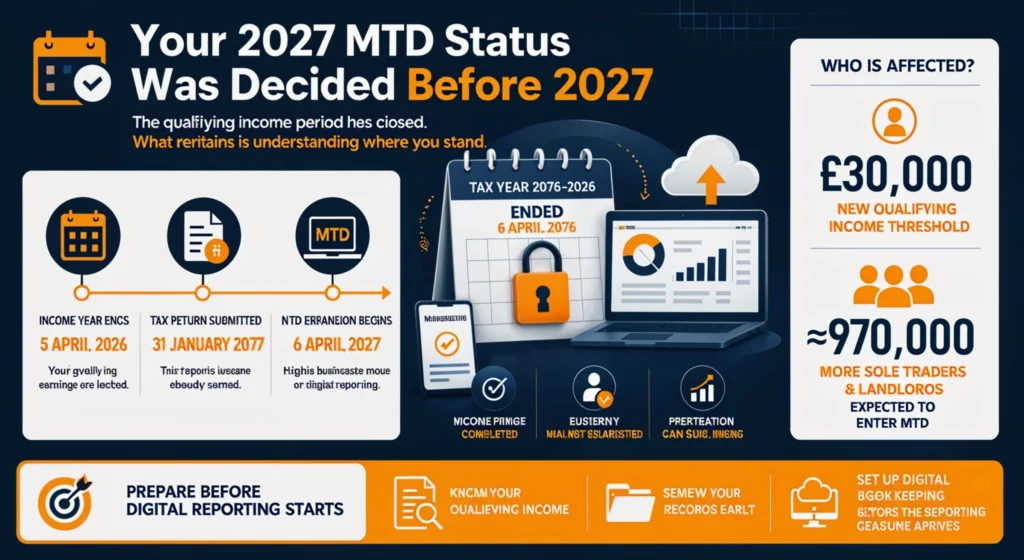
The filing deadline for that return is 31 January 2027. But the income it reports is done and fixed. You cannot go back and change it. Whether you are in phase two or not is already determined by what you earned this past year.
Checking that number now costs nothing. Missing it could mean joining MTD from day one without any preparation in place.
Gross Income, Not Profit. This Is Where Most People Get It Wrong
The threshold is not applied to profit. It is applied to gross income before any expenses come off.
A consultant invoicing £34,000 with £8,000 in expenses has a taxable profit of £26,000. Sounds like they are safely under £30,000. They are not. Their qualifying income is £34,000. They are in phase two.
A sole trader earning £20,000 from freelance work and £15,000 from a rental property has qualifying income of £35,000. Neither stream alone crosses £30,000. Combined, they do. Same result.
What does not count: PAYE salary, dividends, pension income, savings interest. Only gross self-employment turnover and gross rental receipts go into the calculation.
How HMRC calculates qualifying income is worth reading carefully if you are anywhere near the line. This specific misunderstanding is why people get surprised by their mandation date.
Phase Two Probably Will Not Get a Soft Landing
Phase one taxpayers received a grace period. No penalty points for late quarterly updates in 2026 to 2027. HMRC wanted to give the first wave room to adjust.
Phase two is a different story.
ICAEW confirmed the soft landing is understood to apply to the first cohort only. The government has not confirmed it will extend to those joining in April 2027. No announcement has been made. As things stand, phase two taxpayers should plan for the full points-based penalty regime from their very first deadline.
One point per missed quarterly update. Four points triggers a £200 fine. Every late submission after that is another £200.
Late payment interest runs from day one regardless of which phase you are in. That part has never had a grace period.
How the Three Phases Actually Stack Up
Three steps. Three different tax years that determine eligibility.
Phase one started 6 April 2026, based on 2024 to 2025 gross income above £50,000. Around 864,000 people. Already live.
Phase two starts 6 April 2027, based on 2025 to 2026 gross income above £30,000. Around 970,000 more people. Eligibility already set.
Phase three starts 6 April 2028, based on 2026 to 2027 gross income at or above £20,000. Note that wording shift. Phases one and two used “above”, meaning exactly £50,000 or £30,000 keeps you out. Phase three uses “or more”, so exactly £20,000 pulls you in.
Eventually close to 4.2 million self-employed people and landlords will be in the system. And one more thing worth knowing: once you are in, getting out is not straightforward. Income dropping below the threshold does not mean you can stop. HMRC requires three consecutive years below the relevant figure before you can apply to leave.
Multiple Income Sources Mean Multiple Updates
If you have more than one qualifying income stream, each one gets its own quarterly update.
A sole trader who also rents out two properties submits three separate updates every quarter. One for the trade. One for each property. That is twelve updates per year before the Final Declaration goes in.
Phase one is already running on this basis. It works once a system is in place. The problem is leaving it until the week before the first deadline to figure out what that system looks like.
Before April 2027: The Practical List
Check your 2025 to 2026 gross figures now, not your profit, your turnover. If self-employment and rental income combined are above £30,000, you are in.
Get onto MTD-compatible software before the new tax year begins. HMRC’s own portal does not accept quarterly MTD submissions. You need software from the approved list. Xero, QuickBooks, and FreeAgent all qualify. Our guide to the best options for sole traders covers what to look for based on your setup.
Start keeping digital records from 6 April 2027, not from your first deadline in August. The first quarterly update covers April to July. Records need to exist for the whole period, not just the week you file.
If you are a landlord, property income is treated the same as self-employment under MTD. Our landlord accounting team can confirm whether your rental income puts you in scope and set up the right system for your portfolio.
If you run as a sole trader, our sole trader accounting service covers full MTD setup, software, and submission support across every quarterly deadline.
Who Is Still Exempt
Not everyone falls into this.
Those who completed the SA109 residence pages on their 2024 to 2025 return are deferred until April 2027 at the earliest. Ministers of religion, individuals receiving Blind Person’s Allowance, and those without a National Insurance number are currently exempt.
Partnerships and LLPs are not yet in scope. Limited companies are explicitly excluded. MTD for Corporation Tax has been ruled out for the foreseeable future. For now, MTD for Income Tax is what matters, and it is a sole trader and landlord issue.
Got questions about whether April 2027 applies to you, which software to use, or how to get records into shape before the deadline? Speak to Lanop today and get a clear answer.