
Why Turnover Alone Can Mislead UK Business Owners
Rising sales can feel like good news. They look great on the dashboard. They sound impressive in a board meeting. But turnover does not tell you how much money your business keeps. And it does not tell you how much you can spend.
Many UK businesses have grown their sales in recent years. Yet at the same time, they have felt the squeeze on margins and cash flow. There is an old saying that fits this well. Turnover is vanity, Profit is sanity, Cash is king.

This guide looks at how a Virtual Finance Director reads the gaps between these three numbers. It shows how they turn those gaps into choices you can act on. It also covers recent changes from HMRC and Companies House. These changes affect how margin, tax and cash fit together.
Turnover Is Vanity, Profit Is Sanity: What the saying means for your business
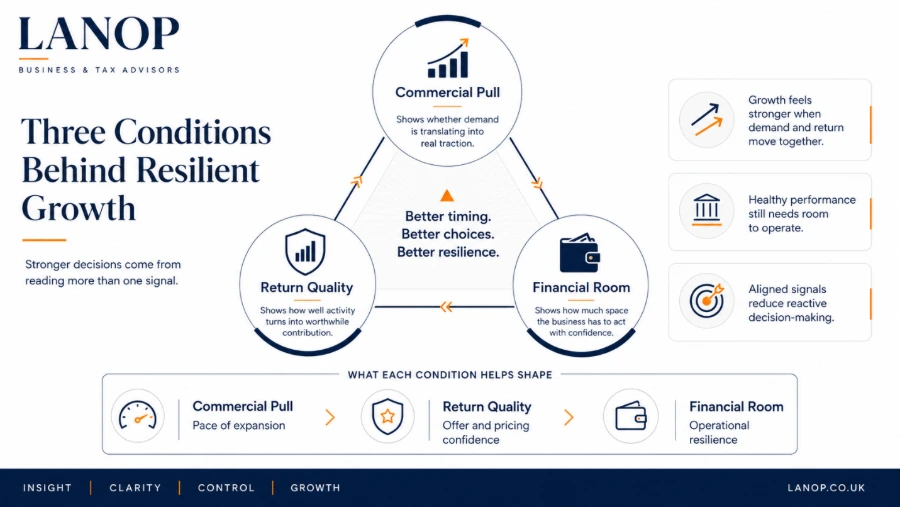
So, what do these three words really mean? Turnover is the headline number. It is your total sales before any costs come off. Profit is what is left after those costs. It shows whether the business model is working.
Cash is what you can spend today. That means wages, suppliers, and HMRC. And here is the catch. A business can report a profit on paper and still run out of cash.
Why higher sales can still leave you with weaker margins
Growth often brings extra costs before the full reward shows up. New clients may come in on tighter pricing. Bigger contracts can carry thinner margins. Scaling up can add wages and overheads too. All of this cuts how much of each pound of sales you keep.
So, when your costs rise faster than your prices, your margin falls. And this happens even while your turnover keeps climbing.
Where a Virtual Finance Director fits in
A Virtual Finance Director works beyond day-to-day bookkeeping and year-end compliance. The role is about what your numbers really mean for you as the owner.
It turns your numbers into real choices. Which clients should you keep? Which prices need a second look? Where is the margin quietly slipping away?
Many growing businesses are missing this layer. It sits between two people. One is the accountant who prepares and files the accounts. The other is the owner who runs the business.
How to Tell If You Have a Turnover, Profit, or Cash Flow Problem
Turnover, what your business sells
A turnover signal is mainly about demand. Healthy or rising sales often show that people want what you offer. Flat or falling sales can point to a demand, pricing or sales problem. Though how you run things may play a part too.
On its own, this number says nothing else. It does not tell you if that trade makes a profit. And it does not tell you whether you have even been paid for it.
Profit, what your business keeps
A profit problem shows up clearly. Sales stay steady. But little is left at the end of the month.
Weak gross profit often points to pricing or direct-cost issues. Weak net profit may mean overheads are too high for the level of trade. Are you busy but the reward feels thin? This is where the problem may sit.
Cash flow, what your business can use
A cash-flow problem is often about timing. But ongoing cash shortages can also point to weak profits or a cost base you cannot sustain. Even a business that makes a profit can struggle to pay its bills. Late-paying customers, stock that ties up money, or a tax bill at the wrong moment can all do it. Cash flow decides whether you can meet your bills this month.
Why do all three numbers need to be reviewed together?
Looking at any one of these figures alone can mislead you. High turnover with low profit points to a pricing or cost problem. Healthy profit with poor cash points to a collection, stock or timing problem.
Looking at all three side by side gives you a clearer view. A Virtual Finance Director builds the management accounts and reporting that make this a normal monthly habit.
The Most Common Mistake Owners Make When Margins Start Falling
Chasing more sales instead of checking gross margin
When profit dips, the instinct is often to chase more sales. But what if gross margin is the real issue? Then extra sales can just multiply a low-margin or loss-making activity. That may leave you worse off, not better.
So, the first question to ask is not, ‘How do we sell more?’ It is, ‘What is each sale making us?’
Mistaking a healthy bank balance for healthy profit
A full bank account is not the same as a business that makes money. Your balance reflects timing, not profit. It can look healthy while margins weaken underneath it.
Reading your bank balance as if it were profit is a common mistake. It is also one of the most costly ones owners make.
Forgetting what is already owed to HMRC and suppliers
A large part of the money in your account may already be spoken for. The VAT collected on sales is one example. PAYE and National Insurance taken from wages are others. Corporation Tax building up on profits adds to the total. These are all bills waiting for their payment deadlines.
Now add upcoming supplier payments on top. Suddenly the cash you can use shrinks fast. It is often far smaller than the headline figure suggests.

Waiting for the year-end accounts to spot the problem
Year-end accounts arrive months after the period they cover. By then, the damage may already be done. Monthly management information can catch the same issue much earlier. And that leaves you time to act. Waiting for statutory accounts to tell the story means you often find out far too late.
How a Virtual Finance Director Improves Profit Margins
Looking at profit by product, service and client
Many businesses do not know which products, services or clients make money. And they do not know which ones quietly drain it. A Virtual Finance Director breaks the numbers down by product line, job and customer. This shows where the real profit sits.
In some businesses, a small group of clients delivers most of the margin. Others may cost more to serve than they bring in.
Finding where the margin is leaking away
Margin rarely disappears in one big moment. Instead, it leaks away slowly. It leaks through prices that have not moved while costs have. It leaks through wage drift. It leaks through supplier price rises that get absorbed without question. And it leaks through overheads that creep up year after year.
A Virtual Finance Director maps and measures these small leaks. Fixing several of them can recover more money than chasing one new contract.
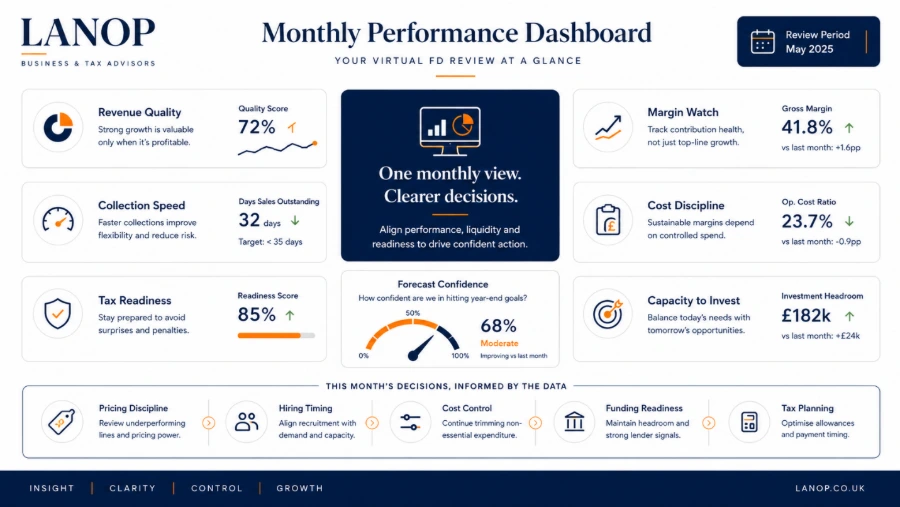
Building monthly management accounts and dashboards
Good decisions need timely numbers. A single report once a year is not enough. Monthly management accounts give you a current read on margin, cost and cash. A clear set of key how it is doing indicators does the same.
A good dashboard turns a pile of figures into a handful of signals. And these are signals you can act on straight away.
Turning the numbers into real decisions
Data only matters when it changes what you do. So the job of a Virtual Finance Director is to turn management accounts into clear choices. These choices cover pricing, hiring, investment and cost control.
Every month should end with choices. It should not just end with another set of statements.
What to Review Every Month to Protect Your Profit
Gross margin by product, service or project
Track gross margin at the level where the work happens. A blended company-wide figure can easily hide problems. A money-making line might be quietly propping up a loss-making one. Looking at margin by product, service or project shows you where to push harder. And it shows you where to fix things.
Net profit margin after overheads
After rent, salaries, software and other running costs, net profit shows what the company truly keeps. Watching this every month shows something important. It tells you whether overheads are growing faster than the sales that pay for them.
A falling net margin alongside steady turnover is an early warning. And it is worth acting on right away.
Debtor days and unpaid invoices
Sales recorded in your accounts but not yet collected are cash you cannot use. Debtor days measure how long customers take to pay. A rising figure is a direct threat to cash flow.
Checking aged debt every month is one of the fastest ways to free up cash flow. And you can do it without selling a single extra unit.
Stock, work in progress and supplier pressure
Money tied up in stock or unbilled work is money you cannot use elsewhere. Watching stock and work in progress shows where cash is trapped. It is trapped on its way to becoming a sale.
On the other side, watch your supplier terms and any pressure to pay early. Balancing the two keeps cash moving.
Tax reserves and upcoming deadlines
Every month, account for the tax your business is building up. VAT, PAYE and Corporation Tax all have deadlines. The cash to cover them should be set aside before it is spent elsewhere. So check your tax reserves against upcoming HMRC dates each month. With support from our self-assessment and tax returns service, this simple habit can prevent an avoidable cash crisis.
Improving Cash Flow Without Slowing Down Growth
Creating rolling cash flow forecasts
A rolling forecast looks ahead. It maps cash coming in and going out over the coming weeks and months. This way, you can spot pressure points before they arrive. Update it regularly and it becomes a live decision tool. It is not a spreadsheet you fill in once and forget. In short, it lets you grow with your eyes open.
Keeping trading cash and tax money separate
Mixing trading money with tax money can trip up healthy businesses. A Virtual Finance Director ring-fences the cash owed to HMRC. That way it is not spent by accident on day-to-day costs.
And this makes VAT and Corporation Tax deadlines much easier to manage.
Tightening payment terms and debtor control
Cash flow often improves fastest when money arrives sooner.
Checking payment terms helps. Invoicing promptly helps too. So does chasing overdue accounts firmly. All of this shortens the gap between doing the work and getting paid for it.
A Virtual Finance Director sets up a credit-control process that runs routinely, not by chance. And it does not change your prices.
Planning tax, payroll and dividend timing
Timing is a tool you can use to your advantage.
Know when VAT, Corporation Tax and payroll are due. Know when dividends are planned. Then you can organise cash around them, instead of scrambling at the last minute.
A Virtual Finance Director maps these duties across the year. This cuts surprises and helps keep growth funded.
Spotting cash gaps early
The whole point of forecasting is an early warning.
A shortfall spotted three months out is just a planning question. The same shortfall spotted next week is an emergency. By watching the forecast closely, a Virtual Finance Director can flag gaps early. And there is still room to arrange finance, cut spending, or speed up collections.
When an Accountant Is Not Enough
Bookkeeper, accountant, management accountant or Virtual FD
These roles solve different problems.
A bookkeeper records transactions. An accountant often prepares accounts and files tax returns. A management accountant produces internal reports. A Virtual Finance Director uses that data to guide financial control and strategy. The exact duties can overlap, depending on the business and adviser.
Many growing businesses already have bookkeeping and compliance support. They get it through services such as online accounting. What they often lack is senior, forward-looking money direction.
When compliance support runs out of road
Compliance keeps you legal. But on its own, it does not make you more profitable.
Filing accurate accounts and tax returns is a must. Still, compliance work mainly looks backwards.
Once you start asking forward-looking questions about pricing, funding and growth, compliance support alone may not be enough.
Signs your business needs strategic finance support
Some signals are hard to ignore.
Turnover growing while profit stays flat is one. Cash feeling tight despite a busy order book is another. Making decisions on gut feel rather than numbers is a third. So is having no clear answer about which clients are profitable.
Any one of these is worth a closer look. Together, they make a strong case for bringing in a Virtual Finance Director.
Virtual FD vs Virtual CFO, what UK SMEs often need
These two titles overlap. But they point in different directions.
A Virtual Finance Director focuses on financial control, reporting, margins, and day-to-day choices. A Virtual Chief Financial Officer leans more towards high-level strategy, fundraising, and investor relations.
Many UK SMEs benefit most from the hands-on direction of a Virtual Finance Director. A Virtual CFO role becomes more relevant later. That is when the business needs deeper support with fundraising, investor relations, acquisitions or a major scale-up.
Recent HMRC and Companies House Changes Worth Knowing
VAT registration and the turnover threshold
VAT registration is driven by turnover, not profit.
According to GOV.UK, a business must register for VAT if its total taxable turnover for the last 12 months goes over £90,000. It must also register if it expects its taxable turnover to go over £90,000 in the next 30-day period alone.
The optional deregistration threshold is £88,000. Both thresholds have applied since 1 April 2024.
The test is based on taxable turnover, not profit. So a fast-growing business can cross the threshold before it feels properly established. Keeping an eye on the rolling total is therefore a pricing and margin issue, not just an admin one. Our self-assessment and tax returns team can help you track it.
VAT late payment penalties and Time to Pay
Paying VAT late now comes with a clear set of charges.
GOV.UK guidance confirms the rules for VAT accounting periods starting on or after 1 April 2025. No first late-payment penalty is charged if you pay within 15 days of the due date. If the tax is still unpaid, a first penalty is worked out at 3% of the amount outstanding at day 15. A further 3% is added on the amount still outstanding at day 30.
From day 31, a second penalty builds up daily. It runs at an annual rate equal to 10% on the outstanding balance. This continues until the balance is paid or the penalty stops under the relevant rules.
Late-payment interest is separate. It runs from the first day the payment is overdue until it is paid in full.
An agreed Time to Pay arrangement can prevent or stop further late-payment penalties from building up. That depends on when it is proposed and agreed. But late-payment interest normally carries on running on the outstanding balance. This is why contacting HMRC early matters when cash is tight.
Corporation Tax deadlines and higher late filing penalties
A company normally has 12 months from the end of its accounting period to file its Company Tax Return.
The Corporation Tax bill is often due earlier. That is 9 months and 1 day after the end of the accounting period. Large and very large companies may have to pay by instalments instead.
GOV.UK confirms a change for Company Tax Returns with a filing date on or after 1 April 2026. The fixed late-filing penalties have doubled. A return that is one day late brings a £200 penalty. Another £200 is charged when it is three months late. If returns are late three times in a row, each fixed penalty can rise to £1,000.
The fixed penalties can apply even when no Corporation Tax is due. A dormant company often does not need to file another Company Tax Return once it has told HMRC it is dormant. The exception is if HMRC sends a further notice to deliver a return. Where a return is required, the filing deadline still matters.
Making Tax Digital for Income Tax from April 2026
Making Tax Digital for Income Tax became mandatory from 6 April 2026 for the first group of affected taxpayers.
GOV.UK guidance confirms who is in that first group. Sole traders and landlords registered for Self Assessment must use compatible software. They must keep digital records and send quarterly updates. This applies if their qualifying income was over £50,000 in the 2024 to 2025 tax year.
The threshold is over £30,000 for the 2025 to 2026 tax year, with use required from 6 April 2027. It is over £20,000 for the 2026 to 2027 tax year, with use required from 6 April 2028.
Qualifying income is the total gross income from self-employment and property before expenses. HMRC normally works it out from the Self Assessment tax return for the relevant earlier tax year. Exemptions may apply in limited cases, including where a person is digitally excluded.
HMRC’s official update confirms the timing for most customers in the first mandatory group. The first quarterly update covers 6 April to 5 July 2026 and is due by 7 August 2026. HMRC will not issue penalty points for late quarterly updates during the 2026 to 2027 tax year. The updates must still be sent before the tax return can be filed. And penalties can still apply to late Self Assessment returns and late tax payments.
Companies House identity verification
Companies House has brought in mandatory identity verification. This falls under the Economic Crime and Corporate Transparency Act 2023.
GOV.UK confirms that from 18 November 2025, identity verification became a legal requirement. It applies to directors and people with significant control, known as PSCs. That date started a 12-month transition period. It is not a single deadline for everyone.
Existing directors must provide their Companies House personal code. They do this through the company’s next confirmation statement. New directors must provide their personal code as part of an incorporation or appointment filing. A person who becomes a PSC after 18 November 2025 can provide the code when first added to the register, or within 14 days of being added. Existing PSC deadlines depend on two things. One is whether the person is also a director. The other is the company’s confirmation statement date or the PSC’s birth month.
Companies House will not accept a company’s confirmation statement until two things are done. All directors must have verified their identity. And the required personal codes must have been provided. PSCs must also verify and submit their details within their own 14-day window. So this is a governance task worth dealing with early. Our guides section covers it in more depth.
Protecting Margins During Inflation and Rising Costs
Checking price rises against real cost increases
Inflation and supplier cost changes make regular price reviews important.
But a flat percentage increase can still leave you behind. This happens if certain costs have risen faster than that.
The better approach is to measure the real rise in your wages, materials and overheads. Then price accordingly. Base the decision on actual cost movement, not a general sense that things have gone up.
Cutting overheads without weakening delivery
Cost-cutting is easy to do badly. Cut spending that supports quality or capacity, and it can backfire. You end up damaging the very thing customers are paying you for.
The skill is finding overheads you can reduce safely. Think duplicated software. Think subscriptions nobody uses. Think supplier terms that have drifted over time.
Renegotiating supplier terms
Suppliers are a lever many businesses underuse.
Review prices, volumes, and payment terms with key suppliers. This can help you recover margin. And it can ease cash at the same time. Longer payment terms help your cash flow. Buying in bulk can improve your unit prices.
A structured renegotiation, backed by the numbers, can often achieve more than owners expect.
Focusing on your highest margin work
Not all revenue is equally worth having. When costs rise, the case for steering your effort towards higher-margin clients, products, and services grows stronger.
Repricing or letting go of low-margin work can lift your overall profit. And this can happen even if it reduces your headline turnover.
This is a clear example of profit mattering more than sales volume.
Using forecasts before the pressure hits
A rolling forecast shows how rising costs will affect your margins and cash flow over the coming months.
You can still respond while you see the pressure coming. Acting on a projected squeeze is often cheaper than reacting after it has already hit.
This forward view is where a Virtual Finance Director can add real value during a period of rising costs.
What a Virtual Finance Director Does in the First 90 Days
Diagnosing where the business stands
The first task is an honest health check.
This means looking at turnover, gross and net margin, profit and cash. The goal is to pin down where the business really stands.
This baseline separates assumptions from facts. Everything that follows is built on it.
Reviewing the reporting itself
Next comes the quality of the numbers you already have.
The Virtual Finance Director reviews your existing management accounts. They spot what is missing, late or out of date.
Owners rely on these reports. So gaps can hide the real position. Closing them is a priority before any big decisions are made.
Checking tax exposure and short-term cash risk
Early work also means looking for risk. The Virtual Finance Director checks upcoming VAT, PAYE and Corporation Tax commitments against spare cash. Then they flag any short-term pressure points.
And this gives you time to plan around them before they bite.
Building a practical margin improvement plan
With the health check complete, the focus turns to action.
The Virtual Finance Director sets out a practical plan. It covers pricing, cost control and client focus.
It is ordered so the quickest, highest-impact changes come first. In short, it is a roadmap you can follow.
Setting up a monthly rhythm
Finally, the work is made to last.
This happens through a monthly rhythm of finance meetings and clear decision reports. Progress is tracked. Choices are made using current numbers. This regular rhythm turns a one-off review into lasting improvement.
How Lanop Helps UK Businesses Turn Turnover Into Profit
Lanop provides Virtual Finance Director support. It is shaped around the size and stage of your business.
Maybe you are a contractor. Maybe you run a growing SME or an established limited company. Either way, you get senior money direction without the cost of a full-time hire. You can see more on our about us page. The focus stays on turning work into lasting profit.
Good decisions need good information. So, Lanop builds the management accounts, rolling cash flow forecasts and KPI reporting you need.
These give you a current, solid view of your business. They are built around the decisions you face, not generic templates.
Lanop looks at where your margin comes from and where it leaks away. Through structured profit margin reviews and cost control planning, the focus shifts. It moves from chasing turnover to protecting profit.
And every recommendation is grounded in your real numbers.
Compliance and cash planning work best side by side. Lanop maps your VAT, Corporation Tax, payroll and Companies House duties across the year. This draws on our know-how in self-assessment and tax returns.
This means your cash and your deadlines line up. You stay ahead of penalties and interest, rather than reacting to them.
The relationship does not stop at the numbers. Lanop also offers ongoing finance guidance. You can read more about the team behind it on our About Us page.
This gives you a sounding board for pricing, spending and growth choices. Finance becomes a real partner in your business, not a year-end formality.
Frequently Asked Questions
A Virtual FD should provide management accounts, KPI dashboards, cash flow forecasts, aged debtor reports and clear action points.
The goal is simple. Help you make better choices on pricing, costs, tax and growth.
Break-even analysis shows how much you need to sell before your business starts making a profit.
It helps you see whether pricing, overheads or direct costs need a change.
Yes. A Virtual FD reviews profit by product, service and client. This shows where margins are too thin. They can then help you set better prices, control discounts and focus on higher-margin work.
An SME should choose a Virtual FD when it needs senior finance guidance but cannot yet justify a full-time hire.
It gives you strategic support without adding a permanent senior salary.
Owner pay should be planned with care. Weigh it against payroll duties, Corporation Tax, VAT, spare cash and the company’s wider working-capital needs. Salary is run through payroll. Dividends must be backed by enough distributable profits and properly documented. Support is available through our self-assessment and tax returns service.
A Virtual FD helps you take money out without creating cash pressure elsewhere.
Conclusion
For many owners, turnover is the first number that comes to mind. But it is not the most reliable measure of how well a business is doing.
Profit tells you whether your model works. Cash flow tells you whether the business can keep going with confidence.
Before you expand any further, it is worth knowing exactly which clients, products or services are truly earning you money. It is also worth knowing where money is quietly leaking away.
Are your sales growing while your profit looks level? Does cash still feel tight despite a busy order book? Then it is time to act. The same is true if key choices are still being made on instinct.
It is time to bring in proper money direction. Lanop helps UK business owners turn activity into lasting profit. This comes through Virtual Finance Director support, monthly reporting, cash flow forecasting, tax planning and practical margin improvement advice.
Get in touch with our team today. Let us put skilled money guidance behind your numbers and help you make better long-term choices.