
HM Revenue & Customs has changed the way most employees receive tax refunds where a P800 calculation covers more than one tax year, meaning affected taxpayers may now need to actively request money that was previously more likely to arrive automatically by cheque.
This change will bring multi-year P800 repayments closer to the digital refund process already introduced by HMRC for many other PAYE overpayments, as confirmed in HMRC’s August 2026 Employer Bulletin.
Key Takeaway
Receiving a P800 indicating that tax has been overpaid does not always mean the refund will be issued automatically. For many multi-year claims, employees will now need to request repayment themselves.
At a Glance
730,000+
Tax refunds went unclaimed in the previous year
£855
Average value of an unclaimed refund
5 working days
Typical timeframe for an online repayment
Up to 6 weeks
Potential timeframe for a cheque repayment
A P800 May Now Require an Extra Step
A P800 is issued when HMRC identifies that someone within the PAYE system has paid too much or too little Income Tax.
Under the revised multi-year process, employees will continue to make their underlying refund claim as usual. HMRC will review the position and, where appropriate, issue a P800 Tax Calculation.
For the majority of affected multi-year cases, however, HMRC will no longer automatically send a repayment cheque after processing the claim.
Instead, the employee will be asked to request the repayment themselves.
Three Ways to Request a Refund
HMRC says repayments can be claimed through:
- HMRC app
- Personal Tax Account
- Online P800 refund service
Employees using the standalone online service can generally make the claim using the reference shown on their P800 together with their National Insurance number.
Why Employees Should Not Ignore Their P800
The practical risk is not that the employee loses their entitlement immediately, but that money due back from HMRC could remain unclaimed while they wait for a payment that is no longer issued automatically. HMRC’s wider refund figures support that concern.
HMRC reported that more than 730,000 tax refunds went unclaimed in the previous year, with the average unclaimed refund worth £855.
Those figures are not limited to multi-year P800 claims; they also show why employees should actively check whether HMRC is waiting for them to request payment.
Why Might Someone Receive a P800?
A P800 may arise for several reasons, including:
- Moving between jobs
- Receiving payments from two employers in the same period
- Changes involving pension or taxable benefit income
Digital Claims Can Be Paid More Quickly
HMRC currently advise that any refunds applied online are usually made within five working days.
Those who do not wish to use digital services can also request a cheque. There are, however, situations when cheque repayments can take significantly longer, and in some cases up to 6 weeks, according to HMRC guidance.
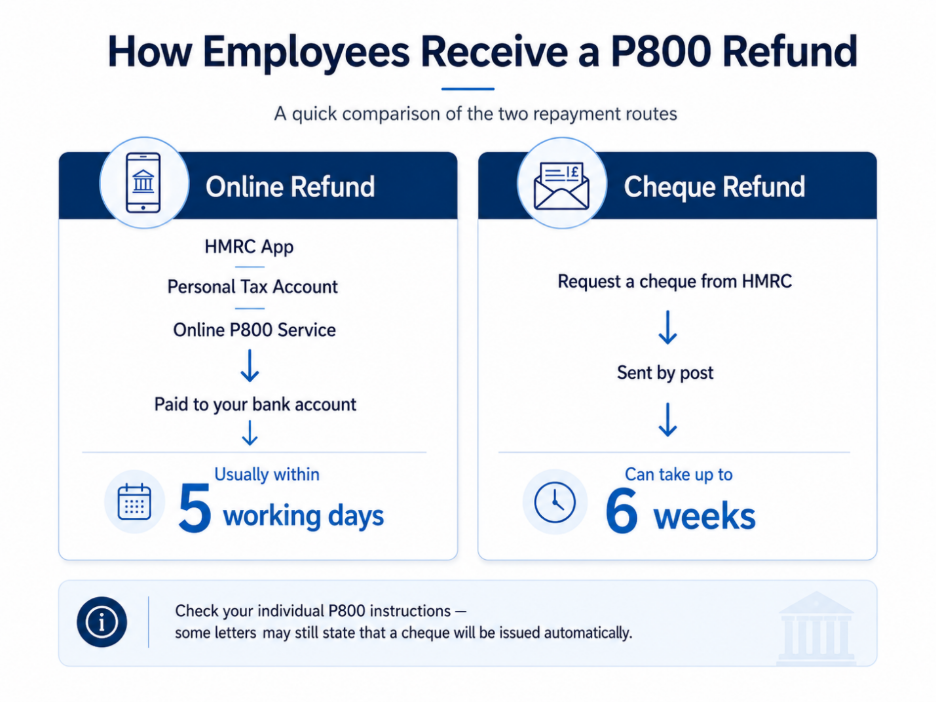
This implies that workers receiving P800 ought to pay attention to the instructions rather than assume the same repayment method is used in each case.
It is still important to note the wording in individual calculations, as some P800 letters will mention this too, so HMRC can automatically send the cheque.
What Employees Should Check Now
Anyone expecting a PAYE refund should ensure their contact details with HMRC are correct and review their Personal Tax Account or the HMRC app for any outstanding repayment instructions.
Where a P800 covers several tax years, employees should, in particular, check whether HMRC is asking them to take further action.
A simple checklist is:
- Check the instructions shown on your P800
- Review your HMRC app or Personal Tax Account
- Make sure your contact details are up to date
- Check whether HMRC is waiting for you to request the repayment
- Do not assume a cheque will arrive automatically
Employers may also want to inform staff of the change, as HMRC has specifically encouraged them to remind employees about the revised repayment process.
Keeping PAYE Refunds from Becoming Unclaimed Money
The change makes it increasingly important to understand HMRC calculations rather than simply waiting for correspondence to resolve itself.
Need Help Understanding a P800?
Lanop Business & Tax Advisors can assist individuals and businesses in reviewing PAYE records, understanding P800 calculations and identifying whether further action is needed where tax has been overpaid.
With HMRC moving more repayment activity towards digital self-service, checking calculations promptly can help ensure that legitimate refunds are claimed rather than left outstanding.