If you run a VAT-registered business, you can usually reclaim VAT on costs bought for business use. This is often called VAT reclaim in the UK, and it can save real money each quarter.
But not every purchase qualifies. Private use, missing evidence, and strict time limits can all block a claim.
Vehicles, imports, property, overseas VAT, and charities all follow their own rules. Get the basics wrong, and HMRC may delay or reject your repayment.
This guide walks through exactly what you can claim, what you cannot, and what to do when HMRC asks questions.
Can You Reclaim VAT in the UK?
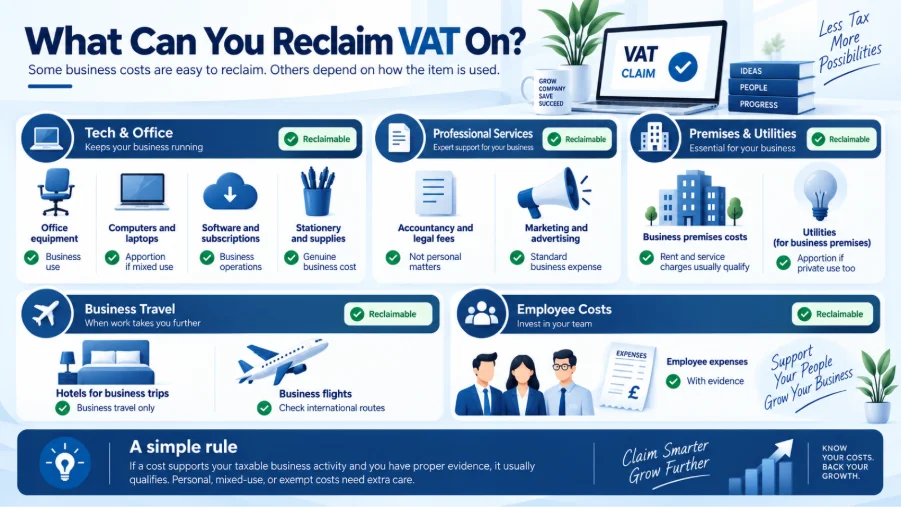
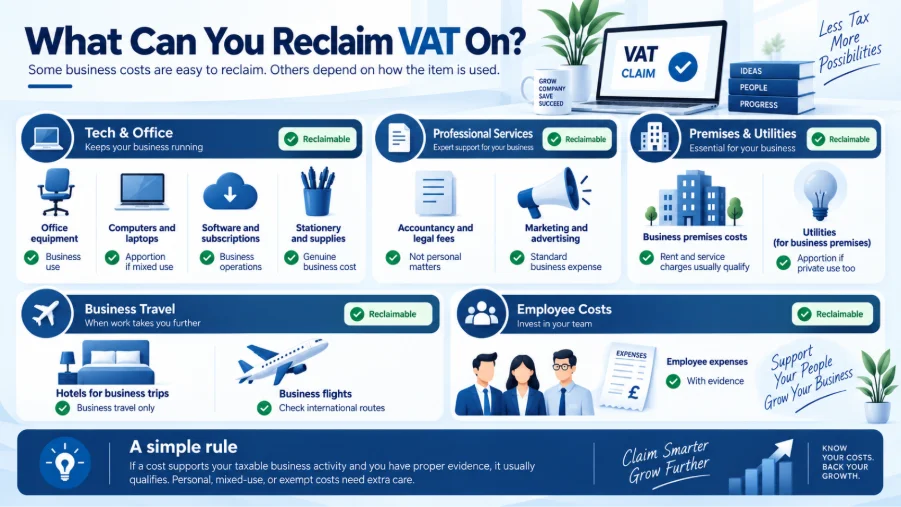
Yes. VAT-registered businesses can normally reclaim VAT on goods and services bought for taxable business use. The purchase requires a valid VAT invoice, a genuine business purpose, and that the claim falls within HMRC’s time limits. Private use, exempt activities, and blocked categories like client entertainment can all reduce or remove what you’re entitled to.
Who Can Normally Reclaim VAT?
VAT reclaim is generally open to any organization registered for VAT. That includes:
- Limited companies
- Sole traders
- Partnerships
- Charities and clubs that are VAT registered
- Landlords and property businesses with taxable rental income
You must be VAT-registered to reclaim VAT through a VAT Return. If you’re not registered yet, don’t worry. Pre-registration rules can still allow you to recover some VAT once you register, and we cover that later.
A major exception applies if you use the VAT Flat Rate Scheme. Businesses using that scheme cannot normally reclaim VAT on purchases, apart from certain capital assets costing more than £2,000 including VAT.
What Conditions Must a VAT Claim Meet?
HMRC looks at five things before a claim stands up:
- VAT was charged on the purchase.
- The cost relates to taxable business activity, not personal use.
- You hold a valid VAT invoice or acceptable evidence.
- Any private use has been identified and excluded.
- The claim falls within the correct time limit.
Miss any one of these, and your VAT reclaim claim could be reduced or refused.
What VAT Cannot Normally Be Reclaimed?
Some costs look eligible but aren’t. These are the mistakes that trip up even experienced business owners.
Personal and Private Expenses
If you buy something for both business and personal use, you can only reclaim the business proportion of the VAT. For example, if half of your mobile phone use is personal, you can normally reclaim 50% of the VAT charged on the purchase price and service plan.
HMRC expects a fair, reasonable split. Keep a record showing how you worked it out.
Client Entertainment
Taking a client to dinner feels like a business cost. It isn’t, for VAT purposes.
VAT on business entertainment provided to UK customers and other non-employees is normally blocked, even where it is intended to build genuine business relationships. A limited exception may apply to overseas customers, although recovering the VAT can create separate output VAT implications. Staff entertainment, such as a team meal provided to employees, can normally qualify, subject to the usual business-use and partial-exemption rules.
Keep these two categories separate in your records. Mixing them is one of the most common errors HMRC flags.
Expenses Where No VAT Was Charged
Not every business cost carries VAT. Insurance, many bank charges, and some professional fees are VAT exempt or outside the scope of VAT entirely.
You cannot reclaim VAT that was never charged in the first place. Always check the invoice. If there’s no VAT shown, there’s nothing to claim.
Exempt Activities and Partial Exemption
If your business makes both taxable and VAT-exempt supplies, you’re “partially exempt.” This means you can’t automatically reclaim all your input VAT.
You’ll need to work out what proportion relates to taxable activity. HMRC has standard methods for this, and some businesses agree a special method with HMRC instead.
If your exempt income is small, a simplification called the de minimis rule may let you reclaim all your VAT anyway. This area gets technical quickly, so get advice if your business has any exempt income at all.
How to Reclaim VAT in the UK
Here’s the practical process for correctly reclaiming VAT.
Step 1: Check Whether the Purchase Qualifies
Ask whether the cost is for business use, whether VAT was charged, and whether any private use applies.
Step 2: Check Your VAT Invoice or Evidence
You need a valid VAT invoice showing the supplier’s VAT number, the VAT amount, and the date. Simplified invoices are accepted for smaller purchases.
Step 3: Record the Input VAT
Log the VAT amount in your accounting software or spreadsheet as input tax. Keep the invoice on file.
Step 4: Include It on Your VAT Return
Input VAT goes in Box 4 of your VAT Return. This is the total VAT you’re reclaiming on purchases for the period.
Step 5: Submit the Return to HMRC
VAT Returns are usually filed quarterly through Making Tax Digital software, although monthly and annual accounting arrangements also exist and HMRC may grant a digital-exclusion exemption. Submit by your deadline to avoid penalties.
Step 6: Receive or Offset the Repayment
If the VAT you’ve paid (Box 4) is more than the VAT you’ve charged (Box 3), HMRC owes you the difference. This gets repaid to your bank account or offset against other tax you owe.
VAT Reclaim 4 Year Rule: How Far Back Can You Claim?
This is one of the most misunderstood areas of VAT reclaim in the UK, so it’s worth slowing down here.
Goods Bought Before VAT Registration
You can reclaim VAT on goods bought up to 4 years before your VAT registration date, provided you still hold them and use them in your business. This is often referred to as the VAT reclaim 4-year rule.
For example, a business buys office furniture and equipment two years before registering. Once registered, it can reclaim the VAT on those items, because they’re still in use and were bought within the four-year window.
Services Bought Before VAT Registration
Services follow a much shorter window. You can only reclaim VAT on services bought in the six months before registration.
For example, a consultant pays for legal advice five months before registering for VAT. That falls within the six-month rule, so that the VAT can be reclaimed. If the same advice had been bought eight months earlier, it would have fallen outside the window and could not have been claimed.
Is the 4-Year Rule the Same as Correcting an Old VAT Return?
No, and confusing the two causes real problems.
The four-year-and-six-month rules apply to pre-registration purchases. Correcting an old VAT Return is a separate situation, where you’ve already been VAT registered and made an error on a return you’ve already filed.
For correcting historic errors on past returns, different time limits and procedures apply, and the correction method depends on the size of the error. If you think a past return contains a mistake, treat it as a correction issue, not a pre-registration reclaim.
Can You Reclaim VAT on Business Mileage?
Reclaiming VAT on mileage confuses almost everyone, mainly because two separate HMRC rates get mixed.
Is VAT Reclaimed on the Full Mileage Payment?
No. When you pay an employee a mileage rate for using their own car, only part of that payment relates to fuel. VAT can only be reclaimed on the fuel portion, not the whole mileage payment.
How Is Mileage VAT Calculated?
You work out the fuel element using HMRC’s advisory fuel rates, then calculate the VAT within that amount using the standard VAT fraction (currently 1/6 of the fuel element, since VAT is charged at 20%).
The full mileage payment may cover fuel, wear and tear, insurance, and other running costs. For VAT purposes, only the VAT attributable to the fuel element can normally be reclaimed.
What Evidence Do You Need?
You need fuel receipts covering at least the VAT you’re reclaiming, and a mileage log showing business journeys, dates, and purposes. Without both, HMRC can disallow the claim.
What Changed for Mileage in 2026?
For the 2026/27 tax year, the approved mileage allowance payment (AMAP) rate rose from 45p to 55p per mile for the first 10,000 business miles, the first increase since 2011. The rate above 10,000 miles stays at 25p per mile.
This is an income tax and payroll figure, not a VAT figure. It sets the limit on what you can pay tax-free, and it’s worth reviewing alongside your wider payroll processes. It has no direct bearing on reclaiming VAT on mileage, which depends on the separate advisory fuel rates.
Advisory fuel rates are reviewed quarterly and vary by engine size and fuel type. Electric vehicles use a separate advisory electric rate, split between home charging and public charging, since public charging costs more per mile. Always check the current rate for the quarter you’re claiming, since it changes throughout the year.
VAT Reclaim on Electric Cars and Vans
Electric vehicles bring their own VAT questions, and the answers often surprise business owners.
Buying an Electric Company Car
An EV does not automatically qualify for full VAT recovery. The same rule applies to electric cars as to petrol or diesel cars: if there’s any private use, including commuting, VAT recovery is normally blocked entirely.
Full VAT recovery on a car purchase is rare and applies only when the vehicle is used exclusively for business, such as a pool car with no private use.
Leasing an Electric Car
Leasing is different from buying. Where a leased car has some private use, businesses can usually reclaim 50% of the VAT on the lease payments. This 50% restriction exists specifically to account for private mileage, and it applies to electric leased cars in the same way as petrol or diesel ones.
EV Charging, Repairs and Maintenance
Charging costs, servicing, and repairs are treated separately from the vehicle purchase itself. If the vehicle has business use and the business pays for the work, VAT on repairs and maintenance can normally be reclaimed subject to the usual rules, even where the vehicle also has private use or VAT on its purchase was blocked.
Charging costs need care. If a business pays for charging at a public point or a workplace charger, VAT can normally be reclaimed subject to business/private use apportionment. Home charging paid personally by an employee involves more complex rules, since the electricity supply contract sits in the employee’s name.
Vans and Commercial Vehicles
Vans and other commercial vehicles are usually treated more generously than cars for VAT. Full VAT recovery is normally possible where the vehicle is supplied to the VAT-registered business and used for its business, and HMRC generally treats incidental private use of most commercial vehicles as insignificant. The vehicle must be classified under the VAT rules; its treatment for capital allowances or employee benefits does not determine the VAT result.
Reclaiming VAT on a hire-purchase van is normally treated as a supply of goods where the agreement provides for ownership to pass. VAT on a qualifying commercial van can therefore usually be reclaimed at the outset, subject to the normal business-use, evidence and partial-exemption rules. VAT cannot be reclaimed on exempt finance charges.
VAT Rules vs Capital Allowances
Don’t assume favorable capital allowances mean favorable VAT treatment. Electric cars currently attract generous capital allowances for Corporation Tax purposes. That’s a separate tax from VAT, with its own rules.
A business can get strong capital allowance relief on an EV and still face the standard 50% VAT restriction on a lease, or no VAT recovery at all on a purchase with private use. Always check the two taxes separately.
Reclaiming VAT on Imported Goods
Reclaiming VAT on imported goods works differently from UK domestic purchases, and mixing up the systems is a common costly mistake.
When Can Import VAT Be Reclaimed?
VAT-registered businesses can normally reclaim import VAT in the same way as UK VAT, provided the goods are for business use and proper evidence is held.
C79 Certificate vs Postponed VAT Accounting
There are two main ways to account for import VAT.
A C79 certificate is issued by HMRC monthly and confirms the import VAT you’ve paid. You use it as evidence to reclaim VAT on your return.
Postponed VAT Accounting (PVA) lets you account for import VAT on your VAT Return rather than paying it upfront at the border and reclaiming it later. The same amount is normally declared as output tax and, where recoverable under the usual rules, reclaimed as input tax on that return. This can provide a significant cash-flow benefit.
Under PVA, you’ll need your monthly PVA statement from HMRC’s online service as evidence, instead of a C79.
Import VAT vs Customs Duty
These are two separate charges, and this distinction matters. Import VAT can normally be reclaimed as input tax. Customs duty cannot. It’s a cost of the goods themselves, added to their value, and it isn’t reclaimable through a VAT Return.
Check your import documentation carefully to separate the two, since some freight agents combine them on a single invoice.
Can a UK Business Reclaim EU VAT?
This question comes up constantly since Brexit changed the rules for UK businesses trading with the EU.
Can EU VAT Go on a UK VAT Return?
No. Foreign VAT charged by an EU supplier cannot be entered on a UK VAT Return. Can a UK business reclaim EU VAT? Normally, it must be reclaimed separately from the tax authority in the country where the VAT was charged, subject to that country’s eligibility rules.
How Does the 13th Directive VAT Reclaim Work?
The 13th Directive VAT reclaim process is generally the relevant route for businesses established in Great Britain. However, a qualifying business established in Northern Ireland may use the EU VAT Refund System for eligible VAT on goods connected with its Northern Ireland activities. Services and claims outside that system may still need the 13th Directive route.
Each EU member state runs its own version of this scheme, with its own forms, deadlines, and minimum claim amounts. Some countries process claims quickly. Others take considerably longer and apply stricter documentation checks.
For example, a company established only in Great Britain sends staff to a conference in Germany and pays German VAT on the hotel and venue hire. That VAT cannot go on its UK VAT Return. Subject to the German eligibility rules, the business would normally apply directly to the German tax authority under the 13th Directive process using the forms and evidence Germany requires, though our guidance on VAT compliance for UK businesses in France shows how similar cross-border reclaims work in practice.
Because rules vary so much by country, it’s worth checking each country’s specific process before assuming a claim will succeed.
Special VAT Reclaim Situations
A few situations fall entirely outside the normal rules.
VAT Reclaim for New Builds
The new-build VAT reclaim most people ask about is the DIY Housebuilders Scheme. It lets someone building their own home, or converting a non-residential building into a home, reclaim VAT on qualifying materials.
Who may qualify:
- Individuals building a new home for themselves or their family
- Individuals converting a non-residential building into a home.
Qualifying costs include most materials permanently incorporated into the build, such as bricks, timber, wiring, and plumbing.
Non-qualifying costs include fitted furniture, carpets, curtains, and many domestic appliances, even when installed during the project.
Claims for VAT reclaim on new-build projects must, in most cases, be submitted within six months of completion using HMRC’s online service. Paper forms remain available for those who cannot use it.
Ordinary extensions or renovations to an existing home do not qualify. The scheme is specifically for new dwellings and qualifying conversions, not general home improvements. Commercial property developers should not assume the same VAT treatment applies to their projects. Developers usually work within the standard VAT rules for construction, which differ significantly from this scheme.
Can Charities Reclaim VAT?
Whether charities can reclaim VAT depends entirely on what they do, not simply on their charitable status.
VAT-registered charities can reclaim VAT on costs related to their taxable activities, in the same way as any other VAT-registered organization.
Charities often carry out a mix of taxable, exempt, and non-business activities. VAT on costs relating to non-business activities, such as purely grant-funded charitable work, is usually not reclaimable.
Where a charity has both taxable and exempt income, partial exemption rules apply, just as they would for a regular business. Some specific reliefs and refund schemes exist for charity costs, such as certain building work, but these apply narrowly rather than across the board.
Charities are not automatically VAT exempt as organizations. Many are VAT-registered and handle VAT on their taxable supplies exactly like any other business.
How Long Does a VAT Refund Take?
Refund delays cause real cash flow stress, so it helps to know what’s normal and what isn’t.
How Long Does HMRC Normally Take?
Repayments are usually made within 30 days of HMRC receiving your VAT Return. If HMRC needs to check that the return is accurate, the repayment can take longer.
Why Is My VAT Refund Under Further Checks?
HMRC can pause a repayment to carry out checks, particularly where a claim is unusually large, where there’s a first-time repayment, or where the figures look inconsistent with previous returns.
What Evidence Can HMRC Request?
HMRC may ask for VAT invoices, bank statements, contracts, or an explanation of unusual transactions. Respond promptly and provide exactly what’s asked for, since incomplete responses only delay the process further.
What Should You Do If the Refund Is Delayed?
Track your repayment through your VAT online account first. If it’s been longer than 30 days with no update, contact HMRC directly. In more serious cases, an unresolved delay can develop into a wider HMRC tax investigation, so it’s worth seeking advice if checks drag on.
If HMRC is late in paying a qualifying VAT credit or overpayment, you may be entitled to repayment interest. For a credit shown on a VAT Return, interest generally starts on the day after the later of the return’s due date and the date the return or claim was submitted. Different start-date rules apply where VAT has already been paid to HMRC, and specific exceptions can also apply.
Conclusion: Make Sure You Reclaim the VAT You Are Entitled To
Getting VAT reclaim right comes down to matching your situation to the correct rule, then applying it carefully.
If you have a straightforward business purchase with a proper VAT invoice, record it correctly and include the eligible input VAT in your VAT Return.
If you’re looking at a historic expense, check whether the four-year rule for goods or the six-month rule for services applies before assuming either one automatically covers your situation.
If you’re dealing with mileage or vehicle costs, calculate VAT using the correct vehicle category and fuel rules, rather than the AMAP rate.
If you’re handling import or EU VAT, identify the correct recovery process first. Neither belongs directly on a standard UK VAT Return.
For anything large, unusual, historic, property-related, partially exempt, or already under HMRC review, get advice before you submit or correct the claim. The right groundwork now prevents a much longer conversation with HMRC later.
If you’re unsure whether a cost qualifies, have historic VAT to review, or HMRC is checking a repayment, Lanop can review your position before you submit or amend a claim. Getting the VAT treatment right early helps you recover the VAT you’re entitled to, while reducing the risk of errors and unnecessary HMRC queries.
Frequently Asked Questions
For goods bought before VAT registration, you can normally go back four years, provided you still hold and use the goods. For services, the window is six months before registration. Correcting errors on returns already filed is subject to separate time limits.
Not normally. Either a full or a simplified VAT invoice is the standard requirement. In limited cases, HMRC may accept alternative evidence, but this is assessed on an individual basis and shouldn’t be relied on as your main approach.
Yes, within limits. Goods bought for the business now registered for VAT can normally qualify if they were purchased within four years before registration and are still held or incorporated in other goods held at registration. Services are generally limited to the six months before registration. The costs must relate to the registered business and be supported by appropriate evidence.
Only on the fuel portion of a mileage payment, not the full amount. Use HMRC’s advisory fuel rates to work out the fuel element, then apply the VAT fraction to that figure. You’ll need fuel receipts and a mileage log as evidence.
Not automatically. Full VAT recovery on a purchased EV is rare and usually requires exclusive business use with no private mileage. Leased EVs with private use normally qualify for a 50% VAT reclaim on lease payments instead.