

Inheriting a house is rarely just a legal event. It often arrives with grief. It brings family talks. It brings choices nobody planned for.
One of the biggest choices is simple to state. Should you sell the home, or rent it out?
This guide covers the main issues involved in renting out an inherited property in the UK. It walks through probate, tax, certificates, and insurance. Landlord law differs across England, Wales, Scotland, and Northern Ireland, so the detailed compliance section below focuses on England and flags where separate rules apply. It is written to help you decide what to do next, not just to explain the law.
Renting Out an Inherited Property in the UK: Key Takeaways
Can You Rent an Inherited Property?
Yes, but only when the person granting the tenancy has the legal authority to act. In many cases, the safest course is to wait until the Grant of Probate or Letters of Administration has been issued. Probate does not itself make the home yours; the property remains part of the estate until it is formally transferred or assented to a beneficiary.
Do You Need Probate Before Renting?
Usually, you should obtain the relevant grant before letting. A named executor derives authority from the will, but the Grant of Probate formally proves that authority to third parties. An administrator generally has no authority until Letters of Administration are issued. Letting earlier can create problems with title, lenders, insurance, other personal representatives, and the tenancy itself, so specialist legal advice is essential before doing so.
What Taxes and Legal Responsibilities Should You Expect?
Rental profit is generally taxed as income and is normally reported through Self-Assessment or, where the rules apply, Making Tax Digital for Income Tax. Capital Gains Tax may arise when the property is later sold. You must also meet the landlord rules that apply in the part of the UK where the property is located.
Can You Rent Out an Inherited Property in the UK?
Yes, once the person granting the tenancy has authority to act for the estate or has become the legal owner. Being next of kin or merely being named as a beneficiary does not, by itself, give someone authority to let the property.
Who Has the Legal Right to Rent an Inherited Property?
Where there is a will, the executor named in it may have authority to act, with the Grant of Probate serving as formal proof of that authority. Where there is no will, an administrator normally obtains authority through Letters of Administration. If there is more than one personal representative, they should act consistently with their joint duties and the terms of the will or intestacy rules.
Can an Executor Rent Out an Inherited House?
Yes, an executor may be able to let an inherited house as part of properly administering the estate. In practice, it is normally safer to wait for the Grant of Probate, check the will, consult any co-executors, lender and insurer, and consider the beneficiaries’ interests. Executors must act in the best interests of the estate rather than for their own benefit.
Can a Beneficiary Rent an Inherited Property?
A beneficiary can let the home once the property has been formally transferred or assented to them and any registration, mortgage, insurance, and co-ownership requirements have been addressed. A beneficial entitlement under a will does not necessarily mean the beneficiary already has legal title or authority to grant a tenancy.
Can You Rent an Inherited Property Before Probate?
Sometimes an executor may have authority before the grant, but letting at that stage is legally and practically risky. An administrator generally requires Letters of Administration before acting. Without clear authority and agreement between the relevant personal representatives, a tenancy may be challenged and suitable banking, lender consent, or insurance may be difficult to arrange. Obtain legal advice rather than assuming the property can be let.
When Does Ownership Transfer After Probate?
A Grant of Probate or Letters of Administration authorises the personal representatives to administer the estate; it does not automatically transfer ownership to a beneficiary. The executor or administrator must formally transfer or assent the property, and HM Land Registry may then need to update the registered title. The timing depends on the estate, tax position, debts, and any dispute or mortgage.
What Should You Do Before Renting an Inherited Property?
There is groundwork to finish first. Start this even while probate is still weeks away.
Secure and Maintain the Property
- Check locks, windows, and any signs of damp.
- Arrange regular visits or ask a neighbour to check in.
- Turn off the water at the mains if the home sits empty.
- Redirect post and cancel unneeded deliveries.
Check the Property’s Legal and Financial Status
Check if there is a mortgage, a charge, or a lease. A quick Land Registry check helps. So does a call to the deceased’s solicitor.
Update Insurance During Probate
Standard home cover often stops working once a home sits empty. Tell the insurer the home is empty and awaiting probate. Ask about inherited property insurance in the UK, cover built for this exact situation.
Understand Your Responsibilities as an Accidental Landlord
Many people never planned to become landlords. That does not lower their legal duties. Once you let the property, the rules applying in its UK jurisdiction apply to you, and reviewing our guide on landlord accounting in the UK is a good starting point. The detailed compliance requirements below relate mainly to England.
Renting Out an Inherited Property After Probate: Step-by-Step Process
Once probate is granted, most families follow the same order when letting inherited property after probate.
- Confirm Authority, Ownership and Probate Status.
Check the will, the grant, any co-representatives, and whether the estate or a beneficiary will be the landlord. Confirm that any required transfer and Land Registry update are being handled correctly.
- Decide Whether Renting Is the Right Choice.
Weigh up the numbers honestly. The next section walks through this choice.
- Prepare the Property for Letting.
Clear clutter and redecorate where needed. Fix anything that would fail a safety check.
- Obtain the Required Safety Certificates.
Book your EPC, gas safety check, and EICR early. Good tradespeople get booked up fast.
- Arrange Suitable Insurance.
Tell the existing insurer about the death, vacancy, and proposed letting. Put suitable cover in place before the tenant moves in and comply with any lender conditions.
- Meet the Applicable Landlord Requirements.
For a property in England, protect any tenancy deposit, complete Right to Rent checks, and check local licensing rules. Use the separate rules for Wales, Scotland, or Northern Ireland where relevant.
- Set the Right Rental Price.
Compare similar local properties. A letting agent valuation helps you avoid pricing it wrong.
- Find and Screen Tenants.
Reference and affordability checks matter. For a property in England, complete the prescribed Right to Rent checks before the tenancy starts.
- Start Managing Your Rental Property.
Keep clear records for tax purposes from your very first rent payment.
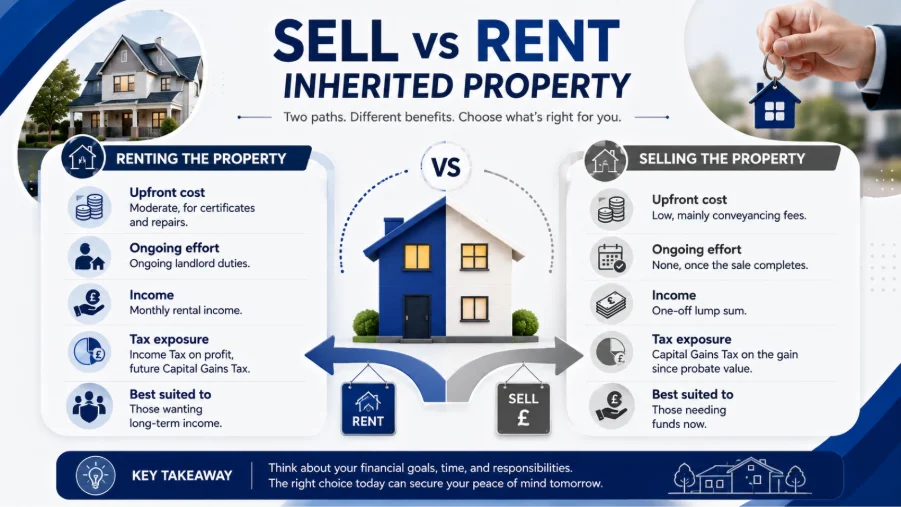
Should You Sell or Rent an Inherited Property?
This is the real question behind most inherited property sell-or-rent searches. There is no single right answer. It depends on your finances and your family’s plans. It also depends on how the home would perform as a rental. If the property is shared between siblings, our guide to inherited property split between siblings covers the extra considerations that come with joint ownership.
When Renting Makes Financial Sense
- The home is mortgage-free, or close to it.
- Local rental demand is strong, with a healthy yield.
- You do not need the sale proceeds urgently.
- You are comfortable taking on landlord duties.
When Selling May Be the Better Option
- The property needs repairs you cannot fund.
- Beneficiaries need cash now, for debts or retirement.
- Several beneficiaries cannot agree on running a rental.
- The home is far away and hard to manage.
Key Factors to Consider Before Making a Decision
Think about your own tax position. Think about how long you would hold the home. Weigh rental profit against a lump sum from a sale. A rental income tax adviser can help before you decide, not after.
The Real Cost of Renting an Inherited Property
New landlords often underestimate the true cost of letting a home. Compliance costs add up. Hidden costs add up too.
One-Off Costs Before Letting
- Safety inspections and certificates, with costs depending on the property and work required.
- Repairs or redecoration before letting.
- Any deposit-scheme, inventory, referencing, or agent administration charges.
- Photography and marketing, if not using an agent.
Ongoing Landlord Costs
- Landlord insurance premiums.
- Letting agent fees, often 8 to 15 percent of rent.
- Routine upkeep and emergency repairs.
- Void periods between tenancies.
Example Monthly Rental Income Calculation
| Item | Monthly Amount |
| Rental income | £1,300 |
| Letting agent fee (10 percent) | £130 |
| Insurance and upkeep reserve | £120 |
| Estimated net income before tax | £1,050 |
Hidden Costs Many New Landlords Overlook
Ground rent and service charges catch flat owners out. So does gardening on a larger plot. Budget for these before you choose to rent over sell.
Tax Rules for Renting Out an Inherited Property in the UK
Inherited-property tax questions usually split into three areas: Income Tax on rental profit, Inheritance Tax on the estate, and Capital Gains Tax when the property is sold. The taxpayer and timing can differ depending on whether the estate or the beneficiary receives the rent or sells the property.
Is Rental Income from an Inherited Property Taxable?
Yes. Net rental profit is generally taxable as property income. During the administration period, the personal representatives may be responsible for reporting estate income. After the property passes to a beneficiary, that beneficiary normally reports their share, subject to the property allowance and Self-Assessment rules.
How Inheritance Tax Affects Rental Property
Inheritance Tax is generally assessed on the estate by reference to values at the date of death. The standard nil-rate band is £325,000, and a residence nil-rate band of up to £175,000 may be available when a qualifying home passes to direct descendants. Spouse or civil-partner exemptions, transferable unused bands, lifetime gifts, and the residence-band taper for larger estates can change the result. The usual death rate is 40 percent on the taxable amount after available exemptions and reliefs, not simply 40 percent of everything above £325,000.
Capital Gains Tax When You Later Sell
For an inherited property, the Capital Gains Tax starting value is normally its market value at the date of death, not the original owner’s purchase price or the date probate was granted. For 2026/27, individuals generally pay 18 percent to the extent a taxable residential-property gain falls within the basic-rate band and 24 percent above it, after allowable costs, losses, reliefs, and the £3,000 annual exempt amount. A UK residential-property disposal normally needs to be reported and any CGT paid within 60 days of completion where tax is due, although exceptions and separate estate rules can apply.
Does Renting Increase Your Future Tax Liability?
Letting does not change the inherited acquisition value, but rental use can affect the reliefs available on a later sale. Private Residence Relief generally depends on the owner occupying the property as their only or main residence; occupation by another family member does not normally qualify the owner. The position should be reviewed if an owner genuinely moves into the property or if the estate sells it during administration.
Tax-Deductible Expenses for Landlords
- Letting agent and management fees.
- Landlord insurance premiums.
- Repairs and upkeep, though not improvements.
- Residential mortgage finance costs, generally through a basic-rate tax reduction for individual landlords rather than a full expense deduction.
- Safety certificates and compliance costs.
Reporting Rental Income to HMRC
Tell HMRC about taxable property income when required and register for Self-Assessment if the reporting rules require it. Keep digital or other adequate records of rent, expenses, ownership shares, and supporting documents from day one. During estate administration, confirm whether the personal representatives rather than the beneficiaries must report the income.
Common Tax Mistakes to Avoid
- Failing to identify whether the estate or beneficiary must report the rent or missing a required Self-Assessment registration.
- Missing the 60-day UK residential-property CGT reporting deadline where tax is due.
- Not retaining evidence of the property’s market value at the date of death as the normal Capital Gains Tax starting value.
- Claiming improvement costs as repairs by mistake.
UK Tax Overview for Inherited Rental Property
| Tax | When It Applies | 2026/27 Rate |
|---|---|---|
| Inheritance Tax | On the estate, before you inherit | Usually 40 percent on the taxable estate after available bands, exemptions and reliefs |
| Income Tax | On rental profit, each tax year | 20, 40 or 45 percent in England, Wales and Northern Ireland; Scottish bands differ |
| Capital Gains Tax | When the property is sold, normally using market value at the date of death as the starting value | 18 percent within the basic-rate band and 24 percent above it for individuals |
Legal Requirements for Renting an Inherited Property in England
The detailed rules in this section apply to most private residential lettings in England. Wales, Scotland, and Northern Ireland have separate tenancy, registration, licensing, deposit, notice, and safety regimes, so a property elsewhere in the UK needs jurisdiction-specific checks.
Energy Performance Certificate (EPC)
A privately rented property in England and Wales currently generally needs an EPC rating of E or above unless a valid exemption applies. In January 2026, the government confirmed a future standard requiring new and existing private rented properties to reach EPC C or equivalent by 1 October 2030 or register a valid exemption. The confirmed maximum required investment is £10,000 per property under the future regime, subject to the final regulations and reformed EPC metrics.
Gas Safety Certificate
For a rented home with relevant gas appliances or flues, arrange an annual gas safety check by a Gas Safe registered engineer. Give the tenant the required record before occupation and after each annual check, within the prescribed time.
Electrical Installation Condition Report (EICR)
For most private rented homes in England, the electrical installation must be inspected and tested at least every five years by a qualified person, with the report supplied as required and remedial work completed within the applicable deadline. Different rules apply elsewhere in the UK.
Smoke and Carbon Monoxide Alarm Requirements
In England, a working smoke alarm is required on each storey used as living accommodation. A carbon monoxide alarm is required in any room used as living accommodation containing a fixed combustion appliance, other than a gas cooker. The landlord must ensure the alarms work at the start of a new tenancy and repair or replace a reported faulty alarm as soon as reasonably practicable.
Deposit Protection Rules
In England and Wales, a tenancy deposit covered by the statutory rules must be protected in an authorised scheme within 30 days of receipt, and the prescribed information must be given to the tenant and any relevant person within the same period. Separate approved schemes and rules operate in Scotland and Northern Ireland.
Right to Rent Checks
Before granting a tenancy in England, landlords must complete the prescribed Right to Rent checks for every adult who will use the property as their only or main home. These checks do not apply in Wales, Scotland, or Northern Ireland.
Landlord Licensing Requirements
Some councils require selective licensing for rental properties in their area. Separate rules cover houses in multiple occupation. Check with the local authority before you advertise.
Essential Documents Every Landlord Must Provide
- A copy of the current EPC.
- The gas safety certificate updated annually.
- The current government renting information required for the tenancy, including the How to Rent guide or any replacement information required under the post-May 2026 regime.
- A written statement of the tenancy terms and other information required under the Renters’ Rights Act 2025 regime.
- Deposit protection scheme confirmation.
The first major tenancy reforms under the Renters’ Rights Act 2025 took effect in England on 1 May 2026. Assured shorthold tenancies were replaced by assured periodic tenancies for most private renters, fixed terms under that regime ended, and landlords can no longer issue Section 21 notices. Possession now depends on an applicable statutory ground and the correct notice and procedure. Other provisions are being implemented separately, so landlords should use the latest GOV.UK guidance when creating or ending a tenancy.
Insurance Requirements for an Inherited Rental Property
Why Standard Home Insurance Is Not Enough
Ordinary home insurance suits owner-occupied homes. It often excludes coverage once you let the home. That leaves you exposed if something goes wrong.
When to Switch to Landlord Insurance
Arrange cover suitable for a tenanted property before the tenant moves in. Landlord insurance is not generally a standalone legal requirement, but an ordinary owner-occupier policy may exclude letting and a mortgage lender may require specific cover. Check buildings, contents, liability, legal expenses, and loss-of-rent terms rather than assuming every risk is included.
Empty Property Insurance During Probate
While the property sits empty during probate, ask about empty home cover. Many standard policies stop paying out after 30 to 60 days of vacancy.
Insurance Mistakes That Could Leave You Unprotected
- Assuming the deceased’s current policy still applies.
- Not declaring the home as tenanted once let.
- Underinsuring the rebuild cost of an older home.
Renting an Inherited Property with an Existing Mortgage
What Happens to the Mortgage After Inheritance?
The mortgage does not disappear on death. It becomes a debt of the estate and must usually continue to be paid during probate.
Can You Rent with a Residential Mortgage?
Usually not. Letting on a standard residential mortgage, without permission, can breach the loan terms. Switching to a buy-to-let mortgage is often necessary once probate is complete.
Speaking to Your Mortgage Lender Before Letting
Contact the lender early. Many offer a temporary consent to let while you decide your longer-term plan.
Renting an Inherited Property with Multiple Beneficiaries
Do All Beneficiaries Need to Agree?
The personal representatives control estate assets during administration and must act properly under the will or intestacy rules. Once beneficiaries jointly own the property, the legal owners and any restrictions on the title determine who must join in decisions. A written co-ownership and management agreement is strongly advisable.
How Rental Income Is Shared
Rental income is generally taxed according to each person’s beneficial entitlement, but the estate may be taxable during the administration period. The legal and beneficial ownership, any declaration of trust, and special rules for spouses or civil partners should be checked rather than assuming an equal split.
Managing Repairs, Costs and Responsibilities
Agree in advance who handles day-to-day choices. Agree how repair and emergency costs get split and approved.
What Happens if Beneficiaries Disagree?
Disagreements are common. They can stall a choice for months. Mediation or professional advice often resolves this faster than letting tension build.
Buying Out Other Beneficiaries
One beneficiary can sometimes buy out the others. This lets them keep the home and live in it alone. It often needs a formal valuation and legal advice.
Common Mistakes to Avoid When Renting an Inherited Property
- Renting before you have legal authority to do so.
- Failing to budget for taxes and regular upkeep.
- Using the wrong insurance policy, or none.
- Ignoring landlord compliance requirements to save money early on.
- Not planning for future Capital Gains Tax.
- Poor communication between several beneficiaries.
Frequently Asked Questions
Not always, but it is normally safest to wait. An executor named in a will may have authority before the grant, whereas an administrator generally does not have authority until Letters of Administration are issued. Letting early can create title, lender, insurance, and co-executor problems, so take legal advice before granting a tenancy.
Yes. Net rental profit is generally taxable. During estate administration, the personal representatives may need to report the income; after the property passes to beneficiaries, each beneficiary normally reports their taxable share. Self-Assessment or Making Tax Digital rules may apply.
It depends on your finances and the home’s condition. It also depends on whether beneficiaries need cash now. Renting suits long-term income, and selling suits those needing funds sooner.
Yes, but authority depends on whether the property is still in the estate or has been transferred into joint ownership. The personal representatives or registered owners should agree the arrangement, and a written co-ownership and management agreement can reduce disputes.
Conclusion
There is no single right answer here. The right choice depends on your circumstances, not a general rule.
Renting tends to make sense when the home is in good shape, and demand is strong. It suits families who do not need an immediate cash sum. It also suits those comfortable taking on landlord duties for long-term income.
Selling often makes more sense when the home needs work you cannot fund. It also suits families who need their share of the estate now. It suits those who cannot agree on running a rental too.
Before you commit either way, consider probate timing, tax exposure, and ongoing maintenance. Think about what you want for your family’s future. A calm choice tends to serve everyone better than one made under pressure. Good advice helps you get there, and our wider estate planning services can support the decisions that come after probate too.
Whatever you decide, you do not have to work it out alone.
Talk to Lanop Before You Decide
At Lanop, we help families through exactly this choice each week. You might need guidance on probate and estate administration. You might need help with rental income tax, Capital Gains Tax planning, or a second opinion before becoming a landlord. Our team is here for all of it.
If you are weighing up whether to sell or rent a property, get in touch with Lanop today. We will help you make a confident, informed choice and support you through whichever path you choose.