Have you started earning money outside your normal job? Maybe it is freelance work. Maybe it is a rental property. Maybe it is a side hustle that grew fast. Now you are asking a tricky question: do you need to register for self-assessment?
This guide gives you clear answers. It covers when you must register, which HMRC route fits you, and how to get your UTR. It also covers what to do if something has gone wrong. Registering, filing a return, and paying tax are three separate steps. Get registration right, and every step after it gets easier.
What Is Self-Assessment and Who Needs to Register?
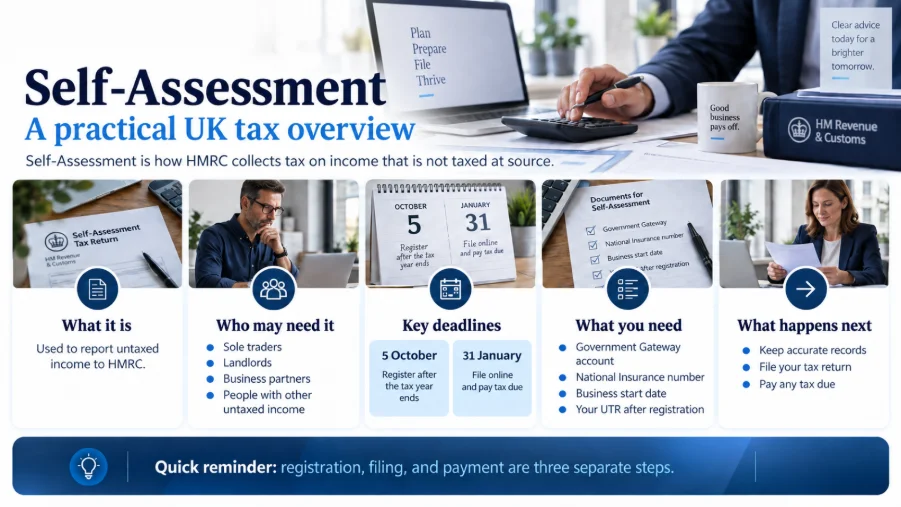
Self-Assessment is how HM Revenue and Customs (HMRC) collects tax. It applies to income that is not taxed at source. Most employees pay tax through PAYE instead. But if you earn untaxed income from self-employment, property, or elsewhere, you likely need Self-Assessment too.
When Do You Need to Register for Self-Assessment?
You may need to register for Self-Assessment if any of these apply to you. You are self-employed and earned over £1,000 in gross trading income. You freelance alongside another job. You earn side hustle income above the relevant reporting threshold. You receive rental income from a property. You are a partner in a business. You have foreign income that you must report. You receive dividend income or savings and investment income that must be reported through Self-Assessment, rather than directly to HMRC. You have taxable capital gains that must be reported through a tax return, or HMRC has already sent you a notice to file. The correct reporting route depends on the type and amount of income or gain.
Do several of these apply to you? You normally need only one personal Self-Assessment registration, and you report the relevant personal income on the same individual return. A business partnership is different: it must also register and submit a separate partnership return.
Do You Need Self-Assessment If You Are Employed Through PAYE?
Yes, sometimes. PAYE only covers your job income. If you also freelance, rent out a property, or earn other untaxed money on the side, you likely still need to register for self-assessment. This is true even if you have a full-time job.
Do You Need to Register If Your Self-Employed Income Is Under £1,000?
The £1,000 figure is your trading allowance. It applies to your gross trading income, which means everything you earn before costs. It is not the same as profit. It is also not the same as your personal allowance.
Stay under £1,000 in gross income, and you often do not need to register. Cross that line, even slightly, and you often need to register. This is true no matter how much profit you actually kept.
Do Company Directors and Business Partners Need to Register?
Being a director does not, on its own, create a Self-Assessment duty. Many directors are paid fully through PAYE. They have nothing further to report. But you are more likely to need to register for Self-Assessment if you also receive income or gains that must be reported through a tax return. Dividends above the £500 allowance do not automatically require Self-Assessment: if you do not already file a return, dividend income over £10,000 normally does. You can usually report smaller taxable amounts directly to HMRC.
Business partners work differently. Each partner registers separately and gets their own UTR. The partnership also registers separately and gets its own UTR. One does not replace the other.
When Do You Need to Register for Self-Assessment?
Knowing when to register for self-assessment protects you from penalties you could easily avoid.
What Is the Self-Assessment Registration Deadline?
The registration deadline is 5 October. This falls after the end of the relevant tax year. The UK tax year runs from 6 April to 5 April. So, if you started earning untaxed income anytime in the 2025/26 tax year, you must register by 5 October 2026.
Registration Deadline vs Filing Deadline vs Payment Deadline
Keep these dates in order. Registration is due by 5 October after the tax year ends. Paper returns are due by 31 October. Online returns and the balancing payment are due by 31 January. If payments on account apply, the first is due by 31 January and the second by 31 July.
For the 2025/26 tax year, that means registering by 5 October 2026. It means filing and paying by 31 January 2027.
Can You Register Before the Tax Year Ends?
You register once your activity has started. It must also fall within the right tax year. Getting the start date wrong is a common cause of delay.
Which Self-Assessment Registration Route Should You Use?
Registering for self-assessment the right way starts with picking the correct route.
If you are newly self-employed, register directly as a sole trader on GOV.UK. This route sets up your Self-Assessment and your Class 2 National Insurance position at the same time.
Is your need based on something other than self-employment? Maybe property income, foreign income, or other untaxed income? Then you likely use the SA1 route instead.
Have you joined a partnership? Then you need to register a partner for self-assessment using form SA401. This covers your own record. The partnership registers itself. The nominated partner often handles this.
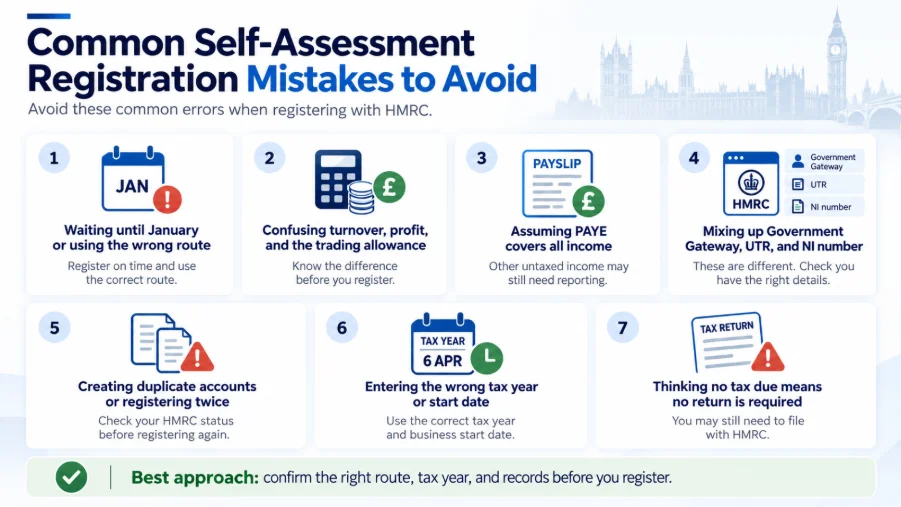
Do you already have a UTR from before? You do not need to start again. If HMRC said you didn’t need a return, but your situation has changed, reactivation is often all you need. Registering again without checking first often creates a duplicate record. That just causes more problems later.
What Do You Need Before Registering?
Gather a few details first. You will need your full legal name, date of birth, and National Insurance number. You will also need your current address and contact details. Note the exact nature of your trade and its start date. Have any existing UTR ready. If you’re in a partnership, gather those details too. You will normally need a Government Gateway account to use HMRC’s online registration service, although postal registration routes are available in some circumstances.
Do your name or address not match HMRC’s records? This can delay or flag your registration. Update your details with HMRC first. Then try registering again, rather than resubmitting the same mismatched information.
How to Register for Self-Assessment With HMRC
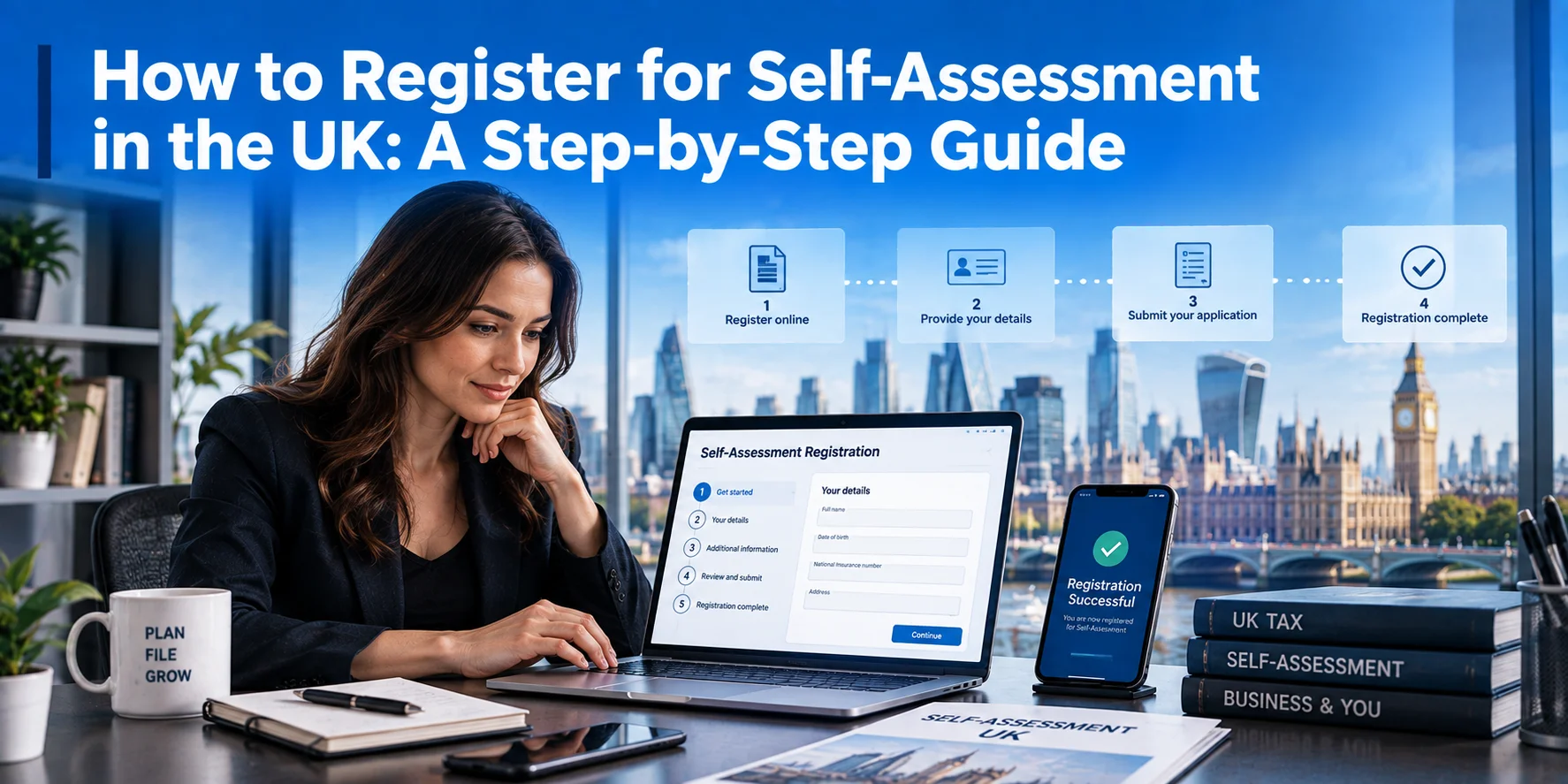
Here’s how to register for self-assessment, step by step.
1. Confirm you need Self-Assessment. Check your income against the criteria above first.
2. Identify the correct tax year. Match it to your actual start date.
3. Choose the right route. Pick sole trader, SA1, or SA401.
4. Access your HMRC online account. Set up a Government Gateway login if you do not have one.
5. Enter your personal and tax details. Take your time and be accurate.
6. Check everything carefully. Check your start date, tax year, and route carefully.
7. Submit the registration. Keep your confirmation reference somewhere safe.
8. Wait for HMRC to process it. Your UTR will arrive by post.
What Is a UTR and Why Do You Need One?
Your Unique Taxpayer Reference, or UTR, is a ten-digit number. HMRC uses it to track your Self-Assessment record. You need it to file a return.
It is not the same as your National Insurance number. Your National Insurance number is a separate personal reference used across the tax, employment, benefits and State Pension systems. It is also not your Government Gateway user ID, which is simply your login. Having a UTR does not always mean that HMRC currently expects you to file a return. The UTR normally stays with you even when you are not required to file.
What If You Have Lost Your UTR?
Check old tax returns or letters from HMRC first. You can also find your UTR in your personal or business tax account or in the HMRC app. If you still cannot find it, use HMRC’s official UTR service or contact HMRC for help. You will need to confirm your identity.
What Happens After You Register for Self-Assessment?
HMRC processes your registration and posts your UTR to you. You should then see an active Self-Assessment record in your Government Gateway account. Do not see it after a fair wait? Follow up directly with HMRC.
From here, start keeping good records. Track your income and invoices closely. Keep hold of allowable expenses and receipts too. Save relevant bank statements and property records, where applicable.
Once you are registered, you often need to file every year. This continues until you tell HMRC your case has changed. HMRC sends an annual notice to file. Act on it, even if you believe you owe no tax.
What to Do If You Registered but Have Not Received Your UTR
Do not register again. A second registration while the first is still processing often confuses. It rarely speeds things up.
Did you submit more than one by mistake? Contact HMRC first. Ask them to confirm which registration is active before you do anything else.
A UTR, online access, and an active Self-Assessment record are three separate things. Do you have a UTR but cannot see Self-Assessment in your account? That may point to an online-access or service-linking issue, but HMRC should confirm your actual registration status before you submit anything again.
Why Might HMRC Reject or Delay Your Registration?
A few common issues explain most delays. HMRC may struggle to verify your identity, often because your personal details don’t match. An old address on file can stop your UTR letter from arriving. An inaccurate self-employment start date can push your registration into the wrong tax year. Or you may have used the wrong route for your situation.
In every case, contact HMRC directly. Ask them to correct the specific detail. Don’t submit a whole new registration.
What Happens If You Miss the Self-Assessment Registration Deadline?
You can still register after 5 October. Do it as soon as you realise, since waiting only shrinks your filing window further.
HMRC may charge a failure-to-notify penalty. This is more likely where tax is owed. The exact outcome depends on your own case, so no fixed result can ever be promised.
Your 31 January filing and payment deadline still applies. This is true no matter when you registered. Not knowing the rule rarely counts as a valid excuse on its own. Register right away, and correct the position, rather than waiting for things to sort themselves out.
What If You Should Have Registered in an Earlier Tax Year?
Work through this step by step. First, identify which tax years are actually affected. Next, reconstruct your income for each one. Then work out any allowable costs you can claim. After that, check what HMRC now expects from you. Work out the tax likely due. Finally, contact HMRC or an expert adviser to formalise the correction.
Are your records incomplete? You can often rebuild a fair picture using bank statements and invoices. Payment platform history helps too, along with accounting software exports, contracts, and business emails.
Do several years need fixing? Are records missing, or are larger sums involved? Foreign or rental income adds complexity too. This is often when getting an accountant involved pays for itself, particularly if it touches on an HMRC compliance check or investigation.
The £1,000 Trading Allowance and Self-Assessment Registration
The £1,000 figure is based on gross trading income. That means total earnings before any expenses, not profit after costs. Assuming otherwise is a common and costly mistake.
This allowance is also separate from your personal allowance, currently set at £12,570 for most people. It generally covers the amount of income you can receive before paying Income Tax, but it can be reduced where adjusted net income exceeds £100,000, and individual circumstances can affect entitlement. Never confuse the two and never add them together.
Do you run more than one side hustle? HMRC often looks at your combined gross trading income across all of them, not each one separately.
Owing tax is not the same as needing to report it. You can meet HMRC’s reporting rules with nil tax due and still need to register and file.
Self-Assessment for Employees, Directors, and Partners
PAYE only covers the job it relates to. Freelance income, consulting, tutoring, and online services can all trigger Self-Assessment. So can gig work and rental income, once they cross the relevant thresholds. This is true no matter what your main job pays you.
Not every director needs Self-Assessment either. Directors paid solely through PAYE often have no obligation. Other income or gains may change that, but the reporting route depends on the type and amount involved. For example, dividend income above the £500 allowance can create tax to pay, while Self-Assessment is normally compulsory for someone not already filing only when dividend income exceeds £10,000. Property income, foreign income, capital gains, or self-employment alongside the company must each be checked under their own reporting rules.
For partners, each person registers separately. Each gets a personal UTR that reflects their own profit share. The partnership also registers separately. It holds its own partnership UTR. That number relates to the partnership return. This return reports total profits and how they get split. Each partner’s own UTR relates to their own personal return instead. The nominated partner files the partnership return. But every partner still files their own personal return too.
Government Gateway, UTR and Self-Assessment: What Is the Difference?
These terms often get mixed up, so here is a quick breakdown. Government Gateway is your login for HMRC’s online services. UTR is your unique tax reference number. Self-Assessment registration means telling HMRC you need to file a tax return. Your Self-Assessment tax return is the yearly document that reports your income and tax. Four different things are often treated as one.
Did you file before but were later told a return wasn’t needed? Has your case changed again since then? Reactivation is often enough. You likely do not need a fresh registration.
Your UTR itself does not expire. It stays valid, even during quiet periods when you are not actively filing. Have you not filed for several years? There is a real difference between genuinely not needing to file and simply missing returns you should have sent. Check with HMRC directly if you are unsure which one applies to you.
Having Self-Assessment access does not always mean this year’s criteria still apply to you. But HMRC will often still expect a return until you formally tell them otherwise. Does HMRC expect a return that you believe you do not need? Resolve it directly with HMRC. Do not simply ignore the notice. Explain what has changed and ask for a proper review.
What Should You Do After Self-Assessment Registration?
Keep accurate records right from day one. Estimate your tax position as the year goes on, rather than guessing everything in January. Prepare your return early. This gives you time to fix any errors and confirms your bill sooner. Budget steadily for the payment deadline too.
Does your bill go over £1,000, with most tax not deducted at source? HMRC may also ask for payments on account toward next year’s bill. Plan for this so it doesn’t catch you by surprise.
Does Making Tax Digital Affect Self-Assessment Registration?
Making Tax Digital, or MTD for Income Tax, is separate from Self-Assessment registration. But the two are closely linked. Registration tells HMRC that you need to report. MTD changes how you keep records and how you submit information once you are in the system.
From 6 April 2026, MTD for Income Tax became mandatory for sole traders and landlords with qualifying gross income over £50,000, subject to the applicable exemptions. The threshold falls to over £30,000 from 6 April 2027 and over £20,000 from 6 April 2028.
Qualifying income means your combined gross self-employment and property turnover. It does not include profit, partnership, dividend, savings, or employment income. Check your own figures each year. MTD depends on your actual income, not on assumptions about your business, and choosing the right MTD-compatible accounting software early makes the transition easier.
When Should You Use an Accountant for Self-Assessment?
Are you a straightforward sole trader? Do you have a clear start date, one income source, and no historic issues? You can often register comfortably alone.
Expert support becomes more valuable in other cases. Maybe you missed the deadline. Maybe you have historic undeclared income, spanning several tax years. Foreign income or rental income adds complexity too, as do director or partnership questions. Missing records or a duplicate registration are also good reasons to get help.
Lanop Business and Tax Advisors can check whether Self-Assessment applies to you. We help you choose the right registration route, and we handle the HMRC registration itself. We also prepare accurate returns in the future. We also help clients resolve historic tax issues, missed deadlines, and ongoing HMRC letters. You get to work from a clear plan, instead of an open-ended worry.
Conclusion: Register for Self-Assessment with the Right Approach
Your next step depends on where you stand right now.
Are you a first-time sole trader? Confirm your start date and register through the correct route well before 5 October. Are you a PAYE employee with new side income? Check whether it crosses the relevant thresholds. Are you a director or partner? Look closely at the type of income involved, not just your job title. That is what decides the outcome.
Do you already hold a UTR? Check whether reactivation is enough before creating a fresh record. Have you missed a deadline, or found unreported income from earlier years? Act now, since early correction is almost always simpler than a delayed one. Has a registration or UTR problem left you stuck? Confirm your actual HMRC status first, before submitting anything further.
Whatever stage you are at, the same principles apply. Confirm whether registration is genuinely necessary. Identify the correct tax year. Choose the right route. And avoid duplicate submissions along the way.
Unsure whether you need Self-Assessment? Have you missed a deadline, or do you already have a UTR? Do you need help fixing an earlier tax position? Lanop Business and Tax Advisors can review your situation and guide you through the correct process with HMRC. Get in touch with our team for straightforward, expert support with your Self-Assessment registration and tax return.
Frequently Asked Questions
HMRC says a UTR usually arrives by post about 15 days after registration, although it can take longer if you live overseas. You normally need your UTR and an active Self-Assessment record before filing your Self-Assessment return, so it is best to register well before the filing deadline.
Contact HMRC and explain how your circumstances have changed. Do not simply stop filing returns. HMRC may continue to expect a return until it confirms that you no longer need to complete Self-Assessment.
No. Your UTR normally stays with you even if you stop filing Self-Assessment returns for a period. If you need Self-Assessment again later, HMRC may only need to reactivate your record rather than issue a new UTR.
Do not submit another registration straight away. A UTR, online access, and an active Self-Assessment record are separate. Check your HMRC account first, then contact HMRC if the registration still does not appear after a reasonable processing period.