

Growth rarely gives you warnings. One quarter, you run a tidy business with clean books. The next, you have more staff, more invoices, and bigger calls to make. Bookkeeping may still be spot on. But something no longer fits.
So, the real question is not whether your bookkeeper is doing a good job. It is whether bookkeeping on its own is still enough for the business you have become. At some point, a business needs to stop just recording its numbers and start using them to steer. That is often when it makes sense to Upgrade from Bookkeeper to Finance Manager and bring more strategic financial oversight into the business. Here are five signs that the moment has come. And here is how to make the switch without stress.
Sign 1: Your reports explain what happened, not what to do next
Good bookkeeping tells you where the money went. A finance manager tells you what that means for the choices ahead. Say your monthly figures land as a neat record of the past, with no readout attached. Then you are missing the layer that turns data into a plan.
So, ask yourself a few honest questions. Do you get management accounts every month, on a set date? Do they explain the gap between the budget and the actuals, rather than just list it? Can you see which products, services or customers earn you money, and which quietly drain it? Bookkeeping answers “what happened.” A finance manager answers, “So what, and what now?”
Sign 2: You cannot confidently predict your cash position
Profit on paper and cash in the bank are not the same thing. The gap between them is where good businesses get caught out. If cash surprises keep cropping up, that is a sign. Your finance function needs a forward-looking perspective it does not yet have.
A finance manager runs a rolling 13-week cash-flow forecast. So you spot the tight weeks before they arrive. They plan for VAT, Corporation Tax, payroll and supplier bills in advance, rather than react when the bill lands. They also watch debtor days, because slow-paying customers can starve a profitable business of cash. Best of all, they let you test a decision first. A new hire, a piece of kit, or a push into a new market: you see the cash impact before you commit.
Sign 3: Major decisions are being made on instinct, not analysis
Instinct built your business, and it still counts. But on its own, it is a thin base for pricing, spending and growth once the numbers get bigger. Make big calls with no solid analysis behind them, and the risk quietly builds up.
A finance manager gives those calls a base. They work out your gross margin by product, service, project or place. So, you know where you really make money. They check budgets against real results and keep a short list of KPIs that guide decisions. They do not hoard numbers no one reads. When something big is on the table, they map out the best case, the worst case and the likely case. So you choose with your eyes open.
Sign 4: More transactions and entities are creating control gaps
Complexity tends to arrive faster than the systems built to handle it. A few more staff. A few more income streams. An extra VAT registration. A second company. Suddenly, the setup that worked at a smaller scale starts to strain.
The warning signs are easy to spot. Month-end reconciliations take longer than they should. People rebuild reports by hand in spreadsheets when the accounting system should produce them cleanly. Too much know-how sits with one person, which poses a real risk when they are away. A finance manager brings in proper controls, clearer sign-off steps and a sensible split of duties. So the business no longer runs on memory and goodwill.
Sign 5: Compliance runs on reminders instead of a managed process
If you hit your deadlines because someone happened to remember them, you do not have a process. You have luck. And luck runs out. As a business takes on more duties, that casual approach turns into a real risk.
A managed finance function assigns a clear owner to each task. Someone owns the annual accounts and the Company Tax Return timetable. Someone tracks Corporation Tax, VAT, PAYE and confirmation-statement dates. Tax is worked out and set aside before it falls due, not scrambled for at the last minute. There is a written compliance calendar, and someone checks each return before it is filed. We cover the exact deadlines and the recent changes further down.
Avoid the most common mistake: add a layer, do not replace a good bookkeeper
Here is where owners often slip up. They read a list like the one above. They decide the bookkeeper is not delivering. And they start hunting for a replacement. In most cases, that is the wrong move, because the two roles do different jobs.
So, keep the bookkeeping where it is: recording transactions, reconciling accounts, running the day-to-day ledger with care. What moves up to the finance manager is the thinking, forward-looking work. That means reporting, forecasting, margin analysis, and financial control. A good finance manager backs up the bookkeeper and reviews their work. They do not simply repeat it.
Sometimes the best answer is the person you already have. If your bookkeeper is sharp and keen, you can retrain or promote them. That works well when continuity matters. But when the business needs skills, it does not yet hold. Often in forecasting, controls or handling growth, outside help is usually the faster and safer route.
Do you need a finance manager, a financial controller, or a finance director?
These three roles are not the same. Pick the wrong one, and you either waste money or leave a gap. The right choice comes down to complexity, not just turnover.
Go for a finance manager when your main needs are solid reporting, forecasting, and daily financial control. Go for a financial controller when your accounting and internal controls need firmer oversight. That often happens as volumes rise and the team grows. Go for a finance director when you face funding rounds, board strategy or big commercial calls that need senior judgement.
For many small and growing firms, a combined or part-time role fits best. You get the seniority you need for a few days a month. And you skip the cost of a full-time executive salary. The rule of thumb is simple. Match the level of support to how complex the business has become, not to a turnover figure alone.
How to upgrade from bookkeeper to finance manager without disrupting the business
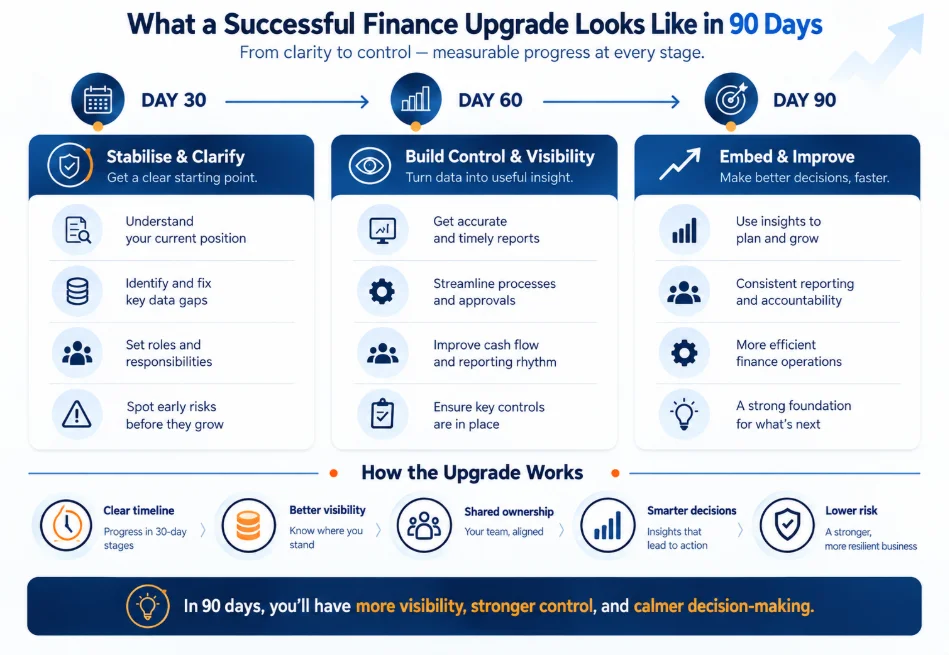
Done well, this change is smooth and barely noticed by the rest of the team. Done badly, it muddies who owns what. A short, clear plan keeps it clean.
Start by reviewing your current finance processes, systems, and any open issues. That way, you know what you are working with. Next, build a responsibility matrix. It sets out who owns bookkeeping, reporting, tax and approvals, with no overlaps and no gaps. Then, agree on who owns the month-end close and management reporting. And check who has access to banking, payroll, HMRC and Companies House.
After that, list all recurring deadlines and their corresponding review steps. Set a 30-, 60-, and 90-day plan so the change lands in stages rather than all at once. And keep things running throughout. Fix any old errors or reporting gaps as you go, rather than tearing everything up on day one.
What a finance manager should deliver every month
A good way to judge the role is by what it produces each month. A finance manager worth their place should deliver:
- Management accounts, produced to an agreed timetable
- Budget-versus-actual analysis, with clear reasons and next steps
- A rolling cash-flow forecast and short-term cash priorities
- Gross-margin and profitability analysis
- A debtor, creditor and working-capital review
- Tax provisions and an upcoming payment schedule
- A KPI dashboard built for decisions, not for show
- An up-to-date compliance calendar and responsibility list
- A monthly meeting with owners focused on actions, not just numbers
If several of these are missing, the role is not yet doing its job.
How to measure whether a finance manager will deliver value
Finance leadership is an investment. As with any investment, you judge it by its return. The fair comparison is outsourced support against the full cost of an employee, not just the headline salary.
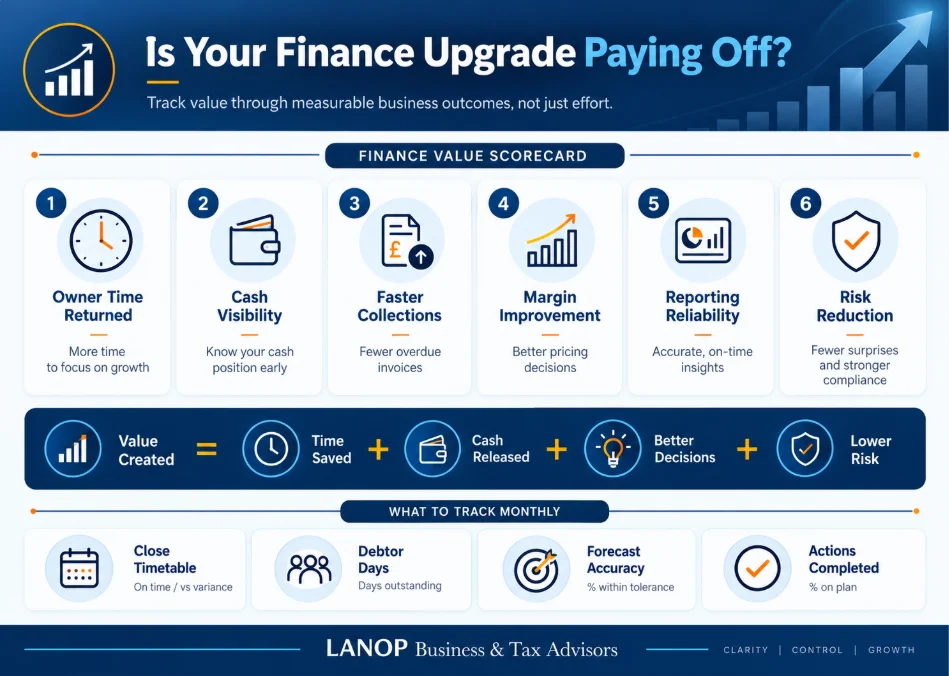
The true cost of an in-house hire is more than pay. It includes employer National Insurance, pension contributions, recruitment and cover for time off. Set that against what a finance manager creates. That means time is handed back to you and your team, faster debt collection, and better margins from sharper pricing and cost control. Add the penalties and poor decisions you avoid. Those rarely show up on an invoice, but they still hit the bottom line.
The habit that matters most is simple. Agree on what “better” looks like in numbers before you start, then review against it. That way, the value is there to see, not just assumed.
Recent HMRC and Companies House changes every finance function must prepare for
Part of the case for finance leadership is that the rules keep moving. Several recent changes affect how UK businesses report and file. And they reward the firms that plan.
Making Tax Digital for Income Tax
From 6 April 2026, sole traders and landlords with qualifying income over £50,000 must keep digital records and report to HMRC through compatible software, according to GOV.UK guidance. As GOV.UK sets out, the threshold then drops to £30,000 from April 2027, and to £20,000 from April 2028. These quarterly updates are short summaries of income and expenses, not four full tax returns. A final declaration follows after the tax year ends.
The joint filing service has closed
As GOV.UK confirms, the free HMRC and Companies House service that let firms file accounts and the Company Tax Return together closed on 31 March 2026. From 1 April 2026, you file with each body separately. And you need commercial software to file the Company Tax Return with HMRC.
Companies House identity verification
According to Companies House guidance on GOV.UK, identity checks became a must for new directors and people with significant control from 18 November 2025. Existing directors are verified during a 12-month window tied to their next confirmation statement. If a director has not verified, the confirmation statement cannot be filed. So, it pays to sort this early.
Software-only accounts filing is now paused
A move to software-only accounts filing at Companies House was planned for April 2027. It would also have removed abridged accounts for small companies. But as Companies House confirmed on GOV.UK in January 2026, these reforms will not go ahead on that date. They are under review, with at least 21 months’ notice promised before any change is made. The direction of travel is still digital, so it is wise to prepare. For now, though, no fixed date applies.
Whichever way these rules go, the responsibility stays with directors. Outsourcing the work does not outsource the blame. That is exactly why a managed process matters.
Protect the business by giving every filing and deadline a named owner
The most effective control is also the simplest. Every filing and deadline gets one named owner and one reviewer. A responsibility matrix removes the “I thought you had it” slip-ups that cause most late filings.
- Annual accounts with Companies House. According to Companies House, private companies file within 9 months of the accounting reference date. The first accounts are due 21 months after incorporation. Late-filing penalties for a private company range from £150 to £1,500. And they double if you file late for two consecutive years.
- Company Tax Return (CT600). Per HMRC guidance on GOV.UK, this is due 12 months after the end of the accounting period it covers.
- Corporation Tax payment. As GOV.UK sets out, firms with taxable profits up to £1.5 million pay Corporation Tax 9 months and 1 day after the accounting period ends. That falls due ahead of the return itself.
- VAT returns. Under GOV.UK’s standard VAT rules, the return and payment are normally due 1 month and 7 days after each VAT period ends.
- Payroll reporting (FPS and EPS). According to GOV.UK, a Full Payment Submission is due on or before each payday. An Employer Payment Summary is due by the 19th of the following tax month.
- Confirmation statement (CS01). As GOV.UK confirms, you file this at least once every 12 months, within 14 days of the end of the review period.
Alongside the matrix, agree on an escalation step. Decide what happens, and who gets told, when an adviser or team member misses a date. A named owner plus a review point turns compliance from a worry into a routine.
How Lanop helps you upgrade from bookkeeping to finance leadership
At Lanop, we start by reviewing your current bookkeeping, reporting, and compliance setup. Then we find where the control and decision-making gaps really sit. From there, we design a finance function that fits your stage, not a template borrowed from a much larger business.
We make the roles clear between the bookkeeper, finance manager, and accountant, so everyone knows their patch. We bring in management accounts, forecasts and KPI reporting. And we built a practical compliance calendar with a proper review step behind it. When a full-time hire is not yet warranted, we provide outsourced finance manager support and scale it as you grow.
Making the move
The five signs point to a threshold, not a failing. A business that has outgrown pure bookkeeping is usually doing well. The right response is to add finance leadership, not to lose the bookkeeping that got you here. Upgrading from bookkeeper to finance manager is how you keep control as you grow. It swaps last-minute reactions for clear, forward-looking decisions.
If any of these signs ring true, the next step is a short chat about where your finance function is now and where it needs to be. Talk to Lanop’s advisory team. We will review your current setup and give you a practical plan for the upgrade.
Frequently Asked Questions
Usually ACCA, ACA or CIMA, though plenty come up through the AAT route and learn on the job. What counts more is whether they can produce solid accounts, forecast cash, and turn numbers into decisions.
An accountant mostly looks back at statutory accounts, tax and compliance. A finance manager looks ahead, running your reporting, forecasting, and daily financial control.
In a small business, yes, and many do both early on. As you grow, it is cleaner to split the roles, so the bookkeeper records and the finance manager reviews and analyses.
Most work off Xero or QuickBooks, then add a reporting or forecasting tool for management accounts and cash flow. The tool matters less than getting accurate numbers and a clear view ahead.
For most sole traders, a bookkeeper plus an accountant for tax is plenty in the early years. The case for a finance manager grows as income gets lumpier, decisions get bigger or Making Tax Digital adds complexity.
Often, it is the ideal fit. You get proper finance leadership for a few days a month, at a fraction of a full-time salary, and can scale it up as the business grows.