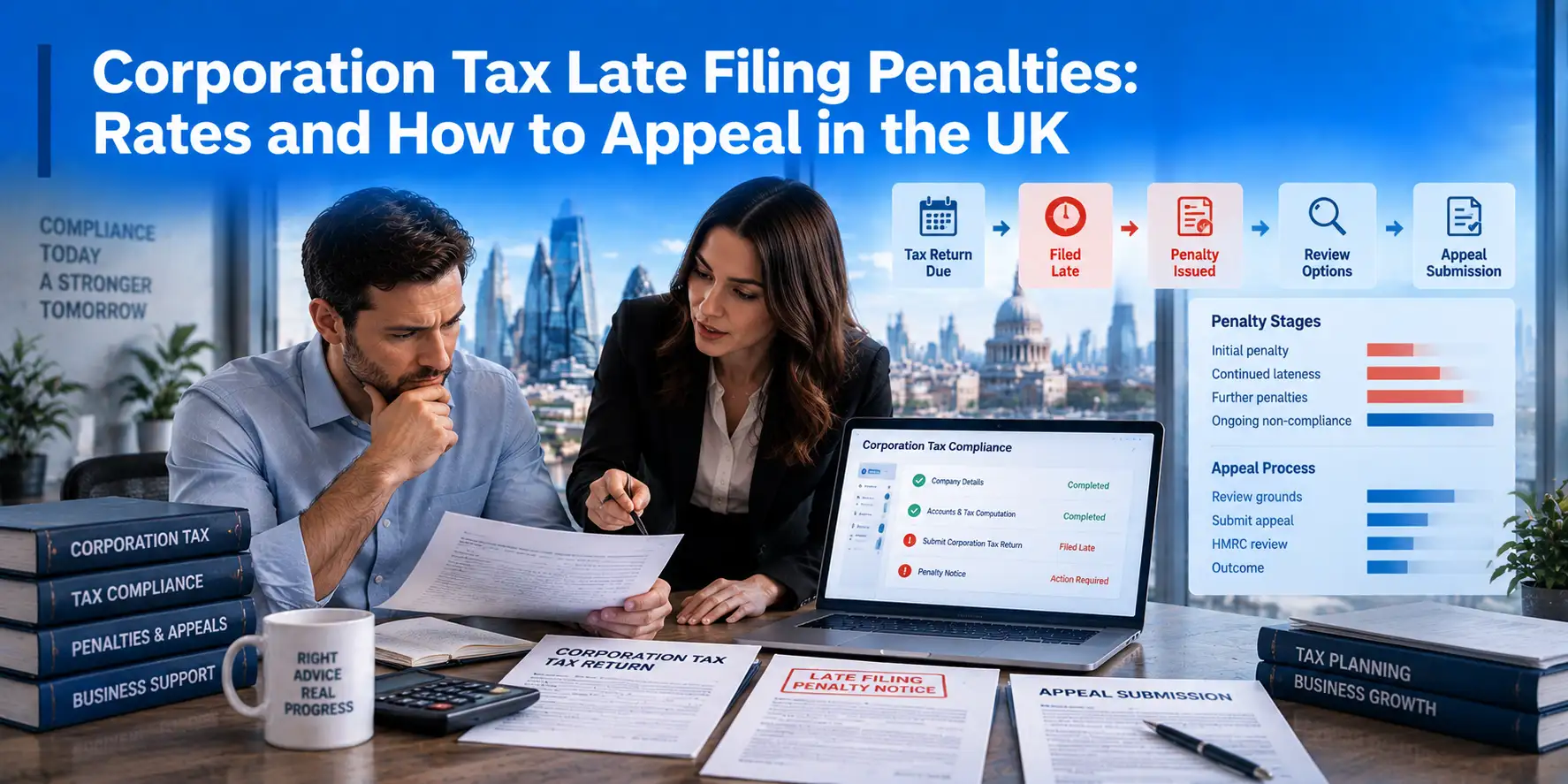
HMRC doubled its fixed corporation tax late filing penalties from 1 April 2026. A return filed one day late now costs £200. If a company files late for three consecutive accounting periods, the higher fixed penalties can rise to £1,000, or £2,000 where the return is more than three months late.
Some penalties can be appealed if there are valid grounds, but acting quickly is important. In this guide, we explain the 2026 penalty rates, when HMRC charges them, what counts as a reasonable excuse, how to appeal, what evidence to provide, and what to do if your accountant or filing software caused the delay.
Corporation Tax Late Filing Penalties in 2026
What Is the Corporation Tax Late Filing Penalty?
A corporation tax late filing penalty starts with a fixed charge when a Company Tax Return (CT600) comes in after its deadline. If the return remains outstanding, tax-related penalties can also apply after six and twelve months.
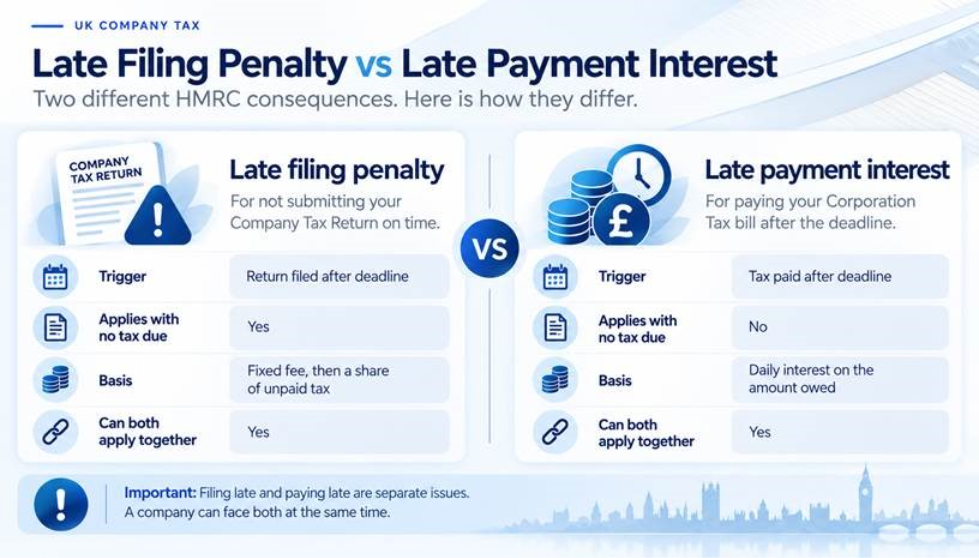
The fixed penalty applies whether Corporation Tax is owed. It is charged for filing the return late, while late payment is dealt with separately.
Who Can Get One?
Any company or organisation that HMRC requires to file a Company Tax Return can get a late filing penalty if it misses the deadline. This includes companies making a loss or with no Corporation Tax to pay, which is why keeping on top of bookkeeping throughout the year makes filing on time much easier.
Can You Be Fined If No Tax Is Due?
Yes. HMRC can charge a corporation tax late filing penalty even when no Corporation Tax is due. Loss-making firms and those with no tax to pay are not safe from this fine.
Can Dormant Companies Be Fined?
A dormant company can still be fined if HMRC has issued a notice requiring a Company Tax Return. Unless HMRC has agreed that no return is needed, the filing obligation stays in place.
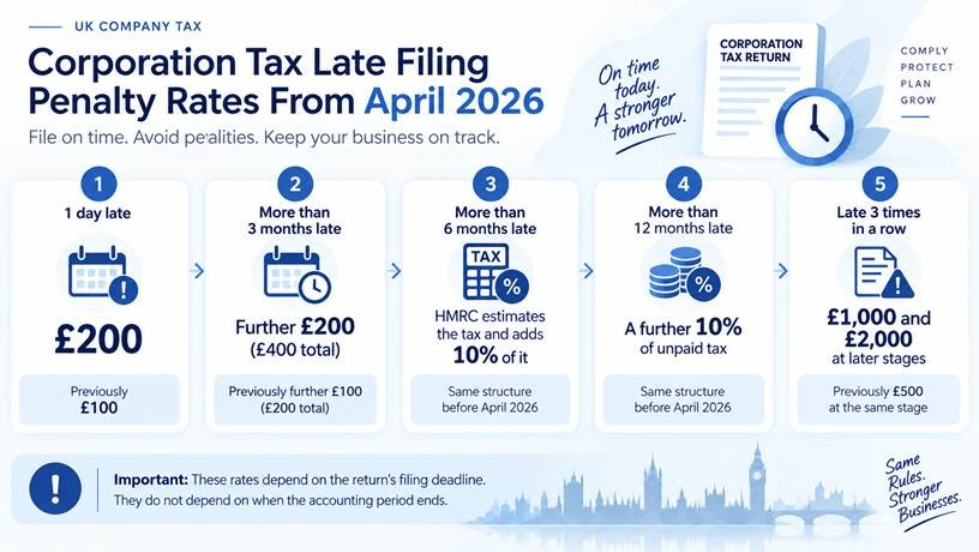
One Day Late
An immediate £200 fine applies as soon as the deadline passes.
After Three Months
A further £200 is added. This takes the late filing penalty for corporation tax total to £400.
After Six Months
HMRC estimates your Corporation Tax bill. This is called a determination. It also adds a penalty equal to 10% of the unpaid tax.
Once you file the actual return, HMRC recalculates the tax, interest and penalties using the correct figures.
After Twelve Months
A further penalty of 10% of the unpaid tax is added. This can take the tax-related late filing penalties to 20% of the unpaid tax, on top of the fixed penalties above.
Repeated Late Filing
If a company is late for three consecutive accounting periods, the fixed penalties increase. For the third consecutive late return, and later consecutive failures until a return is filed on time, the penalty is £1,000 if the return is up to three months late and £2,000 if it is more than three months late.
When Do the New Rates Apply?
The rise applies to returns with a filing deadline on or after 1 April 2026. The government announced the change at Budget 2025. HMRC says the penalties were originally set in 1998 and had lost around half their real-terms value through inflation, so the increase is intended to restore their original real-terms effect and encourage timely filing.
The filing date decides which rates apply, not when your accounting period ends. So, a period that closed in 2025 can still fall under the new rules. This happens if its filing deadline lands after 1 April 2026.
Corporation Tax Filing Deadline vs Payment Deadline
Paying on time does not save you from a filing fine. These are two separate duties.
| Duty | Deadline | Result if missed |
| File the CT600 | 12 months after the accounting period ends | Fixed and tax-based filing fines |
| Pay Corporation Tax | Usually 9 months and 1 day after the accounting period ends | Daily interest on late payment |
You can pay on time and still get fined for filing late. You can also file on time and still face interest if you pay late. One does not cancel out the other, so it helps to plan cash flow around both dates as part of wider tax planning.
Why Have I Received a Corporation Tax Late Filing Penalty?
I filed with Companies House: That filing is separate from HMRC’s CT600. It does not cover HMRC’s own filing rule.
My company made no profit: The fixed fine applies to the late filing itself. It does not depend on the tax owed.
My company is dormant: Being dormant only ends the duty once HMRC has agreed that no return is needed.
I thought my accountant had filed it: The company still holds the legal duty. But what you were told still matters when you appeal.
HMRC says my return was never received: Clicking submit doesn’t always mean HMRC received it. Rejections can happen with no clear warning.
I received two penalties: This can happen when your accounts cover more than 12 months. A Corporation Tax accounting period cannot be longer than 12 months, so you may need to file two Company Tax Returns covering the longer accounts period.
What to Do After Receiving a Penalty
- Check which accounting period it covers.
- Confirm the real filing deadline.
- Check whether HMRC took in your CT600.
- File any missing return right away.
- Check the penalty amount and reference number.
- Note the appeal deadline on the notice.
- Gather proof to back up your case.
- Decide, honestly, whether you have grounds to appeal.
An appeal will not always work. Be honest with yourself before you build one.
How to Appeal a Corporation Tax Late Filing Penalty
You can appeal a corporation tax late filing penalty in a few cases. Maybe HMRC got the sum wrong. The return may have been filed on time. Maybe HMRC used the wrong period. Or you have a reasonable excuse.
You normally have 30 days from the date on the penalty notice to appeal. If you still have not filed the return, file it first. HMRC’s current guidance says you must file your Company Tax Return before appealing a Corporation Tax late filing penalty.
Follow the appeal instructions on your penalty notice. GOV.UK provides a Corporation Tax late filing penalty appeal service, and the current process asks you to complete the appeal form and send it to the address shown on the form.
Your appeal should explain what happened and when. Explain how it stopped you from filing, and when the problem ended. Then show what your firm did next, and what proof backs each point.
What Counts as a Reasonable Excuse?
No fixed list guarantees success. HMRC considers each case on its own facts and asks whether something stopped you meeting the filing obligation despite taking reasonable care.
- Serious illness or a hospital stay, especially when it was sudden and well proven.
- A death in the family, especially close to the deadline.
- HMRC’s own online service breaking down, if you can show when it happened.
- A sudden software fault, though routine glitches you should have seen coming carry less weight.
- Fire, flood or theft, as long as you can prove it.
- Several small problems at once, where none alone was enough, but together they truly stopped you from filing.
A strong reasonable-excuse explanation should cover four points. What happened? When did it happen? How did it stop you filing? And how quickly did you act once the problem ended? Your proof should link each step.
Reasons That Rarely Work Alone
Simply forgetting the deadline or being too busy will not normally be enough on its own. Saying you did not know the filing date is also unlikely to succeed without stronger facts. Being short of cash for the tax bill does not excuse a late return, because payment and filing are separate duties.
Relying on someone else can sometimes be relevant, but HMRC looks closely at what happened and what reasonable steps the company took. That leads us to accountant error.
Can You Appeal If Your Accountant Filed Late?
Simple reliance on a slow or dilatory accountant is not normally a reasonable excuse on its own. But HMRC’s guidance recognises that reliance on someone else can sometimes be relevant, and incorrect or misleading advice may be considered. The outcome depends on the full facts and what the company reasonably did to meet the deadline.
If you gave your accountant everything on time, this helps your case. Emails, dated file transfers, and written promises all add weight.
If your accountant told you the CT600 had been filed, keep that proof. Written proof of this claim is a fact HMRC will weigh. It does not promise success, but it helps.
If your accountant fell ill or stopped replying, act fast. Contact HMRC as soon as you spot the problem. Build your own paper trail rather than waiting.
If you swapped accountants near the deadline, keep a clear handover record. Check the filing status straight with HMRC.
What Evidence Should You Include?
Useful proof includes several things. Medical or bereavement records. Emails with your accountant. Proof that files were sent on time. HMRC’s own receipt of your submission. Software logs. Screenshots of any errors. Proof of HMRC outages. Call reference numbers fire, flood or theft reports.
Strong proof shows what happened, and when. It shows how the event hit your filing, and what you did next.
I Submitted My CT600, but HMRC Says It Was Not Filed
When you submit a Company Tax Return online, HMRC should issue an acknowledgement of receipt. Keep that acknowledgement because it shows HMRC received the return. It does not mean HMRC has agreed that the figures in the return are correct.
If your software shows a rejection or error and you do not receive HMRC’s acknowledgement, fix the problem and resubmit the return.
Keep HMRC acknowledgements, receipt IDs, time stamps, software logs, rejection notices and any letters from your adviser. These matter if HMRC later says a return was not filed.
Can You Appeal After the 30-Day Deadline?
A late appeal is one made after the normal window. HMRC can accept a late appeal where there was a reasonable excuse for missing the appeal deadline and the appeal was made without unreasonable delay after that excuse ended. This is separate from the reason the return itself was late.
Filing any missing return will still help your case.
What Happens If HMRC Rejects Your Appeal?
You can ask HMRC for a statutory review of your case. A review officer from a different team looks at the decision. HMRC says reviews usually take 45 days, although they can take longer.
You may also be able to take the appeal to the First-tier Tribunal. For direct tax, the usual route starts with an appeal to HMRC. After that, you can request a review or notify the tribunal at the appropriate stage. If you accept a review, you normally need to wait for the review outcome before going to the tribunal.
The exact route and deadline depend on your decision letter. Follow what your own letter says.
Should You Pay While Appealing?
You may be able to ask HMRC to delay payment of some or all of the disputed amount while an appeal or review is in progress. For direct tax, HMRC says you normally have 30 days from starting the appeal or review process to ask for payment to be delayed.
HMRC will tell you in writing whether it agrees. Interest can continue to build on disputed tax until it is paid, and other late payment charges may still apply.
A Time to Pay arrangement is separate from an appeal. It deals with how an amount is paid, not whether the penalty or tax decision is correct.
What Happens If You Do Not File?
Once a return is more than six months late, HMRC can send a tax determination. This is its own guess at what you owe. You cannot appeal a determination itself. The only way to replace it is to file your real return. If HMRC’s guess looks too high, act fast. Filing soon lets HMRC work out your true tax, interest and fines. In more serious or drawn-out cases, this can develop into a full HMRC tax investigation, so specialist support is worth considering.
HMRC’s current Corporation Tax late payment interest rate is 7.75% a year from 9 January 2026. This rate can change, so check the current figure on GOV.UK before you rely on it.
Are Corporation Tax Late Filing Penalties Tax Deductible?
No. Many people ask if corporation tax late filing penalties are allowable as a deduction. HMRC’s guidance is clear that penalties for breaches of the law are not allowable deductions. They should therefore be added back when calculating taxable profits.
Late payment interest on Corporation Tax works differently. HMRC says that interest is tax deductible for Corporation Tax purposes and can be included in the company’s accounts for the period in which it was incurred.
Companies House Penalties vs HMRC Corporation Tax Penalties
Company accounts go to Companies House. The CT600 goes to HMRC. These sit under two separate sets of law.
You can get fined by both at once. Companies House late-filing fines can reach £1,500 for a private firm. This doubles if you file late two years in a row, and it runs apart from any HMRC fine.
Filing with one body never covers the other. Track both dates separately in your calendar.
2026 HMRC Update on Penalty Notices
HMRC temporarily paused some automatic Corporation Tax late filing penalty notices in 2026 while it updated its systems for the new rates. In August 2026, HMRC confirmed that the system updates were complete and automatic notices had resumed.
If you filed late but have not received a notice yet, that does not mean the penalty has gone away. HMRC says companies remained liable during the pause, and some notices may arrive later than usual.
Common Misconceptions
- There is no grace period. Fixed fines start from one day late.
- No tax due does not mean no fine.
- Paying the tax does not remove the need to file.
- Companies House filing does not cover HMRC.
- An accountant’s error does not shield the firm on its own.
- Keep HMRC’s acknowledgement of receipt. A software submission on its own is not the same as having evidence that HMRC received the return.
- No letter yet does not mean there is no fine.
- You can still try to appeal after 30 days.
How to Avoid These Penalties
Track filing and payment dates separately. Start your accounts early. Do not rely only on HMRC’s own reminders. Check that HMRC has received your CT600. Keep every receipt.
Check in on your accountant’s work as you go. Raise any hold-ups before the deadline hits. Keep tidy records all year round, a task made far easier with solid small business accounting support.
Conclusion
If a return is still missing, file it now rather than wait. If the fine looks wrong, check the dates and your proof of filing first. Do not assume HMRC made a mistake without checking.
If you had a real, reasonable excuse, gather your proof. Appeal within 30 days. If your accountant caused the problem, write down exactly what happened. Note what your firm did in response.
If the appeal deadline has passed, think it through with a clear head. Ask whether a late appeal, with a fair reason for the delay, stands a real chance. If HMRC has already turned down your appeal, the review and tribunal routes are still open.
If your case involves several fines, a determination, or a dispute over filing, expert help is well worth it.
Have you received a Corporation Tax late filing penalty? Did HMRC get the sum right? At Lanop, our team of accountants can help. We can check your filing position, identify any missing Corporation Tax Returns, and assess your real chances of appeal. We can also help you deal with HMRC with more confidence. Contact our team today to work out the right next step for your business.
Frequently Asked Questions
£200 from one day late and another £200 after three months. At six months, a 10% penalty can apply to unpaid tax, with another 10% at twelve months. Higher £1,000 and £2,000 fixed penalties can apply after repeated consecutive late filing.
Yes, if you have valid grounds. This can include a reasonable excuse or a penalty that HMRC has calculated incorrectly.
Possibly. Simple reliance on an accountant is not normally enough by itself, but the result depends on the facts, including any incorrect or misleading advice and the steps the company took to file on time.
You can ask HMRC for a statutory review, or take the appeal to the First-tier Tribunal at the appropriate stage. HMRC says reviews usually take 45 days.
Yes. Interest is about late payment, and the fine is about late filing. Both can apply at once.