
Germany’s 15% corporate tax rate is not what your company will pay. It is only the headline figure.
Add the solidarity surcharge and local trade tax, and the German corporate tax rate most companies face typically lands between 25% and 33%, depending on the town. On €100,000 of profit in a town with a 400% trade tax multiplier, a GmbH pays €29,825, not €15,000.
For UK owners, the surprises do not stop there. Finanzamt registration, filing deadlines, VAT, and double-tax rules all change what you owe.
This guide explains what you may pay, which rules apply to your situation, and what to do next. It reflects the rules in force in October 2026.
What Is the German Corporate Tax Rate in 2026?
The German corporate tax rate in 2026 has three parts. There is a 15% federal corporate income tax. A 5.5% surcharge applies to that tax. And there is a local trade tax. Together, they usually add up to about 30% of profit.
Corporate Income Tax, Solidarity Surcharge and Trade Tax
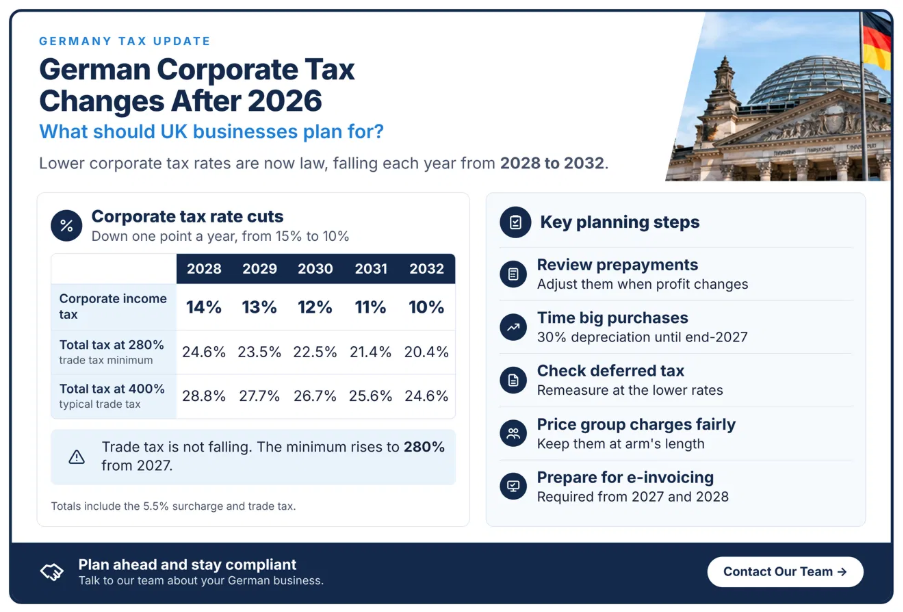
The German corporation tax rate is known as “Körperschaftsteuer”. German corporation tax rate is 15% of taxable profit. The tax rate, including surcharge, is 15.825%, according to PwC Tax Summaries. This rate is already set to fall by one point a year from 2028, reaching 10% in 2032.
“Solidaritätszuschlag” solidarity surcharge is 5.5% of the tax and not the profit. This is the reason why 15% turns into 15.825%.
“Gewerbesteuer” is a municipal tax set by your town and charged on profit, not sales. VAT is the tax on sales, which we cover in a later section.
The headlines of German corporation tax rate mention only 15%. That is only the first step.
Why the Total Tax Rate Can Approach 30%
You cannot deduct trade tax from your corporate income tax base. So, the two taxes stack. The local multiplier decides how high the total goes.
| Trade tax multiplier | Trade tax rate | Total tax rate* |
| 200% (legal minimum in 2026) | 7% | 22.825% |
| 280% (legal minimum from 2027) | 9.8% | 25.625% |
| 400% | 14% | 29.825% |
| 475% (Cologne) | 16.625% | 32.45% |
*Corporate income tax and solidarity surcharge (15.825%) plus trade tax.
The multiplier examples come from Pandotax. Deloitte puts the average combined burden at about 30%. These German corporate tax rates are examples, so check your own town.
How Much Tax Does a GmbH Actually Pay in Germany?
Here is a quick answer to how much tax a GmbH pays in Germany. On €100,000 of taxable profit and a 400% multiplier, the company pays €29,825. It keeps €70,175.
Example: German Corporate Tax on €100,000 Profit
| Tax | Calculation | Amount |
| Corporate income tax | €100,000 × 15% | €15,000 |
| Solidarity surcharge | €15,000 × 5.5% | €825 |
| Trade tax | €100,000 × 3.5% × 400% | €14,000 |
| Total | €29,825 | |
| Profit left in the company | €70,175 |
This example assumes both tax bases equal €100,000. It leaves out shareholder taxes.
Why the Actual Tax Bill May Differ
Real bills rarely match the example. Trade tax adds back part of some costs, such as interest, rent, and license fees. Loss carry forwards have limits. Dividends from other companies can be largely exempt.
Treat the example as a starting point. Your adviser can adjust it for your numbers, ideally as part of wider tax planning.
How Does German Trade Tax (Gewerbesteuer) Work?
Here is German trade tax Gewerbesteuer explained in three steps. First, the Finanzamt works out your trade profit. Second, it multiplies that profit by 3.5%. Third, your town applies its own multiplier (Hebesatz) and sends the bill.
On €100,000, step two gives €3,500. At a 400% multiplier, the tax is €14,000.
How Municipal Trade Tax Rates Are Calculated
Each town sets its own multiplier. Until the end of 2026, the legal minimum is 200%. That changes in 2027. The new law, published on 2 July 2026, raises the minimum to 280% from the 2027 tax year, as the Haufe summary of the law confirms. The goal is to stop firms from moving their seat on paper to low-tax towns.
If your town already charges more than 280%, nothing changes. If it charges less, your bill goes up. On €100,000 of profit, 200% costs €7,000. At 280%, you pay €9,800.
Why Business Location Changes the Total Tax Cost
A low multiplier looks attractive. But tax is only one factor. Consider where your staff, customers, and suppliers are. Also consider office costs and hiring.
A seat with no real activity can also raise questions with the authorities. Pick a location you can back up with genuine operations, and our business setup in Germany service can help you weigh the options.
Does a UK Company Have to Pay Corporate Tax in Germany?
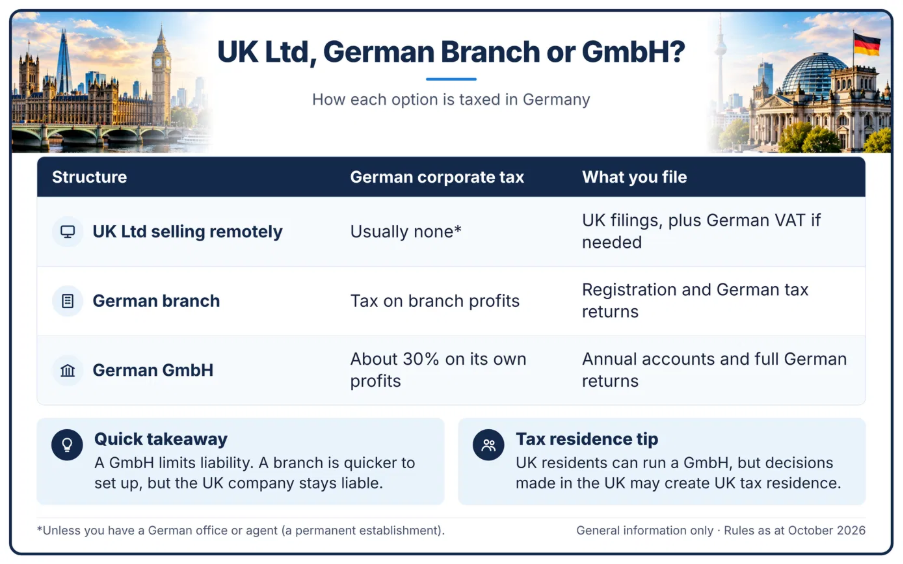
Not just because it sells to German customers, German corporate tax usually applies in three cases. The company is tax resident in Germany. It has a permanent establishment there. Or it earns certain German source income.
If your UK company only sells to German clients, your position may differ from a company with a German office. Let us look at both.
Selling to German Customers vs Having a Permanent Establishment
Remote sales with no German presence usually do not create German corporate income tax.
A permanent establishment is a fixed place where you do business. Think of an office, a shop or a workshop. A person in Germany who regularly signs contracts for you can also create one. An employee working from a home office in Germany needs a careful check.
Before you set up a GmbH, check whether your UK company already has a German taxable presence.
How Do UK Businesses Register with the Finanzamt and ELSTER?
The Finanzamt is your local German tax office. Your company’s location decides which one handles your file. Think of this as an ELSTER tax portal UK business owner guide in short. You register, send a questionnaire, and get tax numbers. Then you file online.
Finanzamt Registration and German Tax Numbers
Finanzamt registration for a UK business in Germany starts with the tax registration questionnaire (Fragebogen zur steuerlichen Erfassung). You send it online. It asks about your activity, expected profit, shareholders, and managers.
The Finanzamt then issues your tax number (Steuernummer). You get a German VAT number (USt-IdNr.) separately once you register for VAT. Do not mix the two up on invoices.
Using the ELSTER Portal to Register and File Taxes
ELSTER is Germany’s official online tax portal. You open an account at elster.de. An activation code normally arrives by post. That can take weeks abroad, so start early.
Common problems include:
- Sending forms to the wrong Finanzamt.
- Company names that do not match the commercial register.
- Losing the activation letter.
- Expecting the portal to be fully in English.
A sent form is not a final decision. It only shows the Finanzamt received your data. The decision arrives later as a tax assessment notice (Steuerbescheid). You normally have one month to object, so read every notice when it arrives.
Your next steps are simple. Confirm your Finanzamt. Gather your registration papers. Open your ELSTER account. Consider hiring a German tax adviser (Steuerberater) for your first filing.
German VAT Registration and Filing Requirements in 2026
VAT is a tax on sales, not profit. The standard German rate is 19%. The reduced rate is 7%. VAT has its own rules, separate from corporate tax, much like the VAT return obligations UK businesses already manage.
When Does a UK Business Need German VAT Registration?
It depends on what you sell and where it goes. If you store stock in Germany or sell goods to German consumers, you will probably need to register. Meridian notes that non-resident sellers face no registration threshold.
If you sell services to German businesses, the customer often pays the VAT under the reverse charge. You may not need to register. Check each income stream on its own.
VAT Returns, Reverse Charge and E-Invoicing Rules
Your filing schedule depends on last year’s VAT bill. Stripe’s guide explains the bands. If you’re above €9,000, you file monthly. Between €2,000 and €9,000, you usually file quarterly. Below €2,000, you can apply to be exempted from these advance returns. You also file an annual return. A quarterly VAT registration for a Germany-UK business is not automatic. For businesses founded up to the end of 2026, the Finanzamt sets your filing frequency from the VAT you forecast in your registration questionnaire. Returns are generally due on the 10th after the period ends.
Electronic invoicing is also changing. Since 1 January 2025, German businesses must be able to receive structured electronic invoices. Issuing them becomes mandatory on 1 January 2027 for firms with prior year sales above €800,000. It applies to all firms from 1 January 2028. Maro VAT reports that foreign sellers with a German VAT number but no fixed base in Germany are not covered. A German GmbH is covered.
German Corporate Tax Returns, Accounts and Payment Deadlines
A GmbH files corporate income tax, trade tax and VAT returns. It also prepares annual accounts, which is far easier with reliable bookkeeping in place. Each task runs on its own clock.
Corporate Tax Returns and Advance Payments
For the 2025 tax year, you must file by 31 July 2026 if you do it yourself. With a tax adviser, the deadline is 1 March 2027 because 28 February falls on a Sunday. Norman Finance lists 2 August 2027 and 29 February 2028 for the 2026 year.
The Finanzamt also collects quarterly prepayments. It bases them on your last assessment. Ask for a change if your profit moves.
Annual Financial Statements and GmbH Reporting Requirements
Every GmbH must prepare annual accounts and publish them. Small GmbHs must prepare their accounts within six months of the year-end, and medium and large GmbHs within three months. The accounts must then be published within twelve months of the year-end. For a 31 December 2025 year-end, the publication deadline is 31 December 2026. Your tax return also includes a standard electronic balance sheet.
| Item | Deadline |
| Corporate and trade tax return, 2025 | 31 July 2026, or 1 March 2027 with an adviser |
| Corporate tax prepayments | 10 March, 10 June, 10 September, 10 December |
| Trade tax prepayments | 15 February, 15 May, 15 August, 15 November |
| VAT returns | 10th after the month or quarter |
| Annual accounts publication | Within 12 months of year-end |
A dormant GmbH is not exempt. It generally keeps filing until it is closed and removed from the register.
What Happens If a German GmbH Files or Pays Taxes Late?
Three kinds of penalties can apply. Late filing, late payment, and late publication of accounts are separate problems. Different offices handle each one.
Penalties, Interest and Director Liability
For late tax returns, the Finanzamt can add a late filing surcharge. Norman Finance cites 0.25% of the assessed tax per month started, with a minimum of €25 for each month started. Unpaid tax can also incur interest and late-payment charges.
The Federal Office of Justice handles late annual accounts. An IHK Aachen guide says it sends a notice with a six-week window. Fines then run from €2,500 to €25,000. Filing late does not cancel a fine on its own.
Limited liability protects shareholders. It does not remove a director’s legal duties. Under German director liability rules for late filing, a director can be personally liable for unpaid tax if the failure was intentional or grossly careless. Take every notice seriously.
How Does the UK and Germany Double Taxation Treaty Work?
A UK-Germany double tax treaty business question usually starts with one worry. Will the same profit be taxed twice? The treaty aims to prevent that. But you often must claim relief and meet its conditions.
When Can Both Countries Tax Business Profits?
Germany can tax the profits of a German GmbH. It can also tax the profits of a UK company that belong to a German permanent establishment. The UK taxes UK resident companies on their worldwide profits, unless an exemption applies. So, both countries can claim the same income.
How Treaty Relief and Permanent Establishment Rules Apply
Treaty relief is not automatic. You must be eligible. The facts must fit the treaty’s definitions. And you must claim relief the right way.
Here is an example. A Manchester company opens a Berlin office. Two employees there negotiate and sign contracts. That likely creates a permanent establishment. Germany taxes the office’s profit at about 30% in total.
The UK also taxes the company’s profit, but it can give credit for the German tax. The credit is generally capped at the UK tax on the same income. The UK main rate is 25% for profits above £250,000. If German tax is higher, the extra is a real cost. A UK election to exempt foreign branch profits may also be an option, so ask your adviser, and a group structuring review can help you compare the routes.
How Are German GmbH Dividends Taxed for UK Owners?
The GmbH has already taxed the profit once. Paying it out to owners adds a second layer of tax.
German Dividend Withholding Tax and UK Shareholders
Germany withholds 25% plus a 5.5% surcharge. That equals 26.375%. The UK-Germany treaty can cut this. An InHouse Lawyer summary lists 5% for a company that directly holds at least 10% of the payer. It lists 10% for pension schemes and 15% in other cases.
Germany usually withholds the full amount first. You then claim the extra back from the Federal Central Tax Office (BZSt). Refunds can take months, so plan your cash flow. Some company shareholders can apply for an exemption certificate in advance.
Individual and company owners follow different rules. A UK company shareholder may qualify for UK dividend exemptions. A UK resident individual normally reports the dividend in the UK and claims credit for German tax paid. Confirm your own position.
Salary vs Dividends for UK-Based GmbH Directors
No single option wins every time. Salary may be deductible in the GmbH, but it can bring payroll and social security questions. Dividends bring withholding tax and UK tax. Where you live and work matters, and so does the treaty.
How Lanop Helps UK Businesses Manage German Corporate Tax
Lanop is a UK-based financial and accounting organization. We focus on practical guidance. We help you understand your cross-border tax exposure and prepare for German duties. We also help you weigh your expansion options before you commit.
Frequently Asked Questions About German Corporate Tax
The federal corporate income tax rate is 15%. A 5.5% surcharge brings it to 15.825%. Local trade tax comes on top. The total is commonly about 30%, depending on your town’s multiplier.
Assume €100,000 of taxable profit and a 400% trade tax multiplier. The GmbH pays €15,000 in corporate tax, an €825 surcharge, and €14,000 in trade tax. That totals €29,825. The company keeps €70,175 before shareholder taxes.
Yes. A UK company can sell into Germany remotely or open a branch. Its German tax position depends on whether it has a permanent establishment. VAT may apply as well. Check your activities before you pick a structure.
Generally, yes. UK residents can usually act as managing directors. The risk is dual tax residence if you run the company from the UK. Keep records of where decisions are made and seek advice.
It can reduce or eliminate double taxation, but relief isn’t automatic. You must meet the treaty’s conditions and claim relief correctly, through credit or exemption. The result depends on your structure and facts.
The Finanzamt may add a late filing surcharge and interest. Late accounts can bring fines from the Federal Office of Justice. In serious cases, managing directors can be personally liable. Act on any notice quickly.
Conclusion: What Should UK Businesses Do Before Paying German Corporate Tax?
Your next step depends on where you stand today.
If you only sell to German customers, first check your real corporate tax and VAT exposure. If you plan an office or staff in Germany, compare a branch with a GmbH and test for permanent establishment risk, and our business setup in Germany team can walk you through both options.
Existing GmbH owners should review their tax figures, deadlines, and prepayments. UK resident shareholders should model dividend tax and treaty relief before taking money out. If you have missed a deadline or received an unexpected notice, act now.
Not sure which group you belong to? Contact Lanop to book a free consultation, talk through your UK and Germany tax position and agree a clear next step.