
HM Revenue and Customs (HMRC) introduced a new online application process for non-statutory VAT clearances on 19 November 2026. The tax authority has withdrawn Annex D, the checklist previously used to submit VAT clearance requests.
Businesses and tax agents must now apply through the GOV.UK online service. The Chartered Institute of Taxation (CIOT) confirmed the change on 20 November 2026. HMRC’s response times and service standards remain unchanged.
What Has Changed in HMRC’s VAT Clearance Process?
The new online form replaces the previous email-based application process. Businesses must sign in to submit their requests. The change only affects VAT clearances. Application procedures for other taxes remain unchanged.
| Application requirement | Previous process | New process |
| Submission method | Online form | |
| Annex D checklist | In use | Withdrawn |
| Online sign-in | Not required | Required |
| Usual response time | 28 days | 28 days |
| Email follow-ups | Available | Available |
Who Can Apply for Non-Statutory VAT Clearance?
Businesses can seek written advice from HMRC when they are unsure how VAT law applies to a specific transaction.
They must first check existing HMRC guidance. If the guidance does not resolve their question, they can apply for clearance.
HMRC does not provide this service simply to confirm a tax position.
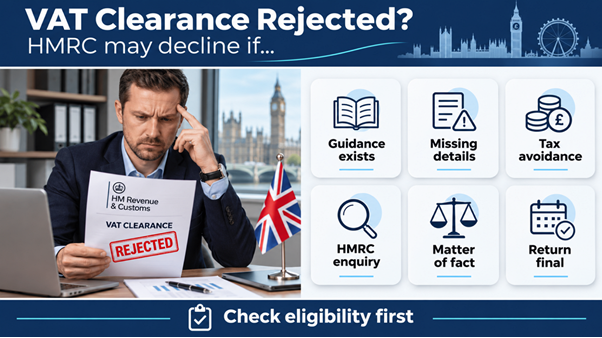
When Can HMRC Reject a VAT Clearance Application?
HMRC may decline a request if:
- Existing guidance already answers the question.
- The application lacks key information.
- The request involves tax avoidance.
- The matter is already under HMRC enquiry.
- The question concerns matters of fact.
- The relevant tax return is final.
Businesses should check their eligibility before applying.
How Long Does HMRC Take to Process VAT Clearances?
HMRC usually responds within 28 days. Cases involving complex VAT issues may take longer.
If HMRC asks for further information, applicants must respond within 30 days. Failure to reply within this period may lead to the closure of their application.
These timeframes remain unchanged under the new online process.
What Happens If VAT Deadlines Fall Before HMRC Responds?
A clearance application does not extend VAT filing or payment deadlines. Businesses must file their returns and pay their tax on time to avoid potential penalties and interest.
If HMRC’s advice differs from the VAT treatment used, businesses can amend their returns within the permitted time limits.
A clearance only applies to its recipient. Businesses can rely on the advice when their information is complete and accurate, and the transaction takes place as described. Certain VAT decisions may also carry appeal rights.
How Should Businesses Prepare for the New VAT Clearance Process?
Businesses should stop using old Annex D templates and prepare their transaction details, relevant VAT laws, supporting documents and reasons for seeking advice.
Tax agents should check their client authority before applying.
New requests must go through the HMRC online VAT clearance service. Applicants can still follow up by emailing nonstatutoryclearanceteam.hmrc@hmrc.gov.uk.
How LANOP Can Help Businesses with HMRC’s New VAT Clearance Process
At LANOP Business & Tax Advisors, we assist companies in the UK with understanding the VAT system and fulfilling their tax responsibilities. Our team will evaluate your VAT queries and determine whether the non-statutory clearance would be appropriate in your case.
We can assist in preparing the necessary documents, checking transactions, and helping you complete the online application to HMRC. We can assist businesses in fulfilling their obligations regarding the VAT declaration and payment while waiting for HMRC’s instructions.
The main priority of our work is providing our clients with competent tax advice, proper reporting, and timely fulfillment of tax requirements. Contact LANOP and let us help you solve your VAT queries.