

Checking your money once a year is risky. The UK market moves fast. Founders who only read yearly accounts fall behind. Lots of things shift your cash, such as late payments. Rising costs. New digital tax rules, like Making Tax Digital. So, you need to watch the numbers more often.

Look at your margin, debtor days, and runway each month. This is how you survive and grow. A simple monthly dashboard helps you spot chances early. It helps you catch small leaks before they get big. And it gives you the facts to make good calls on hiring, pricing, and spending. You stop waiting for the year-end to tell you what went wrong.
Why Should Founders Track Financial KPIs Every Month Instead of Waiting for Year-End Accounts?
Year-end accounts only show what has already happened. By the time you see them, the year is over. The choices are made. Any problem they flag is months old. It’s like driving while you stare in the mirror.
Monthly tracking is different. You see trends as they form. You can still act on them. That shift, from looking back to managing now, is what sets our planners apart from firefighters.
How Monthly Tracking Improves Your Decisions
Old data is risky to act on. Say your gross margin dropped in March. You want to know in April. Not next January, when your accountant files the official accounts.
Monthly KPIs give you a quick feedback loop. You change the price. You hire a salesperson. You agree to the new terms with a supplier. Within weeks, you can see if it worked. This closes the gap between action and proof. That gap is where good judgment grows. Over time, you stop guessing. You start steering.
The Difference Between Financial and Non-Financial KPIs
Financial KPIs measure money. Think about sales, margin, cash, and the ratios that tie them together. They are lagging signs. They tell you how the business has done in pounds and pence.
Non-financial KPIs measure the activity behind that money. Things like customer loyalty, conversion, happiness, and how busy your team is. These often move first, before the money shows up. A founder who watches only the money sees the result. But they miss the cause. The two work together. We came back to that later.
Why Monthly Management Accounts Matter for UK SMEs
Year-end accounts are a compliance job. They keep Companies House and HMRC happy. But they were never built to help you run the business day to day.
Management accounts are different. You prepare them monthly. You shape them around your business. They are built to guide choices, not file a return.
For a UK SME, these accounts are the engine behind good KPIs. Without them, your numbers are just guesses. With them, every KPI sits on clean data you can trust. Not making them yet? That’s your first decision. Good KPIs need a good source.
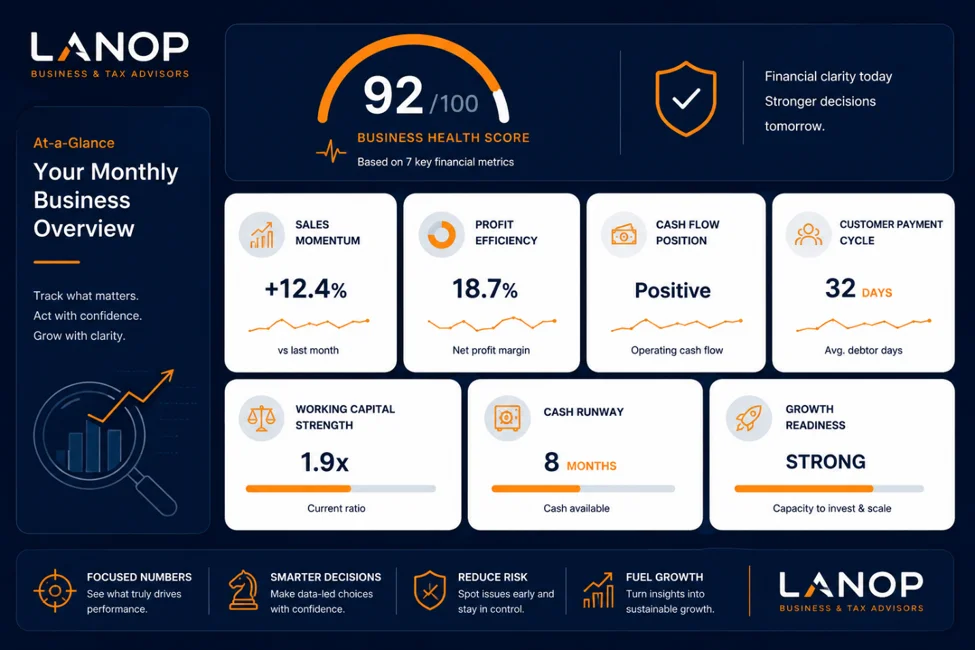
Which 7 Financial KPIs Should Every Founder Track Monthly?
You could watch dozens of metrics. Tracking all of them is just noise. The seven below keep it simple. They give you a clear, honest view of how you’re doing, how much cash you have, and whether you’ll survive.
1. Revenue Growth Rate
The revenue growth rate shows how quickly your sales rise or fall. You compare one period with the last. You write it as a percentage. Look at it month on month and year on year. Each view tells you something different.
Growth rate is the pulse of a scaling business. A steady rise makes hiring, funding, and forecasts easier. A flat or falling trend is a warning. Check the health of the business before it hits your bank.
Here’s the part founders often miss. What sits behind the number matters. Growth from heavy discounts is not the same as growth from real demand. So, read “growth” next to “margin,” which we cover next. That tells you whether you’re growing profit or just getting busier.
2. Gross Profit Margin
The gross profit margin is the slice of sales left after direct costs. For a product business, that’s the cost of goods. For a service business, it’s the people and tools to do the work. This is where pricing problems hide.
A slipping margin usually means one of three things. Your prices have not been kept up with costs. Your supplier prices have crept up. Or your delivery has become less efficient.
Track it monthly, and the trend shows up early. Then you can talk to suppliers, adjust prices, or tighten delivery schedules. You fix it before it hits the bottom line. Leave it to year-end, and the problem has had twelve months to grow.
3. Net Profit Margin
Net profit margin is what’s left after all costs are deducted. That includes overheads, salaries, and taxes. It shows how much of each pound you keep.
Sales can flatter you. It’s the number founders love to share at events. But it says nothing about whether the business works. A company can post big sales and still lose money on every order.
Net margin cuts through that. It forces an honest look at all your costs. It shows if the business really makes money. If sales climb while net margin falls, you’re getting bigger and weaker at once. That’s exactly the trend monthly tracking is built to catch.
4. Operating Cash Flow
Operating cash flow is the real cash your core business makes from trading. It comes before financing and investment. It cuts past the accounting tweaks. It shows what moved in and out. Profit is an opinion shaped by accounting choices. Cash is a fact.
A business can look good on paper and still struggle to pay staff. Why? Because profit counts sales, you’ve invoiced but not yet collected. This is the most useful thing a founder can learn. Cash flow tells you if the business funds itself or leans on its overdraft. We cover the profitable yet broken trap later. It ends more good businesses than weak sales ever do.
5. Debtor Days (Accounts Receivable Days)
Debtor days show how long customers take to pay you. It runs from the invoice to cash in the bank. A figure of 45 means you wait about six and a half weeks. That’s for work you’ve already done. Every day, a customer holds your money; you fund their business, not yours.
Rising debtor days drain your working cash. And the faster you grow, the more it hurts. Late payment is a long-running problem for small UK firms. The Federation of Small Businesses, in its 2025 Late Payments Report, found most small firms had been paid late in the past three months.
New Rules Are Coming for Late Payers. Late payers are about to be squeezed. The government in March 2026 announced its toughest campaign against late payments in more than 25 years, and imposed a six-month time limit on payments, while the worst payers were highlighted in their own annual reports, and powers were handed to the Small Business Commissioner. For founders, it’s a two-way street. Payment terms for big customers are even tighter, and their payment history is more prominent. The answer is the same regardless; watch your debtor days monthly and know just who owes you and how long.
Furthermore, a growing company is more at risk. It puts more work on credit each month. Watch debtor days monthly, and you’ll see when collections slip. Then you can tighten terms, chase sooner, or pause work for repeat late payers. You act before the gap eats your cash.
6. Working Capital Ratio
This ratio weighs what you own and is owed against what you owe soon. It asks a blunt question. Can the business cover the next twelve months of bills with what it has? The ratio well above one, looks stable. A ratio near or below one is a warning. It means what you owe is outrunning what you have to pay for it.
For a founder, the trend is gold. A ratio that drops month after month flags rising risk. And it flags it well before you miss a payment. It’s one of the clearest early signs that growth is eating too much cash. It pairs neatly with the cash runway, which is next.
7. Cash Runway
Cash runway is the number of months you can keep going before cash runs out. You work it out from your cash balance and your average monthly burn. It’s the survival number. For a young or fast-growing business, it’s the gap between a calm fundraiser and a panicked one.
Three months left? That’s a crisis. Nine months? That’s a plan. Track the runway monthly, and you buy yourself time. Time to raise money, cut costs, or collect faster. You do it on your terms, not under pressure. This number should catch our attention. Monthly tracking makes sure they’re not.
How Do These KPIs Help You Plan for Growth Instead of Reacting to Problems?
Moving from reacting to planning is the real win. On its own, each KPI is a snapshot. Put them together, month by month, and you get a forward view. It shows where you are. It also shows where you’re heading.
Spotting Growth Early
Trends show up before totals do. Maybe one product line has a rising margin. Maybe one customer group is growing fast. Maybe a service is getting cheaper to deliver. These patterns appear in monthly data. They show long before year-end reports.
That early view lets you lean in while the chance is fresh. The founders who spot the signal first get to act first.
Making Big Decisions with Confidence
Big choices need solid numbers behind them. Think about hiring a senior salesperson, taking bigger premises, or buying more stock. Each one rests on guesses about cash, margin, and growth.
Track these KPIs monthly, and those guesses firm up. You can model how a new hire affects your runway. You can weigh an expansion against your working capital. You can time the move to your cash flow. The numbers turn a leap of faith into a careful step.
Using KPIs and Planning Together
KPIs are not a scoreboard you glance at and forget. They pay off when they feed straight into your planning. Run a monthly review. Let each number shape the next choice. That’s what turns reporting into strategy.
This is what separates firms that scale on purpose from those that scale by luck. The data sits in every business. The only question is whether anyone uses it to look ahead.
What Is the Most Common Financial KPI Mistake UK Business Owners Make?
One mistake comes up more than any other. And it’s rarely the one founders expect.
Chasing Revenue While Ignoring Cash Flow
Sales are tempting. They’re easy to see and fun to celebrate. So, founders track sales closely and let cash flow slip. That’s the wrong way around. Sales tell you the business is wanted. Cash flow tells you it will survive. Put all your focus on the top line, and cash warnings go unnoticed. By then, they’re urgent.
Why Profitable Businesses Still Run Out of Money
A profitable business runs dry when cash leaves faster than it comes in. You pay suppliers, staff, rent, and tax on a set schedule. But customers pay you on theirs. The two rarely line up.
Growth makes this worse, not better. Every new order ties up cash before the customer pays. So, a fast-growing, profitable firm can starve itself of cash. It happens because it’s succeeding. That’s why cash flow and runway sit in the seven. And it’s why profit alone is risky to trust.
The Hidden Risks of Poor Debtor Management
Weak debtor control is a top reason cash and profit drift apart. Invoices go out late. Terms aren’t enforced. Chasing is patchy. The work is done, and the sale is booked. But the cash sits in someone else’s account.
The risk builds quietly. One slow payer is an annoyance. A whole book of slow payers is a cash problem. Monthly debtor days tracking keeps it in plain sight.
How KPI Trends Reveal Problems Early
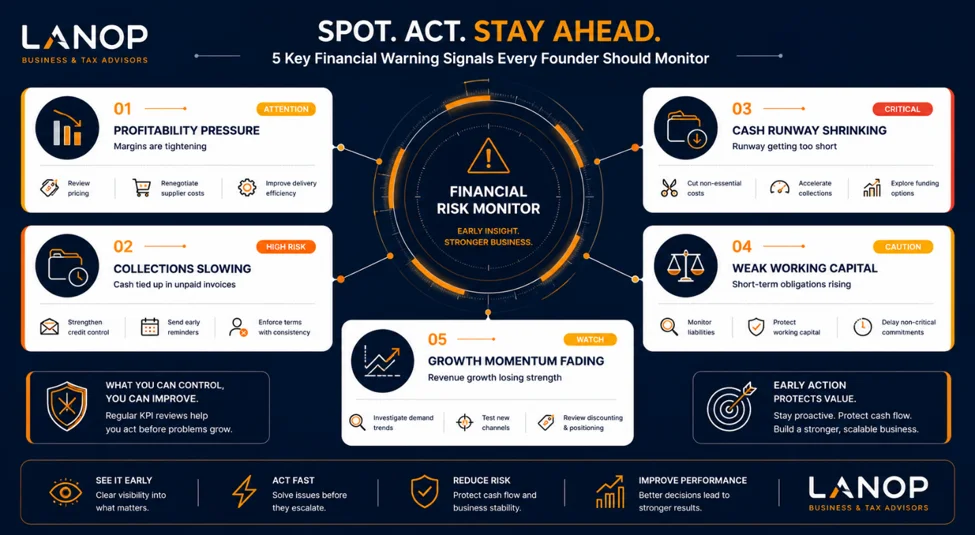
No business fails overnight. The signs are built up. Margin slips a point. Debtor days creep up. The runway shortens. The working capital ratio softens. Each one alone is survivable.
Read them together, month by month, and tell a story. You see it long before the crisis hits. Watch the trends, and you have time to change the course. Wait for year-end, and you often find out too late. Choice really comes down to one thing. Do you track monthly?
Which Non-Financial KPIs Should You Track Alongside the Financial Ones?
Financial KPIs tell you what happened to the money. Non-financial KPIs often tell you why. And they tend to move first. Watch both, and you get cause and effect, not just effect.
Customer Retention Rate
Retention shows how many customers stay with you over time. It’s one of the strongest early signs of financial health. Why? Because keeping a customer almost always costs less than winning a new one. A falling rate warns that future sales are at risk. It often shows before sales move. A rising rate quietly lifts every money metric below it.
Lead Conversion Rate
Conversion shows how many prospects turn into paying customers. It links your sales and marketing work straight to revenue. A small lift can raise sales without spending more on leads. Track it monthly, and you’ll see whether your sales engine is getting sharper or quietly clogging up.
Employee Productivity and Utilisation
For people-based businesses, this is where profit is won or lost. It shows how much of your team’s time goes on paid, useful work. Low use drags on the margin, even when sales look fine. Watch it monthly, and you’ll know whether the work covers your team’s costs or if you’re carrying a slack.
Customer Satisfaction Metrics
Satisfaction scores show how strong your customer bonds are. They might come from a formal Net Promoter Score. Or from a simpler check. Either way, they’re an early signal for loyalty and referrals. Unhappy customers leave. And they tell others. By the time it shows up as lost sales, the damage is done. Track it early and you can step in.
How Non-Financial KPIs Shape Financial Performance
The link is direct and easy to follow. Better retention steadies your sales. Higher conversion lifts your return on marketing. Better use of your team widens the margin. Happier customers protect the foundation that creates it all.
Pair these with the seven financial KPIs, and you see the whole system. You see the activity that drives money. And you see the money itself. That full view is what a finance director, in-house or virtual, is there to build.
Do Different Types of Businesses Need Different Financial KPIs?
The core seven fit almost everywhere. What changes is the focus. The right dashboard leans on the metrics that matter most to your model. And that varies widely across business types.
Financial KPIs for Startups
Early-stage firms live and die by cash. So, runway, monthly burn, and revenue growth lead the way. The real question is simple. Can you survive the next milestone? Profit often comes later by design. So net margin matters less early on than how fast you burn cash. A startup founder who knows their runway to the week is in control. One who doesn’t is exposed.
Financial KPIs for Growing SMEs
As a business moves past survival, the focus widens. Gross and net margin, working capital, and debtor days move to the Centre. Now the goal is to scale and stay profitable. This is the stage where founders hit the profitable but cash-poor wall. Here, the full set of seven earns its keep. And a monthly review becomes a real edge.
Financial KPIs for Contractors and Consultants
For contractors and consultants, time is the product. So, utilisation, day-rate realisation, and debtor days matter most. Income depends on billable hours that get billed and collected. Cash flow is often lumpy. It’s tied to project milestones and client payment cycles. Watch debtor days and runway closely. That keeps the gaps between payments from becoming a crisis.
Financial KPIs for Property Businesses
Property businesses run on yield, occupancy, and the gap between rent and finance costs. So, the ones to watch are net rental margin, void periods, and cash flow after finance costs. Interest rates make cash flow forecasting key here. A portfolio can look fine on paper. But it gets squeezed hard when finance costs rise. So, the gap between profit and cash needs real attention.
Financial KPIs for Established Limited Companies
Mature limited companies can take a wider view. Return on capital, net margin, and dividend cover join the core set. The questions shift. How do you use capital well? How do you give owners a fair, lasting return? At this stage, KPIs tie straight into tax planning. How you take profits when you invest, and how you structure the company, all affect the numbers. That’s where joined-up financial and tax advice adds the most value.
What Recent HMRC and Tax Rule Changes Make Monthly KPI Tracking More Important?
The rules are pushing UK business towards real-time, digital records. That makes monthly discipline less of a choice. It’s becoming a standard way to work.
Making Tax Digital for Income Tax and What It Means for Your Records
GOV.UK guidance sets out how Making Tax Digital for Income Tax works. The rules start from 6 April 2026. They apply to sole traders and landlords with a qualifying income over £50,000. That’s based on their 2024/25 Self Assessment return. The same guidance confirms the threshold, then drops. It falls to £30,000 from April 2027, and to £20,000 from April 2028.
GOV.UK guidance also sets out what you must do. You keep digital records. You send HMRC quarterly updates. That replaces one annual return with five touchpoints a year. The first quarterly deadline is 7 August 2026. HMRC has also confirmed a points-based penalty system for late filing. In short, quarterly digital reporting is becoming the baseline. Keep clean monthly records now, and the switch will be far smoother.
Why Real-Time Visibility Is Now Essential
The direction is clear. We’re moving away from the once-a-year catch-up. We’re moving towards ongoing digital data. Keep accurate figures month to month, and you’re not just compliant. You’re ahead.
Once your records are tidied monthly for digital reporting, the KPI data is already there. So, compliance and good management start to pull the same way. Treat this as a chance, not a chore, and you gain a real edge.
How Better Reporting Helps Tax Planning
Accurate, timely numbers are the basis of good tax planning. See your profit, cash, and trends throughout the year, and plan. You plan how you take income, when you invest, and how you time choices. You don’t rush it at year-end.
Good KPI reporting and good tax planning use the same source. That source is your management account. Build it once, and it serves both jobs. That’s exactly where an adviser who links the two pays for themselves.
What Directors Must Do to Watch Financial Health
Under the Companies Act 2006, directors have a legal duty. They must promote the company’s success. They must act with reasonable care, skill, and diligence. In plain terms, that means knowing where the money is and watching it. If solvency is in doubt, more rules kick in. The wrongful trading rules in the Insolvency Act 1986 add a duty to act in the interests of creditors. And not knowing the numbers is no defense.
Monthly KPI tracking is a practical way to meet this duty. It shows active oversight. It gives an early warning so that you can act in time. For directors of growing firms, this isn’t optional. It’s part of doing the job well.
How Can Founders Build a Practical Monthly KPI Dashboard?
A dashboard only helps if you use it. The aim is a clear, reliable view. You should be able to read it in minutes and act with confidence. Not a giant spreadsheet that nobody opens.
Which KPIs Belong on a Founder Dashboard
Start with the seven financial KPIs above. Then add two or three non-financial ones that fit your model. Use utilisation for a consultancy. Use retention for a subscription business. Use occupancy for a property business. Then stop. Resist the urge to add more. Ten clear metrics drive action. Forty drive avoidance. Keep it simple.
How Often to Review Your KPIs
Most KPIs deserve a monthly review. The time is just after your management accounts close. Cash needs more frequent eyes. Check it weekly if cash is tight. It moves faster than anything else.
The review itself matters as much as how often you do it. Hold a regular monthly session. Let each number prompt a decision. That’s what turns data into management.
Using Management Accounts for Reliable Data
Every KPI is only as good as the data under it. That’s why management accounts sit at the Centre. They’re checked, accurate, and prepared monthly. They’re the one source your dashboard should draw from.
KPIs built on rough data mislead you. A confident choice on a wrong number is worse than no choice at all. Get the accounts right, and the dashboard becomes something you can truly run the business on. If you take one structural step from this article, make it this one.
Common Reporting Mistakes to Avoid
The usual errors are easy to spot and easy to avoid. Tracking too many metrics, so none get attention. Building KPIs on patchy data. Working out a metric differently each month, so the trend means nothing.
The biggest mistake of all is simple. You build the dashboard and never act on it. A report that drives no decision is a cost, not an asset. The discipline isn’t in the building. It’s in use.
How Lanop Helps Business Owners Track and Improve Financial KPIs
Knowing which KPIs to track is one thing. Producing them each month, reading them well, and turning them into choices is harder. That’s where most founders want a partner. And that’s the work we do.
Monthly Management Accounts and KPI Reporting
We prepare accurate monthly management accounts. Then we turn them into a clear KPI dashboard built around your business. You get checked numbers you can trust. And you get a view shaped by the metrics that drive your choices, not a generic template.
Virtual Finance Director Support for Growing Businesses
Need senior financial thinking without a full-time hire? Our virtual finance director service gives you that. We design the right KPIs for your stage and model. We join your monthly review. And we bring the thinking that turns numbers into direction. It’s finance leadership sized to what a growing business can carry.
Cash Flow Forecasting and Financial Planning
Cash is where most businesses come unstuck. So, we build forward-looking cash flow forecasts and runway models alongside your KPIs. You spot problems early. And you make funding, investment, and hiring calls on your terms, not under pressure.
Tax Planning Linked to Your Numbers
We’re UK-qualified advisers. So, we connect your financial performance straight to your tax position. The same monthly data that powers your KPIs also guides your tax planning, profit extraction, and compliance; the two work together, not apart. With Making Tax Digital reshaping reporting, that link matters more than ever.
Strategic Advice for Founders, SMEs and Limited Companies
Beyond the numbers, we’re a sounding board for the choices they point to. Maybe you’re a startup protecting a runway. Maybe you’re an SME scaling profitably. Maybe you’re an established company looking to sharpen returns. Either way, we bring the commercial and tax view to help you act with confidence.
Conclusion
The idea is simple. Never be surprised by your own numbers again. Make the seven KPIs a monthly rhythm. Check your management accounts. Review revenue and margins. Tighten debtor management. Treat the runway as your survival signal. Then use them all to guide hiring, pricing, and spending. That’s the difference between acting on foresight and reacting to hindsight.
As your strategic finance partner, Lanop can help. We build a dashboard around your key concerns. We check your data. And we create a 90-day action plan. So, you control cash, steady your growth, and choose how to scale rather than react. Speak to our team today to book your management accounts and KPI review and take control of your numbers.
Frequently Asked Questions
For charities and nonprofits, the goal is sustainability and accountability, not profit. So, the ones that matter most are reserve levels, the split between restricted and unrestricted funds, and a cost-to-income ratio.
Yes, especially for subscription or scale-up models. An LTV of at least three times CAC is often seen as a sign of profitable growth rather than cash burning.
It depends on the industry. But a net margin of around 10% is a fair benchmark. And the month-on-month trend tells you more than any single month.
Yes. Knowing the monthly sales needed to cover all costs turns pricing and hiring into clear targets. It also works with a runway to show when the business stops losing cash.
Beyond the core seven, they monitor forecast accuracy, budget variance, and how quickly the monthly close is completed. Their main job is to ensure the reliability of the numbers.