
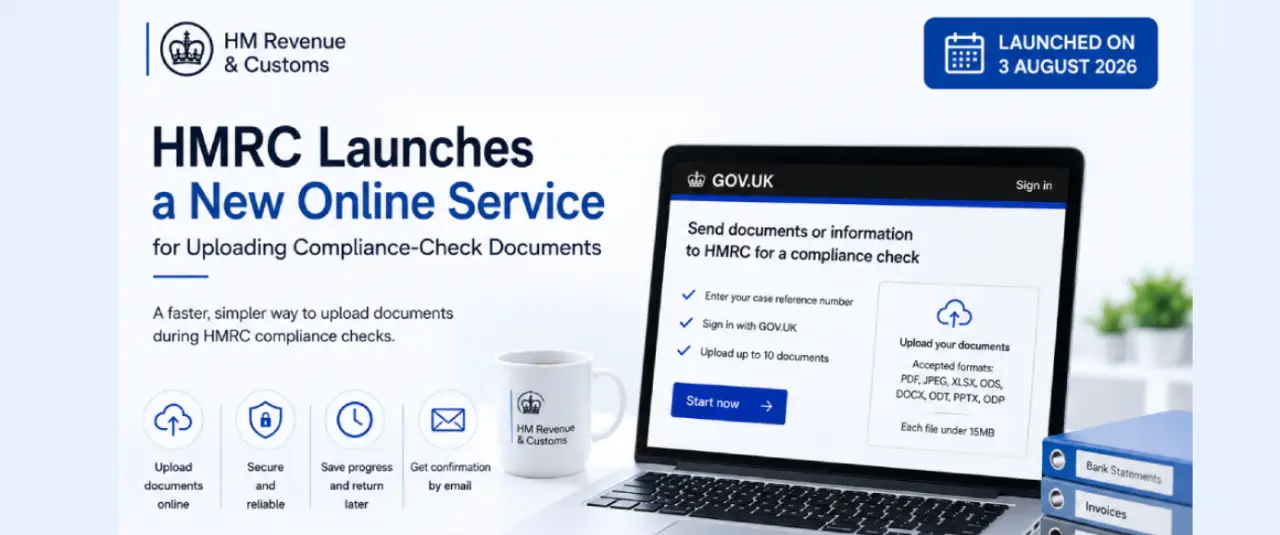
If you have received a letter from HMRC asking for documents as part of a compliance check, there is now a faster and cleaner way to respond.
HMRC published a new online service on 3 August 2026 that lets taxpayers and their authorised agents upload documents directly through GOV.UK. No printing. No email attachments are back and forth. No posting physical copies and hoping they arrive on time. You go online, log in, and submit.
It is a small change on paper. In practice, for anyone who has been through a compliance check, it is a meaningful one.
Who Can Use It
The service is for anyone who has received a letter from HMRC’s compliance team specifically requesting additional information. If you have that letter, you can use this form. If you have not received one, it is not for you.
Authorized agents can also submit documents on behalf of their clients. So, if your accountant or tax adviser handles HMRC correspondence for you, they can use this service directly without needing to route everything through you first.
What You Will Need Before You Start
One thing above anything else: your case reference number. It is printed on the HMRC letter you received. Without it, your submission may be delayed or not processed correctly.
You will also need a GOV.UK sign-in. If you have already used HMRC’s online services, you have one. Otherwise, there will be an opportunity to create your account when you complete the application form.
The process allows you to save your progress and proceed from where you stopped, which means that you don’t need to collect all the necessary information at once.
File Formats and Upload Limits
HMRC accepts documents in the following formats: PDF, JPEG, XLSX, ODS, DOCX, ODT, PPTX and ODP. Each file must be under 15MB. You can upload up to 10 documents in a single submission.
If you have more than 10 documents to send, HMRC says to split them into groups of 10 and submit them in batches. It is not the most elegant solution, but it works.
Once you submit, you receive a confirmation email with a submission reference number. Keep that email. It is your proof that the documents were received.
Why HMRC Has Done This Now
This is not a standalone decision. It sits inside a much bigger programme of work HMRC has been running to move its services online.
In its Transformation Roadmap Progress Update published in July 2026, HMRC confirmed it was enhancing document upload capability as part of its compliance digitisation plans. 78 percent of all customer interactions with HMRC are now digital, up from 65 percent five years ago. This new service extends that reach into compliance correspondence, which has traditionally been one of the more paper-heavy parts of the process.
It happens at a time when HMRC is struggling with a much larger workload of compliance issues. The gap in taxes for the year 2024 to 2025 is £59.2 billion. HMRC has recruited extra compliance officers and upgraded its systems to manage its increased workload. The process of uploading all documents digitally avoids any unnecessary communication and eases the workload for both parties.
What a Compliance Check Actually Involves
A compliance check is how HMRC verifies that a taxpayer has paid the right amount of tax. They are not always a sign that something has gone wrong. HMRC runs checks routinely across different taxpayer types, including self-employed individuals, landlords, company directors and businesses of all sizes.
When HMRC opens a check, it typically writes the taxpayer asking for specific records or explanations. Bank statements, invoices, expense receipts, and income records. Until now, sending those documents meant either emailing them across (with all the version control and security risks that bring) or posting physical copies.
The new upload service brings that process in line with how most financial admins already work. You gather the files, log in, reference your case number, upload, and submit. The record is tracked from that point.
The Broader Digital Shift and What It Means for You
Making Tax Digital for Income Tax went live in April 2026. 436,000 taxpayers have now filed their first quarterly update under the new regime. Around a third of those who should have signed up by April still have not, and HMRC has made clear it will pursue those cases.
The document upload service is a separate tool, but it belongs to the same direction of travel. HMRC wants digital records, digital submissions, and digital correspondence wherever possible. For taxpayers and agents who work across multiple clients or complex tax positions, getting comfortable with these tools now makes sense.
If you are currently under a compliance check, or you have received an information request from HMRC and have not yet responded, the new service is available now at GOV.UK. Search for “Send documents or information to HMRC for a compliance check” or go directly to the service through your HMRC online account.
For broader support on tax compliance, record-keeping under Making Tax Digital, or preparing for a compliance check, Lanop’s team of chartered accountants can help you get organised before HMRC asks the questions.
Need help responding to an HMRC compliance check or getting your records in order? Lanop’s chartered accountants work with businesses and individuals across exactly these situations. Visit lanop.co.uk to get in touch.