
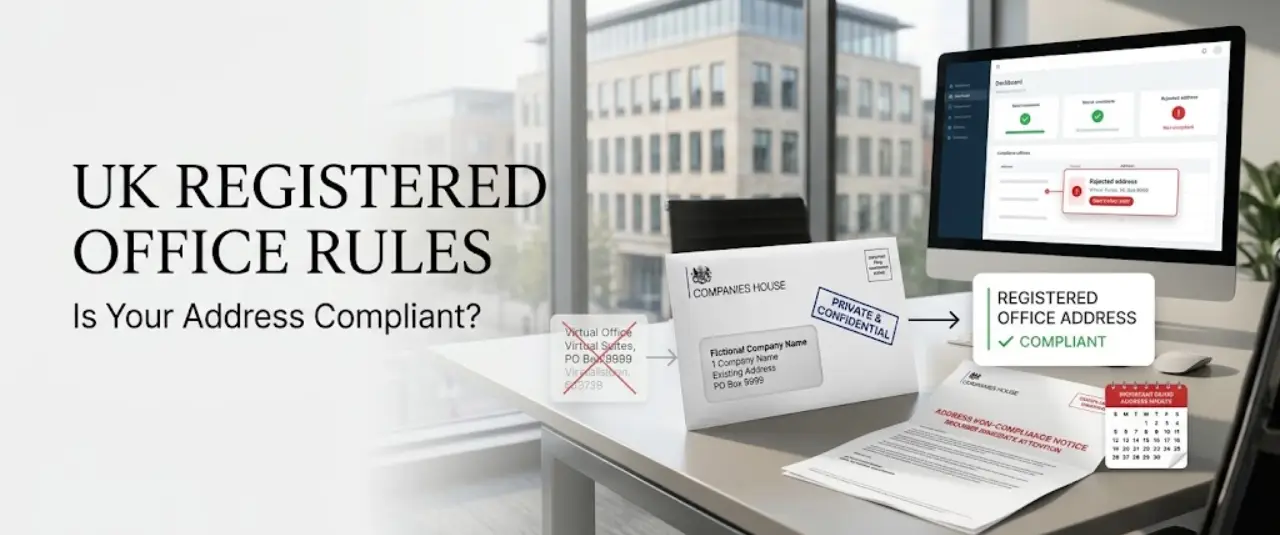
The rules that came into force through the Economic Crime and Corporate Transparency Act 2023 concerning the registered office continue to trip up many businesses. Non-conforming addresses have been rejected by Companies House throughout the years 2025 and 2026. Directors only find out that there is a problem once they receive a letter.
At a glance:
- All UK companies must maintain an “appropriate address” as their registered office
- A PO box alone no longer qualifies, even from a commercial provider
- Documents sent to a non-compliant address are treated as legally delivered
- Companies House can reassign your registered office to a default address if you fail to act
- The fix is straightforward but must be done properly via form CH01
What the Law Actually Changed
That period ended. Companies House moved to active enforcement through 2025. Businesses still sitting on a PO box, an unverified virtual office, or any address where documents are not reliably received are now in breach. The volume of rejection notices issued since enforcement began confirms this is not a theoretical risk.
Some of what is required here includes making sure that compliance is something that is continuously maintained as opposed to just being set up once. For instance, we have compiled a list of things to consider as far as UK business compliance is concerned at our company compliance checklist for UK businesses.
What “Appropriate Address” Means in Practice
The legislation is specific. An appropriate address is one where a document sent there would be expected to reach someone acting on behalf of the company, and where acknowledgment of delivery can be obtained.
A PO box does not meet that test. Neither does a virtual office address from a provider who collects mail but does not actively handle or forward it on your behalf. A serviced office address can work, but only if the provider confirms in writing that they receive and forward correspondence reliably. Having a contract with them is not enough if the practical arrangement does not match it.
Your accountant’s address works. Your solicitor’s address works. Your home address works. A mail forwarding box you rented because it looked more professional probably does not.
For limited companies in the UK, the registered office is also where statutory registers are held unless a SAIL address has been registered separately. Both addresses have to meet the appropriate address standard.
What Happens if You Do Nothing
Companies House has the power to change your registered office to a default address. That default is their own address, Cardiff for companies incorporated in England and Wales, Edinburgh for Scotland, Belfast for Northern Ireland. It becomes part of the public record immediately.
That signal matters. Suppliers, lenders, clients and HMRC can all see it. It looks like administrative failure, because it is.
There is a more serious practical risk. Legal documents delivered to your registered office are treated as received, whether you actually got them or not. A county court claim, a winding-up petition, an HMRC notice. If it goes to an address you no longer monitor, the clock runs regardless. Missed correspondence has contributed to a number of insolvency cases over the past two years. This is not a remote scenario.
If HMRC correspondence starts going astray, the consequences can compound quickly. Businesses that find themselves in that position often need specialist support to manage the fallout.
Who This Affects Most
Startups and newly registered companies are particularly exposed. When a business is set up in a hurry, the registered office address is often picked for convenience rather than compliance. A cheap virtual address, a friend’s flat, a provider nobody has properly checked. That decision can sit quietly in the background until it causes a problem.
The same applies to small businesses that have moved premises, changed accountants, or restructured since they were originally formed. If the registered office address was not updated at the time, it may still be pointing at a location the business no longer uses.
The Lanop FAQ on confirmation statements covers this directly. The confirmation statement filed annually with Companies House confirms your registered office among other key details. If that address is wrong, the confirmation statement is wrong. Both issues need fixing at the same time.
How to Fix It
The process is not complicated if you act on it promptly. File form CH01 with Companies House to update the registered office address. Online filings are typically processed within 24 hours.
Before you file, verify that the new address actually meets the appropriate address test. If you use a professional services firm, get written confirmation that they will accept, log and forward correspondence, and keep that confirmation on file. If your current provider cannot give you that in writing, find a different provider.
The cost of a compliant address is small. The cost of missing a legal notice is not.
One Date Worth Checking
There is no amnesty scheduled and no indication of one. Companies House enforcement has been consistent and is expected to continue. If your registered office is a PO box or a virtual address you have not verified against the March 2024 rules, the right time to check it is now, before a notice arrives rather than after.
Lanop helps businesses stay on top of Companies House filings, registered office requirements and HMRC correspondence. Get in touch if you want a straightforward review of your current setup.