
Moving from the UAE to the UK? You are not alone. Many high net worth families from Pakistani and Gulf backgrounds make this move every year. But most of them underestimate one thing. The UK tax system can catch you out fast.
Offshore accounts, UAE income, family trusts and overseas property do not stay protected just because you lived in Dubai. Once you land in the UK, HMRC can tax your worldwide income and gains.
The rules changed big in April 2025. The old non-dom protections are largely gone. This guide covers what matters right now in 2026. You will learn the real risks, the common mistakes, and the steps you should take before and after you move.
Key UK Tax Changes Affecting UAE Residents and HNWIs in 2026
What Changed After the UK Non-Dom Reforms
The UK scrapped the old remittance basis rules in April 2025. The system now works on where you live, not where you were born or where your family comes from.
If you are a new UK tax resident, you may get a four-year relief called the Foreign Income and Gains (FIG) exemption. This lets you keep overseas income and gains out of UK tax for four years.
But there is a catch. You only qualify if you were not UK tax resident in any of the ten years before you arrive. Many returning residents do not qualify. That is when the real surprises start.
Temporary Repatriation Facility (TRF) 2026 and 2027 Explained
The temporary repatriation facility TRF 2026 2027 is a time-limited window for people who built up offshore income or gains before 2025.
It lets you bring that money into the UK at a lower tax rate. The rate is 12% in the 2025 to 2026 tax year. It rises to 15% in 2026 to 2027. After April 2027, the window closes.
If you have overseas cash or gain you want to move to the UK, now is the time to look at this. A specialist adviser can help you decide if it applies to your case.
How These Changes Affect Gulf and Pakistani Families
For families with wealth in the UAE, Pakistan, and the UK, these new rules make things more complex. Your Gulf origin tax UK implications now depend on where you live, how long you stay, and how your money is set up. It is not just about where the income came from. peak to a family wealth adviser. The more complex your assets, the more value good advice adds.
How Moving from the UAE to the UK Can Change Your Tax Position
When UK Tax Exposure Starts
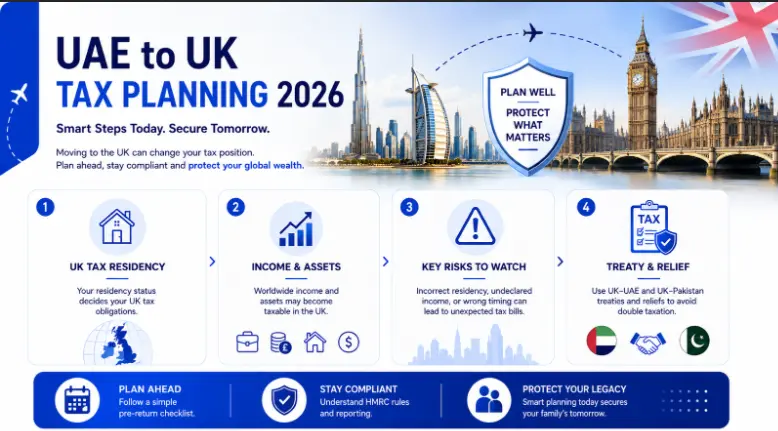
Your UK tax residency UAE income position is set by the Statutory Residence Test. You usually become a UK tax resident from the day you arrive.
From that point, HMRC can tax your worldwide income and gains. That includes UAE bank interest, dividends from overseas firms, rental income from property abroad, and profits from asset sales anywhere in the world.
Types of Income That May Become Taxable
- Interest from UAE or Gulf bank accounts
- Dividends from overseas private companies
- Rental income from property in Pakistan or the UAE
- Profits from selling property, shares or business assets
- Payments from overseas trusts or family offices
Why Returning Residents Get Unexpected Tax Bills
The return to UK tax implications often hit people hard because HMRC does not send a welcome letter. You may not know your overseas income is taxable until your first tax return is due.
By then, you may owe more than expected. Late filing can add penalties on top. Getting ahead of this is far cheaper than catching up later.
UK Tax Residency Rules for UAE Residents Explained
Understanding the Statutory Residence Test
The Statutory Residence Test (SRT) uses three things to decide if you are a UK tax resident. It looks at how many days you spend in the UK, how many UK ties you have, and your overall situation.
It is not a simple day count rule. Many people get this wrong.
UK Day Count Rules and UAE Ties
The UK day count rules UAE ties HMRC framework counts your days in the UK and looks at your connections. These are called ties. They include having a UK home, a close family member in the UK, doing work in the UK, and spending 90 or more days here in either of the past two years.
The more ties you have, the fewer days it takes to become a UK resident. With four or five ties, just 16 days in the UK can make you resident for that full tax year.
Why Staying Under 183 Days Is Not Enough
A lot of people think staying under 183 days keeps them safe. That is often wrong. If you own a UK home, have family here, or work in the UK, you can become a UK resident in far fewer days. Gulf expats who own UK property or have children studying here need to be very careful.
Split Year Treatment for UK Arrivals and Dubai Departures
What Split Year Treatment Means
The split year treatment UK arrival Dubai departure rules allow your first or last UK tax year to be split into two parts. One part is treated as non-resident. The other party is a UK resident.
This means not all your income in that year gets taxed in the UK. It can make a big difference to your first-year tax bill.
When Split Year Treatment May Apply
Split-year treatment applies in set cases. For most UAE based people, the most common situations are arriving in the UK to make it their main home or leaving the UK to live and work abroad full-time.
Understanding Double Taxation Between the UK and UAE
UAE UK Double Tax Treaty Explained for 2026
The UAE UK double tax treaty explained 2026, is narrower than most people expect. It mainly covers air transport income between the two countries.
It does not give broad protection to individuals. Many UAE residents assume the treaty keeps them safe from double taxation UK UAE. That is not the case for personal income.
Tax Treaty UK UAE Benefits
The tax treaty UK UAE benefits are mostly relevant for companies, not individuals. Because the UAE does not charge personal income tax, there is nothing to offset against your UK tax bill. You simply pay UK tax on that income.
Where Double Tax Issues Can Still Arise
Double tax questions do arise when income comes from multiple countries. If you earn rental income from Pakistan while living in the UK, the UK Pakistan double tax treaty income planning rules can help. That treaty is more detailed and can give tax credits or relief on specific income types.
HMRC Overseas Income Reporting and UAE Offshore Accounts
Can HMRC See My UAE Bank Accounts
Yes. The UAE takes part in the Common Reporting Standard (CRS). This means UAE banks send account data to HMRC every year for UK residents. HMRC CRS reporting for offshore accounts in the UAE is already in operation.
HMRC knows about your UAE account balances, interest earned and in some cases your transactions. The question is not whether they can see it. The question is whether your tax return matches what they already have.
Overseas Assets That May Require Reporting
- UAE and Gulf bank accounts
- Property in Pakistan, the UAE or other countries
- Shares in overseas private companies
- Foreign pension plans
- Interests in overseas trusts or family foundations
UAE Resident UK Property Tax Implications
Rental Income Considerations
If you own UK property and live in the UAE, your UAE resident UK property tax implications already include rental income. Non-residents with UK rental income must report it. Once you move to the UK, your allowances may improve but the rules stay in place.
Capital Gains Considerations
Non-residents have paid UK CGT on UK residential property since 2015. Commercial property was added in 2019. Once you become a UK resident, all your UK property gains fall under UK CGT. So do your overseas property gains.
Common Property Planning Mistakes
- Selling UK property after you become UK resident without any CGT planning
- Not reporting rental income during your time in the UAE
- Holding UK property in your personal name when a structure might be more tax efficient
- Missing the Annual Tax on Enveloped Dwellings charge where it applies
Offshore Wealth Structuring UK and UAE
Trust Structures
If you hold assets in a non-UK trust, offshore wealth structuring UK UAE gets more complex the moment you become a UK resident. HMRC has detailed rules on offshore trusts. These cover charges on the person who set the trust up, payments made to UK residents, and what must be reported.
Structures that worked well during your UAE years may need a full review before you move.
Overseas Companies
Offshore companies that used to hold UK investments or rental property can attract extra scrutiny. HMRC’s rules on Controlled Foreign Companies and the Transfer of Assets Abroad can apply where a UK resident has interests in overseas firms.
Wealth Protection Considerations
The goal is not to avoid tax. It is to make sure your setup is clean, tax-efficient, and right for where you are now. Many structures built during the UAE‘s life were never designed with UK residency in mind.
Reviewing them before you move is far simpler than fixing them once you are a UK tax resident.
UK Inheritance Tax Exposure for Gulf and Pakistani HNWIs
UK IHT 10 Year Tail After Leaving for UAE
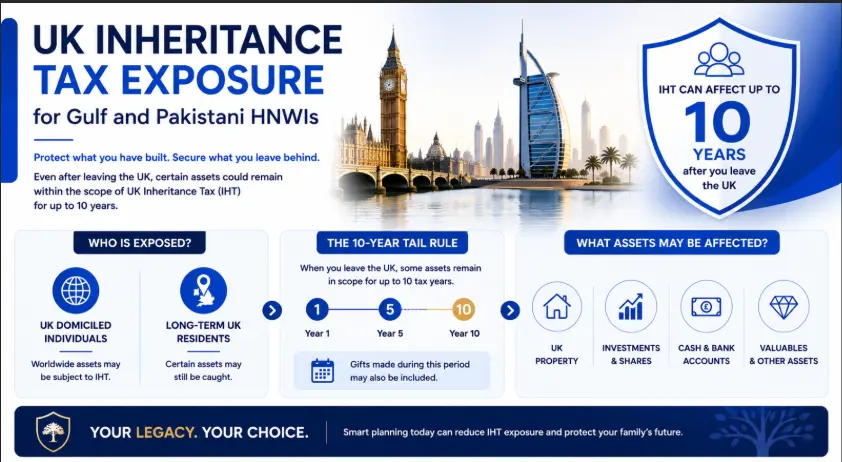
This is one of the most misunderstood areas. The UK IHT 10-year tail after leaving for UAE means your estate does not escape UK inheritance tax (IHT) the moment you leave.
If you were UK resident for at least ten of the last twenty tax years, you stay within UK IHT scope for a period after leaving. For long term UK residents, that tail can be up to ten years.
Gifting assets or moving wealth offshore while the tail is still running may not remove those assets from UK IHT at all.
Assets That May Remain Exposed
- UK property, investments and cash held in UK accounts
- Overseas assets held during the IHT tail period
- Gifts made within seven years of death
- Assets held in trusts set up while you were UK domiciled
Tax Planning for Pakistani British and Gulf HNWIs
UK Pakistan Double Tax Treaty Income Planning
For people with Pakistan source income, such as rental property, business interests or family transfers, the UK Pakistan tax treaty offers real relief in some cases. It stops double taxation on set income types and allows credit for Pakistani tax paid. Getting this right matters. A UK tax accountant for Pakistani families can make sure the treaty claims are filed correctly.
Overseas Family Business Considerations
If your family runs a business in Pakistan or the Gulf, the Pakistani British HNWI UK tax planning picture gets wider. You need to look at whether dividends paid to UK resident family members are taxable, whether business decisions made from the UK create a tax presence, and how profits are taken out.
Property, Gifts and Remittances
Receiving money from family abroad while you are a UK resident is not always taxable. But it depends on where the money came from. If it comes from overseas income, HMRC may treat some of it as taxable.
Gifts from non-UK resident family members are treated more favourably. But you still need proper records to support your position.
Multi Country Family Wealth Challenges
Many Gulf and Pakistani HNWI families hold wealth across the UK, UAE, Pakistan and beyond. Joining up the tax planning across all those countries needs a clear, structured approach. Piecemeal fixes tend to create bigger problems down the line.
Tax Planning Checklist Before Returning to the UK From Dubai
Actions 60 to 90 Days Before Moving
- Review all your assets and check what falls into UK tax scope on arrival
- Think about realising overseas gains while you are still UAE resident
- Get your trust structures and offshore company holdings reviewed by a specialist
- Confirm your UAE residency exit is clean and documented
- Check whether the FIG exemption applies to your residency history
Actions 30 to 60 Days Before Moving
- Open UK bank accounts and get ready to register for self-assessment
- Work out whether split year treatment applies to your arrival
- Check your UK property positions, including any rental income reporting or CGT owed
- Look at whether the TRF window applies to any offshore income you have built up
Final Steps Before You Move
- Make sure all overseas accounts and assets are listed and ready to report
- Appoint a UK tax adviser with experience in cross border HNWI cases
- Register for self-assessment from the year you arrive
- Plan your day count carefully in the early years to stay on top of your residency position
Common Tax Mistakes Gulf Expats Should Avoid
Selling Assets at the Wrong Time
Selling overseas investments or property after you become a UK resident triggers UK CGT. Selling before you arrive, while still a UAE resident, is often far more tax efficient. Timing is everything here.
Ignoring Temporary Non-Residence Rules
If you lived in the UK, moved abroad, and return within five years, HMRC can pull certain gains and income back into charge. This catches people who made offshore disposals during their time away, thinking they were safe.
Getting Income Timing Wrong
Receiving a big bonus, dividend, or distribution just after you arrive in the UK creates a tax charge that could have been avoided. Planning when large payments land can save a significant amount.
Missing Reporting Requirements
The HMRC overseas income reporting rules apply from day one of UK residency. Foreign bank accounts, overseas property, trust interests, and offshore company shares all need to be disclosed. Missing these can result in penalties far larger than the tax itself.
Frequently Asked Questions
It starts from the date you become a UK tax resident under the Statutory Residence Test. Split-year treatment may reduce your exposure in your first year. But from that date, your worldwide income and gains are in scope.
The temporary repatriation facility, TRF 2026 2027, lets eligible people bring pre 2025 overseas income or gains into the UK at a reduced rate. The rate is 12% in 2025 to 2026 and 15% in 2026 to 2027. The window closes in April 2027. If you have offshore reserves, speak to an adviser now.
Only in very limited cases, mainly for aviation income. For most personal income, the treaty offers little protection. Because the UAE does not tax personal income, there is nothing to set off against your UK tax bill.
Not always. UK resident settlors and beneficiaries of offshore trusts face specific tax charges. Your trust structure should be reviewed by a specialist before you move.
What should you do next?
Moving between the UAE and the UK brings real tax risk, especially for families with wealth spread across multiple countries. The rules changed in April 2025, and there is less room to plan than there used to be.
Our team at Lanop works with Pakistani British families, Gulf expats, and international HNWIs on these exact issues. We know the UK tax rules. We know how cross border family wealth works. And we know the specific concerns that come with Gulf and South Asian family structures.
If you want a private conversation about your own situation, get in touch. We are happy to help you understand where you stand and what your options are.