
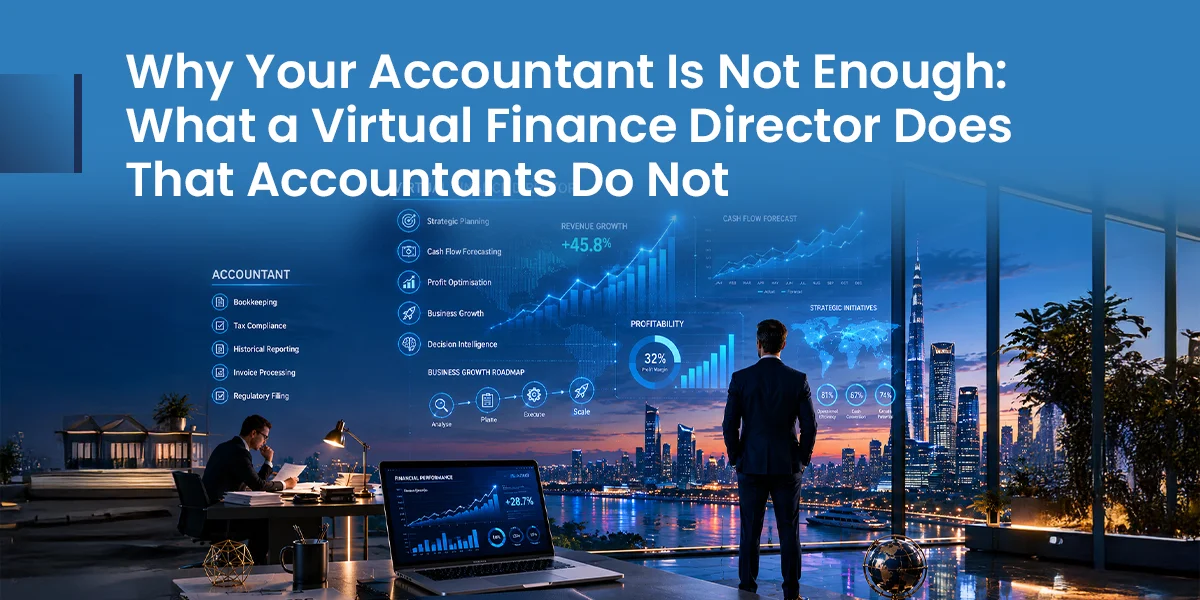
It is more financially complex than ever to run a business in the UK. Revenue goes up, teams expand, decisions are made, and for many SME owners, the view of the finances gets further out of reach. Calls with the accountant cover tax bills and filing dates. But the harder questions go unanswered. Is this growth profitable? What will cash flow look like in three months? Are we ready to hire? Most growing businesses are unknowingly exposed to a strategic financial leadership gap, not merely a compliance support gap.
An accountant is not a Virtual Finance Director, and this is one of the most common and costly assumptions UK business owners make. This article sets out what each role does, why compliance reporting alone is not enough as a business grows, and how to tell if the financial support you currently have is fit for purpose.
What Accountants Do for Small UK Businesses
The Core Accounting Role
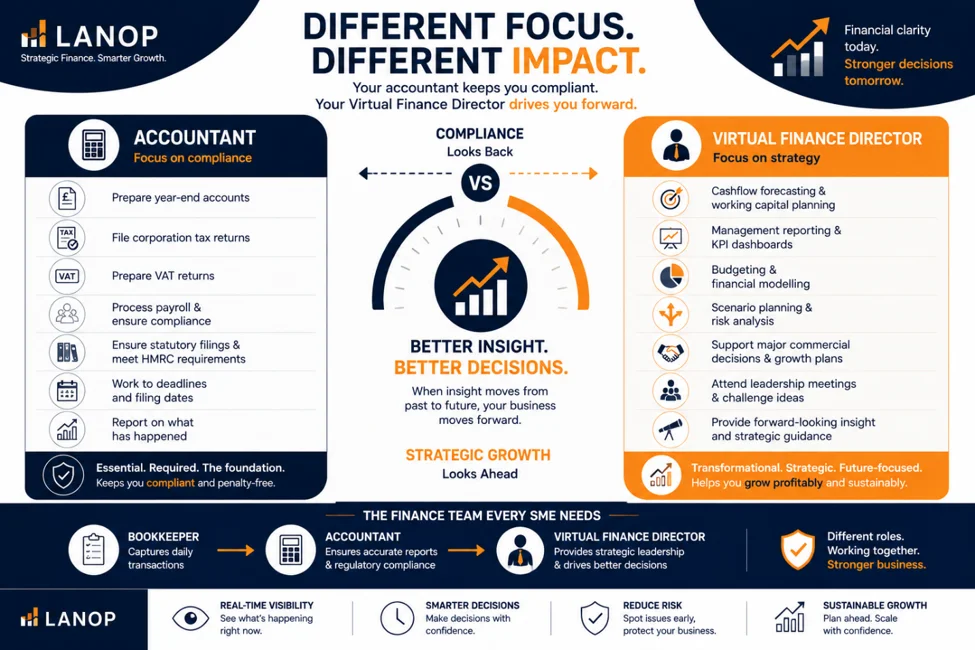
Most accountants who work with small UK businesses handle a set of tasks. They prepare year-end accounts, file tax returns, assist with VAT, and ensure the business complies with regulations. This work matters. Without it, directors can face fines and legal trouble.
But following the rules is just the start. Accounts done after the year end tell you what happened. They do not tell you what is coming or what to do next.
Many owners think their accountant is watching their finances right now. In most cases, that is not true. Most accounting arrangements are built around deadlines, not day to day advice.
What a Virtual Finance Director Does Each Day
A virtual finance director, or VFD, works inside your business on a part-time or regular basis. They give you senior financial advice. The kind you would only get from a full-time board hire. Their work covers cash planning, monthly reports, budgeting, and advice on major business decisions.
An accountant looks at the past. A VFD helps you plan the future. They sit in leadership meetings, ask hard questions, and help you turn your numbers into a clear plan. They are not doing your bookkeeping. They help your business think clearly about money and risk.
Why Following the Rules Alone Will Not Help Your Business Grow
Statutory accounts are prepared to comply with the rules of Companies House and HMRC. They are not built to help you decide whether to hire, check if a new contract will make money, or work out why your margins are falling even as sales go up.
Growing a business needs data that looks ahead. That means rolling forecasts, live reports, and regular reviews. None of this comes with a standard accounting service.
Without it, growth becomes more reactive. You fix problems instead of planning. The businesses that grow best can see their finances clearly at every stage. Following the rules alone will not give you that.
Finance Director vs Bookkeeper vs Accountant
It helps to be clear on what each role does. A bookkeeper keeps your day to day records in order. That data feeds into an accountant who files your returns and handles your legal duties. A finance director uses all of that to give your business financial leadership.
These are not the same roles. Each one serves a different need. Most growing businesses need all three to do well. The key question is whether the director’s level role is being filled. For many small UK businesses, it is not.
How Virtual FDs Use Technology to Show You Your Finances Right Now
Virtual finance directors usually work with cloud-based tools like Xero or QuickBooks, along with forecast tools and live dashboards. This gives both the VFD and the business owner a current, accurate view of how the business is doing. Not a report on where things stood six months ago.
Seeing your finances right now changes the quality of your choices. When a director can see daily cash figures, spot late payments early, or track margins by product, the business is in a much stronger position. Technology does not replace financial skill. It makes it sharper.
How Do You Know When Your Business Has Outgrown Its Accountant?
The Warning Signs Most Business Owners Miss
The first sign is when money choices start to feel like guesswork. If you cannot say whether you can afford to hire, cannot tell if a client is making you money, or cannot see your cash three months ahead; you have a financial blind spot. That blind spot will cause real problems over time.
Other signs include accounts filed months late, no monthly reports, and chats with your accountant that only cover tax bills and filing dates. That is not a dig at accountants. That is the job they were hired to do. The problem is when owners want financial guidance but only have filing support.
Why Year-End Reports Create Blind Spots
Year-end accounts are, by nature, historical. They may be filed six, nine, or even twelve months after the period they cover. By the time you read them, business has often moved on.
Making choices based on year-end data means working with old numbers. For a fast-growing business, that gap can turn a good call into a costly one. Monthly or quarterly management accounts can close that gap. But they are not a legal requirement for most small businesses. That is exactly why many firms do not have them, and why money mistakes happen.
What Happens When Growth Outruns Your Financial View
Fast growth without financial control is one of the most common reasons UK businesses hit serious trouble. Sales go up, the team grows, and costs rise. Without a clear financial picture, the warning signs stay hidden until the damage is done.
A business turning over one million pounds with poor cash planning is more at risk than a half-million-pound business with tight controls. Scale makes both gains and risks bigger. Without a clear view of your finances, the risks will win.
Why Profitable Businesses Still Struggle with Cash
Profit and cash are not the same thing. Mixing them up is a costly mistake. A business can show a profit and still fail to pay staff or suppliers if its working cash is poorly managed.
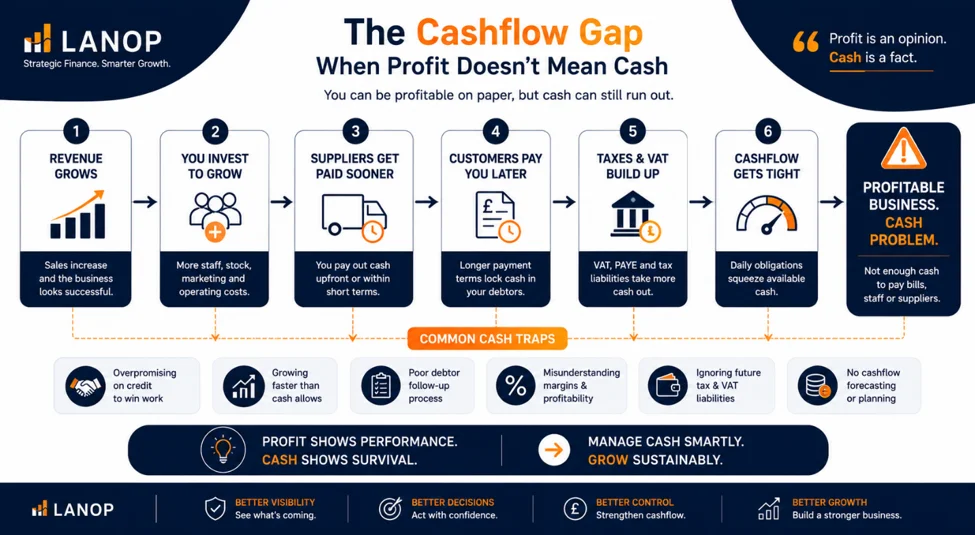
Common causes include offering long payment terms without tracking who owes you, growing too fast without watching your cash inflows, and not setting aside enough for VAT or tax bills. All of these are easy to avoid with the right controls. All are easy to miss without them.
What Problems Can a Virtual Finance Director Solve That an Accountant Usually Cannot?
Cash Flow Forecasting and Working Capital Planning
Cash flow forecasting is the basis of financial health for any small business. A VFD keeps rolling forecasts covering up to 13 weeks for day-to-day cash flow and 12 months for planning. This means the business always knows where it stands and where it is headed.
This is not a one-off task. It is a living process. It gives directors the insight they need to fund day-to-day work, handle busy seasons, and invest in growth without running out of cash.
Pricing, Margin Analysis, and Profit Tracking
Many small UK businesses charge too little or fail to identify which parts of the business are profitable. A VFD looks at your gross margin by product, service, client, or channel and turns that into clear choices you can act on.
Pricing rarely comes up in a standard accounting service. Yet it has a direct, immediate impact on your profit. Getting it wrong slowly eats into the business. Getting it right can change it. That is why financial strategy and smart accounting belong together.
Monthly Management Reports and KPI Dashboards
A good monthly pack gives the business owner a clear view of results versus budget, cash position, profit by area, and key figures. Reviewed each month with a VFD, it becomes your main tool for running the business well.
KPI dashboards usually cover revenue, gross margin, debtor days, creditor days, overhead as a share of revenue, and cash. When these numbers are visible and talked through often, problems show up early. Well before they become a crisis.
Budgeting and Scenario Planning During Growth
A budget is a statement of strategy, not just a set of numbers. A VFD builds budgets that align with your plan and tests them against real-world scenarios. What if a key client leaves? What if a new hire takes six months to get up to speed? What if a supplier puts prices up?
Scenario planning is especially useful during growth. It lets directors make choices based on a clear view of risk rather than gut feel alone.
Investor Reports and Funding Prep
A standard accounting service does not produce the financial data you need to raise money, whether through a bank loan, equity, or asset-backed finance. Investors and lenders want to see monthly reports, a cash flow forecast, a solid financial model, and clear proof that the directors know their numbers.
A VFD can play a direct role in funding talks. For businesses seeking investment or planning to expand, this prep work can be what makes a raise succeed.
Financial Strategy Support for Growing Businesses
Beyond the numbers, a VFD fits into the broader strategic discussions in your business. Thinking about a buyout? Looking at a new market? Planning to restructure? These choices carry financial costs that need to be worked out before you commit. A VFD brings that financial rigor without the cost or the tie of a full-time hire.
Tax Planning, Risk Review, and Business Recovery
Good tax planning is not the same as tax filing. Filing means sending in accurate returns. Planning means setting up the business to cut its tax bill legally, and doing so early enough to make a real difference.
An experienced VFD will spot chances that a typical accounting service would miss. These include the timing of big purchases, use of tax reliefs, group structure choices, and how directors are paid. For those running through a limited company, contractor accounting and VFD services work well side by side.
A VFD also watches for early signs of financial stress, before things get serious. When a business is already in trouble, a VFD can help it recover by cutting costs, negotiating with creditors, improving cash flow, and developing a clear recovery plan.
Do You Need a Finance Director or an Accountant at Your Current Business Stage?
Sole Traders and Micro Businesses Under 250k Turnover
At this stage, a good accountant and a reliable bookkeeper will cover most of what you need. Tax filing, VAT returns, and year end accounts are the priority. Financial strategy support is unlikely to be worth the cost at this level. That said, sole traders nearing the VAT threshold, currently 90,000 pounds in taxable turnover, as set by HMRC, should seek advice early, timing and structure matter. Choices made at this point can have an impact well beyond the current year.
Help with self-assessment tax returns is a good starting point for sole traders dealing with these thresholds.
Growing Businesses Between 250k and 1m Turnover
This is often the stage where the gap between filing and strategy becomes clear. Revenue is real, the team is growing, and costs are rising. The owner is making choices about hiring, investment, pricing, and credit without the data needed to make them well. For small business accounting services that go beyond year-end compliance, this is the moment to act.
Monthly management accounts and at least some VFD input become genuinely useful at this stage. Not every business at this level needs full, ongoing VFD support, but all benefit from it.
Businesses Scaling Beyond 1m Revenue
Above one million pounds, financial complexity grows fast. Multiple income streams, larger teams, greater supplier exposure, and often external funding responsibilities all require proper financial oversight. Relying on year end accounts alone at this scale is a serious risk.
Ongoing VFD support becomes very hard to justify not having. The cost of poor financial choices at this scale typically far exceeds the cost of the service.
Businesses Preparing for Funding, Hiring, or Expansion
Any business undergoing a major change needs financial input that goes well beyond the filing process. Whether you are raising capital, making a senior hire, opening a new site, or buying another business, a VFD adds real value at these moments. They help the business enter its next phase with accurate data, a credible plan, and the right financial controls.
For businesses where passing the business on is also on the agenda, a VFD’s financial modelling skills are equally useful.
When an Outsourced Finance Director Makes More Sense Than Hiring In-House
The annual salary for a full-time finance director typically ranges from 80,000 to 150,000 pounds, before employer for National Insurance, pension, and benefits. For most small businesses, that level of hire only makes sense once the business is bringing in three to five million pounds or more.
An outsourced or virtual finance director gives you the same level of skill as someone who has worked as an FD or CFO across many sectors, at a fraction of the cost. You get the strategic input you need without incurring a fixed cost you cannot yet afford.
What Does a Virtual Finance Director Cost in the UK?
Typical Pricing Models
Virtual finance director services in the UK are usually set up in one of two ways. The first is a fixed monthly fee for ongoing support. The second is a day rate for one off or periodic work. Monthly deals suit businesses that need regular reports, monthly meetings, and ongoing support. Day rates work well for single tasks like funding prep, a financial review, or a period of rapid change.
Day Rates vs Monthly Packages
Day rates for experienced virtual finance directors in the UK typically range from 500 to 1,500 pounds per day, based on experience, sector, and the scale of work. Monthly packages usually range from 500 to 1,000 pounds for lighter support, rising to 3,000 to 5,000 pounds or more for a full financial strategy service.
What matters is not the cost itself but the return. If a VFD finds 50,000 pounds in tax savings or stops a cash crisis that would have cost six figures, the fee pays for itself quickly.
Virtual Finance Director vs Full-Time Finance Director Costs
The salary for a qualified finance director in the UK ranges from 80,000 to 150,000 pounds per year. On top of that, employers pay National Insurance, pension, benefits, and recruitment fees. The true cost of a full-time hire is much higher than the base salary.
Virtual finance director services at 2,000 to 3,000 pounds per month are a very different cost. They are fixed and scalable, and they come without the ties or risks of a full-time role.
What Drives the Price of an Outsourced Finance Director
The scope of work drives price, how often input is needed, the person’s experience, and the complexity of the business. A business with multiple entities, overseas dealings, or outside investors will need more support than a simple single-entity business.
Sector knowledge also plays a role. A VFD with direct experience in tech, professional services, or retail will often deliver more value in those settings.
The Hidden Cost of Delayed Financial Decisions
There is a real cost to not having proper financial oversight. It just never shows up on an invoice. Instead, it shows up in pricing choices that quietly eat into margins. In hiring decisions made without a clear financial case. In funding bids that fail because the numbers were not ready. And in cash crises that could have been spotted weeks earlier.
These costs are high. They are just less visible than the monthly fees.
What Is the Biggest Mistake UK Businesses Make Before Hiring a Finance Director?
Waiting Until Cash Problems Become Critical
The most common mistake is waiting too long. Many business owners only look for a VFD when they are already in trouble. The bank has raised concerns, a supplier is chasing payment, or the directors have realised they cannot make payroll in six weeks.
At that point, the VFD’s first job is to address a crisis rather than develop a strategy. Getting involved early, before problems become serious, is almost always more effective and less costly.
Relying Only on Historical Accounting Data
Year-end accounts and tax returns describe what has already happened. Making forward-looking choices based solely on that data is like driving while only looking in the rear-view mirror. Forward-looking financial management requires rolling forecasts, regular reports, and active monitoring. None of this is produced as standard in a typical accounting service.
Scaling Without Forecasts or Financial Controls
Fast revenue growth is not, by itself, a sign of financial health. A business growing quickly without financial controls, including budgets, sign-off processes, margin tracking, and cash flow monitoring, is taking on risks it may not even know about.
The most dangerous period for many small businesses is the phase of rapid growth. Costs go up, cash is used faster than income comes in, and the business’s financial complexity grows faster than the owner can manage. That is exactly when proper financial oversight matters most.
Assuming Accountants Provide Strategic Financial Leadership
This belief causes real harm. Accountants are trained in financial reporting, tax, and filing duties, not in commercial strategy, financial modelling, or business leadership. That is not a criticism. It simply reflects what the role covers. When a business owner assumes their accountant is also providing strategic financial guidance, they often find out too late that major decisions were made without adequate analysis. In specialist sectors, this gap is even wider, whether that is accounting for law firms, healthcare businesses, or real estate.
Ignoring Management Reports Until Lenders or Investors Ask for Them
Many business owners see management accounts for the first time only when a bank or investor asks for them. At that point, producing years’ worth of monthly reports retrospectively is a big task, and their absence raises questions lenders are unlikely to ignore.
Building a regular reporting habit early makes the business more credible, better run, and easier to fund. It is much easier to keep up than to create under pressure.
What Risks Do UK Directors Face Without Proper Financial Oversight?
Director Duties Under the Companies Act 2006
Company directors in the UK carry significant personal legal duties. The Companies Act 2006 requires directors to act in the company’s best interests, exercise reasonable care and skill, and avoid conflicts of interest. Importantly, directors are expected to understand the company’s finances. Not knowing is not a defence.
Where a company fails, and it can be shown that directors did not take proper steps to understand or address the financial position, personal liability can follow. That risk is real, and it grows with the size of the business.
Risks of Weak Financial Controls and Poor Reporting
Businesses without proper financial controls face a range of serious risks. Fraud, error, and mistakes in reported figures are more likely. Management makes choices on unreliable data. And the business lacks the financial evidence needed to satisfy lenders, investors, or HMRC if questions are raised.
Weak reporting also means that a decline in financial health goes unseen. Problems that could have been fixed early become critical before anyone notices.
Wrongful Trading and Solvency Monitoring
Under the Insolvency Act 1986, directors who let a company keep trading when they knew, or should have known, that there was no real chance of avoiding insolvency may be held personally liable for the company’s debts. This is called wrongful trading.
The practical point is that directors must monitor solvency on an ongoing basis. That requires current, accurate financial data, not accounts prepared six months after the year-end. A VFD with strong financial oversight reduces this risk by keeping the business’s financial position visible and under management.
Late Filing Penalties and Compliance Failures
Late filing at Companies House brings automatic fines. These start at 150 pounds for filing up to one month late and rise to 1,500 pounds for private companies filing more than six months late. Repeat lateness doubles those figures.
HMRC fines for late or incorrect tax returns and payments are scaled and can add up quickly. Corporation tax paid late also incurs interest charges at rates set by HMRC. These are costs that proper financial management can prevent entirely.
Why Governance Demands Grow as Your Business Grows
A business turning over 200,000 pounds faces different expectations from lenders, suppliers, staff, and regulators than one turning over 5 million pounds. As the business grows, scrutiny grows too. Controls that were fine at one stage may be wholly wrong for the next.
A VFD helps the business stay ahead of rising demands by building strong financial habits early, rather than scrambling to catch up later.
How Are Recent HMRC and Companies House Changes Increasing the Need for Financial Support?
Making Tax Digital and What It Means for Your Business
Making Tax Digital, or MTD, is a major shift in how HMRC expects UK businesses to manage and report their tax affairs. MTD for VAT has applied to all VAT-registered businesses since April 2022. MTD for Income Tax Self-Assessment is being rolled out in phases from April 2026, starting with sole traders and landlords earning over 50,000 pounds.
The practical result of MTD is that businesses must keep digital records and file tax data more often. For businesses without proper bookkeeping systems, this is a big shift. For those already using digital tools, the filing burden is manageable. But the higher filing rate makes it more important than ever to have accurate, up-to-date financial data at all times.
Quarterly Reporting and Real Time Financial Data
The move to quarterly reporting is not just an admin change. It creates an expectation that businesses have current financial data available and are actively using it. A business that scrambles to pull together quarterly updates without proper systems is both less compliant and less well run than one that already has them.
VFDs help businesses build systems that make regular reporting easy, not stressful.
Companies House Identity Checks
The Economic Crime and Corporate Transparency Act 2023 brought major changes to Companies House. These include mandatory identity checks for company directors and people with significant control. The broader aim of the reform is greater accountability and openness.
Directors who are not on top of their compliance duties face more scrutiny and greater consequences when things go wrong.
Greater Scrutiny of Directors
HMRC and Companies House are both investing in data analysis and compliance work. The era of filing returns and being largely left alone is changing. Businesses with solid financial records, consistent reporting, and clear governance are in a much stronger position when regulators come knocking.
Directors who cannot show they have taken their financial duties seriously face greater personal risk.
Why Financial Governance Matters More Than Ever for Small Businesses
Taken together, the legal and regulatory changes of recent years have raised the bar for UK company directors, whether the business has five staff or five hundred. Meeting those demands needs more than a good accountant. It needs active financial oversight, current reporting, and a director or a VFD who takes real ownership of the business’s financial health.
How Can a Virtual Finance Director Help Your Business Scale Safely?
Building Reliable Cash Flow Forecasting Systems
A VFD does not just produce a cash flow forecast. They build the systems and habits that make forecasting a regular, reliable part of how the business runs. That means clean data, clear assumptions, and a process for regularly reviewing and updating the forecast.
When cash flow forecasting is built into the way the business operates, surprises become far less common. Directors can see problems forming early, look at their options, and act before they are under pressure.
Better Financial Choices Through Live Reporting
Live reporting, whether through a dashboard or a monthly management pack reviewed in real time, improves financial decision-making. When directors review current data, they ask sharper questions and make more informed decisions.
The alternative, relying on data that is weeks or months old, is one of the biggest reasons growing small businesses run into avoidable financial trouble.
Building Finance Processes That Keep Up with Growth
As a business grows, its financial processes must grow with it. The systems that work at 300,000 pounds in revenue are not enough at two million. A VFD maps out current processes, spots the weak points, and builds the financial systems the business needs for its next stage.
Businesses that invest early are better positioned to grow without financial shocks.
Spotting Risks Before They Become Expensive Problems
Part of a VFD’s value lies in what it prevents. An experienced finance professional who regularly reviews the numbers will spot warning signs that a non-specialist might miss. A debtor book ageing, a quiet decline in gross margin, or overheads growing faster than revenue are all patterns a VFD will catch early.
Spotting these trends when options are still open is very different from spotting them after the damage is done.
Supporting Hiring, Expansion, and Operational Planning
Every big operational choice has a financial side. Hiring a new team member, opening a new office, buying equipment, or taking on a large new contract all affect cash flow, profit, and the overall financial position of the business. A VFD makes sure those choices are based on accurate financial analysis.
For businesses in specific sectors, combining this financial oversight with specialist accounting know-how gives the clearest financial picture.
Providing an Outside View and Industry Experience
One often overlooked benefit of a virtual finance director is the experience they bring from outside your business. An experienced VFD will have worked across many sectors and at various stages of the business. They have seen the patterns, what works, what does not, and where the common mistakes are.
That outside view is genuinely useful. An in-house team, however strong, develops blind spots. A VFD asks the questions that internal staff have stopped asking. That often makes a real difference.
How Does Lanop Help UK Businesses with Financial Support?
Lanop’s Virtual Finance Director Services for Small Businesses
Lanop provides virtual finance director services to small- and medium-sized UK businesses that need financial input without the cost or commitment of a full-time hire. The team brings qualified, experienced finance professionals into client businesses on a retained or project basis.
The service is built around the financial challenges small UK businesses actually face. These include cash flow management, monthly reporting, funding prep, and financial advice at the moments that matter most.
Support for Contractors, Limited Companies, and Growing Businesses
Contractors and limited company directors benefit from tax-efficient structure advice and regular financial oversight. Limited companies receive monthly management reports and cash flow support. Growing businesses preparing for investment or expansion get the financial prep needed for funding talks.
Every client gets financial input tailored to their specific situation.
Monthly Reports, Forecasts, and Cash Flow Planning
Lanop’s VFD service includes producing and reviewing monthly management accounts, rolling cash flow forecasts, and KPI dashboards built for the business. These are not documents made for their own sake. They are reviewed in regular meetings where real decisions get made.
The rhythm of the monthly financial review is one of the most practical changes a business can make. Directors who know their numbers consistently make better choices.
Helping Clients Stay Compliant While Improving Profit
Compliance and profit are not at odds. A business that is well run, tax efficient, and financially organised is both more compliant and more profitable than one that is not. Lanop brings both together, helping clients meet their legal duties while actively improving financial performance. Tax planning, margin analysis, pricing review, and cost management all sit alongside the compliance work.
Flexible Outsourced Finance Director Support Without Full-Time Costs
Lanop’s VFD services are structured to suit the business, not to fit a standard template. Some clients need regular monthly support. Others need intensive input at specific points of change. Both are handled, and the service can grow as the business’s needs change. The result is access to senior financial expertise at a cost that reflects the business’s actual needs, rather than the fixed cost of a full-time appointment. Explore Lanop’s full accounting services to find the right level of support for your stage.
Conclusion
It is essential for any UK business, especially a small or medium enterprise, to ensure that key financial reports are reviewed each month. Reports like Profit and Loss, Cash Flow, Balance Sheet, Aged Debtors, and Budget vs Actual provide the visibility needed to stay profitable, track cash flow, and make decisions with confidence.
Growth needs more than compliance and tax filing. It needs proactive forecasting, financial planning, and strategic oversight to stay in control. At Lanop, we support UK SMEs by enabling them to go beyond compliance with financially focused, practical leadership tailored to their growth phase. Also, you can assess your business using the SME Monthly Financial Health Check template attached below. Offering a practical approach to a monthly cash flow overview, report, forecast, and financial management.
TEMPLATE DOWNLOADABLE LINK OF EXCEL FILE
Download your free Monthly Financial Health Check Excel Template and instantly assess cash flow, profitability, key financial metrics, and overall business performance with a simple, ready-to-use spreadsheet.
Download Excel Template ↓When your company is expanding faster than your financial visibility can keep up, now is the moment to act. Talk to the Lanop team today to find out how strategic financial support can increase profitability, improve control, and enhance long-term stability.
Frequently Asked Questions
Onboarding typically takes 2 to 4 weeks and covers a data audit, software review, KPI agreement, and the production of an initial management pack. This is considerably faster than hiring a full-time employee, which typically takes 3 to 6 months, including recruitment and onboarding.
Indicators of return include improvements in cash flow position, identified tax savings, margin increases from better pricing, and successfully secured funding. For most SMEs, the return on investment is realised within 4 to 6 months through better decisions and the avoidance of financial issues.
A well-structured contract should include a clear description of services, the number of days or hours covered, specific deliverables, a notice period of typically 30 to 90 days, the fee structure, GDPR-compliant data-handling provisions, and confidentiality clauses. Clear terms prevent scope creep and protect both parties.
A management accountant produces internal reports covering costs, variances, and records. A VFD uses that information to provide strategic direction: investor preparation, forecasting, and guidance to the board. One creates the data. The other acts on it.
Yes. A VFD prepares due diligence documentation, builds valuation models, advises structuring capital gains tax efficiency, and presents the financial story to prospective buyers. This preparation can significantly affect the final sale price. For businesses where succession planning is part of the exit strategy, VFD involvement is particularly valuable.