

Why Transparency Changes Everything in 2026
You are thinking about moving to Italy or Greece for tax reasons. You have looked at the numbers. Italy’s flat tax. Greece’s non-dom regime. Both look good on paper.
But there is one question most people miss. What does HMRC still know about you after you leave? Do European tax authorities share data with HMRC? Does moving abroad change what gets reported?
Moving changes your tax bill. It does not change what banks report. This guide explains why that matters and what you can do about it in 2026.
What Is Automatic Exchange of Information?
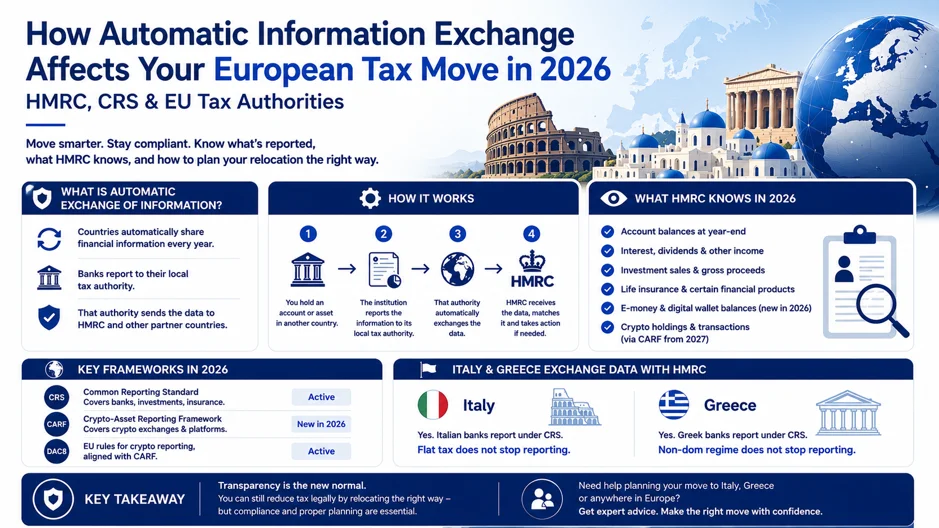
Automatic exchange of information (AEOI) means governments share financial data with each other. It happens every year. No request is needed. Banks report your account details to their local tax office. That office sends the data abroad.
Over 120 countries now take part. The UK was one of the first to join. Italy and Greece are both full members. So are Switzerland, Cyprus, and the UAE.
The OECD runs the system. It sets the rules. Countries write those rules into their own law. Once two countries both sign up, data flows between them year after year.
How the OECD Global Tax Transparency Framework Works
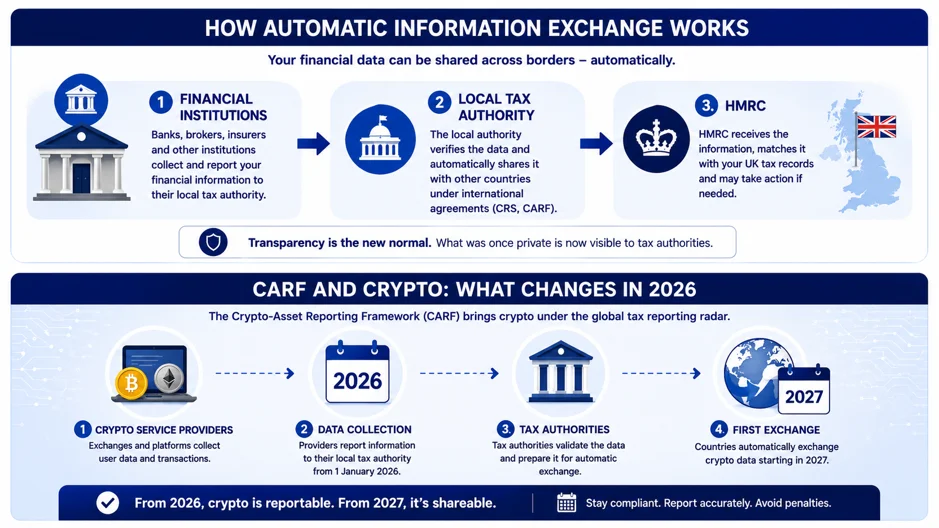
The OECD global tax transparency framework has two core parts. The Common Reporting Standard (CRS) covers bank and investment accounts. The Crypto-Asset Reporting Framework (CARF) covers digital assets. Both are live from January 2026.
CRS has been running since 2017 for most countries. CARF is new this year. Together, they cover almost all financial assets UK residents hold abroad.
DAC8 is the EU version of CARF. All EU member states must comply. Italy and Greece are both covered. Crypto reporting is now a legal duty across the EU from 2026.
The Difference Between CRS, CARF, FATCA and DAC8
| Framework | Who It Covers | What It Reports | 2026 Status |
|---|---|---|---|
| CRS (Common Reporting Standard) | 130+ participating countries and jurisdictions | Financial account information, including bank accounts, investment accounts, and certain insurance products | Updated to CRS 2.0 from January 2026 |
| CARF (Crypto-Asset Reporting Framework) | 48+ committed countries and jurisdictions | Crypto-asset transactions, transfers, and holdings | Data collection begins in January 2026, with the first information exchanges expected in 2027 |
| FATCA | US persons and entities worldwide | Foreign financial accounts and overseas assets held by US taxpayers | Ongoing reporting regime focused on US tax compliance |
| DAC8 (EU Directive) | All EU member states and relevant crypto service providers | Crypto-asset transactions and related information aligned with CARF requirements | Effective from January 2026 across the European Union |
Which Countries Exchange Tax Data With HMRC?
The UK has active exchange links with over 100 countries. Italy, Greece, Switzerland, Cyprus, Jersey, Guernsey, and the Cayman Islands all send data to HMRC.
Brexit did not stop this. The UK takes part through the OECD system. It does not need EU membership to share CRS data. Exchange with Italy and Greece goes on as normal.
What HMRC Knows About Your Offshore Accounts in 2026
Under CRS, foreign banks report your account details to their local tax office each year. That office then sends the data to HMRC.
What gets reported:
• Your name, address, date of birth and tax ID
• Your account balance at year end
• Interest, dividends and other income paid to you
• Gross proceeds from selling investments
• From 2026: account type and joint account status (new under CRS 2.0)
CRS 2.0 takes effect in January 2026. It adds more detail to every report. HMRC matches this data against UK tax returns. Any gap triggers a review.
For offshore cases, HMRC can go back 12 years where you were careless. There is no time limit at all where fraud was involved. If you have undeclared offshore income or assets that could now be exposed through CRS reporting, the Worldwide Disclosure Facility is the structured route to bring your position up to date with HMRC before they come to you.
Does Moving to Europe Stop HMRC Getting Information?
The Key Point
• Moving abroad changes where you pay tax.
• It does not change what banks report.
• Your Italian or Greek bank still reports your account to local tax authorities.
• That data can still reach HMRC.
What changes to your UK tax liability? Once you leave the UK under the Statutory Residence Test, you stop paying UK income tax on most foreign income. But HMRC still taxes UK-source income. Rent from a UK property, and certain UK pensions stay taxable no matter where you live.
Does Italy Exchange Tax Information With HMRC?
Yes. Italy and the UK have an active exchange link. Italian banks report to the Agenzia delle Entrate. That authority sends the data to HMRC each year.
Can HMRC see your Italian bank account? Not in real time. But through CRS, the data arrives at HMRC every year. If you held UK tax residency during any of those years, HMRC can act on it.
Italian banks report deposit accounts, investment accounts, insurance products, and fund holdings. From 2026, e-money accounts and digital payment products are also in scope under CRS 2.0.
Italy’s Flat Tax Regime and CRS Reporting
Italy’s flat tax regime (Art. 24-bis) lets new residents pay a fixed charge on all foreign-source income. From 1 January 2026, that charge is €300,000 per year for new applicants. People who joined before 2026 keep their earlier rate under the grandfathering rules.
The regime runs for up to 15 years. It covers foreign dividends, foreign capital gains, and most other overseas income. Italian income is always taxed at normal Italian rates.
Does the Italy flat tax stop CRS reporting? No.
The flat tax is a tax tool. It is not a reporting waiver. Italian banks still report your accounts. Italian tax offices still share that data with HMRC. The flat tax changes your Italian tax bill. It does not change what is reported.
Italian flat tax residents do not have to report foreign assets on their Italian tax return. But this is an Italian filing rule only. It has no effect on what foreign banks report under CRS.
Common mistakes UK expats make with this regime:
• Thinking the flat tax creates financial privacy
• Not exiting UK tax residency properly before the move
• Staying as the key decision-maker in a UK business after leaving
• Skipping the advance ruling from Italian tax offices
Our detailed guide on Italy’s €300,000 flat tax for UK HNWIs covers exactly who benefits at the new rate, how the regime interacts with UK exit planning, and what the numbers look like at different income levels.
Does Greece Exchange Tax Information With HMRC?
Yes. Greece takes part in CRS. Greek banks report to the AADE. The AADE sends that data to HMRC each year.
Greece’s non-dom regime works like Italy’s flat tax. New residents pay €100,000 per year on all foreign-source income. The regime lasts 15 years.
This is a tax tool. CRS reporting still goes on. Greek banks still report. HMRC still gets the data.
To move to Greece, you need a clean exit from UK tax residency. The UK-Greece double tax treaty splits income between the two countries. You need both sides done right. If you are a retiree considering Greece, our guide on Greece’s 7% pension tax regime for UK retirees explains the separate and often cheaper route available to those drawing pension income, including how it interacts with CRS obligations.
CRS 2.0 Key Changes from January 2026
CRS 2.0 New Rules (from January 2026, first reports 2027)
• E-money products and central bank digital currencies are now in scope
• Indirect crypto held through funds and derivatives is now covered
• Banks must do extra checks on residency claims from high-risk schemes
• New data fields are required for every reportable account
• Tax ID collection rules are stronger than before
The update closes gaps in the old CRS. Platforms like Wise and Revolut hold real balances for millions of users. Under e-money CRS reporting under the expanded scope, those accounts now face the same rules as a standard bank account.
Are Wise and Revolut Accounts Reportable Under CRS?
Under CRS 2.0, e-money firms that hold stored-value products must report just like banks. Whether a specific firm is in scope depends on its products and where it is based.
Wise and Revolut are both regulated in the UK and EU. Treat these accounts as reportable. Make sure your declared tax residency with them is correct. Wrong records create risk under the new rules.
CARF and Crypto Reporting From 2026
The Crypto-Asset Reporting Framework (CARF) is a new OECD standard for digital assets. It covers exchanges, brokers, custodial wallet providers, and some DeFi firms.
From January 2026, these providers must collect tax data from customers and report their transactions. The first reports under CARF go to tax offices in 2027, covering 2026 activity.
What CARF reports:
• Customer name, address, tax ID and residency
• Swaps between crypto and fiat money
• Swaps between different crypto assets
• Crypto transfers and retail payment transactions
HMRC already had a lot of crypto data before CARF. This new system extends coverage to all crypto-asset service providers in member countries. 48 countries have committed to CARF. The EU enforces it through DAC8.
Self-custody wallets are outside direct CARF scope. But any use of a central exchange creates a reportable trail. If you hold crypto and are planning a move to Italy or Greece, our crypto accountants can help you understand how CARF affects your position in your new country before the 2027 reporting cycle begins.
How Offshore Trusts Are Reported Under CRS
Trusts are covered by automatic exchange of information for trusts. Banks holding trust assets report those accounts. They also report the people behind the trust.
Who gets reported:
• The settlor who set up the trust
• All trustees
• Named and discretionary beneficiaries
• Any person who controls the trust
If you are reviewing an existing trust structure ahead of a European move, our guide on trusts, foundations, and holding companies for UK HNWIs covers how each structure now sits under the post-2025 rules and what residency changes mean for each one.
Beneficial Ownership and UBO Registers in Europe
All EU member states run UBO registers. Companies must list their real owners. Italy, Greece, and Cyprus all operate these registers.
Tax offices use this data. Under CRS and DAC6, they can find the real owner behind trusts, companies, and foundations. Nominee directors do not hide ownership from tax offices. CRS makes banks identify the actual controlling person.
The Six Biggest Myths About Tax Reporting in 2026
Myth 1: Moving Abroad Stops HMRC Seeing My Accounts
It changes your tax bill. It does not stop reporting.
Myth 2: Italy’s Flat Tax Stops CRS Reporting
Italy flat tax and HMRC CRS reporting are separate things. The flat tax is a tax tool. Reporting goes on.
Myth 3: Crypto Is Invisible to Tax Offices
From 2026, CARF collects data from exchanges. Reports reach HMRC in 2027.
Myth 4: Offshore Trusts Avoid Reporting
Trusts are fully within CRS. Controlling persons are reported.
Myth 5: Brexit Ended Exchange with Europe
The UK uses the OECD system. Exchange with Italy and Greece continues.
Myth 6: Fintech Accounts Are Outside CRS
CRS 2.0 brings e-money products into scope from January 2026.
Italy vs Greece for UK Expats: A Quick Comparison
| Feature | Italy | Greece |
|---|---|---|
| Special Regime | Flat Tax Regime (Article 24-bis), €300,000 per year from 2026 | Non-Dom Regime, €100,000 per year |
| Regime Length | Up to 15 years | Up to 15 years |
| CRS Exchange with the UK | Yes, active since 2017 | Yes, active since 2017 |
| Crypto Reporting | DAC8 applies from January 2026 | DAC8 applies from January 2026 |
| Best Suited To | Individuals with foreign income exceeding €750,000 per year | Individuals with foreign income between €300,000 and €700,000 per year |
Italy works best for people with very high foreign income. At €750,000 or more per year, the €300,000 flat charge is a real saving. The lifestyle, culture, and business links make it a strong base.
Greece suits those with more moderate foreign income. The €100,000 charge works well in the €300,000 to €700,000 range. Property investment and retirement income fit the Greek regime well.
Both countries share data with HMRC. Both are full CRS members. The tax benefits are real. They work best when the planning is built on compliance, not on hiding assets.
If you are still weighing which country makes most sense for your income profile, our Italy vs Greece vs Cyprus flat tax comparison models all three regimes side by side with worked examples.
How to Relocate to Europe While Staying Compliant
Establishing Tax Residency Correctly
The Statutory Residence Test sets the rules for leaving UK tax residency. You must meet the test in full. A clean exit needs expert advice in the year you leave.
Updating Your Financial Institution Records
Once you have a new tax residency, update your records with every bank and platform you use. CRS 2.0 requires banks to check that your residency claim makes sense. Old records create risk.
Reviewing Offshore Structures Before You Move
If you have trusts, offshore companies, or complex investments, review them before you move. CRS affects you differently in each residency. A structure built for your old position may not suit your new one.
Preparing for CARF If You Hold Crypto
Check whether your exchange reports under CARF in your new country. Getting ahead of the 2027 reporting cycle is far better than being caught by it.
When to Get Professional Advice
You need cross-border advice if you are changing tax residency, restructuring offshore arrangements, holding crypto, managing a trust, or running a UK business from abroad. Each of these has specific CRS and CARF implications that need professional review.
Frequently Asked Questions
Through CRS, Italian banks report UK-resident account holders to Italian tax offices. That data goes to HMRC each year.
No. The flat tax cuts your Italian tax bill. Reporting goes on regardless.
From 2026, specified e-money products fall within CRS 2.0. Keep your residency records up to date with these platforms.
From 2026, CARF-committed exchanges collect and report transaction data. First reports reach HMRC in 2027.
No. The UK shares data through the OECD. CRS exchange with Italy and Greece continues as before.
Yes. Trusts fall within CRS scope. Settlors, trustees, and beneficiaries are all reportable.
Not effectively. CRS makes banks find the real controlling person. EU UBO registers add further disclosure.
Italy’s flat tax, Greece’s non-dom regime, pension planning, timing of asset disposals, and investment structuring all offer real scope within a compliant framework.
Conclusion: International Tax Planning Has Changed, Not Disappeared
Global tax transparency is here to stay. CRS covers over 120 countries. CARF brings crypto into scope from 2026. E-money platforms follow in the same update. The information flow is bigger, faster, and more detailed than ever before.
None of this kills the chance to plan. It changes the approach.
If your foreign income is above €750,000 per year, Italy’s flat tax at €300,000 makes clear sense. You need a proper UK exit, a valid Italian residency, and an advance ruling from Italian tax offices. Done right, the saving is real.
If your foreign income is more moderate, Greece’s €100,000 flat charge often works better. The UK-Greece tax treaty is well tested. Property and retirement income sit well within the regime.
If you hold crypto, act now. CARF started collecting data in January 2026. Reports reach tax offices in 2027. Getting ahead of that is easy with the right advice.
If you have trusts or offshore structures, review them before you move. Residency changes alter your CRS position. Structures built for your old life may not suit your new one.
The planning decisions you make now shape how you sit within these systems. The right move, done at the right time, with the right structure, is still very achievable.
At Lanop, we help UK entrepreneurs, investors, and families navigate tax residency, UK tax exit planning, wealth structuring, and cross-border compliance with confidence.
Contact Lanop today to discuss your relocation plans and receive tailored guidance for a compliant and tax-efficient move to Europe.