The UK wealth planning world changed a lot in 2025 and 2026. Recent UK changes around inheritance tax, non-dom rules, and offshore structures have led many high-net-worth families to rethink existing plans.
If you have a complex estate, the challenge is not simply choosing between a trust, foundation, or holding company. It is finding a structure that protects your wealth, supports your family goals, and continues to work over the long term.
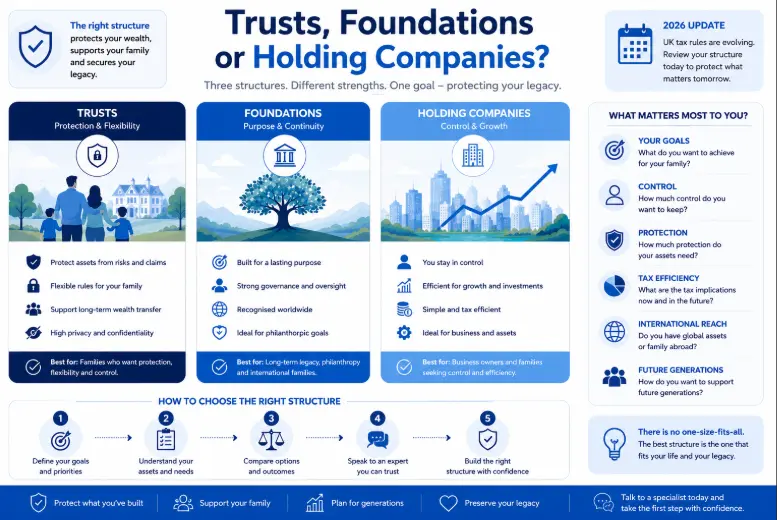
Trusts vs Foundations vs Holding Companies: Quick Comparison
Before going into detail, here is a quick snapshot of how the three structures compare across the things most wealthy families care about.
| Factor | Trust | Foundation vs Holding Company |
|---|---|---|
| IHT exposure | Discretionary trusts face 10-year charges. Excluded property trusts may offer relief on pre-2025 rules. | Foundation: depends on UK tax treaty. Holding Co: assets stay in estate unless shares are gifted. |
| Control | Settlor loses legal ownership. Letter of wishes guides trustees. | Foundation: council controls. Holding Co: director and shareholder keep full control. |
| Divorce protection | Strong. Trust assets are often outside matrimonial claims. | Foundation: similar. Holding Co: weaker unless shares sit inside a trust. |
| Succession | Clear. Deed directs distributions across generations. | Foundation: charter governs. Holding Co: shares pass by will or gift. |
| Tax reporting | UK trusts: TRS registration required. | Offshore structures: CRS and FATCA reporting applies globally. |
| Privacy | Trust deed not publicly filed. | Foundation: varies by location. Holding Co: UK accounts filed at Companies House. |
Quick answer: Want strong succession planning and asset protection? A trust is usually the best place to start. Want more control and flexibility across borders? A foundation may suit you better. Own a business or investment portfolio and want to keep things simpler? A holding company is worth looking at first.
Why Wealth Structuring Matters More in 2026
How UK Wealth Planning Rules Changed
The non-domicile tax system ended in April 2025. That removed a planning tool many families had used for decades.
From April 2025, long-term UK residents face UK inheritance tax on assets held all over the world. HMRC now calls these people long-term residents, or LTRs. You become one if you have lived in the UK for 10 of the last 20 years.
The excluded property trust rules also changed. Trusts set up before 6 April 2025 by non-doms may still hold some protection. But it depends on what assets the trust holds and when they were settled. It is not a safe assumption.
Why Existing Structures May Need Reviewing
Many families set up offshore trusts or holding companies under the old non-dom rules. Those same structures may now create surprise tax exposure.
The anti-avoidance rules around offshore trusts are still in place. These include the Transfer of Assets Abroad rules and the settlement rules. A setup that worked cleanly before may now trigger income tax or capital gains charges if you still have certain ties to the arrangement.
If your advisers have not reviewed your setup since 2024, now is the time to act.
Key Risks Wealthy Families Are Trying to Avoid
- Inheritance tax on worldwide assets once LTR status applies
- Losing control when you move assets into a structure
- Children or grandchildren spending inherited wealth badly
- Family rows that damage relationships and destroy value
- Assets being split in a divorce settlement
- Tax problems when children live in different countries
Understanding the Three Wealth Structures
What Is a Trust?
A trust is an arrangement where you hand assets to trustees. They hold and manage those assets for the people you name as beneficiaries. You give up legal ownership. But a letter of wishes lets you guide how trustees act over time.
Common UK trust types used in wealth planning include discretionary trusts, bare trusts, and interest in possession trusts. Offshore trusts set up in Jersey or Guernsey are popular for families with international links.
Benefits of Trust Structures
- Inheritance tax planning: Assets in a discretionary trust usually sit outside your estate for IHT after seven years, if conditions are met
- Asset protection: Trust assets are often shielded from divorce claims and creditors
- Succession: Trustees can pass wealth across many generations, guided by the deed and letter of wishes
- Privacy: Trust deeds are not public documents in the UK or most offshore locations
Limitations of Trust Structures
Trustees have legal control, not you. Some settlors find this hard to accept
- Discretionary trusts face a ten-year periodic charge of up to 6% of the trust value, plus exit charges on distributions
- UK trusts must be registered with HMRC on the Trust Registration Service
- Offshore trusts can still trigger UK tax charges if you live in the UK
What Is a Foundation?
A foundation is its own legal entity. Think of it as a cross between a trust and a company. It has its own charter and is run by a council. Popular places to set one up include Liechtenstein, Malta, and the Channel Islands.
Foundations are less common in UK domestic planning. But they work well for international families with assets and beneficiaries spread across many countries.
Benefits of Foundations
- The foundation owns assets in its own name as a separate legal entity
- Founders usually have more say than in a trust setup
- Flexible for families with cross-border succession needs
- Can be used for charitable or private purposes
Limitations of Foundations
- Complex to set up and run, with higher professional fees
- UK courts and HMRC are less familiar with foundations, which can create uncertainty
- May cause double tax issues due to how they are treated for UK tax
- UK residents using foreign foundations still face anti-avoidance rules
What Is a Holding Company?
A holding company sits at the top of a group. It holds shares in other companies, investment portfolios, or property. It can be a UK limited company or set up offshore in BVI, Cayman, or the Channel Islands.
For business owners and entrepreneurs, a holding company is often the first structure worth looking at. It lets you keep control while separating personal assets from business risk.
Benefits of Holding Companies
- Business Asset Disposal Relief may apply on qualifying business sales
- Profits held inside the group can be reinvested in a tax-efficient way
- Family investment companies let parents pass economic value to children while keeping voting control
- Intergroup dividends may benefit from dividend exemption or the substantial shareholding exemption
Limitations of Holding Companies
Shares stay inside your estate for IHT unless you give them away, which can trigger capital gains tax
- UK companies must file accounts at Companies House, so there is less privacy than with a trust
- Offshore holding companies face Controlled Foreign Company rules if UK residents are in control
- Complex group structures need ongoing professional management\
The Questions Most HNWIs Ask Before Choosing a Structure
How Much Control Do I Want to Keep?
This is often the deciding factor. Holding companies give you the most control. You stay on as director and shareholder. Trusts ask you to let go of legal ownership, which can feel uncomfortable. Foundations sit in between.
If keeping control matters most to you, a family investment company or holding company may be a better first step than an offshore trust.
How Do I Protect Wealth Across Multiple Generations?
A well-drafted trust deed can set out exactly how wealth passes to children, grandchildren, and beyond. You can set age limits before money is released. You can add conditions. You can guide how funds are used without cutting anyone out.
Foundations can do similar things through their charter. Holding companies alone offer fewer built-in succession protections unless you combine them with a trust.
Could Family Circumstances Change Later?
Almost certainly yes. Marriages, divorces, moves abroad, business changes. Your structure needs to be flexible enough to handle all of that.
Trusts with wide discretionary powers can adapt to changing needs. A rigid setup built for today could cause real problems in ten years.
Trust vs Foundation vs Holding Company: Detailed Comparison
| Factor | Trust | Foundation vs Holding Company |
|---|---|---|
| IHT exposure | Discretionary trusts face 10-year charges. Excluded property trusts may offer relief on pre-2025 rules. | Foundation: depends on UK tax treaty. Holding Co: assets stay in estate unless shares are gifted. |
| Control | Settlor loses legal ownership. Letter of wishes guides trustees. | Foundation: council controls. Holding Co: director and shareholder keep full control. |
| Divorce protection | Strong. Trust assets are often outside matrimonial claims. | Foundation: similar. Holding Co: weaker unless shares sit inside a trust. |
| Succession | Clear. Deed directs distributions across generations. | Foundation: charter governs. Holding Co: shares pass by will or gift. |
| Tax reporting | UK trusts: TRS registration required. | Offshore structures: CRS and FATCA reporting applies globally. |
| Privacy | Trust deed not publicly filed. | Foundation: varies by location. Holding Co: UK accounts filed at Companies House. |
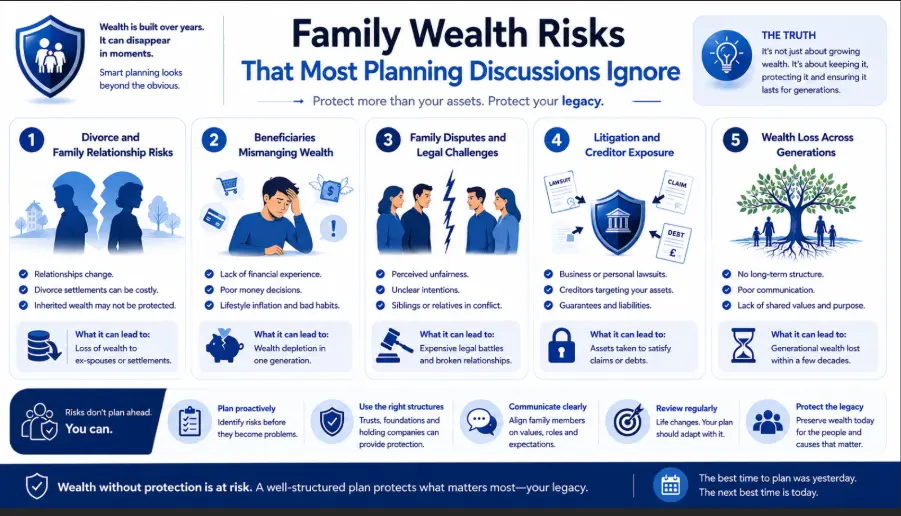
Family Wealth Risks That Most Planning Discussions Ignore
Divorce and Family Relationship Risks
UK courts have wide powers in divorce cases. Personal assets are almost always on the table.
Trust assets can sometimes be brought into claims. But a well-structured discretionary trust, where no one has a fixed right to the money, is much harder to attack. This alone makes trusts worth thinking about if you have significant inherited or business wealth.
Beneficiaries Mismanaging Wealth
Handing a large lump sum to a 25-year-old rarely ends well. Discretionary trusts let trustees control when and how much money is paid out.
You can set conditions such as age limits, education requirements, or matching provisions. You protect the money without cutting anyone off.
Family Disputes and Legal Challenges
Inheritance disputes are rising in the UK. A trust that clearly records what you want reduces ambiguity. Foundations with a clear charter work in a similar way.
Passing assets through a will alone leave them open to challenge under the Inheritance Act.
Litigation and Creditor Exposure
If you run a business, legal claims are a real risk. Assets held in a trust or foundation are generally separate from your personal estate.
They may be protected from business creditors, if the structure was set up properly and not to hide money from existing creditors.
Wealth Loss Across Generations
Research shows most family wealth is gone by the third generation. Governance helps slow that process.
Investment policies, family councils, regular reviews. A trust or foundation without governance is just a legal wrapper. With governance, it becomes a long-term wealth tool.
Family Office Structures and Governance Planning
What a Family Office Actually Does
A family office brings together investment management, tax planning, succession planning, and family governance under one roof. It acts as the hub around which other structures sit.
When a Family Office Makes Sense
If your investable wealth is above roughly £30 to 50 million, or you have complex cross-border assets and multiple family branches, a formal family office may make sense.
Below that level, a multi-family office is usually more cost-effective.
Combining Family Offices with Trust Structures
A family office governance wrapper combined with a trust or foundation gives you both the ability to manage wealth and the legal framework to protect it. The trust holds the assets. The family office manages them day to day.
Governance Structures for Long-Term Wealth Preservation
Good governance means agreeing in advance how decisions get made, who is involved, and what happens when people disagree.
A family charter, an investment policy, and regular family meetings are not just good habits. They can stop disputes that would otherwise end up in court.
International Families and Cross-Border Planning Challenges
Children Living Outside the UK
If a beneficiary lives in the US, Australia, or Germany, distributions from a UK trust may create local tax issues. The US in particular treats distributions from foreign trusts very harshly.
Your UK planning must account for where your beneficiaries live, not just where the trust is based.
International Asset Ownership
Property in France, investments in the US, business interests in Asia. Each country has its own succession and tax rules. A structure that works for UK assets may not cover overseas ones.
French assets, for example, follow French succession law regardless of what your UK trust says.
Residency Changes and Future Mobility
If you plan to leave the UK, your structure needs to work from your new home too. Some offshore trusts become more effective once you are no longer UK resident. Others create compliance headaches.
Any setup built for a UK-based settlor should be reviewed before a permanent move.
Offshore Structures in 2026: Key Considerations
Offshore Trust Planning
Offshore trusts set up in Jersey, Guernsey, BVI, or Cayman can still work well for the right clients. They are most effective when the settlor was genuinely non-UK domiciled at settlement, the assets are held outside the UK, and the trust predates the LTR changes.
For BVI and Cayman trust planning, the key question is whether the trust qualifies as excluded property. After April 2025, this depends on the assets held, the settlor’s domicile status at settlement, and the new LTR rules.
Offshore Foundations Compared with Trusts
Comparing an offshore foundation with an offshore trust often comes down to control and jurisdiction. Liechtenstein foundations, for example, let founders reserve certain rights. Many settlors find this more comfortable than handing full control to a trustee.
That said, foundations cost more to run and fewer UK advisers have experience with them.
Excluded Property Trust Considerations
The excluded property trust rules changed significantly after April 2025. Assets settled before 6 April 2025 by a non-dom settlor may still qualify for IHT protection. But only if the assets themselves are held outside the UK.
Cash in a UK bank account would not qualify, for example. Specialist advice is essential here.
When a Trust, Foundation or Holding Company May Not Be the Right Fit
Situations Where Trusts May Not Be Appropriate
- You need to access the capital freely and often. Trusts make this hard
- Your estate is below the IHT threshold, and the cost outweighs the benefit
- You cannot accept that trustees have legal control. This can lead to conflict
Situations Where Foundations May Not Be Appropriate
- Your assets are mainly in the UK. UK courts do not always deal well with foreign foundation structures
- You need a quick, low-cost solution. Foundations are expensive to set up and maintain
- Your adviser team does not have experience with foundation jurisdictions
Situations Where Holding Companies May Not Be Appropriate
- You have no business assets. A holding company adds cost without IHT benefit for personal wealth
- You want to pass assets to the next generation without triggering a capital gains tax charge on transfer
- Privacy matters a lot to you. UK companies are on the public record
Frequently Asked Questions
It depends on your situation. Offshore trusts set up before 6 April 2025 by a non-dom may still protect non-UK assets from IHT. But if you are now a long-term UK resident, your worldwide assets could be in scope. Do not assume your existing structure still works. Get it checked.
They do different things. An FIC gives you more control and avoids periodic IHT charges. A trust gives stronger asset protection and a cleaner IHT outcome over time. Many families use both. A trust holding shares in the FIC is a common arrangement.
Shares in a holding company sit inside your estate for IHT unless you give them away or they qualify for business property relief. BPR may apply to trading companies or holding companies of trading groups. It does not apply to pure investment holding companies.
A UK discretionary trust can be set up from a few thousand pounds in professional fees. An offshore trust with a professional trustee typically costs £5,000 to £20,000 or more to establish, with annual fees on top. A UK holding company can be formed for under £1,000, though proper advice adds to that. Foundations are typically the most expensive of the three.
Not necessarily. But trustee residency affects tax treatment, reporting obligations, and control issues. Using non-UK trustees can sometimes improve tax efficiency for international families, but it also increases complexity and compliance costs. Choosing trustees based only on convenience is a common mistake.
Conclusion: Making the Right Choice for Your Family’s Future
There is no single right answer. The best wealth structure depends on how much control you want, the size and type of your estate, where your family lives, and how the UK rule changes affect your specific situation.
At Lanop, we work with HNWIs, entrepreneurs, and international families to review, build, and maintain wealth structures that hold up over time. If your existing arrangements have not been reviewed since the 2025 non-dom and LTR changes, now is the right moment to act.
Contact us to speak with one of our advisers about your situation.