
Introduction
Here is something most software guides skip. Picking Xero or QuickBooks does not fix your books on its own.
When Amazon pays you, you get one bank deposit. That deposit bundles sales, refunds, fees, and VAT. Your software sees a number. It can’t split it.
That’s where most ecommerce bookkeeping falls apart. Not from bad intent. Just from using the wrong tool for the job. Most people pick software by price or name and only realise the problem months later.
Why Online Selling Needs a Different Setup
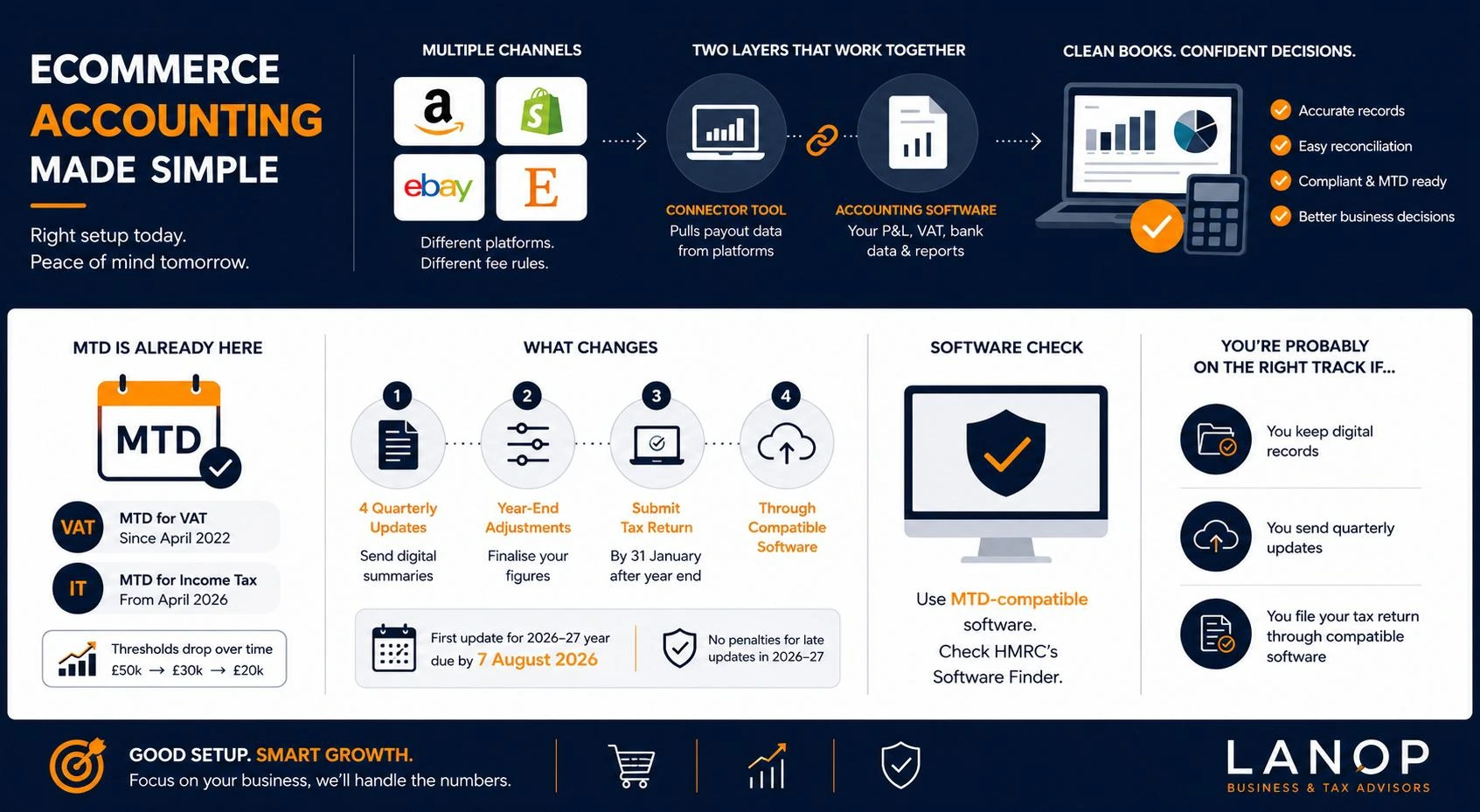
Running a standard shop with UK customers is simple. Ecommerce is not. You might sell on Amazon, Shopify, eBay, and Etsy at once. Each pays on its own terms. Each has its own fee rules.
VAT gets complex fast. If you want expert support from the start, our retail and ecommerce accounting service covers the full range of compliance and financial needs for online sellers.
The Two Layers Ecommerce Sellers Often Use
Think of ecommerce accounting in two parts. The first is your core software. Xero, QuickBooks, Sage, or FreeAgent. Your profit and loss, VAT returns, and bank data all go here.
The second is often a connector tool. A2X and Link My Books are common options for marketplace sellers with complex payouts. These tools sit between your sales channels and your accounting software, pulling payout data from platforms such as Amazon or Shopify and posting cleaner entries into your books. Without a suitable integration or a carefully managed manual process, matching payouts to the bank can become difficult.
MTD in 2026: What You Need to Know
Making Tax Digital is live. MTD for VAT has applied to VAT-registered businesses since April 2022. Businesses within scope must use compatible software to keep digital records and file returns, unless an exemption applies.
From 6 April 2026, MTD for Income Tax applies to sole traders and landlords whose combined qualifying income from self-employment and property was over fifty thousand pounds. The limit drops to thirty thousand from 6 April 2027, and twenty thousand from 6 April 2028. Qualifying income is generally gross income before expenses and is assessed using the relevant earlier tax return.
What MTD Actually Changes
Under MTD for Income Tax, you send four quarterly updates to HMRC each year. Each update is a digital summary of your self-employment or property income and expenses, not a tax return. After the tax year ends, you use compatible software to make any adjustments, add other income and submit your tax return by 31 January following the tax year.
For the first mandatory group, the first quarterly update for the 2026 to 2027 tax year is due by 7 August 2026. HMRC will not issue penalty points for late quarterly updates during 2026 to 2027, although penalties still apply for late tax returns or late tax payments.
You can keep records in a spreadsheet if compatible bridging software connects those records to HMRC. Whether you use one product or more, the setup must maintain digital records, send quarterly updates and submit your tax return through compatible software.
What MTD Means for Your Software Pick
Several tools in this guide offer MTD-capable options, but check that the exact product and version are compatible. HMRC’s software finder lists products that have completed its recognition process. HMRC does not recommend or endorse any software provider.
If you’re already VAT-registered and using software to file, you’re likely already in good shape. The Income Tax side is the new part to check.
Top Best Ecommerce Accounting Software in 2026
Xero: A Strong All-Round Pick for UK Online Sellers
Xero is one of the most widely supported accounting tools for UK ecommerce. Its main strength is its app ecosystem. Xero works with a broad range of add-ons, and many ecommerce connector tools support it.
Xero plans start at seven pounds a month with Simple. For businesses needing standard accounting features, Ignite costs sixteen pounds and allows twenty invoices and ten bills a month. Grow is thirty-seven pounds. Comprehensive is fifty pounds and adds multi-currency, while Ultimate is sixty-five pounds and adds project tracking. Prices exclude VAT and were checked in July 2026.
Where Xero Falls Short
Multi-currency starts on the fifty-pound Comprehensive plan. If you sell in euros or dollars, you pay more. Xero’s built-in stock features may be too limited for large product ranges so that some sellers will need a separate inventory app.
Xero has confirmed another UK price rise from 1 September 2026. Simple will remain seven pounds a month, while Ignite will rise to eighteen pounds, Grow to thirty-nine pounds, Comprehensive to fifty-five pounds and Ultimate to seventy pounds, excluding VAT. Budget for announced increases, not just today’s rate.
QuickBooks Online: A Strong Alternative
QuickBooks Online is used by millions of customers globally. In the UK, it is a widely used alternative to Xero and suits sellers who prefer a clear, guided layout.
QuickBooks discontinued its UK Desktop Pro and Premier products on 30 June 2023. The cloud tool is now the main option. It integrates with hundreds of apps and includes Intuit Intelligence features for tasks such as transaction categorisation and financial workflows. It’s a good fit if your accountant is already set up on QuickBooks.
QuickBooks Costs and User Limits
QuickBooks Online pricing varies by plan, billing option and promotion, so check the current checkout price. User allowances also vary by plan, with larger teams requiring a higher tier. The user limits matter as your team grows.
Like Xero, QuickBooks often benefits from a connector when marketplace payouts combine sales, refunds, fees and taxes. Depending on your sales platform and volume, a tool such as A2X or Link My Books can make reconciliation cleaner, but it is not a universal requirement for every seller.
Sage: Strong UK Roots and Native Stock Tools
Sage has been in UK accounting for decades and supports UK VAT workflows. Its regular prices after the introductory offer are twenty pounds a month for Start, forty-three pounds for Standard and fifty-nine pounds for Plus, excluding VAT. Standard adds features for suppliers, CIS, reporting, quotes and cash flow, while multi-currency and inventory are included in Plus.
Sage Plus includes native inventory tools, which may suit product-heavy sellers who prefer to manage stock inside their core accounting software. Businesses with large or complex product ranges should still compare its inventory depth with dedicated stock systems before deciding.
Who Should Use Sage
Sage suits UK sellers who want UK-focused compliance support and may also work well for businesses with staff. Payroll is included in all three Sage Accounting plans. Start and Standard include one employee, while Plus includes five, with an additional monthly charge for extra employees.
Before choosing Sage, confirm that every third-party app and ecommerce platform you rely on has the integration you need. This is particularly important for sellers operating across several marketplaces.
FreeAgent: A Practical Option for Smaller Sellers
FreeAgent is a UK tool built for sole traders and small businesses. NatWest Group owns it. Eligible NatWest, Royal Bank of Scotland, Ulster Bank and Mettle business account holders can get FreeAgent free, although optional add-ons may still be charged.
For ecommerce, FreeAgent has a native Amazon UK link. It costs six pounds a month plus VAT as an add-on. Shopify and other channels can connect through third-party integrations. Available features can depend on the business type and accounting basis selected.
When FreeAgent May Not Be Enough
FreeAgent does not set a hard usage restriction on its Amazon integration. Still, the practical upper limit is around two hundred orders a day, roughly six thousand in a thirty-day month, because of the volume imported through Amazon’s API. High-volume or multi-channel sellers should test whether the workflow meets their needs.
If you’re a sole trader selling online, it helps to have proper compliance support alongside your software. Our sole trader accounting services cover everything from software setup to quarterly VAT and tax returns. As you grow, you may need to move beyond FreeAgent or add other specialist tools.
A2X and Link My Books: When a Connector Helps
If you sell on Amazon, Shopify, eBay or Etsy, a connector can save time when payouts contain many separate elements. A2X and Link My Books are two common options. Both can turn raw marketplace payout data into cleaner entries in your books.
A2X splits payouts into sales, refunds, fees and taxes, and can post to systems including Xero, QuickBooks, Sage and NetSuite. Its individual plans vary by ecommerce platform, monthly order volume and number of stores, with some plans starting at around twenty-nine US dollars a month. Multi-channel subscriptions are also available.
Link My Books vs A2X: How Pricing Differs
Link My Books recommends plans using both average monthly order volume and the number of connected sales channels. A2X offers both individual platform plans and multi-channel subscriptions, so total cost depends on the exact platforms, stores and order volumes involved.
Both tools support ecommerce reconciliation, but setup, VAT mapping, supported channels, order limits and total cost vary. Compare your exact sales channels, regions and accountant workflow before choosing rather than assuming one option will always be cheaper or easier.
Free Options: What They Can and Cannot Do
Free tools exist but have real gaps. Wave’s current product information does not confirm a UK-specific MTD filing workflow or built-in marketplace reconciliation. Zoho Books has a free tier and supports MTD for VAT and Income Tax, although it is not designed specifically for complex multi-channel marketplace accounting.
Before relying on any free product, confirm the exact HMRC-compatible features, supported business type and transaction limits. Zoho Books states that MTD for Income Tax is available on all plans, although eligibility and supported property scenarios are subject to its current product conditions.
VAT for UK Ecommerce Sellers: The Gap in Most Guides
VAT gets complex when you sell into the EU. Post-Brexit, the rules on cross-border VAT depend on where your stock is stored and how your goods are sold.
The One Stop Shop scheme can let eligible businesses report qualifying cross-border B2C EU VAT through one Member State, reducing the need for multiple registrations. It does not remove every local VAT obligation. Stock stored in EU warehouses, domestic supplies and some Amazon FBA arrangements can still create local registration requirements. Your software and connector setup must handle the transactions correctly.
Getting this right matters. VAT returns for ecommerce sellers service covers cross-border VAT, MTD filing, and full HMRC compliance for online businesses. If you use Amazon FBA and store goods in EU warehouses, the rules are even more specific. Get advice before you scale into EU markets.
Multi-Channel Selling: What to Look For
Selling on four platforms at once is common. The challenge is getting clean data from each into one set of books. Look for tools that post one summary entry per channel, not one line per sale. That keeps things tidy and makes bank matching faster.
Avoid setups where each sale posts as a raw line in your bank feed. At volume, that turns into a mess very fast.
Stock and Cost of Goods: A Separate Problem
Basic accounting tools track stock at a surface level. If you hold hundreds of products or ship from more than one warehouse, you’ll need a dedicated stock app on top.
Tools like Cin7 or Linnworks can handle more detailed inventory workflows and feed data into Xero or QuickBooks. It adds cost, but it may be worthwhile for larger sellers. Getting cost of goods right is essential if you want to understand true profit by product.
If you’d rather not manage the bookkeeping side yourself, Lanop’s outsourced bookkeeping services in the UK can handle all of this for you. They use Xero and QuickBooks and give you real-time access to your numbers without the manual work.
Choosing the Right Ecommerce Accounting Software by Business Needs
Smaller or lower-volume sellers with straightforward UK sales may find Xero Ignite or FreeAgent suitable, adding Link My Books only where their marketplace reconciliation requires it. Eligible NatWest or RBS users should consider the included FreeAgent account first. Lanop’s small business accounting services UK are a good option if you want expert support alongside your software from day one.
Growing multi-channel sellers may consider Xero Grow or QuickBooks, with A2X or Link My Books where marketplace reconciliation requires it. Plan for any connector cost on top of the core software fee. Order volume, channels, VAT complexity and stock needs matter as much as turnover.
High-volume or operationally complex sellers may need Xero at a higher tier or Sage, a suitable connector setup, a dedicated stock tool, and an ecommerce accountant involved in the books and tax filing. Turnover alone should not determine the setup. Transaction volume, warehouses, channels and cross-border VAT are also important.
Quick Summary: Where Each Tool May Fit
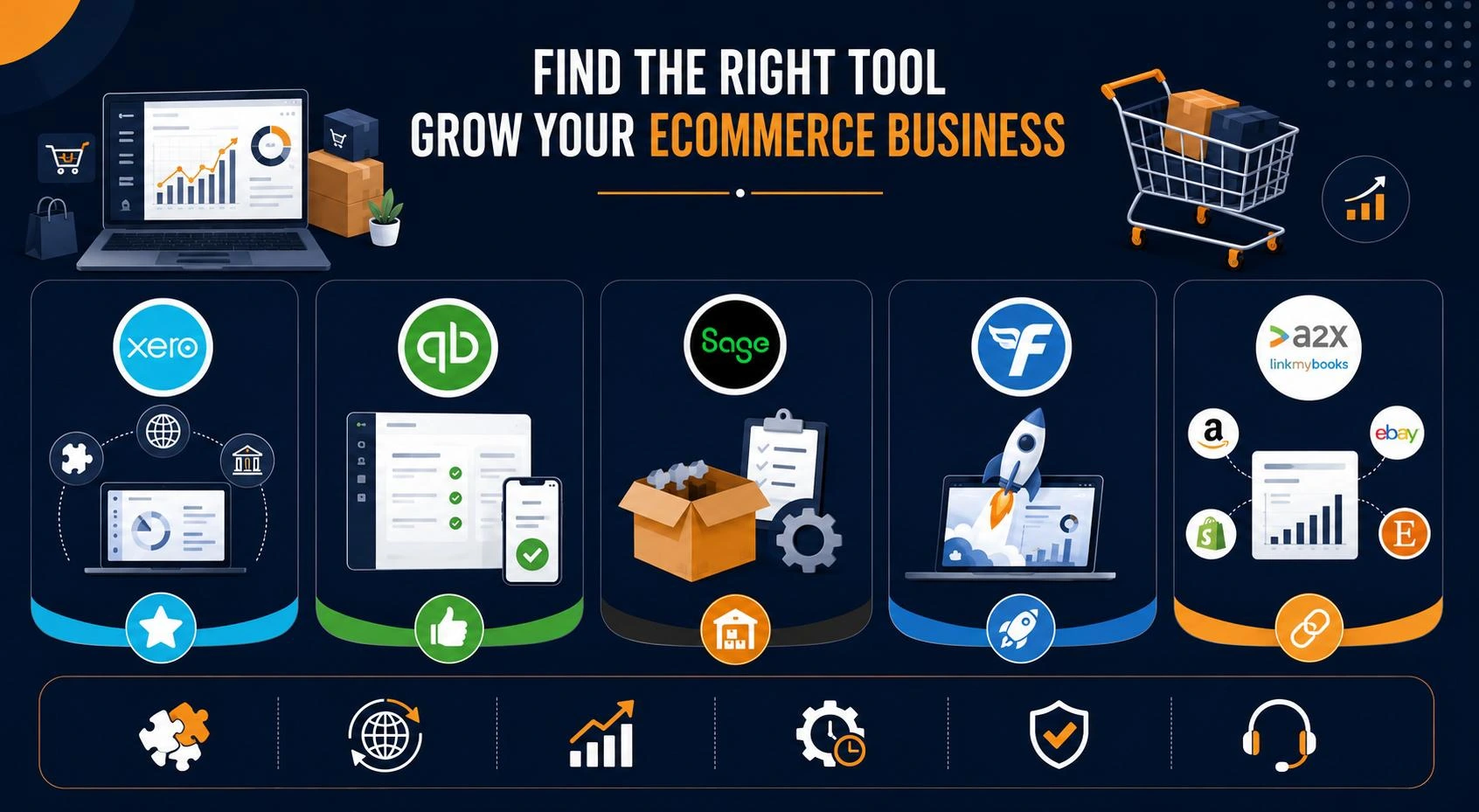
- Xero is our all-round pick for many UK ecommerce businesses. It has a large app ecosystem and no general user cap. Watch the tier you need for multi-currency, projects and other advanced features.
- QuickBooks Online is a strong alternative with broad app support. It suits sellers who want a guided layout or already work with an accountant using QuickBooks. Watch the user limits as your team grows.
- Sage may suit UK sellers who want native inventory in the Plus plan and payroll included in the accounting package. Confirm all required ecommerce integrations before committing.
- FreeAgent is a practical entry point for sole traders and small sellers, especially eligible NatWest Group and Mettle business account holders. Its Amazon integration has a practical daily order limit.
- A2X and Link My Books can be valuable for marketplace sellers with complex payouts. Compare supported channels, order limits, store limits, VAT workflows and total cost before choosing.
Getting Your Setup Right
Picking the right tools is only part of it. Getting the setup correct, handling VAT properly, and keeping books that hold up in an HMRC check all matter just as much.
Lanop Business and Tax Advisors works with online sellers across the UK. Our team of chartered accountants can help you pick the right software, get it set up correctly, and handle your VAT and MTD filing on your behalf.
Our cloud-based online accounting services cover everything from Xero setup to year-round compliance for ecommerce businesses of all sizes. If you’re not sure where to start, that’s a good place to start the conversation.
Frequently Asked Questions
Standard tools like Xero and QuickBooks can work for ecommerce. A connector such as A2X or Link My Books is often helpful when marketplace payouts combine sales, fees, refunds and taxes, but it is not mandatory for every seller. The right setup depends on the platform, volume and quality of the available integration.
Usually not for a complex multi-channel seller. Wave’s current product information does not confirm a UK-specific MTD filing workflow or built-in marketplace reconciliation. Zoho Books supports MTD for UK filing, including on its free plan, but its suitability depends on your business type, channels and transaction volume.
It means businesses within scope must use compatible software that has completed HMRC’s recognition process. MTD for VAT already applies to VAT-registered businesses unless an exemption applies. From 6 April 2026, MTD for Income Tax applies to sole traders and landlords with combined qualifying income over fifty thousand pounds.
Both link sales channels to accounting software and help break down marketplace payouts. A2X pricing varies by platform, order volume and store count, with individual and multi-channel options. Link My Books pricing considers both order volume and the number of connected channels. Compare your exact setup rather than assuming one is always cheaper.
You must register if your total taxable turnover for the last twelve months goes over ninety thousand pounds, or if you expect it to go over ninety thousand pounds in the next thirty days. If you use Amazon FBA, additional rules may apply depending on where your stock is held. Get advice before you reach the limit, not after.
Yes. A spreadsheet can be used to keep digital records if compatible bridging software connects those records to HMRC. The software setup must be able to send the required MTD submissions and, for Income Tax, submit the tax return.