
British citizens can live in Malta, but only with an approved residence route. That’s the first thing to know if you’re moving to Malta from UK. Second, immigration permission and tax residence are separate matters, so a permit doesn’t switch off your UK tax duties. Malta also changes its special tax programs on 1 January 2027, so timing matters more than usual. Here’s what to sort out on residency, pensions, companies, property and inheritance.
Can You Move to Malta from the UK After Brexit?
Yes, as long as you hold the right permission. Free movement ended with Brexit, which changed the rules for moving from the UK to Malta. People often ask whether you can move to Malta from the UK without a job. Often, you can. It just depends on the route.
For short visits, you can stay up to 90 days in any 180 days within the Schengen area. Beyond that, you’ll need a residence permit.
Which Malta Residence Route Could Suit You?
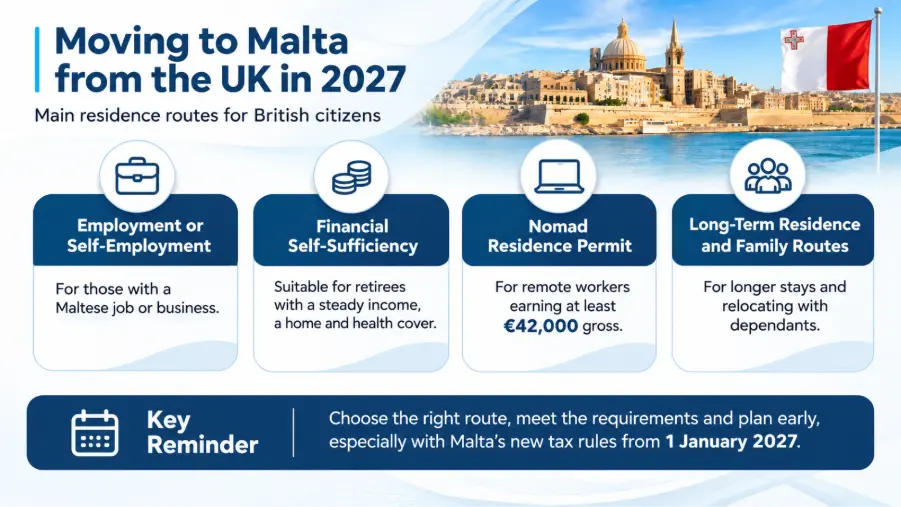
Moving to Malta from the UK requirements change with each route, and so do the Malta residency requirements UK applicants must meet. Roughly, your options look like this:
- Employment or self-employment, tied to a Maltese job or business.
- Financial self-sufficiency, which suits many retirees who can show steady income, a home and health cover.
- The Nomad Residence Permit, for remote workers paid from abroad who earn at least €42,000 gross.
- Long-term residence and family routes, which build on years of stay and dependants.
A good starting point is how you earn your money. Once you know that, check the current rules with Identità and Residency Malta.
What Are Malta’s New Tax Rules for UK Expats in 2027?
If you’re moving to Malta from UK and want special tax status, you’ll apply under the Individual Tax Program Rules, 2026 from 1 January 2027. Malta published them as Legal Notice 195 of 2026 on 14 July 2026. The headline Malta tax benefits for UK expats sit inside this optional program, so you don’t get them just by living there.
What Changes Under Malta’s Individual Tax Program?
Four older schemes now sit inside one framework with four statuses: Global Resident, EU, EEA or Swiss Resident, Retired Pensioner and UN Pensioner. Most British citizens would look at the first or the third.
The minimum annual tax goes up. Global Resident status moves to €35,000 from €15,000, while Retired Pensioner status moves to €15,000 from €7,500. You’ll also need to buy property worth €700,000 or rent for €14,000 a year.
Status lasts five years and then needs renewing. Qualifying foreign income that you bring into Malta keeps the 15% rate. Check each figure with the Malta Tax and Customs Administration before you commit.
Don’t mix this up with ordinary tax residence. That means Malta taxes you as a resident under its normal rules.
Should You Apply Before 31 December 2026?
If you’re granted status, or apply on or before that date, you keep the current rules until 31 December 2031.
That doesn’t make rushing a smart move for everyone. Not every British citizen qualifies, and you need a real plan to live in Malta. If your foreign income is modest, ordinary rules might cost you less than a fixed minimum tax. Run the numbers first, ideally with proper tax planning.
How Do You Stop Being a UK Tax Resident When Moving to Malta?
You have to pass HMRC’s Statutory Residence Test. The leaving UK tax residency rules look at your days, your ties and your work, so moving house alone isn’t enough.
How the Statutory Residence Test Works
The test has three parts. Automatic overseas tests can show you’re not resident, and automatic UK tests can show you are. If neither settles it, the sufficient ties test decides, weighing your family, accommodation, work and past UK days.
A common myth says fewer than 183 days means you’re non-resident. It doesn’t. If you keep a UK home and close family here, even fewer days can leave you exposed.
What Happens When You Leave During a UK Tax Year?
The UK tax year runs from 6 April to 5 April. Split-year treatment can divide it into a UK part and an overseas part, but only in set cases, such as starting full-time work abroad. If you leave in March instead of April, the result might change.
Telling HMRC You Have Left
Let HMRC know by sending form P85 when you go. If you file Self-Assessment, fill in the residence pages (SA109) too. Keep a simple log of departure dates, UK visits, and working days.
How Much Tax Will You Pay in Malta in 2027?
Malta taxes residents on a progressive scale that reaches 35% above €60,000. Budget 2027, delivered on 26 October 2026, left headline rates unchanged, setting Malta tax rates for 2027 for most single taxpayers. UK citizens who gain Malta tax residency by living there don’t need a special program either.
How Does Malta Tax Foreign Income?
Most newcomers are resident but not domiciled in Malta, so the remittance basis applies. That means Malta taxes foreign income only when you bring it into Malta, and it doesn’t tax foreign capital gains at all.
Don’t read that as tax-free, though. Income you remit is taxed at ordinary rates, or 15% under special status.
What About Your UK Savings?
Moving your own capital isn’t normally income, but the interest it earns is. Keep capital and interest in separate accounts and hold statements showing where each transfer came from.
Will You Pay Tax in Both the UK and Malta?
Not usually, though you may have to file in both countries. The UK-Malta double taxation agreement shares out taxing rights and gives credit relief, and our international and offshore accounting team handles these cross-border filings regularly. If both countries claim you as a resident, treaty residence rules settle the clash.
The treaty doesn’t remove your filing duties. You may still file a UK Self-Assessment and claim relief.
What Happens to Your UK Pension When You Move to Malta?
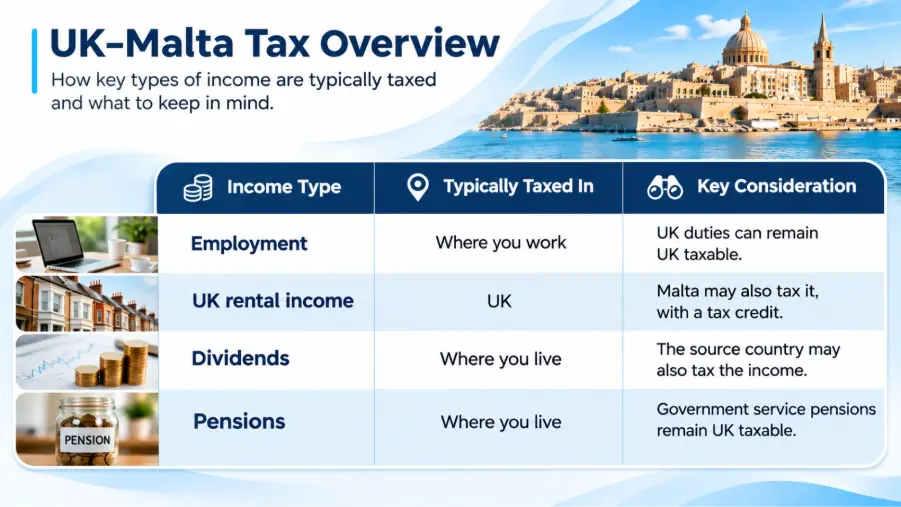
Malta taxes most UK State and private pensions once you live there. Government service pensions, like civil service, police and most teachers’ pensions, usually stay taxable in the UK. There’s a catch too. Pension income you don’t bring into Malta can stay taxable in the UK.
Malta is generous here. From 2026, residents aged 61 and over can exempt pension income up to €37,104 a year, and Budget 2027 announced a rise of €520 to €37,624. That exemption shapes the UK pension tax Malta residents pay.
Should You Transfer Your UK Pension to Malta?
You’ve got three choices: leave it in the UK, draw income abroad, or move it into a Malta QROPS. A UK pension transfer to Malta can trigger a 25% overseas transfer charge. Since 30 October 2024, the main workaround is living in the same country as the QROPS and staying there for five tax years.
Please don’t move or withdraw anything without individual, regulated advice, and consider how it fits into your wider financial planning.
Can You Keep Your UK Limited Company While Living in Malta?
You can, but your move doesn’t relocate the company. A UK company stays UK resident. Malta may claim it too if key decisions are made there, a test called central management and control. Treaties often settle that clash by looking at place of effective management.
A director working from Malta could even create a permanent establishment there.
Salaries and Dividends
Malta may tax pay for work done there, so payroll and social security need careful handling. UK companies don’t usually withhold tax on dividends, but Malta may tax them when you remit them.
UK Company or Maltese Company?
It comes down to where your clients are, where you work, real substance, and cost. A cross-border tax review is worth having before you move, and our Malta business setup service can walk you through setting up a Maltese company.
What Happens to Your UK Property, Savings and Investments?
Renting Out Your UK Home
You can keep and rent out your UK home, but UK tax still applies. Under the Non-Resident Landlord Scheme, agents or tenants may deduct basic rate tax unless HMRC approves gross payments, and specialist landlord accounting support can help you handle the paperwork. You report the income through Self-Assessment, and Malta may tax it too, with treaty credit.
Selling Before You Leave
If you sell UK property as a non-resident, you must report it to HMRC within 60 days of completion. Temporary non-residence rules can also tax some gains if you come back within five years.
Existing ISAs keep their UK tax-free status, but you can’t add new money once you’re non-resident. So, review any major sales before you set a departure date.
Property Costs in Malta
Malta property tax for expats mostly means stamp duty, usually 5% of the transfer value.
Will UK Inheritance Tax Still Apply After Moving to Malta from UK?
For a while, yes. Since 6 April 2025, UK Inheritance Tax follows long-term residence. If you lived in the UK for 10 of the last 20 tax years, your worldwide estate can stay exposed for 3 to 10 years after you leave, which is why inheritance tax planning matters before you go.
Malta has no general inheritance tax, though duties can apply to some transfers, such as property. So, the Malta inheritance tax UK expats worry about is mostly a UK issue.
What Changes for UK Pensions from April 2027?
The Finance Act 2026 brings most unused pension funds and death benefits into the estate for deaths on or after 6 April 2027. It’s wise to review wills, beneficiaries and pensions together before you leave, as part of wider estate planning.
Is Moving to Malta Financially Worth It for UK Residents?
How the Two Countries Compare
Whether moving to Malta from the UK is profitable depends on your income sources. Malta’s top rate is 35% above €60,000; its pension exemption is generous, and foreign income is taxed only when remitted. On the other side, healthcare often means private cover.
Budget 2027 also announced that free childcare and public transport go to Maltese, EU and long-term resident households, not British families. On the bright side, UK citizens are exempt from the new €83 monthly driving license charge.
Who Gains Most
Retirees with eligible pensions often gain the most. Business owners need real substance in Malta, and investors need a remittance plan. Tax savings shouldn’t be the only factor, because rent, healthcare and family ties count too.
Your 2027 Checklist for Moving to Malta from the UK
Here’s how to move to Malta from the UK, step by step:
- Confirm your Maltese residence route.
- Review the 2027 tax rules and the 31 December 2026 deadline.
- Test your UK residence position.
- Assess pensions, assets and business interests.
- Plan HMRC reporting, including P85 and Self-Assessment.
- Arrange accommodation, healthcare and Maltese registrations.
- Track UK visits and tax reporting after you move.
If you’re moving from the UK to Malta, keep proof of every step.
Frequently Asked Questions About Moving to Malta from the UK
Yes, if you qualify as self-sufficient or hold a Nomad Residence Permit. You’ll need to show income, a home, and health cover.
There’s no single safe number. If you were recently a UK resident, you can pass an automatic test with fewer than 16 days, but your ties can change the limits.
No. Foreign income you remit is taxable, though foreign capital gains aren’t. Income from UK sources stays taxable in the UK.
Yes, but keep an eye on where key decisions are made, so Malta doesn’t claim control of the company.
Mostly yes, though residents aged 61 and over can be exempt up to €37,104. Government service pensions stay taxable in the UK.
Not straight away. Long-term residence rules can keep your estate exposed for 3 to 10 years, and UK property stays in scope.
Planning Your Move to Malta in 2027? Get Your Tax Position Right First
So, can you make the move to Malta while keeping your finances in order? You can, with the right plan. That plan depends on your income, assets, UK residence history, and long-term goals.
If you’re retired, review pension tax, transfer charges, and estate planning before April 2027. Business owners should review company residence, payroll, and dividends. If you own property or investments, check UK rental income, asset sales, remittances, and Inheritance Tax. If you’re an employee or remote worker, confirm your residence permission, income tax, and social security.
It is far more expensive to sort out issues after you have gone than before you move to Malta from the UK, knowing that you will be relocating in 2027. LANOP can assist you in reviewing your UK tax position, understanding your cross-border obligations, and planning your way forward. Contact Us to book a free consultation and discuss your situation.