For UK high-net-worth individuals, relocating to Malta is no longer just a lifestyle choice. For UK high-net-worth people, it is a smart tax and wealth-planning move first.
Warm winters help. So do English-speaking towns and easy access to Europe. But the key question matters more: will the move protect your wealth, or quietly create new risks?
This guide shows you how to move to Malta from the UK, step by step. You’ll see how Malta business and residency setups work. You’ll see what happens to your UK tax. And you’ll see where people go wrong.
We wrote this for business owners, investors, retirees and families. So read it as a planning tool, not a brochure.
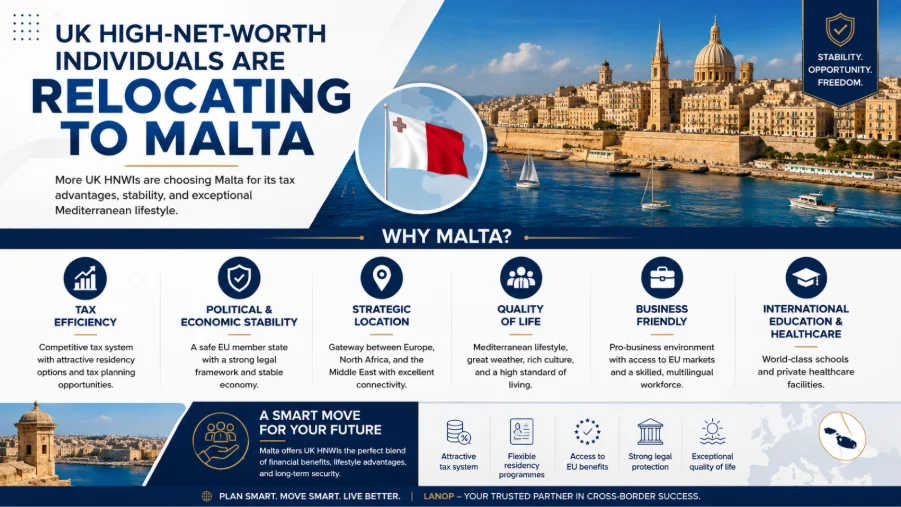
Why UK High-Net-Worth Individuals Are Relocating to Malta in 2026
What has changed for UK residents in recent years
Brexit changed things for UK nationals. You now need a permit to live in Malta long-term.
The UK is now treated as a third country. That changes which Malta programmes apply to you. It also changes how fast you can move.
The main benefits of moving to Malta
Malta has English as an official language. It sits in both the EU and the Schengen area.
A valid Maltese permit can support short travel within Schengen. The usual 90-day rules still apply outside Malta.
The main tax benefit is a 15% rate. It covers qualifying foreign income that you bring into Malta under an approved programme.
Add good weather and a small island. Daily life can feel easy fast.
Who Malta is best suited for
Malta suits retirees with foreign pensions. It suits business owners who can work from home.
It suits investors who want an EU base. And they can keep their UK ties. It also suits families who want English-speaking schools.
When Malta may not be the right choice
Is most of your income UK-sourced? Is it hard to move? Then Malta’s tax perks shrink fast.
Do you need daily access to UK specialist care? Does your business need a steady UK base? Weigh these points first.
Before Relocating to Malta: What Every UK Resident Should Plan First
Review your UK tax residency status
Your UK tax residency sets what HMRC expects from you. Your Malta plans do not.
So get this checked before you book flights, not after. Try to make it part of wider tax planning, not a last-minute look.
Understand the Statutory Residence Test
The Statutory Residence Test, or SRT, sets one thing each year. It sets whether you’re a UK tax resident. It weighs your UK days against ties like family, work and property.
Miscounting your days is a common slip. It is a costly one too.
Consider split-year treatment before leaving
Split-year treatment can split a UK-resident tax year. It creates a UK part and an overseas part. For most cases, the overseas part is treated as non-resident.
But it only applies when one of the statutory cases is met. You cannot simply choose it. So check the terms early.
Review your UK assets and investments
List your property, ISAs, pensions, shares and business interests. Do this before you move.
Each one is treated differently once you leave the UK tax system.
Decide what to restructure before you move
Some assets work better if you sell or change them first. Do this before you become a Malta tax resident. Also, get the timing wrong. Then you could pay UK tax you didn’t need to.
Prepare the papers you will need through the move
Gather your passport, proof of income, bank statements, cover and property papers early. A full file speeds up your Malta claim from day one.
Choosing the Right Malta Residency Route
Employment and Other Residence Permits
UK nationals moving after Brexit must use a non-EU route. A job often needs a work and residence permit.
Economic self-sufficiency is mostly tied to an approved Malta tax or investment programme. These routes do not hand you a special tax rate on their own.
Malta Global Residence Programme (GRP)
The GRP is built for non-EU, non-EEA and non-Swiss nationals. This takes in most UK applicants moving after Brexit.
It gives a 15% rate on qualifying foreign income received in Malta. A minimum yearly Malta tax of €15,000 applies to the beneficiary and covered dependants.
You’ll also need qualifying property. The purchase threshold is €275,000 in most of Malta. It drops to €220,000 in the south of Malta or Gozo.
The yearly rent threshold is €9,600 in most areas. It falls to €8,750 in the south or Gozo.
Malta Permanent Residence Programme (MPRP)
The MPRP grants permanent residence status. It does not give the GRP’s special personal tax rate.
Residence cards and ongoing checks still need care. It suits people who want a long-term base for themselves and eligible family members.
Malta MPRP 2025 reform changes explained
Here are the Malta MPRP 2025 reform changes explained. For claims under the rules in force from 1 January 2025, you need assets of at least €500,000. That takes in €150,000 in financial assets.
Or you can show €650,000, which takes in €75,000 in financial assets. The qualifying property threshold is €375,000 to buy anywhere in Malta or Gozo. The lowest yearly rent is €14,000.
The programme rules were changed again in July 2025. So, use the current consolidated rules and your licensed agent’s checklist before you apply.
Which residency option is right for you
Want special tax status on qualifying foreign income? Then look at the GRP.
Want permanent residence status for eligible family members? Then look at the MPRP.
A job-based or other permit may fit better where the move is driven by work. Many HNWIs pair one of these with UK exit planning too.
| Feature | GRP | MPRP |
|---|---|---|
| Purpose | Special tax status and residence route | Permanent residence status |
| Tax rate | 15% on qualifying remitted foreign income | No programme-specific personal tax rate |
| Minimum annual tax | €15,000 for beneficiary and covered dependants | No programme-specific annual minimum tax |
| Property threshold | €220,000-€275,000 purchase or €8,750-€9,600 annual rent | €375,000 purchase or €14,000 annual rent |
| Renewal | Status subject to annual compliance | Permanent status; card and compliance formalities apply |
| Best for | Tax planning on qualifying foreign income | Permanent residence for eligible family members |
How to Relocate to Malta from the UK Step by Step
Step 1: Set your goals for the move
Decide why you’re moving. Tax savings? Lifestyle? Family? Business growth? Each goal points to a different route.
Step 2: Review your UK tax status
Check where you stand on UK tax. Work through your SRT status. Check your split-year fit too.
Do all of this before you apply for anything in Malta.
Step 3: Pick the right residency programme
Compare the GRP, the MPRP and any job-based route that fits your facts. Base the choice on your goals, budget, work and long-term plans.
Step 4: Gather your documents
Gather your papers. Collect financial statements, proof of funds, cover and background checks.
The MPRP needs a licensed agent, so bring one in early.
Step 5: Find a place to live in Malta
Find a place to live. Rent or buy, based on your programme’s property rules.
Step 6: Submit your residency application
Send in your claim once the file is complete. Time varies by route, due diligence and the facts of the case.
Missing or mismatched papers can cause delays.
Step 7: Relocate your finances and personal assets
Move your money. Open a Malta bank account. Set up currency transfers. Update your investments once your status is confirmed.
Step 8: Complete your arrival steps
Finish your arrival steps. Register your address. Collect your residence card. Sign up for Maltese tax on time.
Malta Tax Residency for UK Nationals
When you become a Malta tax resident
Malta tax residence is a question of fact. Spending more than 183 days in Malta often makes you tax resident for that year.
But you may count as resident from your arrival date if you come to set up home there. A permit helps your immigration status. It does not decide tax residence on its own.
When UK tax residency ends
UK tax residency doesn’t end the moment you land in Malta. The Statutory Residence Test sets your status for each UK tax year.
Split-year treatment only applies if its detailed terms are met.
How the UK–Malta Double Taxation Agreement works
The UK-Malta Double Taxation Agreement, or DTA, does not remove each cross-border tax charge. It shares out taxing rights and gives treaty relief. It can also give credit where both countries tax the same item.
Your residence, income type and remittance status still matter.
How foreign income is taxed in Malta
Under the GRP, qualifying foreign income received in Malta is taxed at 15%. The €15,000 yearly minimum still applies.
Foreign income that you do not bring into Malta is mostly outside Malta tax under the remittance basis. Malta-source income and other types follow their own rules.
How capital gains are treated
Say you are taxed in Malta on the remittance basis. Then your foreign capital gains are mostly not taxed in Malta, even when you bring the proceeds in.
Malta-source gains and UK rules can still apply. So check the asset and timing before a sale.
How pensions are taxed
Treaty treatment depends on the pension type. Most private pensions paid for past work are taxed only in the country where you live.
UK government-service pensions mostly stay taxable in the UK, unless the treaty exception applies. The State Pension, lump sums and scheme-specific payouts need their own check.
Tax points for company owners and investors
Keeping a UK company does not split its tax status from your move. A UK-registered company often stays UK tax resident.
But running it from Malta can also create issues. Think Maltese residence, a permanent establishment, payroll, or treaty problems. So get cross-border advice before key choices move.
Common UK tax mistakes to avoid before you move
Miscounting UK days is a common slip. So is assuming split-year treatment applies on its own.
Temporary non-residence rules can also pull certain income and gains back into charge if you return after a short break. Remittances into Malta need planning too.
Managing Your Wealth Before and After Relocation
Should you keep or dispose of UK property?
Keeping UK property can affect your SRT ties. It can affect your ongoing UK tax too. UK rental income stays taxable in the UK. And non-resident capital-gains rules can apply on a sale.
So the timing and reporting status need checking before and after the move.
Your investment portfolio after you move
Your portfolio’s tax treatment can shift once you’re a Malta resident. Check your fund’s home base. Check the income type. Check the reporting status too, with your adviser.
What happens to ISAs and pensions
You can often keep an ISA after you become non-UK resident. It keeps its UK tax relief. But you mostly cannot add new money while non-resident. And Malta may not accept the ISA’s UK break. Furthermore, pensions need their own check.
Estate and inheritance planning
Malta does not charge a standalone inheritance tax. But duty or other charges can arise on some transfers. UK inheritance tax can still apply.
From 6 April 2025, the main test is long-term UK residence. It is not domicile alone. That is why inheritance tax planning should sit next to any move.
Managing trusts and family wealth structures
Got a UK trust? It may need a check once you move. Who runs it matters. Who set it up matters.
Where those who benefit live matters too. This is often where succession planning work overlaps with the move itself.
Currency and cross-border banking
Moving large sums from GBP to EUR carries exchange rate risk. Where you can, move funds in stages. Don’t move it all in one go.
Buying Property in Malta as a UK National
Can UK citizens buy property in Malta?
Yes, UK nationals can buy property in Malta. As third-country nationals, they will mostly need an Acquisition of Immovable Property permit, unless a break applies.
One example is a qualifying purchase in a Special Designated Area.
Malta property purchase requirements for residency
The Malta property purchase requirements for residency set different minimums by programme. GRP thresholds range from €220,000 to €275,000, based on location.
The MPRP uses a €375,000 purchase threshold.
Buying versus renting before settling
Renting first can help you test the area before you buy. Choose the term around your programme, claim timeline and landlord-registration rules. Don’t rely on a fixed six- or twelve-month rule.
Legal due diligence before purchasing
Check title, planning status, permits, burdens and any ground-rent terms. A Maltese notary handles the public searches and deed process.
Even so, get your own legal and tax advice before you sign.
Property taxes and ongoing ownership costs
Budget for stamp duty, notary fees, and ground rent where it applies. Add yearly upkeep too. These costs add up fast.
Common property buying mistakes
One common slip is committing too early. That means before you confirm your route, AIP status and qualifying-property rules. So is skipping due diligence or lowballing repair and ownership costs.
Opening a Malta Bank Account as a UK National
Who can apply
Malta banks set their own sign-up rules. They often want a clear Malta link, ID, address proof, tax-residence details and a clear source of wealth or funds.
So check the chosen bank’s rules before you apply.
Documents banks commonly request
Expect to give your passport, proof of address, tax ID details and proof of the source of funds and wealth. Banks may also ask for account statements, work or business records, and more. It depends on the risk.
Source of wealth and AML checks
Malta banks run anti-money laundering and customer due-diligence checks. So be ready to explain and prove how you built your wealth. And where the money came from.
Why applications are delayed
For a Malta bank account UK national claim, delays can arise when the proof is thin or does not match up. That covers source-of-funds, source-of-wealth, address or tax-residence proof.
So, prepare a clear paper trail before the bank asks for it.
Choosing the right banking solution
Compare Maltese banks, global banks and regulated payment providers. Look at services, deposit cover, currencies, lending and fees.
Then check whether the bank accepts your residence and tax profile.
Running UK and Malta banking together
Keep UK accounts only where the bank’s non-resident policy allows it. A two-country setup can make payments easier.
But it also creates new checks. Think reporting, address and tax-residence checks. So, confirm the terms before you move anything.
Healthcare in Malta for UK Expats
Public healthcare access
Access to the Malta healthcare system for a UK expat depends on two things. One is your status. The other is your right to use it. You may qualify through Maltese social-security payments. A registered UK S1 form can work too. So can another accepted route.
It is not automatic for each UK national who moves.
Private healthcare options
Private care and insurance are widely on offer. Some families use them alongside public cover.
Compare provider networks, exclusions, excesses and cover for ongoing conditions. Do that before you rely on a policy.
Health insurance rules
GRP and MPRP applicants need full health insurance that meets the relevant programme rules. Public-healthcare cover may help in practice.
Even so, the claim proof must still satisfy the responsible body.
Getting medical care after you move
You do not mostly need to register with one GP in Malta. Use the local health centre or a private provider.
Keep your residence and cover documents handy for appointments and prescriptions.
Healthcare for retirees
Retirees should check one thing closely. Does your policy cover past conditions? Check this before you rely on it long term.
Cost of Living in Malta for UK Expats
Malta cost of living for UK expat budgets needs real numbers, not vague averages. So, here’s what drives the cost.
Housing costs
Housing costs vary sharply by area, property type and season. Central harbour spots such as Sliema and St Julian’s often cost more in rent. That holds against many parts of Gozo or the south.
Check current listings rather than island-wide averages.
Utilities and household expenses
Utilities depend on property size, how many live there, tariff and cooling use. Ask for recent bills before you rent or buy.
Budget for seasonal swings rather than one flat monthly figure.
Healthcare costs
Private insurance prices vary by age, medical history, excess, benefits and area cover. Get written quotes for each family member.
Then check exclusions before you use a figure in your budget.
Education expenses
International school fees vary by school, year group, transport, and extra activities. Get the current fee schedule straight from each school.
Budget on your own for registration, uniforms and trips.
Transportation and daily living costs
Transport needs depend on where you live and work. Compare bus routes and journey times against parking, vehicle, registration, fuel and insurance costs.
Do that before you decide whether to own a car.
Lifestyle costs for high-net-worth families
Private clubs, marina berths, premium housing and frequent dining can push costs up quickly. So build the budget around your real lifestyle, not a generic online average.
Relocating Your Family to Malta
Residency options for spouses and dependants
The GRP and MPRP can take in eligible family members, but the terms and fees differ. Under the MPRP, certain adult children must be unmarried, mainly dependent and under 29. That is tested when you send in the main claim.
Education and international schools
Malta offers English-language and international-school options. Places, entry rules and fees vary. So contact schools early and do not assume there is space.
Family healthcare
Check that each family member has cover, not just the main applicant.
Long-term residency planning
Think ahead. Each family member must keep meeting the relevant programme rules.
Under the MPRP, adult-child eligibility is tested when you make the claim. It looks at age, marital status and dependency terms.
Running a Business After Relocating to Malta
Keeping a UK business after relocation
You can keep a UK company after you move. A UK-registered company often stays UK tax resident.
But choices made from Malta can create new duties. Think Maltese tax residence, a permanent establishment, payroll, or social security. So review how it’s run before the move.
Establishing a Malta company
Setting up a Malta company can suit some owners. It fits those who reshape around their new base. But it needs joined-up legal and tax advice, sound commercial reasons and group structuring that keeps both countries aligned.
Corporate tax points
Malta’s imputation and shareholder-refund system can lower the effective Malta tax. It applies to some paid-out profits. The result depends on the income account, shareholder status, anti-avoidance rules and UK interaction.
So, model it before you set it up.
Running cross-border operations
Run a business across two countries, and new questions come up. Think pricing between related firms, a taxable base abroad, and reporting rules. Moreover, sort these out before you move.
Economic substance
Tax bodies look at where key choices, people, functions and risks sit. A paper company or nominal board may not support the claimed Malta tax residence or treaty status. So, build the way it’s run around real activity.
EU Entry Exit System Malta: What UK Nationals Need to Know
What the Entry/Exit System is
The EU Entry/Exit System in Malta replaced manual passport stamping for eligible short-stay travellers. It records entries, exits and refusals on a system. It uses travel document data, a face image, and fingerprints.
Who the system applies to
It applies to eligible non-EU nationals, including UK visitors, travelling for a short stay. The phased rollout began on 12 October 2025. The system became fully live on 10 April 2026.
How residency changes EES rules
Holders of valid residence permits, and long-stay visas sit outside the EES system. Carry the right residence document when you travel.
A passport alone may make you look like a short-stay visitor.
Common myths about EES
EES is not a visa or a residence permit. It records eligible short-stay border crossings. And it helps work out your allowed stay.
It does not create a right to live or work in Malta.
Relocating to Malta Timeline: What to Do Before and After Your Move
| Timeframe | What to do |
|---|---|
| Six months before | Review UK tax residence, compare routes and appoint advisers or an agent. |
| Three months before | Prepare due-diligence documents and property options; submit when complete. |
| One month before | After approval and confirmed dates, finalise insurance, banking and moving logistics. |
| First week in Malta | Complete permit-specific address, biometrics or card formalities. |
| First ninety days | Register for tax and healthcare as applicable, and complete banking. |
| First Malta tax filing | File under Malta rules with coordinated UK and Malta advice. |
Common Mistakes When Relocating to Malta from the UK
- You assume an immigration permit changes tax residence on its own. UK ties can keep you UK resident, and Malta residence is a separate factual test.
- You trigger UK tax residency by accident, mostly by miscounting days or missing family ties.
- You pick the wrong residency programme. Tax certainty and permanent settlement are different goals.
- You buy property before you know which programme, and which minimum price, applies to you.
- You underrate banking checks and start your proof-of-funds paperwork too late.
- You skip inheritance and succession planning, especially where the post-6 April 2025 UK long-term residence rules may still apply.
- You don’t line up your UK and Malta advisers. That leaves gaps between the two systems.
How Lanop Supports UK High-Net-Worth Individuals Relocating to Malta
Moving to Malta touches each part of your money at once. Lanop works with UK HNWIs through each step.
That starts with UK exit tax planning and SRT checks. It includes choosing the GRP or the MPRP based on your real goals.
We line up cross-border tax rules between the UK and Malta. We draw on our wider global and offshore accounting know-how.
We shape your wealth around pensions, ISAs, trusts and property. And we support your ongoing checks once you’ve settled.
Business owners get help too. We cover keeping, changing or moving your firm, without breaking either country’s rules.
Thinking about setting up locally? Our Malta business setup service can walk you through the options. Book a free consultation with our team, and we’ll map out what it means for your business before you commit to anything.
Our job isn’t to sell you on Malta. It’s to make sure that if you go, you go with a clear plan.
Contact us to start your plan with clarity, not guesswork. Book a free consultation with one of our chartered tax advisers today.
Frequently Asked Questions
Mainly, timing depends on the route, due diligence, document quality, property steps and how busy the authority is. So, start planning early and use the current programme checklist.
UK nationals can often visit Malta visa-free for short stays, subject to Schengen limits. A longer stay needs the right Maltese residence permit, and the route may have its own entry or claim rules.
There is no single minimum investment. The GRP pairs qualifying property with a €15,000 minimum yearly tax.The MPRP pairs asset proof, qualifying property and statutory admin fees and contributions. So, check the current rules before you commit funds.
Possibly. The SRT sets UK residence. UK-source income, UK property, pensions, temporary non-residence and company interests can keep UK tax in play.Also, the DTA then shares out taxing rights and relief.
It depends on the bank. Some UK banks serve non-residents. Others restrict accounts, products or overseas addresses.
So, check the bank’s policy before you move. Set up backups before any account is limited.