
Introduction
Most people think the hard part of Selling Inherited Property in UK is finding a buyer. It isn’t. The hard part is everything before the property can even go on the market. Probate delays. An unexpected tax bill. Sibling arguments.
Capital gains tax you didn’t know applied. These are the things that catch people off guard. This guide covers all of it, in plain terms.
The Mistake Most Families Make
Many guides treat probate and taxes as separate steps. Do this, then that, one at a time. They overlap. You can value the property before probate is done. You can list it with an agent and accept an offer during probate. You just can’t complete the sale until the grant arrives.
That one fact can save you months. Many families sit and wait for the grant before they do anything else. By then, they’ve lost a good chunk of the selling season.
What Is Probate and Do You Always Need It?
Probate is the legal process that determines who has the right to administer the estate. If there’s a will, the named executor applies for a Grant of Probate. If there’s no will, a close relative applies for Letters of Administration. Both carry the same legal authority to sell.
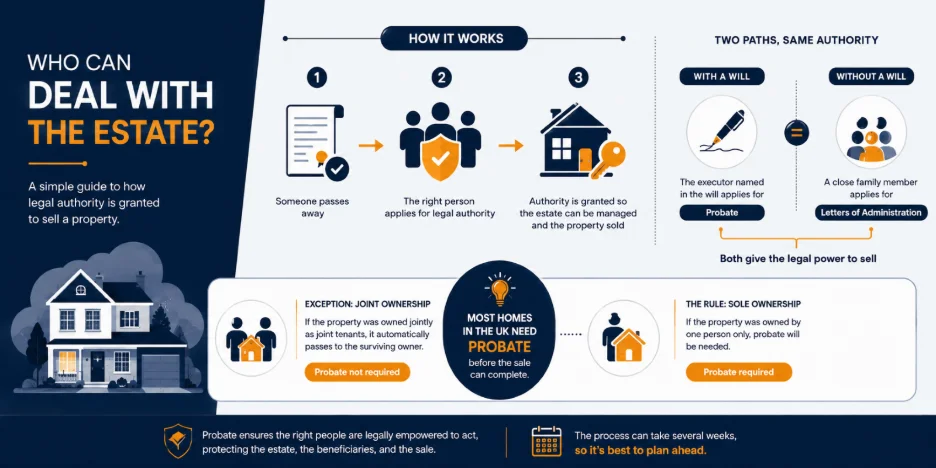
Most houses in the UK require probate before the sale can be completed. There are a few exceptions. If the property was owned jointly as joint tenants, it passes to the surviving owner without probate. For sole ownership, you’ll need it.
How Long Does Probate Take?
There’s no fixed answer. Simple estates take three to four months. Complex ones, especially those involving tax or a contested will, can take a year or more. The property cannot be sold until the grant arrives.
Don’t wait to get started. Instruct a lawyer early. Get the property valued. List it if you want to. Just be upfront with any buyer about the timeline.
How to Apply for Probate
You’ll need the relevant probate application form, depending on the circumstances of the estate. A full Inheritance Tax account using form IHT400 may be required where the estate does not qualify as an excepted estate. The probate application should be supported by the required documents, including the death certificate and, where applicable, the will. The probate application fee is currently £526 for estates valued above £5,000.
Different rules apply in Scotland and Northern Ireland.
Inheritance Tax: What You Actually Owe
The standard threshold for inheritance tax is £325,000. Estates below that pay nothing. Above it, the rate is 40% on the excess.
But the threshold can rise. If the deceased left their main home to children or grandchildren, the limit is £500,000. That’s the basic £325,000 plus an extra £175,000 called the residence nil-rate band.
The rate can also drop to 36%. That happens if the will leaves at least 10% of the estate to charity.
The Circular Problem With Inheritance Tax
This is where it gets stressful. The tax must be paid before probate is granted. But probate is needed before the property can be sold. And the money to pay the tax is often locked up in the property itself.
You can’t sell without probate. You can’t get probate without paying the tax. That’s the deadlock many families hit. There are ways around it, though.
How to Pay Inheritance Tax Without Selling Property
You don’t have to sell to cover the bill. Four options are worth knowing.
Use the Direct Payment Scheme
HMRC can take the tax directly from the deceased’s bank account. If there’s enough cash in the estate, this is the cleanest route. No loans. No instalments. Just a direct transfer.
Pay by instalments
For tax owed on property, HMRC lets you spread it across ten annual payments. The first is due six months after the date of death. Interest runs on what’s still owed, but you can clear the balance early if your situation changes. We did a detailed breakdown of how the IHT instalment option works and when it makes sense. You apply using form IHT400.
Take an inheritance tax loan
These are specialist loans built for exactly this situation. You borrow to pay the tax, get the grant, then repay from the sale proceeds. The estate stays intact. You sell on your own timeline. It costs more overall due to interest, but it breaks the deadlock faster.
Use savings
If you or other heirs have cash, that can cover the bill. The property stays untouched until you’re ready to sell.
Talk to a tax adviser before you pick a route. The right one depends on the size of the estate and your own plans. How fast do you need to move? Do you want to keep the property or get the cash? Those answers will point you in the right direction.
Capital Gains Tax When You Sell
People often mix up inheritance tax and capital gains tax. They’re two different things. The estate pays inheritance tax at the time of death. Capital gains tax comes later. It applies if the property’s value has risen since the date of death.
No CGT is owed when you inherit the property. You only pay for it when you sell it. And only if you sell for more than the value at death.
How the Maths Works
The value of the property on the date of death is called the probate value. That becomes your starting point for CGT. If the property was worth £250,000 when the person died, and you sell it for £280,000, your gain is £30,000.
Any profit the deceased made during their lifetime is wiped out. You don’t pay tax on that. You only pay on the gain that happened while you owned it.
Rates and Allowances for 2025/26
CGT rates on homes are 18% for basic rate taxpayers. Higher rate taxpayers pay 24%. Your gain is added to your income first. That decides which rate you fall into.
Each person gets a tax-free allowance of £3,000 per year. Any gain below that is not taxed. If the property is shared, each person gets their own £3,000 allowance on their share. That cuts the overall bill.
The 60-Day Reporting Rule
Once you complete the sale, you have 60 days to report and pay any CGT owed. You do this via HMRC’s UK Property Account online. Miss the deadline, and you face automatic fines.
The rule applies even if no CGT is owed. It runs from the completion date, not the exchange date. Don’t confuse the two.
Can You Reduce or Avoid CGT?
Yes, in some cases. If you genuinely make the property your main residence, Private Residence Relief may reduce or remove CGT when you sell. The amount of relief available depends on your circumstances, including the period of occupation and ownership. The final nine months of ownership generally qualify for relief, subject to the rules.
Our guide to Private Residence Relief explains exactly how the relief works and what you need to document. If you’re thinking about moving in, read that before you decide anything.
Documents You’ll Need to Sell
Getting your paperwork together early saves time during the legal process. Your lawyer will need the Grant of Probate or Letters of Administration first. This is what proves you have the legal right to sell. Without it, nothing can be completed.
Beyond that, you’ll also need:
- Death cert
- The will (if there is one)
- Land Registry title documents (or old deeds for unregistered property)
- TA6 Property Info Form
- TA10 Fixtures Form
- Energy Performance cert (required to list the property)
- Building rules and FENSA certs for any work done
- Proof of ID for AML checks
- Leasehold management pack if the property is leasehold
Your lawyer will also obtain an Assent of Property from the Land Registry. It confirms the owner has died and that you now have the right to deal with the property.
If the property is unregistered and the deeds are missing, your lawyer can help establish ownership another way. It takes longer, but it’s workable.
The Sale Process, Step by Step
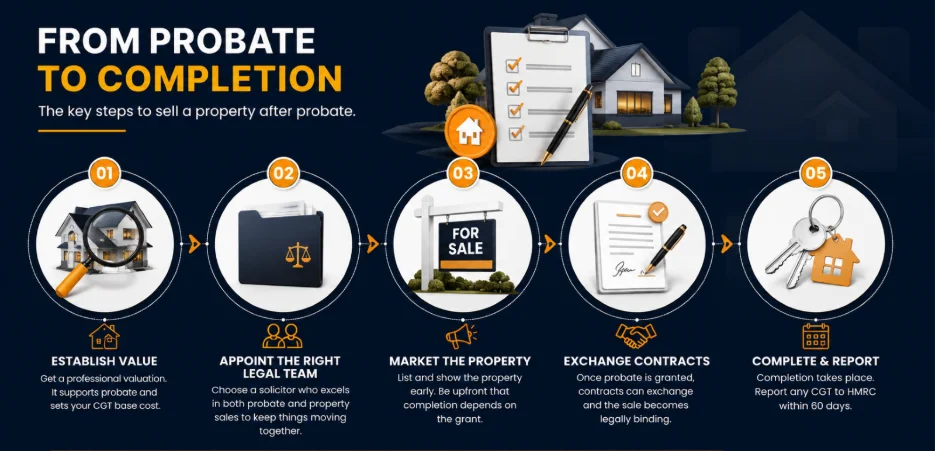
Once probate is granted, the sale runs like any other property deal.
- Get the property valued. You need this for probate anyway. The same figure becomes your CGT base cost. Two or three estate agent valuations will usually do. If the estate is large or the value is in dispute, a RICS surveyor provides a more defensible figure.
- Instruct a lawyer early. Pick one who handles both probate and property sale. Not all lawyers do both well. You want a team that can run the sale and the probate in parallel, not switch between them.
- List the property. You can market it and accept offers before probate is completed. Tell buyers that completion depends on the grant. Some won’t wait. That’s fine. Others will.
- Exchange and complete. Once the grant arrives, contracts can be exchanged. The completion follows, usually a few weeks later. CGT is then reported within 60 days of completion.
Which Route Should You Take?
Open market gives you the best price. An auction is faster and more certain, but you’ll usually get less. Cash buyers are the fastest of all, but the discount can be steep. Most people should start with the open market unless speed is truly the priority.
Selling Inherited Property with Siblings
This is where things can get complicated. Property is often one of the most valuable assets in an estate, making disagreements among beneficiaries more difficult to resolve. Clear communication and early advice can help reduce delays and unnecessary conflict.
Joint Tenants vs Tenants in Common
As joint tenants, all siblings own the whole property together in equal shares. A sale needs written consent from everyone. If one person refuses, nobody can sell without a court order.
As tenants in common, each person owns a defined share. That share can be sold separately if needed. This gives more options when siblings want different things.
When One Sibling Won’t Agree
If you can’t reach a deal, the sibling who wants to sell can apply to court. A judge can order the sale. But it’s slow and costly, and it can scar family ties for good.
Try mediation first. A trained mediator can help the family find a way through without a judge deciding for you. It’s faster, cheaper, and far less destructive.
Selling Your Share of Inherited Property
If you own as tenants in common, you can sell your share. In practice, buyers rarely want a partial stake in a property with other owners. A sibling buyout is usually cleaner. One person pays the others their share and takes full ownership.
The buying sibling will need a mortgage or cash. Both sides should get separate legal advice. Stamp duty applies at the full market rate, even in a family transaction.
Selling Fast When You Need To
Sometimes a long sale isn’t realistic. The estate has ongoing costs. There’s a mortgage still running. Siblings are in dispute, and the tension is building. You just need it to be resolved.
For genuine speed, an auction or a cash buyer is your best bet. An auction sets a fixed completion date, usually 28 days after the hammer falls. Cash buyers are even faster, but you’ll get a discount on the price.
Weigh what matters more. Price or speed. They rarely come together.
Is There a Time Limit on Selling Inherited Property?
No. There’s no legal deadline for when you have to sell. You can hold the property, rent it out, or sell it whenever it suits you. But waiting has its own costs.
The property keeps generating bills. Council tax, insurance, maintenance. If it rises in value, your CGT bill rises with it. If you rent it out, you’ll pay income tax on the rental profit.
Once probate is granted, your main options are to live in it, rent it, sell through an agent, auction it, or accept a cash sale. No single right answer. It comes down to your finances and what you want from the estate.
Income Tax on Rental Income from Inherited Property
Rent the property before selling, and you’ll pay income tax on the profit. That means rental income minus costs: repairs, agent fees, and mortgage interest. The net is added to your income and taxed at your normal rate.
Managing a rented inherited property? Lanop’s landlord accounting service handles reporting, rental accounts, and self-assessment so you’re not doing it alone.
When you eventually sell, CGT applies to any gain since the date of death. Renting it out first doesn’t cut that bill.
Your Self-Assessment After the Sale
Selling an inherited property usually means filing a self-assessment return for that tax year. This is true even if you’ve never filed one before. It’s separate from the 60-day property return. The two overlap, but both are required.
First time filing with HMRC? Lanop’s self-assessment service handles CGT reporting, rental income, and any HMRC correspondence.
Getting the Tax Side Right
Some estates are simple. Others come with rental income, multiple properties, or several heirs, each with their own tax positions. The numbers can get complex fast. Getting advice before you sell, not after, can change what you owe.
Lanop Business and Tax Advisors work with property owners and estate heirs across the UK. Got a capital gains tax question on a family property? Need help with a self-assessment return? Our team can work through the details with you.
Frequently Asked Questions
You can market it and accept an offer. But the sale cannot be legally completed until you hold the grant.
No. CGT only applies when you sell. And only if you sell for more than the value at death.
Potentially, yes. Private Residence Relief may reduce CGT if the property becomes your main home. The relief available depends on your individual circumstances and the period you qualify for relief.
Try mediation first. If that fails, you can apply to court for an Order of Sale. It’s the last resort.
Probate takes three to twelve months. Once that’s done, the sale itself takes roughly eight to twelve weeks from offer to completion.
Grant of Probate or Letters of Administration, death certificate, Land Registry title documents, proof of identity, EPC, and forms TA6 and TA10.
No legal limit. Each sale is assessed for tax on its own. You get one annual CGT allowance per tax year across all your gains combined.