

Every growing business hits a point. The numbers stop being simple. Sales might look healthy. But the cash still feels tight. Mainly, reports arrive late. Decisions are delayed. Moreover, year-end accounts only show what happened months ago. At that point, most owners ask the same thing. Do we need a finance director? Can we even afford one?

This guide has real answers, with real figures. It compares the cost of a part-time finance director to that of a full-time hire in 2026. It shows what drives the price. And it helps you match the right level of support to your business. It also covers HMRC and Companies House rules. These make the decision more urgent than many owners think.
Why This Is Really a Control Question
When owners look up the cost of a part-time finance director, they are rarely just price-checking. They want to know one thing. Can they gain control of their finances without paying a six-figure salary?
There is a real gap between buying finance time and buying finance leadership. A bookkeeper records what happened. A finance director shapes what happens next.
In 2026, basic bookkeeping is not enough on its own. Digital filing rules keep growing. Penalties have got harder to avoid. Lenders now want solid numbers before they hand over funding.
Weak reporting has a hidden cost. It rarely shows up on an invoice. Instead, it shows slow cash flow, missed deadlines, and needless fines. It also shows up as growth chances that slip by, simply because nobody ran the numbers in time.
How Much Does a Part-Time Finance Director Cost in 2026
Most part-time and fractional finance directors in the UK charge in one of three ways.
Day rates usually sit between £600 and £1,200. The rate depends on seniority, sector, and location. London and investor-backed work sit at the top end.
Monthly retainers for one to four days a month often fall between £1,500 and £5,000. Project fees apply to one-off work instead. Think fundraising support, new systems, or exit prep.
Virtual FD pricing tends to run lower than on-site work. Why? Because there’s no travel or office time to pay for. A fully remote virtual FD can work from your cloud data. They can deliver monthly accounts, a cash flow forecast, and a board call. All of this can cost less than one single on-site day each week. Hybrid setups mix remote work with a few site visits. These sit somewhere in the middle.
A few things push the fee up or down: turnover and transaction volume matter. But complexity matters more. A business with clean data, one entity, and a simple VAT will pay less. A similar business with messy records, stock, and several revenue streams will pay more.
Urgency, board involvement, and the state of your current reporting all shape the price, too. Rules like these can shift with a new law. So, it is worth checking the latest position with HMRC or a qualified advisor before you set up your budget.
Comparing the Real Numbers
A full-time finance director earns a big package in 2026. Recent hiring data puts FD starting pay at £90,000-£140,000 across the UK. Pay climbs higher in London, especially at larger or investor-backed firms.
But salary is just the starting point. The true cost runs much higher.
Employers must add employer National Insurance at 15%. This applies to earnings above the £5,000 threshold, a rule that has been in place since April 2025. Auto-enrolment pension adds a minimum of 3% of qualifying pay.
Recruitment fees add 15% to 25% of salary on top of that. Add software, kit, holiday cover, and onboarding time. The real first-year cost of a senior full-time FD can easily pass £145,000.
| Cost element | Full-time FD (typical) | Part-time FD (2 days/month) |
|---|---|---|
| Salary or fees | £90,000–£140,000 | £18,000–£36,000 per year |
| Employer NIC at 15% | £12,750–£20,250 | Not applicable |
| Pension (3% minimum) | £2,700–£4,200 | Not applicable |
| Recruitment fees | £13,500–£35,000 (one-off) | Not applicable |
| Realistic year-one total | £145,000+ | £18,000–£36,000 |
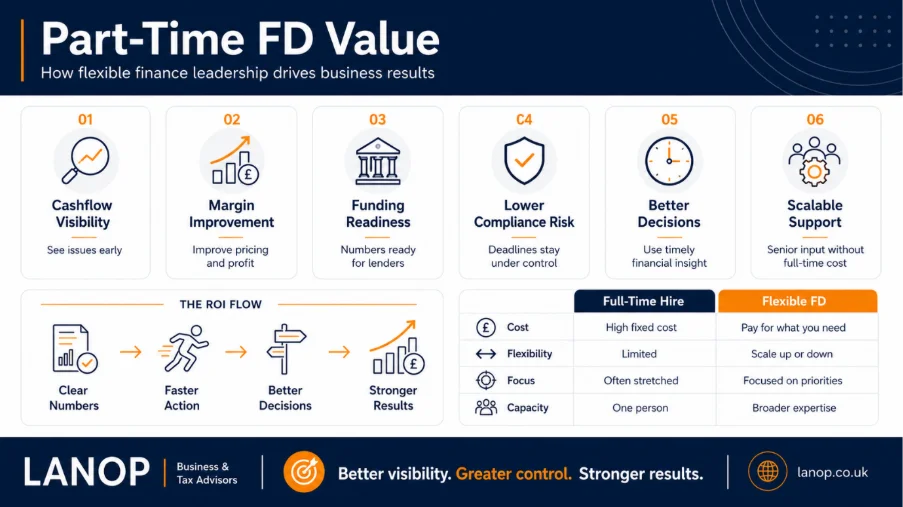
A full-time hire rarely makes sense on cost alone. It only pays off once the finance work truly fills a week. That tends to happen once a business passes roughly £5 million to £10 million in turnover. It also makes sense if the business runs daily treasury or funding work. Or if it needs a finance team, that must always be “on”. Below that point, most SMEs end up paying for the time they do not use.
Moreover, lower cost usually matters, but what matters is the value the financial support creates in practice.
What Level of Finance Support Do You Actually Need
Not every finance problem calls for a finance director. A bookkeeper keeps your records clean and reconciled. An accountant handles your statutory accounts and tax returns and keeps you compliant. A financial controller runs the monthly close, the controls, and the reporting.
A part-time FD sits above all of these roles. They turn raw numbers into a strategy. That means pricing calls and funding plans, too.
The line between a part-time FD and a fractional CFO comes down to two things: remit and audience. A fractional CFO usually works with investor-backed or exit-focused firms on capital strategy. A part-time FD instead runs finance day-to-day for owner-managed businesses.
Most UK SMEs have a turnover between £500,000 and £5 million. For them, one to four days a month is usually plenty. So how do you know you’ve outgrown accountant-only support? A few signs stand out. Year-end accounts are your only real source of numbers. Cashflow surprises keep hitting you. Or a lender or investor asks a question your reports can’t answer.
The Most Common Mistake: Waiting Too Long
The costliest financial mistake UK owners make is waiting too long. Most only reach out once cash flow has broken down, a fine has been levied, or a funding bid has failed. By then, fixing the problem costs far more than preventing it would have.
Three patterns cause most of the damage.
First, relying on year-end accounts alone means every call gets made on stale data. Second, owners often conflate tax compliance with real financial strategy. A filed tax return does not mean the business is healthy.
Third, many directors believe that hiring an accountant or an FD absorbs them of their legal duty. It does not. Directors stay legally responsible for filings and taxes, even when someone else handles the work. So, deadline control needs to be on the board’s radar.
A rolling cash flow forecast helps here. Check it often, and it will flag a shortfall early. That gives you time to act, rather than react.
Matching Support to Your Growth Stage
Different stages need different levels of help. So, match the model to where your business sits, rather than grab a generic package.
A sole trader or landlord getting ready for Making Tax Digital mostly needs new systems and an accountant. A bit of light advice helps too. A contractor moving into a limited company usually needs help with salary and dividend planning. VAT registration calls and clean bookkeeping from day one matter here too.
A service business in the high hundreds of thousands primarily needs cash flow visibility. A virtual FD can cover that in just one day a month. An SME in the low millions usually needs monthly accounts, KPI reports, and board packs. That points to two to four days a month.
A growth business heading toward £10 million should weigh a bigger fractional role against a full-time hire. Investor-backed or exit-focused firms tend to require strategic direction, due diligence, and sharp forecasting. This is where fractional CFO support earns its keep.
Protecting Business from HMRC and Companies House Risk
Deadline control should sit at the heart of any part-time FD role. The penalty rules have a real bite in 2026.
VAT returns and payments are usually due one month and seven days after the VAT period ends. Late VAT returns build up penalty points. A quarterly filer hits the limit at four points. That triggers a £200 fine.
Late VAT payments carry their own rising cost. Pay within 15 days, and there’s usually no penalty, though interest still runs from day one. Pay between 16 and 30 days late, and a first penalty of 3% of the unpaid VAT kicks in.
Still unpaid on day 31? Add another 3%. A second penalty then accrues each day at a yearly rate of 10% until the debt is cleared. Moreover, HMRC now charges late payment interest at around 7.75%. That is the Bank of England base rate plus 4%. These rates are set to alter again from April 2027. So, it pays to build some slacks now.
Additionally, the above rates are subject to change again from April 2027, so businesses should check the latest HMRC interest rate before budgeting.
Furthermore, Corporation Tax is normally due nine months and one day after the accounting period ends. The CT600 return itself is due twelve months after the period ends. Companies House requires private company accounts to be filed within 9 months of the year-end. Late-filing fines start at £150 and rise to £1,500. The confirmation statement must be filed within 14 days of the end of each review period.
Payroll has its own rhythm, too. Employers must report pay to HMRC through Real Time Information, on or before each payday. It’s worth checking director salary plans each April against the current NI thresholds. A part-time FD who builds a compliance calendar around these dates turns fine risk into a routine task. It stops being a constant worry.
Recent Changes Worth Acting On
A few recent changes make 2026 a bad year to finance on autopilot.
Making Tax Digital for Income Tax kicks in from 6 April 2026. It applies to sole traders and landlords earning over £50,000. It calls for digital records and quarterly updates. The threshold then drops to £30,000 from April 2027 and £20,000 from 6 April 2028, pulling in far more people. Those affected who file late will move onto the same points-based penalty system already used for VAT. Moreover, the penalty points for late quarterly updates will not apply in the first tax year, 2026/27.
Companies House identity checks became law from 18 November 2025. New directors must now verify their identity before appointment. Existing directors must do the same alongside their next confirmation statement, during a 12-month grace period. This rule also covers persons with significant control. So check everyone on your register is covered.
The 15% employer NIC rate and the lower £5,000 threshold, both in effect since April 2025, have raised the cost of every full-time hire. Hiring a part-time FD through their own limited company also brings off-payroll working rules into play. So, check their employment status properly before work starts.
This whole area keeps shifting. It is worth checking the latest position with HMRC or a qualified advisor before you set up.
Choosing the Right Model for Your Location
Location still shapes price and choice, even in a remote-first world. A part-time FD in London charges the highest day rates. But London also has the deepest pool of sector experts, especially for funded and regulated firms.
Manchester, Leeds, and Edinburgh all have strong regional markets. Their rates usually sit 15% to 25% below London. Cambridge, meanwhile, draws premium rates for tech and life sciences skills.
Businesses outside big cities often do their best with a hybrid model. This pairs a remote virtual FD with a few sites visits each quarter. Look locally when board presence, site visits, or team leadership matter. Where the work is data-led, a virtual FD backed by cloud tools usually offers better value, whatever the postcode.
Building a Smarter Finance Function Without Over hiring
The goal is not to hire a job title. It is to build a finance function that works. A well-run part-time FD role usually delivers monthly accounts within 10 working days of the month-end. It also brings a rolling cash flow model and a KPI dashboard that the board actually uses.
Budgeting and scenario planning tend to follow next. This lets the business test decisions before it spends any cash.
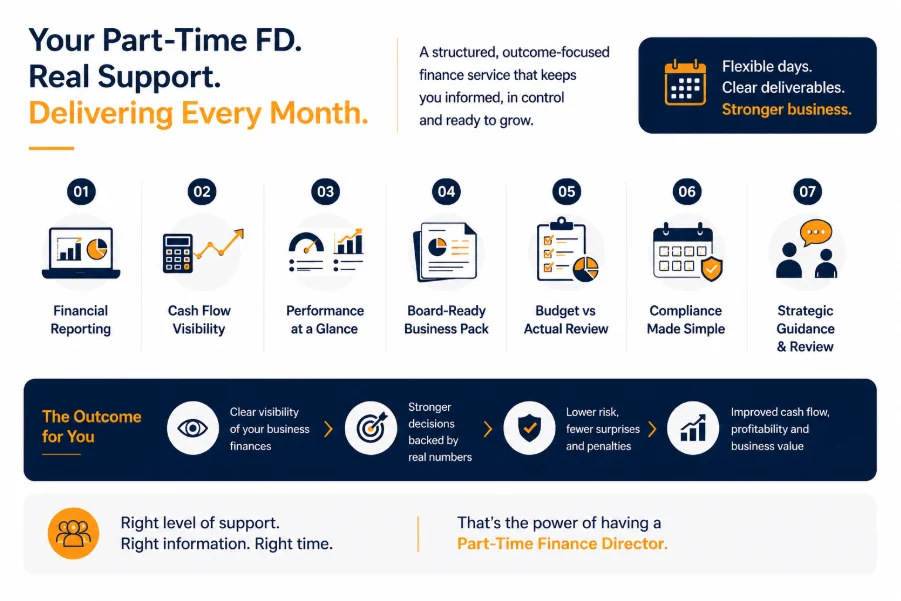
Beyond reporting, the real value often sits on the commercial side. Pricing, margin, and profit reviews often uncover more value than any cost-cutting drive. Funding and investor-readiness work then ensures your numbers are already in shape. That way, when you need capital, the numbers match what banks and investors expect to see.
How Lanop Helps UK Businesses Control Finance Director Cost
Lanop Business & Tax Advisors works with sole traders, contractors, limited companies, and SMEs right across the UK. We help them get their finance function to the right size.
We start by checking what you actually need. That might be an accountant, a controller, a part-time FD, or a mix of these. We then build a real cost comparison against a full-time hire. That way, the choice sits on your own numbers, not guesswork.
From there, our team sets up HMRC and Companies House deadline controls. We sharpen your management accounts and cash flow reports. We also support MTD readiness, VAT discipline, payroll, and Corporation Tax planning. Because the support scales up or down, you can start one day a month. Then grow as the business grows. No recruitment fees. No employer NIC. No notice periods.
Move Forward with the Right Finance Decision
The decision process is fairly simple. Are you making calls without monthly numbers to back them up? Hire a part-time finance director now. Do you have compliance risks you can’t fully list, or funding talks underway? Bring one in to help.
Is your bookkeeping unreliable? Fix your systems first. Bad data wastes good advice and good money. Only move from part-time to full-time once the workload truly fills a week, and the £145,000+ true cost is clearly worth the value it brings.
Whichever path fits, drifting is the worst choice of all. Fines, interest, and missed chances build up quietly while you wait to decide.
Book a consultation with Lanop. We’ll review your finance function, your compliance calendar, and the true cost of your options. You’ll walk away with a clear, costed plan for the level of finance leadership your business actually needs.
Frequently Asked Questions
Yes, for most businesses with a turnover of roughly £500,000 or more. The fee is small next to its effect on decisions. Below that, a good accountant is often enough for now.
Yes, in almost every case. It counts as an allowable business expense against Corporation Tax. Keep your invoices and a clear scope of work and check your own position with your accountant.
Look for a qualified accountant with ACA, ACCA, or CIMA qualifications. They should have real board-level and commercial experience, ideally in your sector. Ask examples of past forecasting or fundraising work. And make sure the personal fit feels right, too.
Most invoices are issued through their own limited company or consultancy, on a day rate or retainer, off payroll. Check their employment status under the off-payroll rules. Or hire through an advisory firm to make this simpler.
Often within one to two weeks. The first month is spent reviewing your numbers and systems. Full value tends to show by month two or three.
Yes. Most work across Xero, QuickBooks, and Sage, building on what you already use. They may add a dashboard tool if your reporting is weak. Or they’ll flag it clearly if the system itself needs replacing.