
International groups with a UK company are asking the same question this year. Does our current director setup still work? Or does it need to change?
The worry often starts with one detail. A director on the board is an overseas company, not a person.
This setup is common in group structures, joint ventures, and funds. It is also the exact setup UK lawmakers now want to restrict. The Economic Crime and Corporate Transparency Act 2023 (ECCTA) aims to prevent foreign companies from serving as directors in the UK. It also plans to tighten the rules for corporate directors in general.
Here is where it helps to slow down. A foreign individual living abroad can still be a UK director today. This reform does not target that person. An overseas company acting as a director is different. That is where the real risk sits.
So do not panic yet. First, understand what has changed. Then check what is still just a proposal. Determine the position of your own structure with support from a specialist in group structuring.
Quick Answer
The UK ban on overseas corporate directors will stop overseas companies from being UK directors. It will also mandate that any corporate director establish a board composed solely of natural persons. The ban is not yet in force. They have not confirmed a fixed start date. Companies with an overseas corporate director, or a complex director chain, should review their structure now. This will prepare them for when the rules start.
What Is the UK Ban on Overseas Corporate Directors?
What Is a Corporate Director?
A corporate director is a company, not a person, appointed to a board. A natural person director is simply a human being holding that role.
Groups often use corporate directors for two reasons. It keeps board control inside a parent company. It also simplifies governance across multiple subsidiaries, particularly when a single head office manages several UK limited companies.
What Does the Economic Crime and Corporate Transparency Act Change?
ECCTA gives Companies House new powers. In the past, the registrar recorded what a company reported. Now, the registrar can review and check that information.
The reform rests on three goals. More clarity on who really runs a company. More accountability for the people behind it. And a registrar that can check and challenge facts, not just file them.
The corporate director ban in the UK measure fits into this wider approach. A company name alone could previously sit as a director with no checks. The reform now ties every corporate directorship back to identifiable, verified individuals.
Are All Corporate Directors Being Banned?
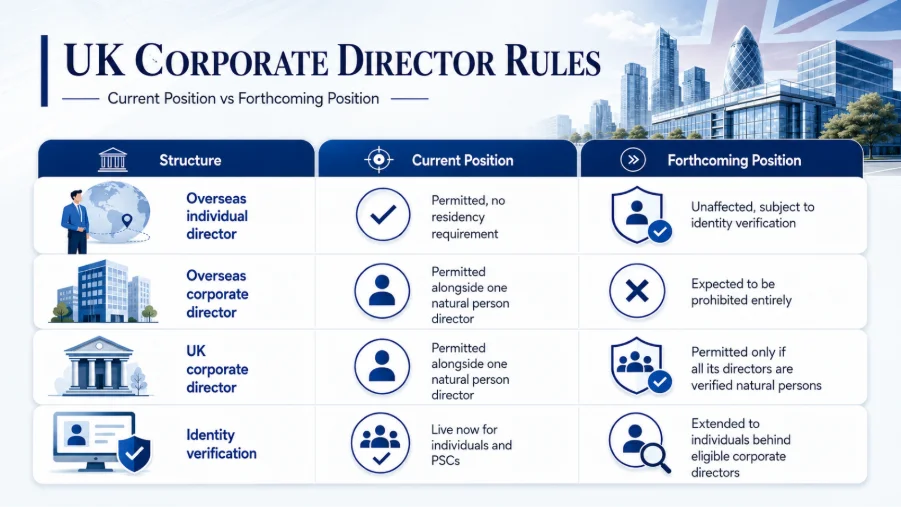
Not entirely. This is where most confusion begins. A corporate director can still be permitted. But each of its directors must be a natural person. Each person’s identity must also be verified.
Overseas companies get the toughest treatment here. Guidance so far points to a full ban on these. UK corporate directors face tighter rules too. But not a full ban.
What Are the Current UK Company Director Requirements?
Every UK company must already have at least one natural person director. That rule is already law, not a future change. A company can also have any number of additional corporate directors, including overseas ones. It simply needs that one human director to remain in place.
No nationality or residency rule prevents a foreign individual from serving as a UK director. This point is worth repeating, since it is the most common misunderstanding in this area. An overseas individual is not the same as an overseas corporate director. The new rules target the second group, not the first.
Under current UK director eligibility requirements, some people cannot serve as directors. This includes anyone under 16. It includes an undischarged bankrupt in relevant circumstances. It also includes anyone currently disqualified by a UK court. Every director must also be properly registered. Under the ECCTA identity checks, individuals must now verify their identities. So must the people behind corporate structures.
When Does the Overseas Corporate Director Ban Take Effect?
As of August 2026, the ban on overseas corporate directors has not started. It sits within the wider ECCTA reform programme. Companies House has confirmed that its transition plan sets out the intention but gives no firm timetable for this specific measure.
Companies House has not set a start date. Timing depends on secondary legislation. It also depends on operational readiness and parliamentary time. Legal commentary continues to call this measure unconfirmed, even though other ECCTA rules already run live.
Any source stating a fixed date should be treated with caution. Trust it only if it links directly to official Companies House guidance.
There is also no live deadline yet for removing an overseas corporate director, simply because the ban itself has not started. Once it does, industry guidance indicates a grace period of around 12 months. This would give existing companies time to remove or replace a non-compliant corporate director. For now, the commencement announcement is the detail to watch for, rather than any assumed calendar date.
Which UK Companies Will Be Affected?
UK companies with an overseas company acting as director face the biggest risk. Is that your setup? Then this reform speaks directly to you.
Foreign parent companies with UK subsidiaries should check one thing closely. Say your parent sits in the UAE, the US, Singapore, India, or Europe. Does it also sit on the UK board? Just owning shares is a different matter.
Multinational groups that use corporate director chains need to trace the entire chain. The natural person rule hits every link. Not just the top link. Not just the bottom one.
Foreign owned businesses planning to form a UK company should plan. Build a compliant director setup from day one. This is far easier than adopting an overseas corporate director now and restructuring later, and is worth discussing with an adviser familiar with international and offshore accounting structures from the start.
Does the Ban Affect Foreign Ownership of UK Companies?
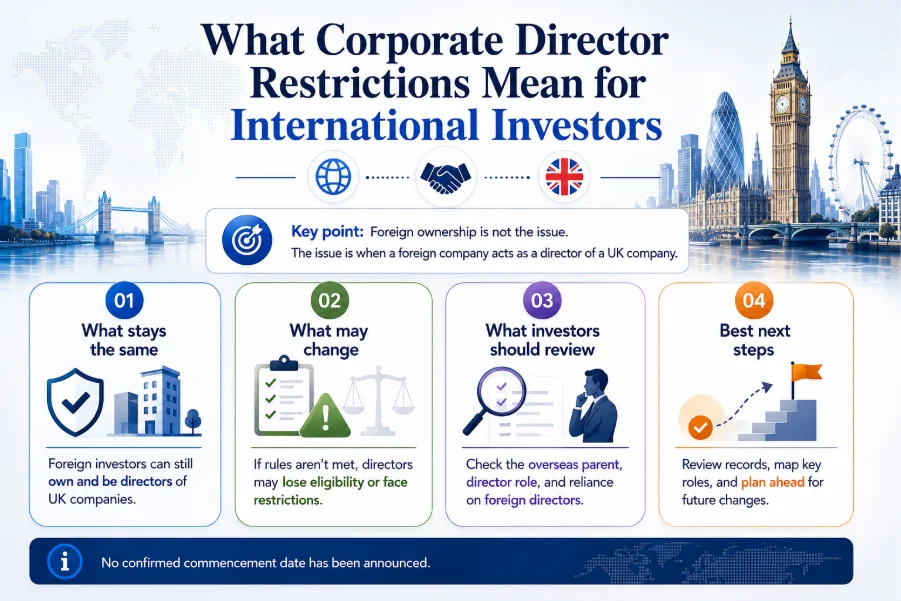
Here is a key point. Directorship and ownership are different legal roles. A director runs the company day-to-day. A director also carries legal duties. A shareholder owns shares. A shareholder votes on big decisions instead.
This reform does not touch share ownership. Not directly. An overseas parent can still own its UK subsidiary. No issue there. The real concern shows up only when that parent also holds a board seat. The same goes for any other overseas firm in the group.
Removing or replacing an overseas corporate director requires no change to shareholdings. Ownership and governance are two separate matters. They should often be reviewed that way, too.
Director vs Shareholder vs PSC: What Is the Difference?
| Role | Main Function | Ownership | Management | Companies House Disclosure |
|---|---|---|---|---|
| Director | Runs the company day-to-day | No ownership required | Yes, direct control | Registered on the public director record |
| Shareholder | Holds shares and ownership rights | Owns part or all of the company | Limited, usually through voting | Recorded on the register of members |
| PSC | Has significant control or influence | May or may not hold shares | May influence without formal role | Recorded on the PSC register |
One point is worth clarifying. Replacing a director does not automatically change the PSC register. That register only needs updating if actual control has genuinely changed too.
How Could the New Rules Affect Your Existing Structure?
Consider an overseas parent that holds shares only, with no board seat. In that case, the ban is unlikely to require any change. Now consider one that is both a shareholder and a corporate director. That structure is most likely to need attention once the rules start.
An overseas individual director is an entirely separate issue. Identity verification still applies to them. But the corporate director ban does not apply, since they are a person, not a company.
A UK company acting as a corporate director still needs a fully verified, natural-person board to remain eligible. Being UK-incorporated alone will not be enough. Some groups use a chain instead, where an overseas parent directs a UK entity, which in turn directs an operating company. Every link in that chain needs checking, not just the top or the bottom.
What Are Your Options if You Have an Overseas Corporate Director?
This section covers the main choices available, addressed one at a time.
- Appoint a natural person director: Many groups will replace the overseas corporate director with a senior individual, often an existing group officer. That person takes on real statutory duties and completes identity verification. This option works best when they genuinely participate in governance, rather than serving as a name on paper.
- Consider an eligible UK corporate director: A UK-registered company can potentially retain this role, provided all of its own directors are verified natural persons. This still involves ongoing administration, so it suits groups with the resources to manage it properly.
- Restructure the group: For more complex groups, this may be the moment to review ownership, holding company placement, and governance together, an area where group structuring support can bring the different pieces together. That approach is more effective than a quick director swap that needs revisiting later.
- Review UK subsidiary versus branch: Some international businesses use this reform as a prompt to reconsider their broader UK entry structure. Legal liability, tax treatment, reporting, and governance differ between the two, and the right choice depends on the business itself.
Natural Person Director vs UK Corporate Director: Which Is Better?
| Factor | Natural Person Director | UK Corporate Director |
|---|---|---|
| Simplicity | Straightforward to appoint | Requires ongoing eligibility checks |
| Administrative burden | Lower, one verification | Higher, verification across every director |
| Group control | Less centralised | Keeps control inside one corporate vehicle |
| Cost | Generally lower | Generally higher |
For smaller UK subsidiaries, a natural person director is usually the simpler and cheaper route. Larger groups that rely on centralised board control may still prefer an eligible UK corporate director, provided the group maintains full compliance across that entity’s own board.
What Should Foreign Owned UK Companies Do Now?
Here is a simple checklist to work through:
- Check your Companies House record. List every registered director.
- Find any corporate director. Note its name, its country, and its type.
- Check its own directors too. Are they real people? Will checks apply to them?
- Map your full ownership chain. Start with the parent firm. End at the UK subsidiary, its directors, shareholders, and PSCs.
- Review your articles and shareholder deals. Check the rules on adding or removing directors.
- Compare your options. Weigh compliance, control, tax, and cost.
- Get ready for the change ahead. But do not rush into moves the rules do not yet demand.
How Do You Remove or Replace a Corporate Director?
In practice, this involves several clear steps. Review the governing documents first. Approve the change properly. Appoint a replacement. Notify Companies House. Update statutory records. Review PSC information if needed. Inform banks or investors where relevant.
Articles of association sometimes need updating too, particularly where they specifically require or restrict certain types of directors. Loan or investment agreements may carry their own notification requirements, which are worth checking separately from Companies House filing duties.
What Are the Penalties for Non-Compliance?
Once the ban commences and any transition period ends, guidance suggests a non-compliant corporate director would cease to hold office. It is best to rely on confirmed Companies House guidance once the rules go live; do not guess in advance.
Companies House already holds stronger powers under ECCTA. Businesses should expect greater scrutiny of company information and compliance obligations as these reforms continue.
Beyond any legal fine, real business risks exist too. An outdated director setup can slow deals down. It can make bank checks harder. It can raise flags during an investment review. These are not legal fines. But they can cost just as much.
How Does Companies House Identity Verification Affect Directors?
Identity checks became law on 18 November 2025. A 12-month grace period came with it. New directors must pass a check first. Then they can be appointed. Existing directors must check by their next confirmation statement. The final cutoff sits at 18 November 2026.
Under the new corporate director rules, more people will need to check too. Anyone on the board of an eligible corporate director must verify their identity. This rule applies no matter where they live. Most people use GOV.UK One Login to check. Or they use an Authorised Corporate Service Provider instead.
Here is the key point to remember: Companies House corporate director rules on identity checks are already live. They follow a set 2026 timeline. The overseas corporate director ban is a separate rule. Related, but not the same. Its start date is still not set.
Could Changing Your Director Structure Affect Taxes?
Where a director lives is not the same as where a company is tax resident. UK tax residence generally depends on where the company was incorporated and on where central management and control happens.
If key decisions are genuinely made outside the UK, that can affect this position. Changing who sits on the board can shift where that control is seen to sit. Groups restructuring director arrangements should also weigh dividend flows, treaty positions, and repatriation planning, rather than treating the change as a purely administrative task. In this area, dedicated tax planning advice adds real value.
What Does the Change Mean for UAE-Owned UK Companies?
There is a clear split here. Picture a UAE parent that owns shares in a UK firm. Now picture one that also sits as its director. Only the second case falls under this reform.
A UAE firm can still own a UK firm with no issue. A UAE-based person can still become a UK director. They need to pass the standard checks.
Start with a full audit of your setup first. Does the UAE parent, or any other overseas firm, hold a board seat? Check that first. Then compare your options. Avoid big changes based on headlines alone. The same advice fits groups from the US, Singapore, India, and other countries with UK subsidiaries.
Should You Restructure Now or Wait?
Reviewing now makes sense in a few cases. An overseas firm might currently serve as a director. Your group might have several layers. Or UK growth or a deal might be coming soon.
On the other hand, quick changes may not be needed. This is true if foreign ownership is the only factor. Ownership alone breaks no rule. The start date is still unclear too. So, there is no rush there.
Before you decide, ask a few clear questions. Who is listed as director now? Is that director a person or a firm? Where is that firm based? Who really runs the UK business day-to-day? Could a change affect your tax status? And when will the rules start?
Common Misconceptions About the UK Corporate Director Ban
A few beliefs keep surfacing among concerned business owners. Most of them do not hold up under closer examination.
Foreign directors are not being banned. Only overseas companies acting as directors are affected. There is no UK residency requirement for any director, individual or corporate.
Corporate directors are not being abolished either. They need a fully verified, natural person board behind them. Foreign parents can still own UK companies, since ownership and directorship remain separate roles.
No removal deadline is currently running, because the ban itself has not commenced. A nominee director does not sidestep verification requirements. Setting up a UK corporate director does not automatically resolve anything either, unless its own board is fully compliant.
Frequently Asked Questions
Not yet. The legislation provides the framework for these restrictions, but the relevant provisions have not yet come into force. Once the relevant provisions come into force, overseas companies are expected to lose the ability to act as directors of UK companies. If your business works this way, it’s worth taking a look now, before that transition period begins.
Yes, for the time being. A foreign company can still act as a director, if the UK company also has at least one individual director on the board. That’s set to change once the new rules take effect.
No start date has been confirmed yet. Once the rules do land, existing companies will likely get about 12 months to sort things out. That means there is no fixed removal deadline running at present.
Yes. Directors don’t need to live in the UK at all. Someone based overseas can still take on that role without any issue. That’s a different thing entirely from an overseas company being appointed as director, which is what these new rules are really aimed at.
Yes. The proposed changes affect who can act as a director, not who can own shares. An overseas parent company can continue to own a UK subsidiary, provided it is not also acting as that subsidiary’s corporate director.
How Lanop Can Help with Your UK Company Structure
Reviewing a director setup against an unfinished rule is not simple, particularly for groups managing several jurisdictions at once. At Lanop Business and Tax Advisors, we work with foreign-owned UK companies and their advisers on exactly this kind of review.
That work covers director and shareholder setups. It covers PSC checks and Companies House filings too. It also covers the cross-border tax questions that often come with these changes. Groups with a UAE, US, or other overseas parent often need one thing first. A full map of the ownership chain. This lets us compare options before anything changes.
Companies with an overseas corporate director, or those setting up a UK limited company under a foreign parent, should speak with Lanop before making changes. Our team can review the current setup, explain which rules apply, and help plan the next steps, with company law, compliance, and cross-border tax planning all in view.
Conclusion: Know What Needs to Change Before You Restructure
Most UK companies with foreign owners are not automatically affected by this reform. The real question is whether an overseas entity currently holds a director seat, not simply whether it holds shares.
If your overseas parent only owns shares, there is likely nothing to fix yet. If an overseas firm sits as director, start reviewing your options now. Do this even without a set deadline.
If an overseas person is the director, that is a separate case. Identity checks matter more there, right now. And if your group spans several layers, a more comprehensive tax and control review is likely worth the time.
Moving too soon just adds cost. It adds no real benefit. Waiting too long carries its own risk too. Once a start date lands, a rushed, panicked change becomes more likely. The better path sits in the middle. Know your risk now. Act once the rules are confirmed.
Talk to Lanop before you change your UK company structure. That way, your choice rests on real facts. Not just headlines.