

When expanding to the UK there is no single best UK company structure for foreign business. The right choice depends on a few things.
It depends on your ownership plans, your liability comfort, where decisions get made, your directors, your tax position, and how big the UK side is meant to grow.
Foreign businesses can still fully own UK companies. That position has not changed.
What has changed is how corporate directors work. A foreign person acting as director is one thing. An overseas company acting as director is another thing. This guide keeps them apart, start to finish. Mixing them up leads to bad choices. We want to help you avoid that.

What Does the UK Corporate Director Restriction Mean for Foreign Businesses?
Current UK Director Requirements
UK law requires a UK company to have at least one director who is a natural person. A company cannot have only corporate directors.
Foreign directors are allowed. Nothing in the law today stops someone in Dubai, Singapore, the US, or India from being a named director of a UK firm.
Here is a common myth. People think UK directors must live in Britain. They do not. Setting up a UK company as a non-resident is normal. A foreign parent can own all of a UK subsidiary. Every director can still live abroad.
What Is Changing for Overseas Corporate Directors?
A corporate director is a company that acts as a director of another company. This is the part that is really changing.
The change comes from a 2023 law called the Economic Crime and Corporate Transparency Act. The reforms will restrict how corporate directors work. Once the new rules are brought into force, a corporate director must meet the qualifying conditions. Its board must be made up only of natural persons, and those directors must have their identities verified. Overseas companies will no longer be permitted to act as corporate directors of UK companies.
So, this is a narrow path, not a full ban. That difference matters a lot.
Identity checks for individual directors and PSCs became compulsory from 18 November 2025. New directors must verify their identity before their appointment is registered. Existing directors have a 12-month transition period, with verification linked to their next confirmation statement. Existing PSCs have separate verification deadlines. Companies House expects the transition for individuals to be completed by mid-November 2026.
The corporate director restriction itself is not yet in force. Companies House’s current transition plan does not give a confirmed commencement date for these restrictions. It says that, following implementation, corporate directors will be restricted to qualifying UK corporate entities with legal personality, with all-natural-person boards whose directors have verified their identities. Overseas companies will be prohibited from acting as corporate directors in the UK. Until the new restriction takes effect, a company can still act as a director where the company’s articles allow it.
What the Restrictions Do Not Ban
Let’s be clear about what stays the same.
Foreign individual directors are not banned. UK directors do not need to live in the UK. A person in the UAE, US, Singapore, or India can still direct a UK firm today.
A foreign parent can still own a UK subsidiary in full. Ownership sits with shareholders. Directors are a separate role. So, these two things stay apart. Changing who directs a firm does not change who owns it. Keep that split in mind as you plan.
Do You Actually Need a UK Company?
Not always. Selling to UK buyers from abroad does not, by itself, force you to open a UK company. Many overseas firms trade into Britain for years. They just use their existing overseas firm to do it.
The picture changes once you have a fixed UK base. This could be an office or another place of business. UK staff, agents, or other arrangements may also create UK tax exposure, depending on the facts and any applicable tax treaty. This is often discussed in terms of a permanent establishment. It can arise even where there is no UK company on paper.
So, ask yourself a few plain questions. Do you have staff based in the UK? Do you have a real UK office? Does someone here sign deals for you? Are real business calls being made from inside Britain?
If none of this fits you, trading from abroad may still work fine. If a few fit you, expanding business to UK structure planning is already overdue. Start now.
What Are the Main UK Structures?
Foreign Parent with a UK Subsidiary
Foreign Parent Company
↓
UK Limited Company
A UK subsidiary structure for overseas company setup makes a separate UK legal firm. This firm has its own directors. It has its own debts and risks too.
Because it stands apart legally, it shields the parent from most UK risk. If something goes wrong here, the UK firm usually answers for it. Not the parent.
This setup suits firms that want a real, lasting UK presence. This can help when hiring staff, signing UK contracts, and building trust with UK buyers and banks. It is the top route for UK company formation for overseas businesses. It also sits behind most multinational UK subsidiary compliance work.
UK Branch or Establishment
Overseas Company
↓
UK Branch / Establishment
A branch is usually not a separate legal firm. It is just your overseas firm working directly in Britain. You register it with Companies House. It gets listed as an overseas company with a UK base.
Because there is no legal split, there is no shield either. The parent carries full risk for whatever the branch does here.
Branches still bring paperwork duties. They also raise UK tax questions on UK trading profit. This route can suit firms that want to test UK work first. It can also suit regulated firms that already work this way at home.
UK Branch vs UK Subsidiary
| Factor | UK Branch | UK Subsidiary |
|---|---|---|
| Separate legal entity | No | Yes |
| Parent liability | Direct, unlimited | Usually limited |
| Governance | Follows parent rules | Own board |
| Tax position | Taxed on UK branch profits | Taxed as UK firm |
| Banking | Often harder to open accounts | Often easier |
| Investment flexibility | Limited | Can issue shares to investors |
| Future sale or exit | Harder to split off | Easier to sell alone |
Neither one wins every time. Don’t expect one right answer here. A small UK footprint may suit a branch just fine. Real, long-term trade often earns the extra paperwork of a subsidiary.
Should a Foreign Parent Use a UK Holding Company?
Foreign Parent
↓
UK Holding Company
↓
UK Operating Company
A UK holding company structure for foreign parent setup adds a layer above one or more UK firms. It usually does not trade on its own.
This setup earns a closer look in a few cases. Maybe you expect more than one UK firm. Maybe you plan to buy other firms here. Maybe you want investors at the top level, while trade stays lower down. Maybe you need to protect valuable ideas or brands. Maybe you already plan a future sale.
But it also costs more. That means extra accounts. Extra filings. Extra bank checks. It is not always a tax efficient UK structure for foreign business move. Whether it helps you depends on your home country and your funding plan. Add a holding firm because it does a real job. Not because it sounds more corporate. Our group structuring service can help you weigh this properly against your own plans.
One UK subsidiary alone usually fits a simple, single expansion best. A HoldCo plus a trading firm earns a look once more than one UK firm, or a buyout, is truly on the table.
How Should You Structure Your UK Directors?
A foreign individual can hold real authority as a director, even if they are appointed by the overseas parent company. This works if they genuinely perform the role. They must exercise their own judgement rather than simply sign documents on instruction.
There is one important point to watch. If key decisions are consistently made overseas, this may affect where the company is treated as tax resident. It is worth considering this early rather than leaving it until later.
A UK-based director can also help with banking, HMRC matters, and day-to-day decision-making. However, appointing one is a commercial choice, not a general legal requirement.
A qualifying UK corporate director may be another option for groups that still want a company to sit on the board once the new rules take effect. It must be a UK corporate entity with legal personality. Its own board must consist entirely of natural persons, and those directors must complete identity verification. This creates additional administration because the corporate director’s eligibility must continue to be monitored.
A nominee director for a UK company is appointed to the board on behalf of another party. However, a nominee is not simply a name on paper. Under UK law, they carry the same legal duties as any other director.
Because of this, the arrangement should be clearly documented. The agreement should define the nominee director’s authority and explain what happens if instructions from the appointing party conflict with the director’s legal duties.
How Can the Overseas Parent Keep Control?
Ownership, running the firm, and being a director are three separate things under UK law. Losing a daily board seat does not mean losing the firm.
Control sits, at heart, with whoever holds the voting shares. A parent that holds most shares keeps the right to name and remove directors. They can also approve big choices. This holds true no matter who sits on the board day to day.
The firm’s own rules, along with any agreement between shareholders, set the terms. They define what shareholders must approve and what directors can decide on their own. This is where planning for how to structure a UK company as a foreign owner takes shape.
Big choices can be saved for shareholder approval instead of the board. Raising cash or entering new markets are good examples. Service deals, parent loans, brand licences, and shared-cost deals add more written power too.
One more thing to know. Anyone who holds over 25% of shares or votes must usually be listed as a person with significant control. This open rule sits inside wider UK company governance restructuring work. It applies no matter where that person lives.
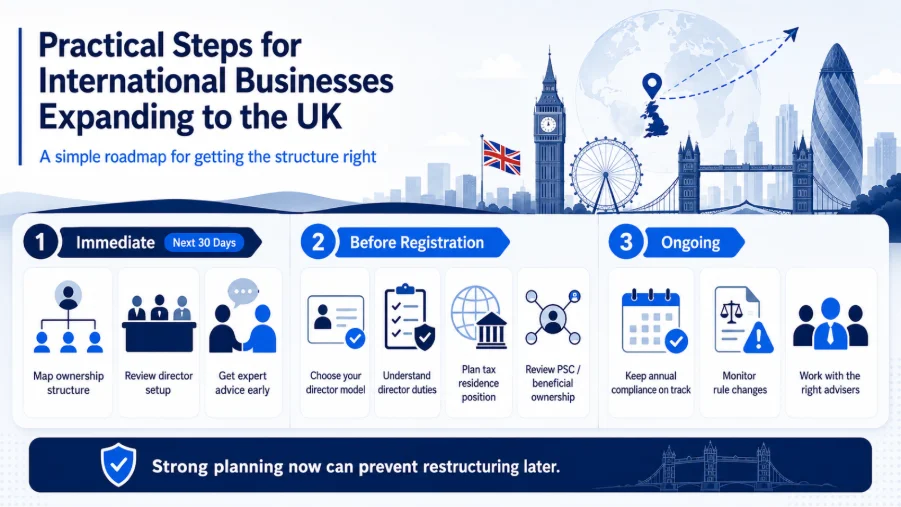
How Does Tax Affect the Right Structure?
A UK-incorporated subsidiary is generally UK tax resident, subject to limited exceptions including treaty rules. It is normally subject to UK Corporation Tax on its worldwide chargeable profits, subject to applicable reliefs. A branch works differently. A non-UK resident company is generally taxed on profits attributable to its UK permanent establishment, subject to applicable rules and treaties.
Even firms trading from abroad can create UK tax exposure. A UK place of business, permanent establishment, or certain agency arrangements may be relevant, depending on the facts and any applicable tax treaty.
Where do the real big calls get made? That question can matter when assessing company tax residence, especially for companies incorporated outside the UK. A UK-incorporated company is generally UK resident under the incorporation rule, although treaty rules can affect the outcome in some cases. For overseas companies, central management and control can be relevant to residence. This is exactly the kind of question worth resolving through dedicated tax planning before you commit to a structure tax planning
A UK firm trading past the VAT limit must sign up for VAT. UK staff go through PAYE. Tax and National Insurance come off pay at source.
Money moved between the parent and UK firm needs care too. Fees, shared costs, loans, and royalties should reflect fair, open market pricing. HMRC can challenge deals that look built to shift profit rather than reflect real value.
Funding can come through share capital or a parent company loan. Shares need no repayment, while loans can be repaid and may allow interest deductions. Cross-border interest may also trigger withholding tax, depending on the treaty.
Profit usually flows back as dividends, loan interest, royalties, or service fees. Each path brings its own UK and home country tax rules. Treaties may cut the tax owed. They rarely wipe it out fully. No setup promises a fixed saving here. That depends on the parent’s home rules just as much as the UK side.
Companies House and Operational Requirements
Every UK firm needs a UK registered office. This can be a service address. It does not need to be a real work site.
Directors and PSCs who are individuals must complete Companies House ID checks. This became a legal requirement from 18 November 2025. New directors must verify before their appointment is registered, while existing directors and PSCs are being brought into the regime during a 12-month transition. The rules apply to people based abroad as well as people in the UK.
Shareholder and PSC details sit on the public record. Firms must file yearly accounts and a yearly confirmation statement. They must also tell Companies House about any change to directors, PSCs, or the registered office.
Here is something worth planning for. Signing up with Companies House does not promise you a UK bank account. Banks run their own checks on directors, shareholders, and real owners. They also look at where funds come from and what deals you expect. Foreign-owned firms can face longer waits because of this.
Hiring UK staff brings PAYE duties, pension sign up, and right to work checks. One more thing worth knowing. Owning or running a UK firm does not, on its own, give you any right to live or work here.
How UK Expansion May Differ by Country
A UAE company setting up in the UK often keeps the UAE parent as the sole shareholder and appoints a UAE-based individual, a UK-based director, or both. Banking checks may take longer where enhanced KYC requirements apply.
Singapore companies expanding into the UK follow the same director rules as businesses from other countries. Groups may keep major strategic decisions in Singapore while the UK company handles local operations. Agreements between the two entities can then set out how costs and responsibilities are shared.
US parent companies often choose a UK subsidiary over a branch to separate risk and simplify group reporting. Transfer pricing between the two entities should also be considered early, especially for management fees and licensed technology.
An Indian company entering the UK will usually compare a branch with a subsidiary before deciding on its structure. Founders think hard about how much risk split they truly want. Reserve Bank of India rules also shape how cash moves from India into the UK firm. This kind of cross-border planning sits well within our wider international and offshore accounting work.
Already Have an Overseas Corporate Director? What to Do
Work through this before the restriction takes effect, not after. The exact commencement date has not yet been confirmed, so monitor the Companies House transition plan and allow time for any restructuring.
- Map your full group structure across every country.
- Find every company that acts as a director anywhere in the group.
- Check where the rule stands today, since the date has shifted once already.
- Pick a new model. Options include a real person, a qualifying UK corporate director, or a wider rebuild.
- Check the new director is fit for the role. Make sure they will take on the legal duties.
- Check your firm’s rules and any shareholder deal still match the new setup.
- Approve new roles and any exits through a proper board vote.
- Update Companies House with the right filings.
- Update bank mandates and who can sign for the firm.
- Check the tax side of the change with your adviser.
- Check contracts, cover, and licences that name the old director.
- Update any deals between firms that name the old director.
- Keep clean board minutes the whole way through.
This replaces corporate director with natural person work goes best with early planning. Do not wait for a rush once the rule is confirmed.
Which Structure Fits Your Expansion Plan?
If you just want to test the UK market, keep it simple. Check if trading from abroad already meets your needs before you open anything. If you want a lasting UK sales or ops team, weigh a branch against a subsidiary. Compare the risk of each against the paperwork of each.
If the parent wants strong group control, focus on share structure and shareholder deals. Do not assume a board seat is your only tool.
If you expect more than one UK firm, or a buyout, a UK HoldCo may earn a look. This applies once that plan is truly close. If you expect outside investors, sort out share types, votes, and exit routes early. Do this before investors show up. If your current UK firm already uses an overseas corporate director, review your setup now.
| Structure | Usually considered when | Main advantage | Main issue to review |
|---|---|---|---|
| Trade from overseas | Limited, occasional UK activity | Lower complexity | Tax and permanent establishment risk |
| UK branch | Direct parent operation | No separate ownership layer | Parent carries direct liability |
| UK subsidiary | Long term UK activity | Separate legal entity | Separate compliance burden |
| UK HoldCo plus OpCo | Complex group or acquisition plans | Structural flexibility | Extra administration |
Common Structuring Mistakes to Avoid
- Thinking foreign individual directors face a ban. They do not.
- Thinking every UK director must live in Britain.
- Mixing up ownership, which sits with shareholders, with being a director.
- Treating a nominee director as just a name on paper.
- Thinking a UK holding firm is always more tax smart.
- Thinking a virtual office alone proves real UK management.
- Thinking Companies House sign up promises a bank account.
- Treating a branch and a subsidiary as the same thing.
- Ignoring permanent establishment risk while trading from abroad.
- Copying a UAE, US, Singapore, or Indian setup straight into the UK.
- Planning tax and control as two separate jobs.
- Setting up a UK firm before planning the wider group around it.
Frequently Asked Questions
Yes, it can. UK law puts no limit on foreign ownership. A foreign parent can hold all shares in a UK firm and keep full control through those shares.
Yes, they can. There is no home country rule here. Directors from anywhere can be named, once they pass Companies House ID checks.
No, it does not. A UK firm needs at least one real person as a director. That person does not need to live in the UK, though.
Yes, it can. That person still carries full legal duty as a director, though. So, the deal needs real paperwork and real oversight.
Find a fit real person or a qualifying UK corporate director. Check your rules and deals. Approve the change through the board. Update Companies House, banking, and deals between firms.
Choose a UK Structure That Works Beyond Incorporation
If your UK activity is still limited, first decide whether you need a UK entity at all. For longer-term operations, a subsidiary may offer a clearer structure, while a branch can suit businesses that want the overseas parent to operate directly in the UK.
The right choice depends on more than incorporation. Director arrangements, ownership, tax, funding, banking, and future group plans all need to work together.
If your existing UK company uses an overseas corporate director, now is a good time to review that structure and prepare for the forthcoming rules.
At Lanop Business and Tax Advisors, we can review your current company structure and help you plan what comes next. This includes corporate director compliance, Companies House requirements, group and family restructuring, ownership changes, holding company structures, cross-border tax, and future expansion.
Get in touch with our team to book a free consultation and talk through your own expansion plans.