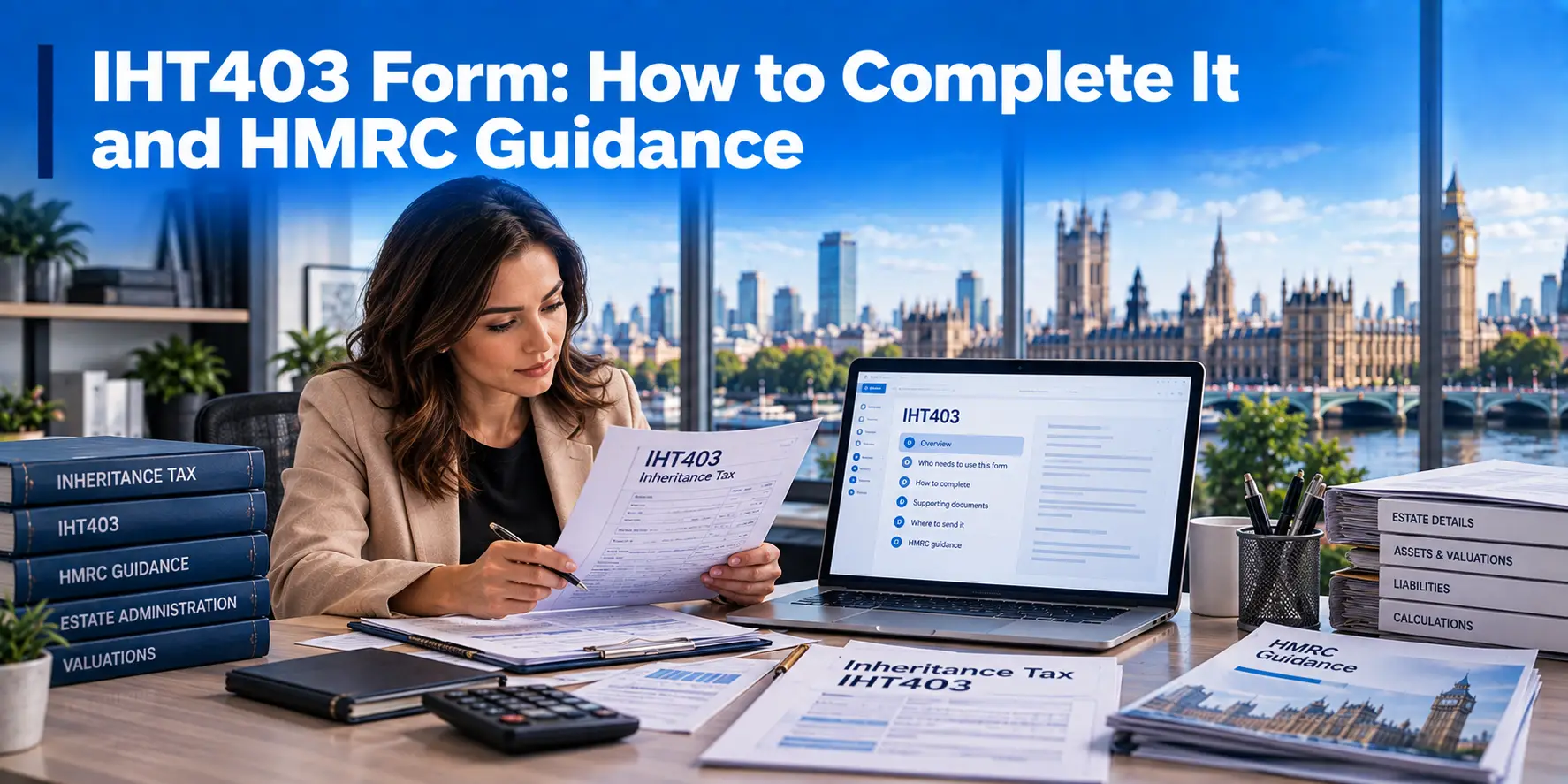
Completing IHT403 Form is one of the hardest parts of settling an estate. Executors often face seven years of bank statements. Gifts get mixed up with capital. Many gifts were never written down.
This guide walks through the 2026 version of HMRC form IHT403. It uses the latest official guidance. You can complete it accurately and avoid common HMRC queries.
Quick Answer
IHT403 is the HMRC schedule used to report gifts and other lifetime transfers. It applies to gifts made by someone who has died. You normally complete it alongside form IHT400. This happens whenever the deceased gave away money, property, or other assets before death. It covers potentially exempt transfers and chargeable gifts. It also covers any claim for the gifts out of income exemption.
What Is IHT403 Form and Who Needs to Complete It?
IHT403 Form is a supplementary schedule. It is not a standalone return. You attach it to IHT400, the main Inheritance Tax account. This applies whenever the deceased made lifetime gifts or transfers of value.
Executors and personal representatives complete it. Professional advisers acting on their behalf do too. Did the deceased give away cash, property, shares, or any other asset for less than its full value? If so, you usually need to complete this form.
It relates directly to IHT400. Box 6 on the main account asks whether the deceased made gifts. Answer yes, and HMRC will include IHT403 Form in the submission.
Lifetime gifts matter for a simple reason. HMRC looks at what left the estate before death. It does not just look at what remained on the date of death. A gift made five years before someone died can still affect the tax owed. This is exactly the kind of exposure that good inheritance tax planning aims to manage well before it becomes an estate-settling headache. Is it always required? Not always. Some estates involve no gifts, no trust transfers, and no life policy arrangements for someone else’s benefit. Many smaller, simpler estates skip this form entirely.
What Changed to IHT403 in 2026?
HMRC updated the form on 6 April 2026. That update reflected a new rule. A £2.5 million cap now applies to combined 100% Agricultural Relief and Business Relief. This cap covers qualifying gifts made on or after 30 October 2024, if they fall within seven years of death.
A second update followed on 22 June 2026. This one corrected a wording issue at question 12. That question deals with gifts where the deceased kept some benefit from the asset.
Always download the current version from GOV.UK. Older PDFs on third-party sites may still show the pre-April wording. Using them can create mismatches with your IHT400 figures.
What Do You Need Before Completing IHT403 Form?
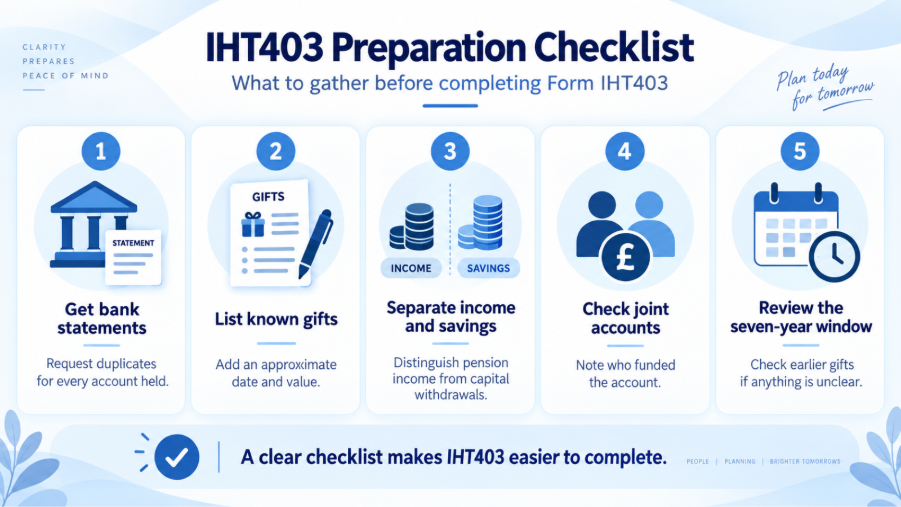
Gathering records is usually the slowest part of this process. Start early. Some documents take weeks to request.
You’ll typically need:
- Bank statements covering at least seven years
- Joint account records, where relevant
- Pension statements and P60s
- Self-Assessment returns, if the deceased filed them, alongside any Self-Assessment correspondence held by their accountant
- Investment and dividend statements
- Rental income records, particularly where the deceased held landlord property
- Details of any gifts, including dates and recipients
- Household expenditure records
- Care home or care cost invoices
- Property transfer documents
- Life insurance or life policy paperwork
- Records of any earlier gifts or transfers
What if a record is missing? Don’t leave the box blank and move on. Note what you tried. Note what you found instead, and why a gap exists. HMRC understands that estates rarely come with perfect paperwork.
How to Complete IHT403 Form Step by Step
This isn’t a box-by-box walkthrough. It’s a practical route through the parts that trip people up most.
Step 1: Identify Gifts and Transfers
List every gift and transfer the deceased made. This includes cash, property, shares, and investments. It also includes anything transferred for less than market value.
Family transfers count too, even informal ones. So does anything involving a life policy written for someone else’s benefit.
Step 2: Check Gifts Made Within Seven Years of Death
Most potentially exempt transfers become exempt once the donor survives seven years, each gift’s date and value determine how it’s treated. Accuracy here matters a lot.
Surviving seven years doesn’t close every question, though. Taper relief can still be relevant. So can earlier chargeable transfers and gifts with reservation. Don’t treat the seven-year mark as the end of the analysis.
Step 3: Apply the Relevant Gift Exemptions
A handful of exemptions can reduce or remove gifts from the taxable total:
- The £3,000 annual exemption, with one year’s unused amount carried forward
- The small gift exemption, for gifts up to £250 per person
- Wedding and civil partnership gift exemptions
- Spouse and civil partner exemptions
- Normal expenditure out of income
Each exemption has its own conditions. Don’t assume a gift qualifies just because it feels reasonable.
Step 4: Check Earlier Transfers
IHT403 earlier transfers refers to chargeable transfers made more than seven years before the gifts shown on the form. Why does HMRC ask about these? An earlier chargeable transfer can still affect how later gifts get taxed. This holds even though the transfer itself sits outside the usual seven-year window.
Here’s an example. Imagine someone set up a discretionary trust nine years before death. Four years before death, they made a cash gift to their daughter. The trust transfer sits outside the standard seven-year period. HMRC still wants it declared, though. It can affect the available nil rate band for later gifts.
This is illustrative only. Not every older gift creates extra tax. HMRC still needs the full picture to work out what applies.
Step 5: Review Gifts with Reservation and Other Complex Transfers
A gift with reservation happens when someone gives away an asset but keeps using it. Or they keep benefiting from it. A classic example is a parent who gives their house to a child. The parent then keeps living there without paying market rent.
Pre-owned asset rules can also apply in related situations. These areas often need professional review. The tax treatment depends heavily on the specific facts and often overlaps with wider estate planning decisions made earlier in someone’s life.
How Do Gifts Out of Income Work on IHT403?
This is where IHT403 gifts out of income claims most often go wrong. HMRC applies three conditions. All three must be met together.
- The gift formed part of the deceased’s normal expenditure.
- It was made from income, not capital.
- Enough income remained afterward to maintain their usual standard of living.
Being able to afford a gift isn’t enough on its own. HMRC needs evidence that the pattern was regular. It also needs proof that living standards weren’t affected.
What Counts as Normal Expenditure?
“Normal” refers to the deceased’s actual lifestyle. HMRC doesn’t have a fixed definition. Regular family gifts can count. So can Christmas or birthday gifts, school fee payments, and recurring rent support. A consistent pattern is what matters most.
Amounts can change year to year and still count as normal. The pattern itself needs to continue.
Some cases are harder to call. Holidays, cars, home improvements, furniture, and one-off purchases fall into this group. These don’t automatically qualify, and they don’t automatically fail either. HMRC looks at whether they fit an established spending pattern. Treat these on a case-by-case basis rather than assuming either outcome.
What Counts as Income for IHT403?
Income includes salary, pensions, State Pension, rental income, interest, and dividends.
Capital is different, and this distinction causes real confusion. Savings count as capital. So do proceeds from a house sale and capital withdrawals from investments. None of this should automatically be treated as income just because the money landed in a bank account.
Should You Use Gross or Net Income?
Current HMRC guidance points to net income, after Income Tax, as the relevant figure. This matters for a practical reason. Pension providers often report gross figures. Bank statements, on the other hand, show what arrived after tax.
Do pension records and bank statements show different amounts? Work from the net figure. That figure reflects what the deceased had available to spend.
When Does Saved Income Become Capital?
Income that gets saved rather than spent can eventually turn into capital. HMRC looks at one key question. Was the income genuinely accumulated for a specific, identifiable purpose? Or did it simply build up as general savings over time?
There’s no fixed cutoff point where income automatically converts. Longer periods of accumulation usually need closer analysis. The longer money sits unspent, the harder it becomes to argue it’s still income rather than capital.
How Do You Complete Page 8 of IHT403?
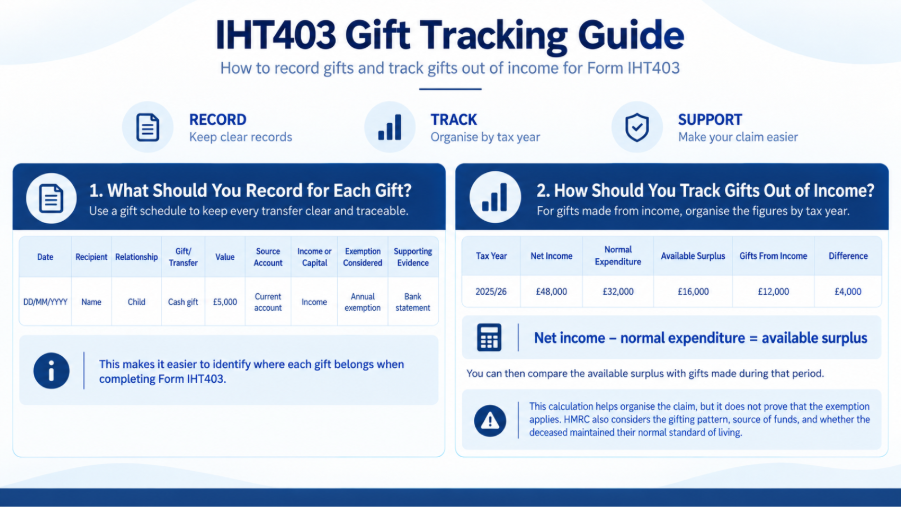
Page 8 sets out the income and expenditure calculation behind a normal expenditure claim. The basic structure looks like this: Net income minus normal expenditure equals available surplus.
You then compare that surplus against the gifts made in the same year.
Illustrative example:
| Item | Amount |
| Net income | £48,000 |
| Normal expenditure | £32,000 |
| Potential surplus | £16,000 |
| Regular gifts made | £12,000 |
In this example, the gifts sit within the calculated surplus. That supports a claim. It doesn’t guarantee HMRC will accept it, though. The pattern and evidence behind the figures still matter.
What If One Year Has Insufficient Surplus Income?
Income can fluctuate. One weak year doesn’t automatically sink a claim. HMRC can consider several years together. This gives a fairer picture of the deceased’s overall pattern.
Sometimes only part of a gift qualifies. Say a £10,000 gift was made, but only £6,000 of surplus income existed that year. The remaining £4,000 may need different treatment, perhaps as a potentially exempt transfer instead.
How Are Gifts from Joint Accounts Treated?
Joint accounts raise a specific problem. HMRC doesn’t automatically apply a 50/50 split just because an account has two names on it.
What matters is beneficial ownership. That means whose money funded the account, and who genuinely made the gift. Picture a husband who paid in all the income, while his wife contributed nothing. He may be treated as the sole source of gifts from that account, despite the joint name.
Are gifts from a joint account automatically 50/50? No. The real funding arrangement matters more. So do the couple’s actual financial contributions, which can outweigh joint ownership.
What If Bank Statements or Gift Records Are Missing?
Missing records are common, especially for gifts made many years ago. You can often reconstruct a reasonable picture using:
- Duplicate bank statements, requested from the bank directly.
- Pension and Self-Assessment records
- P60s and investment statements
- Cheque records and standing order histories
- Correspondence with recipients
- Records held by a previous accountant or held on file by your current bookkeeping provider, if the deceased used one
Unidentified transactions need care. Don’t automatically label an unclear payment as a gift. But you shouldn’t ignore it either, especially if it’s large enough to affect the estate’s tax position. Document your reasoning wherever you make an estimate. Keep the basis for each figure clear.
Can You Use an IHT403 Spreadsheet?
Yes. An IHT403 spreadsheet can make it much easier to organise several years of gifts, income, expenditure, and supporting records.
It does not replace the official HMRC form. Instead, use it as a working schedule before transferring the final figures to IHT403 and IHT400.

The workbook includes separate sheets for:
- Gifts and lifetime transfers;
- Gifts made from income;
- Supporting evidence;
- Annual income and expenditure summaries.
This Lanop template is an independent working tool. It is not an official HMRC form and does not replace HMRC guidance.
Does the Spreadsheet Replace Form IHT403?
No. The spreadsheet is only a working tool. You must still use the official HMRC form where IHT403 is required. The figures in your spreadsheet should also remain consistent with the amounts entered on IHT403 and IHT400.
Keep the workbook alongside relevant bank statements, pension records, tax documents, and other supporting evidence.
If the figures do not reconcile, or it is unclear whether gifts came from income or capital, Lanop can help review the records and prepare the supporting calculations before the estate is submitted to HMRC.
What Evidence Should You Keep for HMRC?
Keep evidence proportionate to the size and complexity of the claim. Useful documents typically include bank and pension statements, P60s, and tax returns. Investment records, rental accounts, and standing order histories help too. Household expense records, care invoices, and correspondence showing a consistent gifting pattern round out the list.
Not every estate needs every item on this list. Larger or more complex gifting histories generally warrant a fuller evidence file.
Common IHT403 Mistakes to Avoid
- Using an outdated version of the form
- Assuming only the last seven years can ever be relevant.
- Treating every regular payment as income without checking its source
- Confusing capital withdrawals with genuine income
- Using gross figures where net income should apply
- Overlooking who funded a joint account
- Claiming gifts out of income without enough supporting evidence
- Ignoring the deceased’s ordinary living costs
- Assuming saved income stays income indefinitely.
- Misunderstanding how taper relief works
- Missing gifts with reservation of benefit
- Leaving out earlier chargeable transfers
- Estimating figures without recording how you reached them
- Entering the same gift twice across different sections
IHT403 vs IHT400 vs IHT100a
| Form | Purpose |
| IHT400 | The main Inheritance Tax account for the estate |
| IHT403 | The supplementary schedule reporting gifts and lifetime transfers |
| IHT100a | Used for certain lifetime transfers reported during the donor’s life, in different circumstances to IHT403 |
IHT400 covers the whole estate. Schedule IHT403 deals specifically with what the deceased gave away before death. IHT100a applies in separate situations. These involve lifetime chargeable transfers, rather than transfers reported after death.
When Should You Get Professional Help with IHT403?
Consider professional review if your situation includes any of the following:
- Substantial lifetime gifts
- Incomplete financial records spanning several years
- Joint accounts with unclear funding
- Income and capital that have become mixed together
- A significant claim for the gifts out of income exemption
- Gifted property
- Trusts involved anywhere in the estate.
- Possible gifts with reservation of benefit
- Earlier chargeable transfers beyond seven years
- Questions already raised by HMRC.
If more than one of these applies to your case, the reconstruction work alone can justify bringing in support, and this is often where succession planning advice becomes just as valuable as the form itself.
Frequently Asked Questions
Generally, you must report gifts made within seven years of death. Earlier chargeable transfers can still matter if they affect available reliefs, so the full picture sometimes extends further back.
Gifts covered fully by the annual exemption may still need listing, particularly if the total gifting pattern is complex. Check the current iht403 guidance notes for the specific reporting thresholds that apply.
Yes. If surplus income covers only part of a gift, the remainder may need separate treatment, often as a potentially exempt transfer.
Request duplicates from the bank. Use pension, tax, and investment records to reconstruct a reasonable picture, and clearly document any estimates.
A supporting spreadsheet can help organize your workings, but the final figures on the official form must match it exactly.
Download it directly from GOV.UK. This ensures you’re using the version updated on 22 June 2026, with the corrected wording at question 12.
Conclusion
Where you go from here depends on how complicated the estate’s gifting history really is.
Are records complete and the gifts straightforward? Are there several years of gifts, mixed income and capital, joint accounts, or gaps in the paperwork? Does the estate involve substantial gifts, property, trusts, or earlier chargeable transfers? In these cases, professional review becomes far more valuable, and it’s worth speaking to a specialist in inheritance tax planning before you submit anything. The more uncertainty surrounds gift history, income, expenditure, ownership, and evidence, the more that support tends to pay for itself.
If the gift history is unclear or the figures don’t reconcile, it’s worth having the position reviewed before submitting IHT403. Contact Lanop today to book a free consultation we can help review the underlying records and prepare the supporting calculations, and check that your estate’s IHT403 and IHT400 reporting stays consistent with the evidence available, so nothing gets flagged back by HMRC later.