

Mark the date. According to the Chancellor’s letter to the Treasury Select Committee, the UK Autumn Budget 2026 lands on 28 October 2026. Business owners are already asking what could change. So are directors, sole traders and contractors. Yet the more useful question right now might be a different one: what’s already been settled?
In the weeks before a Budget, rumours get mixed up with real rules. Some of what you read is tax law that’s been in place for months. Some is policy the government announced earlier. And some is pure guesswork. Keeping those apart really does matter.
Why? Because acting on a headline is risky. Acting on a law that’s already in force is simply good planning.
In this guide, we’ll pull those threads apart. You’ll see the rules that apply today, then the areas worth watching before Budget Day. We’ll also point out what directors and sole traders might want to check now, without betting on any one prediction.
What is already confirmed before the Autumn Budget 2026?
Before diving into Autumn Budget 2026 predictions, get clear on the rules you’re working with today.
Income Tax first. As per GOV.UK, if you live in England, Wales or Northern Ireland, your standard Personal Allowance for the 2026/27 tax year is £12,570. GOV.UK also states that income above that is taxed at 20%, 40% and 45%, for basic, higher and additional rate.
Both the Personal Allowance and the basic-rate limit are now fixed by law. According to the legislation published on legislation.gov.uk, they won’t move until 2030/31.
Directors, pay attention to dividends. As per GOV.UK’s dividend tax guidance, since 6 April 2026, anything over your allowance has been taxed at higher rates: 10.75% for basic-rate taxpayers, 35.75% for higher-rate taxpayers and 39.35% for additional-rate taxpayers. The same guidance confirms your tax-free dividend allowance is still £500.
To be clear, none of this is a forecast. It’s how things work now. If you run your own company, these figures should already be shaping how you pay yourself.
What tax changes should businesses watch for in the Autumn Budget 2026?
For smaller firms, Budget questions tend to circle the same ground. How much does it cost to employ people? What help is there for investing? How are profits taxed, both in the business and in your own pocket? And what happens when you draw money out of the company?
Corporation Tax, Capital Gains Tax, dividend tax, business rates and investment reliefs will all be on people’s radar. But until the Chancellor has spoken, and the Treasury has put out the detail, any talk of change is only talk.
Let’s say you’re weighing up a big equipment purchase. Don’t just ask whether a tax relief might vanish. Ask whether the purchase stacks under the rules you have now. After the Budget, you can check if anything confirmed shifts that answer.
Selling shares, or even your whole business? The same logic holds. Hurrying a sale because of Capital Gains Tax rumours can leave you with legal headaches, a weaker deal or a cash squeeze. Those can easily outweigh the tax you thought you’d save.
How could the Budget affect limited company directors?
For people who own and run a company, the salary-versus-dividends question never really goes away.
As per HMRC’s policy paper on tax rates for property, savings and dividend income, dividend tax rose from 6 April 2026. So, it’s worth working out afresh what it now costs you to take profit out. Last year’s approach might not give last year’s results.
So, should you rush a dividend out before 28 October? Usually, no. A dividend is only valid if the company has enough retained profit to cover it. The paperwork has to be in order, too. And your personal tax picture needs a look before anything is paid.
If your director’s loan account is overdrawn, there’s another rule to know about. The tax charge on loans to participators follows the dividend upper rate. According to HMRC’s technical note on the dividend changes, that charge climbed to 35.75% when dividend rates went up.
That’s why a proper pre-Budget check shouldn’t stop at the headline rates. Salary, dividends, perks, pension payments, director’s loans, spare cash, and next year’s expected profits all affect each other. Look at them side by side.
What should sole traders and self-employed businesses be watching?
Plenty of sole traders are facing their biggest change of 2026 right now, and it has nothing to do with the Budget. It’s Making Tax Digital (MTD) for Income Tax.
As per HMRC, since 6 April 2026, MTD has covered sole traders and landlords with qualifying self-employed and property income of more than £50,000. The bar then gets lower. HMRC guidance states that from 6 April 2027 it catches income over £30,000, and from 6 April 2028, income over £20,000.
Once you’re in, your records have to be kept digitally. Every three months, you’ll also send HMRC an update through approved software.
According to HMRC’s MTD penalties guidance, in the 2026/27 tax year those updates are normally due on 7 August 2026, 7 November 2026, 7 February 2027, and 7 May 2027.
Notice that first date? By the time the Budget arrives, it’s already behind us.
That’s a good reminder. However loud the Budget chatter gets; the day-to-day jobs still come first. Keep your books digital, file expenses under the right headings, and send each update on time.
What recent HMRC and Companies House changes should businesses already be dealing with?
It’s easy to fixate on taxes that might appear and miss the rules that are already changing your admin.
MTD is a good example. HMRC has stated that during the 2026/27 tax year, it won’t hand out penalty points for quarterly updates that arrive late. That’s a breather, not a free pass. You still must keep digital records and file what’s needed. Late tax returns and late payments can still lead to penalties.
From the second year, the late-filing system works on points. As per HMRC, reach 4 points and you’ll be charged £200. Miss another deadline while you’re still on 4 points, and that’s another £200 each time.
Companies House has changed its rules as well. According to Companies House guidance, verifying your identity has been a legal requirement since 18 November 2025. Companies House also states that if you’re already a director, you’ll usually need to supply your personal code with your company’s next confirmation statement.
And if your business uses commercial premises, don’t forget business rates. As per GOV.UK, a new revaluation started in England and Wales on 1 April 2026.
You won’t see many front-page stories about these. Even so, they’re likely to hit your workload well before any Budget measure does.
What is the biggest mistake businesses make before a Budget?
Mistaking a rumour for the law. It happens every year.
A paper runs a story about a possible tax rise. An industry group flags an area that’s “ripe for reform”. Neither one guarantees the Chancellor will go ahead. Parliament may not approve of it either. And even if it does happen, it may not start straight away.
Meanwhile, someone who reacts too early might take a dividend they didn’t need. They might sell an asset sooner than planned or rip up an investment plan. Once that’s done, there’s no going back.
A calmer method works better. Put every issue into one of four boxes: current law, officially announced policy, consultation or speculation.
After that, model what each would mean for your business.
Picture two firms buying the same machine. The first genuinely needs it, so tax timing is just one factor among several. The second is only buying because it’s worried an allowance could disappear. That second firm should slow down.
What should you review before Budget Day?
You don’t need a crystal ball to prepare well.
Cash flow is the place to begin. List the Corporation Tax, Income Tax, VAT and PAYE you expect to pay. Set those against planned dividends, big purchases, and any borrowing you have in mind.
If you’re a director, look over how you pay yourself, and make sure any dividend you’re planning can lawfully be paid. If you’re a sole trader, find out whether MTD applies to you, and get your books up to date.
Thinking about investing, or selling something? Run the figures under more than one tax scenario. When the real measures come out, you’ll be able to respond with a plan, not panic.
Got commercial premises? As per GOV.UK’s business rates guidance, check whether the 2026 revaluation has shifted your rateables value or your rates bill.
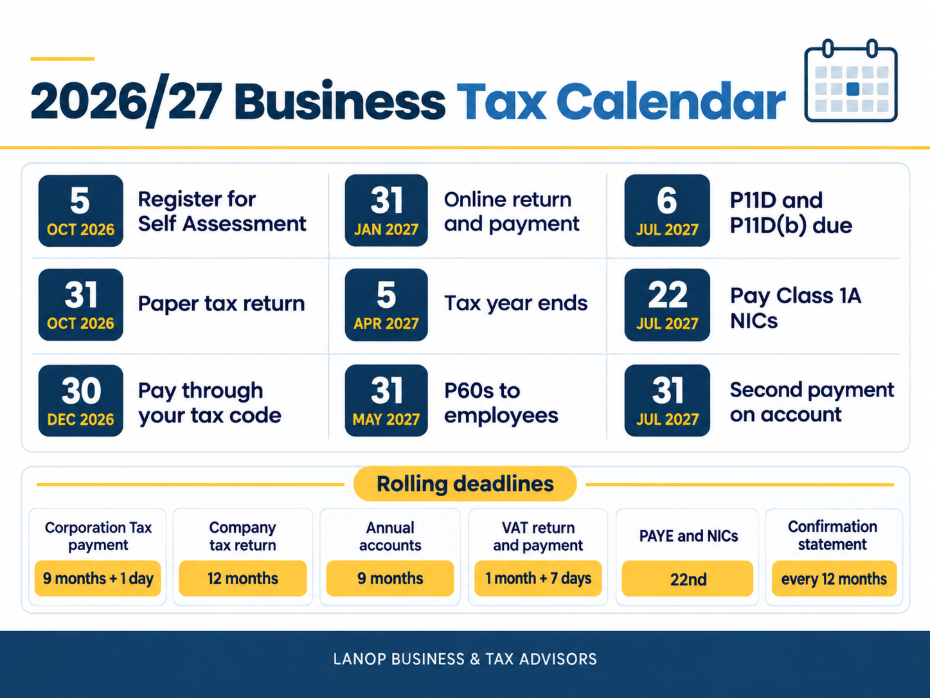
When does a Budget announcement actually affect your business?
What the Chancellor says on the day isn’t law yet.
A few measures take effect at once, or close to it. Many others must wait for a Finance Bill, further regulations or fresh HMRC guidance. Until those appear, nobody knows exactly how the new rules will work.
Whenever something is announced, ask yourself:
- What’s actually been announced?
- When does it kick in?
- Who’s covered by it?
- Which law or HMRC guidance supports it?
Timing is especially important if a deal straddles Budget Day. An October announcement could apply that same day. It could wait until next tax year. Or it might start on some other date entirely.
For that reason, LANOP checks each confirmed change against the date it legally takes effect. We don’t go by the headlines alone.
How can LANOP help businesses prepare for the Autumn Budget 2026?
At LANOP Business & Tax Advisors, we help directors, sole traders and SMEs understand how current rules, and any confirmed Budget changes, apply to them personally.
Ahead of Budget Day, we can go through your salary and dividend split and your Corporation Tax forecast. We can also look at planned spending, pension contributions, any asset sales and your cash flow.
Caught by Making Tax Digital? We’ll check your record-keeping as well, confirm your software is HMRC-approved and help you stay on track with quarterly updates.
After the Budget, it’s time to act rather than guess. We’ll tell you which measures touch your business, when they begin and whether your tax plan needs adjusting. Get in touch with our team to book a pre-Budget review.
Frequently Asked Questions
According to the Chancellor’s letter to the Treasury Select Committee, Wednesday 28 October 2026 is the scheduled date.
Nobody knows for sure until the Chancellor delivers the Budget and HM Treasury releases the detail. In the meantime, keep what’s confirmed apart from what’s being predicted.
Until the government says so, treat any rise as unconfirmed. Base your planning on today’s Corporation Tax rules, not on press reports.
It’s a regular topic before most Budgets. Still, if you’re planning a sale, avoid locking yourself into anything irreversible because of speculation.
Not as a matter of course. Look at how it’ll be taxed first. Then make sure the company has the retained profit and the cash to pay it, and think about your other income.
As per HMRC, MTD for Income Tax has applied since 6 April 2026 to people with qualifying income above £50,000. If the Budget adds anything new, weigh it up separately once it’s confirmed.
Sometimes, but often not. A few measures start on Budget Day. Others need legislation first or begin on a later, stated date.
Begin with whether the business actually needs it. If it does, then work out the relief and timing using current rules and anything confirmed, not guesswork.
Conclusion
Expect plenty of noise before the Chancellor delivers the UK Autumn Budget 2026. For UK businesses, though, the useful question is simple. What might change, and what already has?
Dividend tax, Making Tax Digital, Companies House ID checks and the business-rates revaluation are already live issues for many firms. On top of that, directors and SMEs should look out for any confirmed measures on business tax, investment, staffing costs and drawing profit from a company.
Good Budget planning isn’t about predicting the Chancellor. It’s about knowing your position today, testing a few “what ifs” and being ready to move once the final rules and start dates are known. If you’d like help getting ready, speak to LANOP Business & Tax Advisors today.