
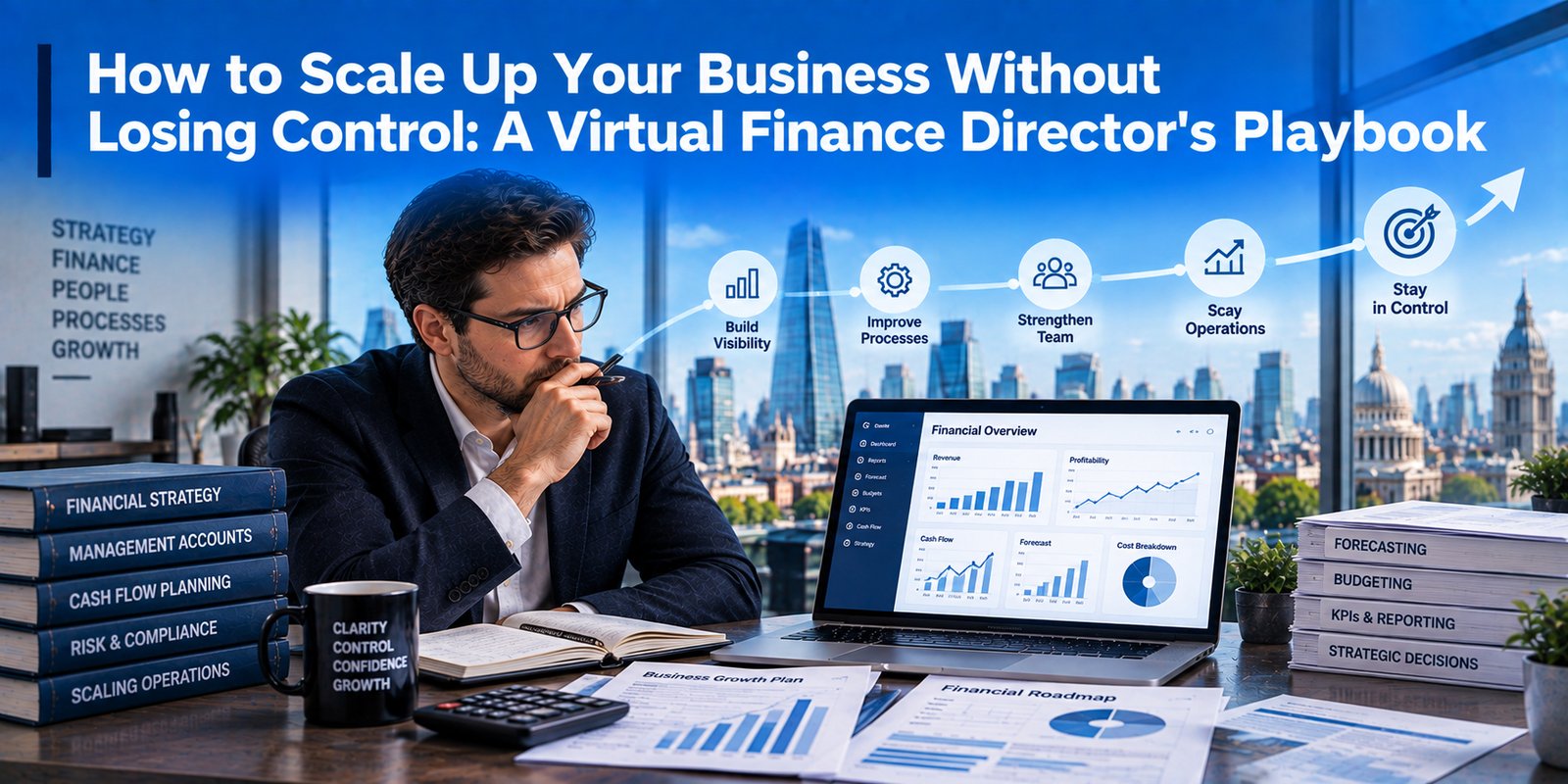
Scaling should make your business stronger. But fast growth can put real strain on your cash, your people and the systems you use to run things.
Sales may go up while margins go down. New staff may join before their roles are clear. And owners can get so caught up in daily decisions that they lose sight of the financial risk.

So the real question isn’t just how to scale up a business. It’s how to grow without losing sight of your numbers, the discipline behind your decisions or control of your cash.
A clear financial structure, backed by timely management information, helps you grow with more confidence.
What does scaling a business actually mean?
Growing and scaling are linked, but they aren’t the same thing. When a business grows, its costs often rise in line with its sales. When it scales, sales go up faster than costs. Its complexity and financial risk don’t rise at the same pace either.
Here’s an example. A consultancy that hires a new adviser for every new group of clients is growing. Now say it makes its service the same each time and improves its pricing. It also uses technology to serve more clients with the same team. That firm is starting to scale.
That means a scaling business should get more efficient as it gets bigger. Its work can be repeated. Its roles are clear. And its managers can make decisions without going to the founder every time.
How do you know whether your business is ready to scale?
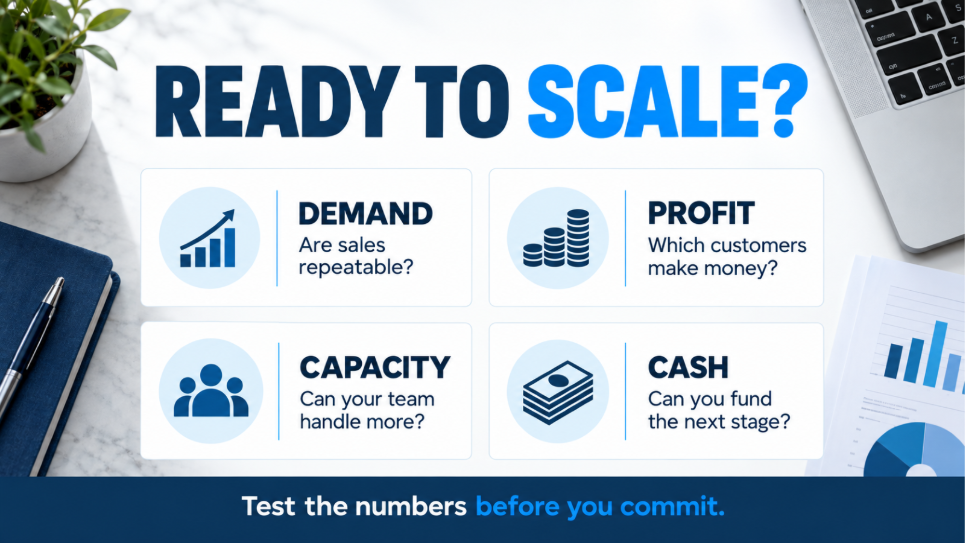
Rising demand is only one sign, and on its own it doesn’t prove you’re ready. Before you commit to new hires, premises, tech or a new market, check that the way you work now is solid.
Start by looking at:
- Gross profit by product, service or customer group
- What it costs to win a customer and what that customer is likely to be worth
- How busy your staff are and how much work you can deliver
- How many customers stay with you and how much revenue repeats
- Debtor days and how your customers pay
- The cash you need to fund each stage of growth
- Tasks that still depend on the owner
- How growth will affect tax and working capital
These figures should show which parts of the business make money, not just which parts are busy. A good profit figure at the top can hide a lot. It might mask contracts priced too low or customers who lose you money. It can also hide a growing need for short-term loans.
It’s just as important to test “what if” scenarios. What happens if sales slow down, customers pay late, wages go up or margins shrink? If a fairly small change would cause a cash crisis straight away, your scale-up plan needs more work.
Build the right financial structure before expanding
A good financial setup for a scale-up links your business plan to your budgets and cash needs. It also names the person who owns each result.
It should give managers the facts in time to change the outcome. It shouldn’t just explain what went wrong after the event.
Use an integrated forecast
A profit forecast on its own isn’t enough. A business can show a profit in its accounts and still run out of cash. That can happen when customers pay late or stock ties up your money. It can also happen when tax is due before the cash from those sales comes in.
An integrated forecast links your profit and loss account, your balance sheet and your cash flow. It should also show when you plan to hire staff and buy kit. And it should show when you’ll repay loans, pay tax and take money out as an owner.
A rolling cashflow forecast then lets you update your plans as things change. The goal isn’t to predict every pound. It’s to spot funding pressure early enough to deal with it calmly.
Introduce management reporting that supports decisions
Monthly management accounts should tell you three things: what happened, why it happened, and what to do next. A useful monthly pack might include:
- Actual results against budget and the last period
- Sales and gross margin by service, product or location
- Your cash position and a short-term cash forecast
- Aged debtors and creditors (who owes you and who you owe)
- Sales pipeline and how much of it you expect to win
- Staff costs, output and capacity
- Tax bills and filing deadlines
- Key risks and what managers are doing about them
Keep your reports focused. Too many numbers can hide the ones that matter.
Each measure should have a clear owner and an agreed target. You should also agree up front what you’ll do when results fall outside the range you’re happy with.
Match funding to the purpose
Short-term cash pressure shouldn’t always be funded the same way as a long-term investment. An overdraft or invoice finance can help cover timing gaps. A term loan or equity may suit a business purchase, new technology or overseas growth better.
Directors should weigh up what the finance costs. Compare that with the likely return and the risk if things go wrong. They should also think about personal guarantees, security and repayment terms. Then there’s the cost of giving away shares, and any limits the deal puts on future decisions.
Start the funding talk before cash gets tight. A lender or investor will usually want forecasts they can trust and up-to-date management accounts. They’ll also want a clear story about how the money will create value.
Protect cash, margins and tax compliance
One of the most common financial issues that small businesses face as they scale is mixing up sales with cash in the bank. When sales rise, you have to spend more on staff, materials and marketing. And you often have to spend it before your customers pay you.
So set clear rules on credit limits and payment terms. Send invoices on time, chase late payments, and give someone the job of collecting money.
On a large contract, you may want to ask for a deposit or for payment in stages. That way, your business isn’t paying for the whole project on the customer’s behalf.
You also need to review your costs as you grow. Extra managers, compliance work, software and quality checks all cost money. They can eat into the margin you make on each sale.
A contract that worked for a small team may stop making sense once you count the full cost of doing the work.
Build tax into your forecast rather than leaving it as a year-end job. According to HMRC, the main Corporation Tax rate is 25% for profits above £250,000. Companies with profits of £50,000 or less may qualify for the 19% small profits rate.
Marginal Relief may apply between those limits. The limits can be lower if you have associated companies. They can also be lower if your accounting period is short.
What about VAT? HMRC guidance says a business must usually register for VAT once its taxable turnover goes over £90,000. If you’re growing, keep a close eye on your taxable turnover. VAT can affect your prices, your contracts and when cash comes in.
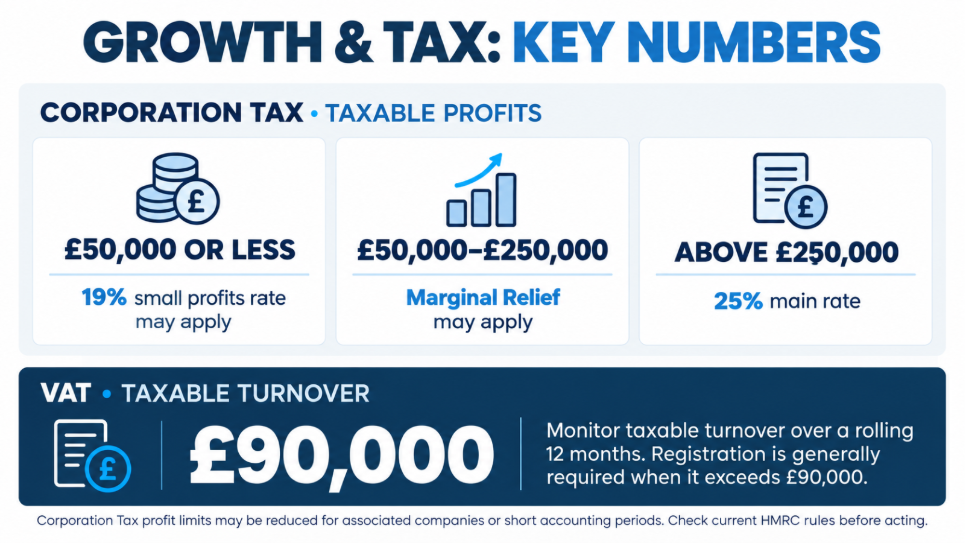
Tax rules and limits can change. Directors should check the latest position with HMRC or a qualified UK tax adviser before they act.
What is the biggest mistake owners make when scaling?
The most common mistake is adding fixed costs before you’ve proved your sales will keep coming. After a short spell of strong sales, a founder may recruit a larger team, sign a long lease or sign up for costly software.
That puts the business under strain when sales slow or customers pay late. It can also push you into taking on poor-quality work just to cover your monthly costs.
A step-by-step approach is usually safer. Set clear conditions for each investment, such as a target level of signed contracts, cash in reserve or sales pipeline won. If you don’t meet them, delay the spend or rethink it.
The second mistake is keeping every decision with the founder. Being in control doesn’t mean you sign off every purchase or deal with every customer issue yourself. It means setting clear limits on who can approve what. It also means splitting up key duties and making sure odd or unusual payments get the right checks.
How can a service business scale without lowering quality?
To scale a service business, you need things to be done the same way more often. But you still need people to use their professional judgement. Start by mapping how work moves from first enquiry to delivery, billing and follow-up.
This often shows up tasks that are done twice, unclear handovers and work that doesn’t need a senior person.
Write down the steps you repeat and set the standard you expect at each stage. Then use technology to support the work. It can help with scheduling, workflow, reporting and document control. But software won’t fix a badly designed process.
You should also measure profit by client, project and team. Track the time spent on rework and on requests outside the agreed scope. Track senior staff time spent checking work, too. This helps you improve your pricing and reshape your service packages. It also helps you spot clients who take up more time than they’re worth.
Quality checks need to grow with the work. Before your volumes rise, build in review points and customer feedback. Make it clear who is in charge of fixing mistakes, too.
Which recent UK changes should scale-up directors address?
Let’s start with Companies House. Its guidance says ID checks are now a legal must for people who set up, run, own or control UK companies. This applies to directors and to people with significant control. It also covers some other company roles.
Companies House also says existing directors will usually need to give their personal code. They do this with the company’s next confirmation statement. A person with significant control may have a 14-day period to give that code, depending on their situation.
These rules matter when you scale, because growth often brings new directors, shareholders, or group companies. So build ID checks, ownership records, and filing duties into your plan for running the company. Don’t leave them until you’re in the middle of a deal.
The rules may keep changing. So, check out the latest Companies House and HMRC rules. Do this before you appoint anyone or change who owns the company.
When should you bring in a virtual Finance Director?
An external virtual Finance Director can help a growing SME that needs senior financial input. It suits a business that doesn’t yet need a full-time Finance Director, or can’t justify the cost of one.
The right time is often clear when:
- Decisions are being made without forecasts you can rely on
- The owner can’t say which customers bring in the best margins
- Cash stays tight even though sales are rising
- Management accounts arrive too late to act on
- Funding bids need stronger financial proof
- The business is getting ready for a purchase, investment or new market
- The accounts team handles day-to-day transactions but lacks a clear strategy
A virtual FD works alongside the owner, the accountant, and the management team. The role goes beyond writing reports. A good FD will challenge your assumptions and test your investment plans. They’ll also make sure you understand the financial risks before you commit.
How Lanop helps UK businesses scale with control
At Lanop Business & Tax Advisors, we help owners turn growth plans into real, practical money decisions. We can help with management reporting, cash-flow forecasts and budgets. We also cover tax planning, financial controls and getting ready for funding.
First, we find out where your business makes money and where cash is being soaked up. We also look at which decisions carry the most risk. Then we build a reporting and planning setup that fits your company’s size, sector and stage of growth.
As you grow, our virtual FD support gives you a senior finance expert on your side. You get this without having to make a full-time hire straight away. That gives your team clearer facts to base decisions on. It also helps you keep good tax, finance and governance habits in place.
Frequently Asked Questions
Yes. Some businesses scale using profits they’ve kept or deposits from customers. Others do it by getting better control of their working capital. The right route depends on how fast you want to grow and how quickly your sales turn into cash. It also depends on how much financial risk you’re taking on.
Not always. A group structure can help keep different activities or investment risks apart. But it can also add more tax, reporting and governance duties. Get UK and local advice before you set up an overseas entity.
Outsourcing can give you expert help without adding permanent fixed costs. But agree a few things before you hand over important work. Set the service standards and decide who gets access to your data. Be clear about who is responsible for what and how you’ll measure results.
Back up your yearly budget with a rolling forecast. Update it whenever your business plans change in a big way. Fast-growing businesses may need to review cash and performance more often.
They should look at the quality of earnings, working capital and tax exposure. They should check how much the business relies on a few big customers. And they should review its contracts, its liabilities and the cost of joining the two businesses together. Do your financial and tax due diligence before you agree the price and how the deal will be funded.
Conclusion
Scaling isn’t only about growth. It’s about building a business that can handle more people, more customers and bigger financial commitments. And it has to do that without hurting your margins, cash flow or control. Good forecasts, clear reporting and strong leadership all lead to better decisions.
Is your business getting ready for its next stage of growth? Lanop Business & Tax Advisors can review your financial structure, cash needs and reporting. Speak with our team about virtual Finance Director support. Together, we can build a scale-up plan based on facts, not guesswork.