Germany is a big market with plenty of buyers. Pick the wrong company type, though, and the costs pile up fast. This guide helps you choose between a GmbH and a UG. You’ll see what setup really costs and what to check before you sign. The rules reflect 2026, but your own situation decides the answer.
Quick Answer
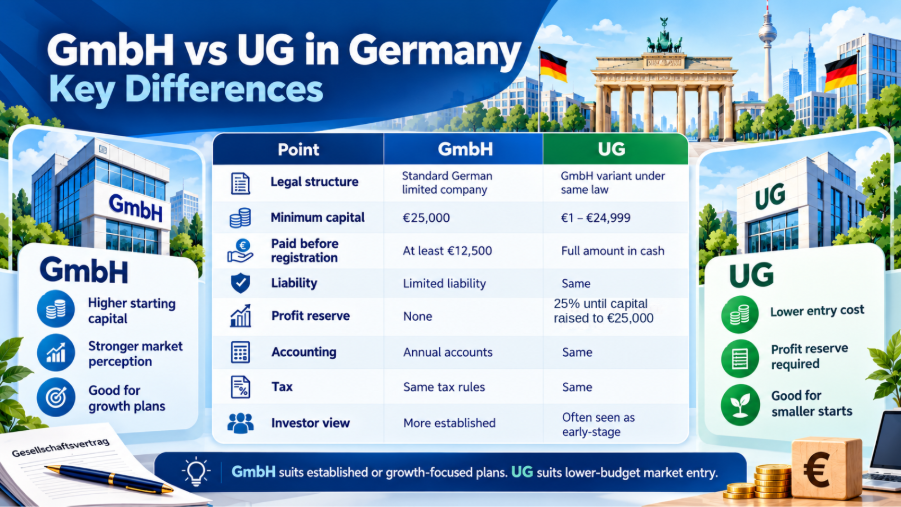
A GmbH needs €25,000 in share capital. For a standard cash formation, at least €12,500 must be paid before registration, including at least 25% on each share. A UG can start with €1, but its capital must be paid in full. It must retain 25% of its annual surplus, after losses carried forward, until its registered share capital is formally increased to at least €25,000. Both give you limited liability. As a UK founder, you also need to weigh tax, banking, ownership, where you run the company, yearly compliance and Brexit.
What Is a GmbH?
A GmbH is Germany’s standard private limited company. Shareholders generally risk their subscribed capital, including any amount they have not yet paid in. The company legally exists once it appears in the Handelsregister, the German commercial register.
What Is a UG?
A UG isn’t a different kind of company. It’s a lighter version of the GmbH, built for founders with little starting cash. The name must end in “UG (haftungsbeschränkt)”. Some banks and suppliers see that label and assume the business is thin on funds. Think about who you’ll be dealing with.
Can a UK Founder Set Up a German Company After Brexit?
You can. Brexit didn’t stop British people or UK companies from owning German companies. It did change the rules around customs, VAT and immigration.
Keep four questions apart. Who owns the shares? Who runs the company? Where do you live? Who may work in Germany? Each one has its own answer.
Can a British Citizen Own 100% of a GmbH or UG?
Yes. One person can hold every share, so you don’t need a German partner. Owning the company won’t give you the right to live or work in Germany, though.
Do You Need a German Shareholder or Resident Director?
No to both. German law has no residency rule for shareholders or for the Geschäftsführer, the managing director. Banks may still want a local contact. And if you work as a director while living in Germany, you may need a residence permit.
Can a UK Ltd Own a German GmbH?
It can, and many do. You’ll just need more paperwork to show that the UK company exists and who can sign for it.
Do You Actually Need a German Company?
Not always, and company formation shouldn’t be your first move. Start with a simple question. What would a German company let you do that you can’t do today?
Can a UK Ltd Sell Directly to Germany?
Often, it can. Plenty of UK firms sell to German customers with no German entity. You may still need a German VAT number, and an EORI number if you ship goods.
Keep an eye on permanent establishment risk. A fixed office in Germany can create a German tax presence. So can a local agent who signs contracts for you.
German Branch vs GmbH or UG
A branch isn’t a separate company. Your UK company stays fully liable for it, and Germany taxes the branch profits. A subsidiary keeps that risk apart.
Staff, premises, stock and local contracts all point towards a subsidiary. So does the trust German customers place in a local company. A small pilot with a handful of clients may need neither.
GmbH vs UG: Which Structure Fits Your Situation?
The best fit depends on what you’re doing.
- Small service business testing Germany: A UG may suit you if you accept its limits.
- Established UK company expanding: A GmbH usually looks stronger to German banks and clients.
- Startup seeking investment: Investors often expect a GmbH. You may have to convert a UG later.
- Ecommerce business holding German stock: Check VAT, customs and liability first. A GmbH often suits bigger stock levels. Ecommerce accountants handle this all the time.
- Company hiring German staff: A local company, usually a GmbH, tends to be the cleaner route.
- Founder with limited capital: A UG can work, but only with a realistic cash plan.
GmbH Share Capital: Do You Really Need €25,000?
What Does the €25,000 Requirement Mean?
It’s the money shareholders promise to put into the company. It isn’t a government fee. The cash sits in the company’s bank account and belongs to the company.
Don’t mix it up with setup costs like notary and register charges. Those are separate.
Can a GmbH Register After €12,500 Is Paid?
Yes. For a standard cash formation, at least €12,500 must be paid before registration. At least 25% of each cash-funded share must be paid, and shareholders remain liable for the unpaid balance.
Can the GmbH Use Its Capital After Registration?
Yes. Once registered, the money can fund genuine business costs, subject to capital-maintenance rules. There’s one trap. If you spend part of it before registration, shareholders may have to cover the gap. Keep early spending low until the company is on the register.
Can You Really Start a UG With €1?
On paper, yes. In real life, it’s rarely wise.
That €1 is the legal minimum. It isn’t what setup costs. Unlike a GmbH, a UG must have its full share capital paid in cash before registration. You can’t form it using assets instead. You’ll still pay notary fees, an accountant, bank charges and insurance. A company with almost no cash can run dry quickly. It can even go insolvent before your first customer pays.
Look at your first six to twelve months of expenses. Set your UG capital with that in mind.
GmbH vs UG Formation and Annual Costs
German Company Formation Costs
The Germany company formation cost comes in several layers:
- Share capital, which stays in your company
- Notary and Handelsregister fees, set by official fee schedules
- The Gewerbeanmeldung, your trade registration at the local office
- Certified translations and apostilles for UK documents
- Legal or tax advice
- Bank onboarding charges
- A German registered address, if you have to rent one
Notary and court fees depend on your capital and how many shareholders you have. They also depend on whether you use the simple Musterprotokoll template. A straightforward case often costs a few hundred euros. Ask the notary for a quote.
Advice, translations and address services usually cost more than the official fees.
What Does the Company Cost Each Year?
Plan for bookkeeping, annual accounts, corporation tax and trade tax returns, VAT returns and payroll. Add IHK membership, bank fees and Transparenzregister charges. Professional help is usually the biggest cost.
A UG cuts the starting capital. It doesn’t cut the yearly paperwork.
Can You Set Up a GmbH or UG From the UK?
Most of the time, yes. But it rarely works the way online ads promise.
Can German Notarisation Be Completed Online?
Yes. Since August 2022, you can notarise qualifying GmbH and UG formations by video call through the Federal Chamber of Notaries. Since August 2023, some GmbH formations using assets instead of cash can also be handled online. Not every asset qualifies, and a UG must be formed with cash.
Can a UK Passport Be Used for Online Notarisation?
Usually not. Being legal and being technically possible are two different things. The platform needs a compatible electronic ID, like a German eID or a recognised EU eID. A UK passport alone generally won’t pass that check.
Will a UK Founder Need to Travel to Germany?
Not always. Many founders use a power of attorney. You sign it in front of a UK notary and get it apostilled. Then someone you trust uses it in Germany. Ask your notary, because the rules vary by case.
Documents UK Founders Need for German Company Formation
Your notary will give you the final list. Here’s what a typical German company registration documents checklist looks like.
Individual UK Shareholder
- Certified passport copy
- Proof of address
- Details of the Geschäftsführer
- Beneficial ownership information
- Power of attorney, if someone signs for you
UK Ltd as Shareholder
- Companies House extract and certificate of incorporation
- Articles of association
- List of directors and beneficial owners
- Proof that the signatory has authority
- Board resolution, where needed
Do UK documents need an apostille? Usually, yes. Both the UK and Germany use the Hague Apostille system.
Do they need a German translation? Often, and it must be certified. Your notary will say what the register accepts.
GmbH and UG Formation Process in Germany
The GmbH formation process in Germany and the UG route follow the same order:
- Choose the structure.
- Decide who owns the shares.
- Appoint the Geschäftsführer.
- Pick the company name.
- Define the business purpose.
- Arrange a German address.
- Draft the Gesellschaftsvertrag (articles).
- Complete notarisation.
- Open the bank account.
- Pay in the share capital.
- Register with the Handelsregister.
- File the Gewerbeanmeldung.
- Register for tax.
- Register for VAT, if needed.
- Meet the Transparenzregister rules.
- Set up accounting and payroll.
Delays tend to hit steps 6, 9 and 13. Bank KYC checks can take weeks, especially with foreign owners. Tax registration moves at the speed of the tax office.
When Can the Company Start Invoicing?
Not necessarily. After notarisation, a GmbH or UG “in formation” may be able to trade and issue invoices before Handelsregister registration. But pre-registration liability is different, and invoices still need to meet tax and VAT rules. Check those points before sending one. Nobody can promise you a fixed timeline.
Geschäftsführer Requirements for UK Founders
The German managing director requirement (Geschäftsführer) catches many founders off guard.
Shareholder vs Geschäftsführer
A shareholder owns the company. The Geschäftsführer runs it and signs for it. One person can be both.
Can a UK Resident Be Geschäftsführer?
Yes. German law doesn’t make the director live in Germany. The company does still need a German address.
What Duties Does a Geschäftsführer Have?
The director speaks for the company and keeps proper accounts. They also meet tax deadlines and watch for signs of insolvency. Limited liability won’t cover every personal claim. If a director breaks their duties, they can face direct claims.
German Business Address and Bank Account Requirements
Your registered seat (Sitz) is the German town or city named in the articles. The company must also register a German business address with the Handelsregister. That address doesn’t have to be where you work. A virtual office may work in some cases, but banks and tax offices sometimes push back.
Bank accounts are where many UK founders lose weeks. Expect KYC checks on shareholders, beneficial owners and where your money comes from. Some banks hesitate when the owners are foreign or nobody is based locally. Capital payments usually go into a formation account.
GmbH vs UG Liability
Both types give you limited liability. Creditors generally go after the company, not your personal assets.
There are exceptions:
- Personal guarantees you sign for loans or leases
- Director misconduct or breach of duty
- Unpaid taxes or social security, in some cases
- Late insolvency filings
- Unpaid share capital
Limited liability is protection. It isn’t immunity.
GmbH vs UG Tax and Accounting
A UG doesn’t get a lower tax rate just because its capital is low. Both pay the same corporate taxes.
German Corporate Taxes
Corporate income tax is 15%. A 5.5% solidarity surcharge applies on that tax, so the total is 15.825%. Municipal Gewerbesteuer, the trade tax, comes on top and changes by location. Germany Trade & Invest puts the combined average near 30%.
The corporate rate will drop by one point a year from 2028. It reaches 10% in 2032. German VAT applies where your activity falls in scope.
Accounting and Annual Compliance
Don’t expect easy bookkeeping just because you run a small UG. You’ll need double-entry books and annual financial statements. Corporation tax and trade tax returns are standard requirements. VAT returns and payroll filings also apply where relevant.
Here’s a 2026 update. German businesses have generally had to be able to receive structured electronic invoices since January 2025. For covered domestic B2B transactions, issuing them becomes compulsory in January 2027 if prior-year turnover exceeds €800,000. Most other businesses follow in January 2028. Exceptions apply.
Will a UK Founder Pay Tax in Germany and the UK?
Possibly in both, and the facts decide it. Setting up in Germany doesn’t settle your UK tax position by itself.
German Corporate Tax Residence
A company with its registered seat or place of management in Germany pays German tax on its worldwide income.
UK Central Management and Control
A company that isn’t UK incorporated can still be UK tax resident. That happens if it’s centrally managed and controlled in the UK. HMRC’s company residence guidance treats this as a question of fact. A bit of UK board input doesn’t automatically trigger it.
Managing a German Company From the UK
Say you make every key decision at your kitchen table in Britain. That gives HMRC a reason to ask questions. Three things count: where you decide, where the board meets and who really runs the business. Keep a record of how decisions get made.
This is the kind of issue to settle through proper tax planning before you set up.
UK Germany Double Tax Treaty
The treaty between the UK and Germany helps settle dual residence and cuts some withholding taxes. You’ll still need an analysis of your own case.
Permanent Establishment Risk
A German company can create a UK taxable presence if it runs from a UK base. A UK company can do the same in Germany. Staff, offices and the power to sign contracts are the usual triggers.
Should You Own the German Company Personally or Through Your UK Ltd?
Neither route wins every time. Get tax advice before you decide.
Personal Ownership
This is simpler to set up. It also keeps the German business apart from your UK company. Dividends then come to you personally, and that can mean a bigger tax bill.
UK Ltd as Parent Company
This supports group planning, intercompany services and investor deals. It also brings more governance work, transfer pricing rules and paperwork. Our group structuring service can help you map out the options. Think about how you’d sell or exit later.
How Can a UK Founder Take Money Out of the German Company?
You can use a salary, managing director pay or dividends. Intercompany service fees and properly documented loans are other routes.
German dividend withholding tax is 25% plus the surcharge, which makes 26.375%, before treaty relief. The UK Germany treaty can lower it. Commonly cited rates are 5% for a company shareholder with at least 10%, and 15% for others. Conditions apply, and UK tax may come into play too. Payments between related parties must be priced at arm’s length.
How Does the UG 25% Profit Reserve Rule Work?
Every year, a UG must move 25% of its annual surplus, after deducting losses carried forward, into a legal reserve. It can use that reserve only to cover qualifying losses or to raise its registered share capital.
Reaching €25,000 in accumulated reserves doesn’t end the rule. It stops only when the UG formally increases its registered share capital to at least €25,000. Until then, the reserve limits how much profit you can pay out.
Does a UG Automatically Become a GmbH at €25,000?
No. Reaching €25,000 in capital and reserves doesn’t automatically change anything. A capital increase needs a shareholder resolution, notarisation and registration. Once registered share capital reaches €25,000, the company may use the GmbH name, but it can also keep the UG name.
What Does Brexit Change for UK Founders?
A German GmbH is an EU based company, which can help you build a local presence. It doesn’t make Brexit go away.
- Customs rules still apply to goods moving between the UK and the EU.
- VAT and import VAT questions remain.
- You may still need an EORI number.
- Immigration stays separate from ownership.
Be wary of anyone who says a GmbH gives you “unrestricted EU access.” What you get is an EU based entity. The rules still apply to it.
What Happens If the Business Fails or You Want to Close It?
Think about the exit on day one. A company with thin capital can hit trouble quickly. German law sets strict deadlines for insolvency filings. Directors must apply without undue delay. The maximum is three weeks after illiquidity and six weeks after over-indebtedness, not an automatic grace period. Even closing a healthy company takes work. You’ll need liquidation, final accounts and final tax filings. That takes time and money.
Your Next Step
Start with the line that sounds most like you.
- Testing Germany with limited cash? Check whether a UG fits your plan.
- Running an established UK business, or chasing investors? Compare a GmbH against your commercial goals.
- Only selling into Germany? First confirm you need a separate company at all.
- Running the company from Britain? Review UK and German tax residence and treaty issues before you finalise the setup.
- Planning to move to Germany yourself? Treat immigration as its own project.
Planning to expand from the UK into Germany? Speak with Lanop before you choose the structure. We can help you look at the company setup alongside UK and German tax, accounting, ownership and ongoing compliance. We also draw on our wider international and offshore accounting experience. That way you can move ahead with a structure that fits how your business will really run.
Contact Lanop today to book a free consultation with our team.
Frequently Asked Questions
Yes. A UK resident can own a German company and often run it too. You’ll still need to handle setup, banking and tax steps.
A GmbH needs €25,000 in registered share capital. It isn’t a government fee. For a standard cash formation, at least €12,500 must generally be paid before registration, including at least 25% of each share.
Legally, yes. Its capital must be paid in full in cash before registration. Most businesses need more cash to cover setup and running costs.
Sometimes. It depends on notary rules, ID checks and which documents you need.
No. Goods moving between the UK and the EU can still trigger VAT, customs and compliance rules.