
Business asset disposal relief (BADR) can cut the Capital Gains Tax on a qualifying company sale to 18% for disposals from 6 April 2026. For a share sale, you usually need to be an employee or office holder of a trading company for at least two years. Most owners also need at least 5% of the shares, voting rights, and economic entitlement. A £1 million lifetime limit applies to qualifying gains. Read on to see where you stand.
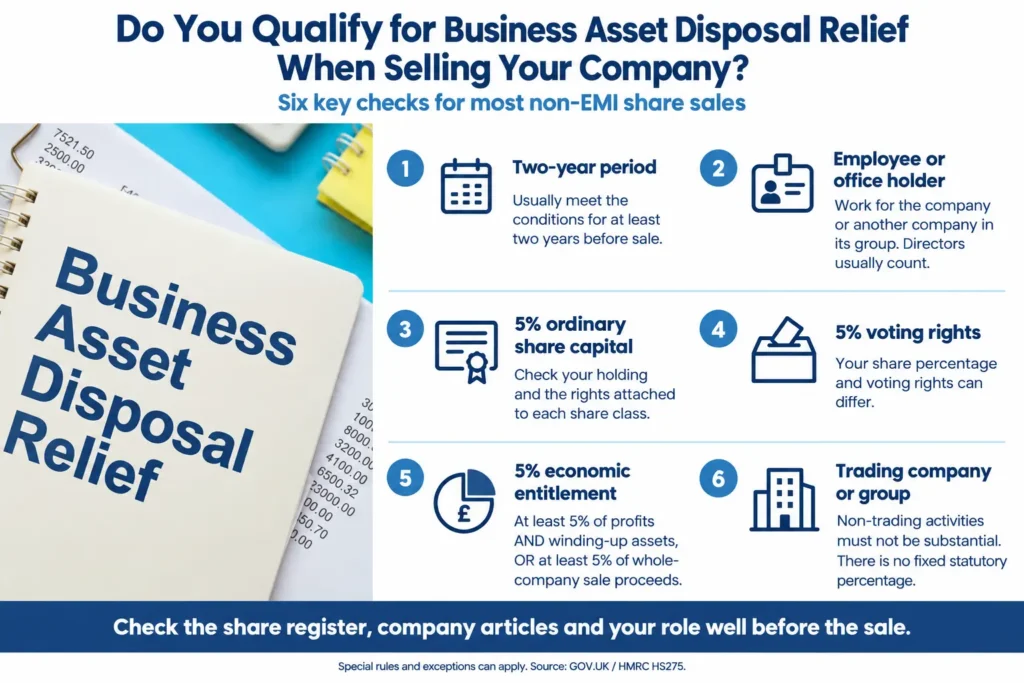
Do You Qualify for Business Asset Disposal Relief When Selling Your Company?
You may qualify if you sell shares in a trading company where you work and hold a real stake. The tests are strict, and you must hold the shares for two years before the sale.
The business asset disposal relief conditions below all need checking. GOV.UK publishes the official business asset disposal relief eligibility rules for share sales. Work through them one by one.
1. You Must Usually Meet the Two-Year Qualifying Period
For most share sales, the conditions must apply for at least two years up to the date of sale. That clock matters.
If you became a director eighteen months ago, you may not be ready. Many owners check this only shortly before completion. By then, nobody can change the history.
If you are close to the line, a short delay can sometimes protect the relief. Weigh that against the buyer’s timetable.
2. You Must Be an Employee or Office Holder
You must be an employee or office holder of the company, or of another company in its group, for the same two years. Directors usually count. Employees count too. Can you claim BADR if you own shares but do not work for the company? Normally, no. Shares alone are not enough. A silent family shareholder with no role will usually fail this test.
3. You Must Normally Own at Least 5% of the Ordinary Share Capital
You need at least 5% of the company’s ordinary share capital. If you hold 6 of 100 ordinary shares, you pass this test. Check the share register rather than relying on memory. Fixed rate preference shares usually sit outside ordinary share capital. Different share classes can change your answer.
4. You Must Normally Hold at Least 5% of the Voting Rights
You also need at least 5% of the voting rights. This catches people out because shares and votes can differ. Some shares carry no votes. The articles of association can also limit voting. A founder with 8% of the shares but only 2% of the votes can fail this test. Read the articles before you assume.
5. Your Shares Must Meet the Economic Entitlement Test
Your shares must also give you a real economic stake. You need a right to at least 5% of the distributable profits. You also need 5% of the assets if the company winds up. There is an alternative route. You can instead have a right to at least 5% of the proceeds if the whole company is sold. Owning 5% of the shares does not automatically guarantee BADR. Unusual dividend or capital rights can change your entitlement. Check them early.
6. The Company Must Be a Trading Company or Holding Company of a Trading Group
In simple terms, trading must be the company’s main activity. Investment and other passive activity can count against you. The law looks at whether non-trading activity is substantial. It does not set one fixed percentage. This matters most when profits build up inside the company. We cover that below.
What Is the Business Asset Disposal Relief Rate in 2026?
Qualifying disposals from 6 April 2026 are taxed at 18%. Use that figure for a sale in the 2026/27 tax year.
| Disposal Period | BADR Rate |
| Up to 5 April 2025 | 10% |
| 6 April 2025 to 5 April 2026 | 14% |
| From 6 April 2026 | 18% |
The government increased the rate in two phases after the Autumn Budget 2024. The business asset disposal relief rates were increased from 10% to 14%, and then to 18%. The rate for 2025/26 is 14%.
Remember that old books mention 10% or 14%. Consider them outdated. While searching for the business asset disposal relief 2025, you will find these percentages. The percentage for business asset disposal relief 2026 is 18%.
Also, keep an eye on your contract dates. If you have an unconditional contract signed in 2025/26 and completed on or after 6 April 2026, HMRC considers that the disposal is completed upon completion. Therefore, the 18% rate applies to such contracts.
How Much Tax Could You Pay When Selling Your Company?
Many owners ask the same thing. How much will HMRC take from my sale? The answer starts with the gain, not the price.
BADR Applies to the Gain, Not Automatically the Selling Price
Start with five terms:
- Selling price: what the buyer pays for your shares
- Base cost: usually what you paid or invested for them
- Allowable costs: costs of the sale, such as legal and advisory fees
- Taxable gain: price, less base cost and allowable costs
- Qualifying BADR gain: the part of that gain that meets the conditions
If you sell your company for £1 million, do you pay 18% overall £1 million? No. You pay on the gain. Base cost and allowable costs come off first.
Under capital gains tax business asset disposal relief rules, only qualifying gains get the lower rate. Gifted or inherited shares can make the base cost harder to work out, which is another reason this often overlaps with wider estate planning.
How Does the £1 Million BADR Lifetime Limit Work?
The business asset disposal relief limit is £1 million of qualifying gains across your lifetime. It is not a cap on your company’s value. A company worth £5 million can still qualify.
Only the first £1 million of your qualifying gains gets the lower rate. Gains above it fall under standard CGT rates. The business asset disposal relief lifetime allowance does not refresh after each sale.
Investors’ Relief has its own separate £1 million limit. HMRC tracks the business asset disposal relief limits separately for each relief.
Can You Claim BADR More Than Once?
Yes. GOV.UK says there is no limit on how many times you can claim. Your total qualifying gains across all claims cannot exceed £1 million.
Do Previous Entrepreneurs’ Relief Claims Count?
Yes. Earlier Entrepreneurs’ Relief gains count toward your lifetime total. The limit was higher before 11 March 2020, and older claims can still matter. Pull out your past tax returns. If you sold before that date, ask HMRC to confirm your position.
Is the £1 Million BADR Limit Per Company or Per Person?
It is per person. You do not get £1 million for each company you own. Everyone has their own limit.
What Happens If Your Shareholding Falls Below 5%?
Picture a founder who owned 8% of the company. The company issued new shares to an investor. The founder’s holding dropped to 4%.
On paper, the 5% test now fails. GOV.UK says relief may still be available in this situation. You can elect to be treated as if you sold and bought back your shares just before the new issue.
That election creates a gain you can claim BADR on. You can also choose to postpone paying the tax until your actual sale.
Do not assume this happens automatically. You must make the election. Get advice before the next funding round, not after it, ideally through proper tax planning ahead of time.
Can EMI Shareholders Qualify with Less Than 5% Ownership?
Yes, EMI shares follow different rules. Employees with qualifying EMI options can claim BADR without holding 5%.
GOV.UK sets two tests. You must have bought the shares after 5 April 2013. You must also have been granted the option at least two years before the sale.
The two-year clock runs from the option grant, not from exercise. You still need to check other conditions, such as the trading company test.
Can Both Spouses Claim BADR When Selling a Company?
If both spouses or civil partners qualify individually, then yes. The HMRC will consider both individuals individually. They both need to have two years’ worth of history, duties, and shareholding. There is also a chance that each individual has his or her own £1 million limit.
Can You Transfer Shares to Your Spouse Before the Sale?
Do not treat a last-minute transfer as a shortcut. Your spouse still has to meet the qualifying period and every personal condition. They also need employee or office holder status and to meet the 5% tests. A late transfer may not create extra entitlement. Seek advice before moving any shares.
Can Surplus Cash or Investments Affect BADR?
A large cash balance does not automatically mean BADR is lost. The wider trading position matters.
HMRC looks at the whole company. The question is whether non-trading activity has become substantial. Factors can include income, asset values, costs and management time.
What If Your Company Holds Large Cash Reserves?
Cash built up from normal trading is common in successful companies. It does not make you a non-trading company by itself. There is no simple statutory cash percentage.
Look at why the cash is there. Money held for working capital, tax bills, or planned growth looks different from cash left idle for years. Reserves that grow while the trade stays small can draw questions.
What If the Company Holds Investments?
Share portfolios, loans to others, and other passive holdings are non-trading activity. A small portfolio may not matter. A large one can change the picture.
Compare the investment income and asset values with the trade itself. If investments have become a big part of the company, ask for a review before you sell.
Can You Claim BADR After the Company Stops Trading?
Sometimes, yes. GOV.UK says that if the company stops trading, you can still qualify by selling your shares within three years.
I stopped trading last year. Have I already lost BADR? Not necessarily. The three-year window may still be open. The other tests still apply, though. You normally need to have met the conditions for two years up to the date you stopped trading. Check your dates before you do anything.
Share Sale vs Asset Sale: Why the Deal Structure Matters
You can sell the same business in different ways. Each way can give a different tax result.
What Happens in a Share Sale?
You sell your shares to the buyer. You are the seller, and the gain is yours. The company carries on, now owned by the buyer. If you meet the conditions, BADR may apply to your gain. This is the situation most people picture.
What Happens in an Asset Sale?
The company sells its underlying assets, such as equipment, stock, and goodwill. The company receives the money, not you. You still own the company, and the cash sits inside it. The company deals with tax on its own gains. You face a separate question when you take money out.
Why Sellers Should Review the Structure Before Signing
Buyers often prefer assets. That can change who pays tax, when, and at what rate. The buyer wants business assets instead of my shares. Could that affect BADR? Yes. A share sale lets you claim BADR on your own gain. An asset sale does not work that way. Rollover equity and loan notes can also alter the analysis, an area where our group structuring service can help you weigh the options. A late switch can undo careful planning. Ask for advice before you agree to the structure.
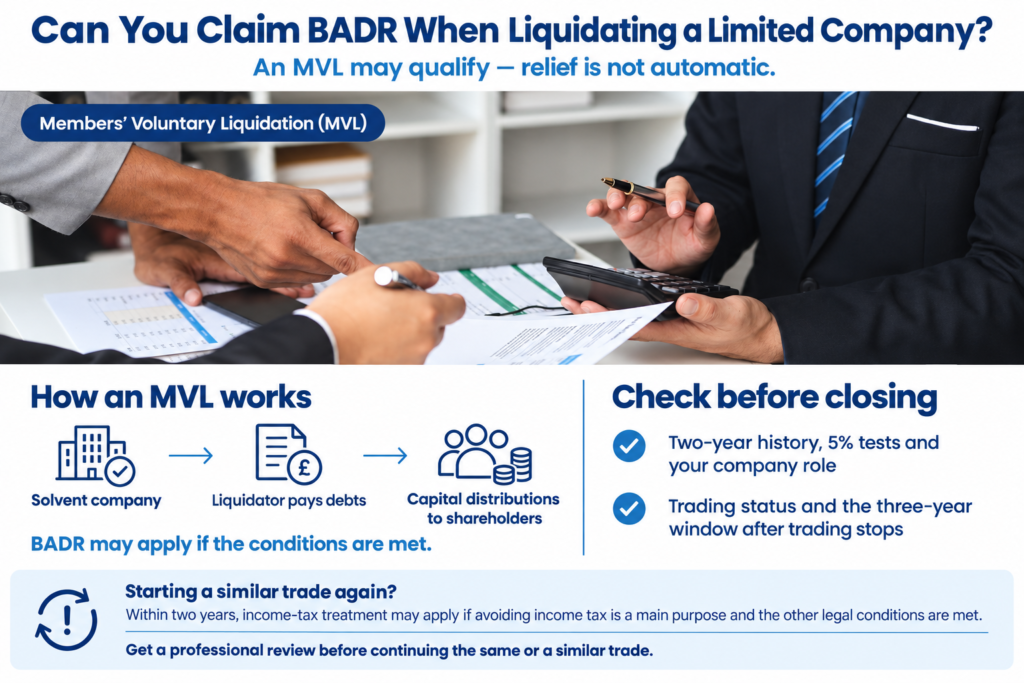
Can You Claim BADR When Liquidating a Limited Company?
This is a common question about business asset disposal relief liquidation. The answer depends on how you close the company and on your facts.
Can BADR Apply to a Members’ Voluntary Liquidation?
A Members’ Voluntary Liquidation (MVL) is a formal way to close a solvent limited company. A liquidator pays the debts. The remaining cash and assets go to shareholders as capital distributions. Those distributions can be taxed as capital rather than income. BADR may be available if you meet the conditions.
Does an MVL Automatically Qualify for BADR?
No. You still need the two-year history, the 5% tests, your role in the company, and trading status. If trading has stopped, the three-year window matters too.
Can You Close the Company and Start the Same Business Again?
Be careful here. The rules target people who close a company, take capital treatment, and then carry on a similar trade. If that happens within two years, and avoiding income tax is a main purpose, the distribution can be taxed as income.
Do not rely on a simple rule of thumb. Get a professional review if you plan to continue the same or a similar trade.
How Do You Claim Business Asset Disposal Relief From HMRC?
The HMRC guidance on business asset disposal relief sets out the claim process. The business asset disposal relief legislation sits in the Taxation of Chargeable Gains Act 1992. Here is the process at a high level.
Calculate the Capital Gain
Work out your selling price, base cost and allowable costs. This gives your gain on the disposal.
Check Your Remaining Lifetime Allowance
Add up earlier BADR and Entrepreneurs’ Relief claims. Subtract them from £1 million. That is what you have left.
Identify Which Gain Qualifies for BADR
Not every gain in a sale necessarily qualifies. Match each gain against the conditions. Keep the remainder for standard CGT rates.
Report the Disposal and Make the Claim
You can claim through your Self Assessment tax return. You can also complete Section A of the BADR help sheet.
GOV.UK lists the deadline as 31 January 2028 for disposals in 2025/26. The same pattern points to 31 January 2029 for 2026/27 disposals. Check GOV.UK before relying on that date.
Frequently Asked Questions
Potentially, yes. BADR might be applicable when a partial disposal takes place and the required criteria of eligibility are fulfilled by that moment. Moreover, the partial disposal of shares might make you eligible for BADR in the future sales of your holding.
Yes, although it complicates the calculation of the Capital Gains Tax. The tax treatment depends on the certainty of the deferred payment. In case of earn-outs or similar types of payments, there might be special rules.
Yes. There are differences in voting, dividends, and capital rights between various share classes. This point is important since BADR eligibility might be related to the percentage of your ordinary shares, voting rights, and economic interests. Having more than 5% of the shares does not always mean meeting all criteria for BADR.
It may apply if the company whose shares you own is the holding company of a qualifying trading group and the other BADR conditions are met. A holding company that mainly holds investments may not satisfy the same trading-group requirements.
It can. Share exchanges, reorganizations, new holding companies, and changes to share rights can affect how BADR applies. Some reorganizations are treated as continuing the original shareholding, while others may require specific elections or further analysis.
You may need to show that you met the required conditions, including your shareholding, voting rights, role in the company, qualifying period, and the company’s trading status. Keep supporting records such as company accounts, share documents, employment records, and sale agreements. For complex cases, professional advice can strengthen your claim, and preparation now makes a far smoother process if HMRC does open an HMRC tax investigation.
Selling Your Company? Check Your BADR Position Before You Commit
Your next step depends on where you are today. If you clearly meet the basic conditions, work out your expected gain. Then confirm how much of your lifetime limit remains. That tells you what tax to expect.
If you have complications, get them reviewed before you complete the process. These include surplus investments, dilution, unusual share rights, restructuring, an asset sale, an MVL or earlier claims.
If you are still planning, review BADR before you agree the final structure. Do it before you sign anything binding. Eligibility always depends on your own circumstances. This article cannot replace advice on your facts.
Planning to sell, restructure, or close your limited company? At Lanop Business and Tax Advisors, we can review your BADR position before the transaction. We can assess your shareholding and company history, estimate your potential Capital Gains Tax exposure, and explain your options. Speak to Lanop about your company sale and BADR position before you finalize your exit.