

Financial governance is the set of records, controls, and reviews that keep a business safe. It helps you stay tax-ready, funding-ready, and director-safe. As your turnover grows, new duties come with it. Also, you take on VAT, payroll, and more reporting. Likewise, the loose habits that worked before start to create real risk.

So, this guide keeps things simple. It explains what financial governance entails day to day. It shows the internal financial controls every growing UK business should have. It covers how those controls change as you scale. And it flags upcoming rule changes so that you can act early.
What does financial governance mean for a UK business owner?
Financial governance is a simple idea. It’s the system of records, controls, and regular reviews behind your numbers. It gives directors a clear, up-to-date view of the business. And it keeps you in line with tax and company law.
Think of it as a layer above the basics. Bookkeeping records what happens. Financial management covers budgets and funding calls. Corporate governance is broader again. It deals with the board and the shareholders. Financial governance is the money part of that picture. It asks who checks what. It asks how often. And it asks what happens when something looks off.
Why this applies to every business
This isn’t just for big firms. It matters to a sole trader with rising sales. It matters to a one-director limited company. And it matters to a multi-site SME too. Size doesn’t decide whether you need controls. It only decides how complex they need to be.
Good governance ties four things together. You need accurate records. You need timely reporting. You need clear controls. And you need tax compliance. Get those four right, and you decide with real numbers, not guesswork. Then a problem, such as a cash shortfall or an unpaid VAT bill, shows up early. You see it weeks ahead, not on the day it hits.
What financial controls should every growing business have in place?
Every growing UK business needs a base layer of internal financial controls. This is true whatever your turnover.
- Keep business and personal money apart. Limited companies must keep company finances separate from directors’ personal finances. A dedicated business bank account is the simplest way to do this and is also good practice for sole traders.
- Do your bookkeeping each month. Match it to your bank statements. Store receipts and invoices online, so there’s no year-end scramble.
- Check supplier payments. Use simple invoice approval steps. Set a written expense policy.
- Track VAT, PAYE, Corporation Tax, and Self-Assessment as they build up. Don’t wait until the return is due.
- Forecast your cash flow. Review who owes you money. Keep a separate tax reserve so that VAT and PAYE money are never treated as cash to spend.
- Watch director loan accounts, dividends, and drawings. Weigh them against the profit the company has really made.
- Keep a digital audit trail. It should satisfy an HMRC or Companies House query without weeks of digging.
There’s more once your team grows. Three extra controls keep spending in check. These are segregation of duties, a two-step sign-off, and a delegation of authority matrix, which are covered in detail in the infographics below.
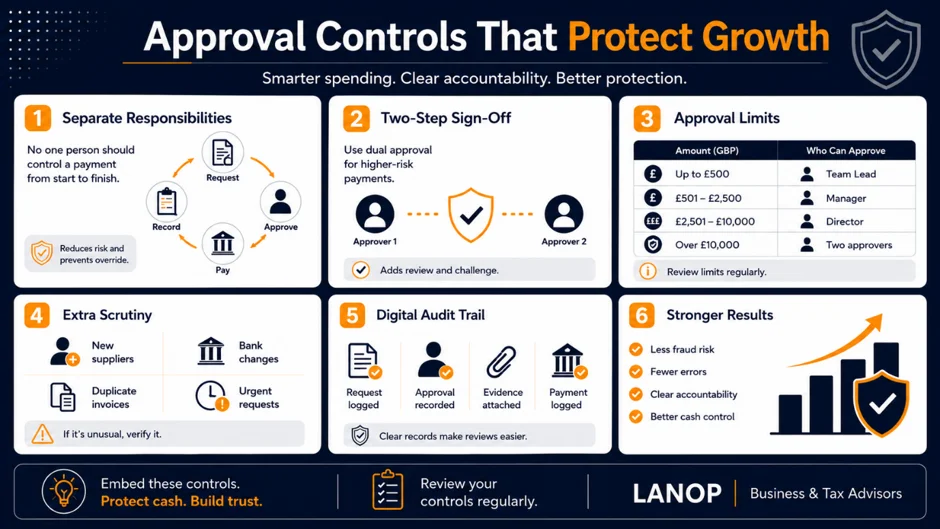
None of this needs to be fancy. Write a short financial governance policy. Reconcile a simple spreadsheet each month. Hold a second bank account for tax. That can be more effective than relying on unchecked accounting software.
How should your financial governance change as the business grows?
Financial governance isn’t fixed. It should grow as the business grows.
Sole traders and early-stage businesses mainly need two things. They need clean records. And they need to know the Self Assessment deadlines. Online returns and payment are normally due by 31 January, while paper returns are normally due by 31 October. HMRC charges an automatic £100 late-filing penalty, even when no tax is owed.
One-director companies and contractors. They take on Corporation Tax and Companies House filings. They also face the new identity check for directors. VAT-registered businesses add another layer. Compulsory registration normally applies when VAT-taxable turnover goes over £90,000 in a rolling 12-month period, or when the business expects to go over £90,000 in the next 30 days. Businesses can also register voluntarily below the threshold. Typically, most VAT-registered businesses make returns every three months, and under the Making Tax Digital rules, they must maintain digital VAT records. Employers with payroll add more still. They handle PAYE reporting and pension auto-enrolment.
When to add more support
Multi-director, family-run, or fast-growing SMEs hit a limit. One spreadsheet can’t keep up. That’s the right moment to bring in monthly management accounts.
Getting ready for funding, expansion, or a sale? You need another step up. Buyers and investors generally want reliable, reviewed numbers, a clear list of who owes you, and evidence of consistent financial discipline. Here’s a simple rule. When you spend more time reconciling numbers than using them, it’s time to move on. That’s when management accounts or outsourced finance support can start to pay off.
What should directors review regularly to stay in control?
Directors should put a short review in the diary. Make it regular. Cover profit and loss. Cover the cash position. Add a rolling cash flow forecast. And watch VAT, PAYE, and Corporation Tax as they build up.
Unpaid invoices and aged debtors matter just as much. A strong profit means little if the cash hasn’t landed. So, round out the agenda each month. Look at supplier payments and upcoming bills. Check director loans, dividends, and drawings. And compare the budget against the actual.
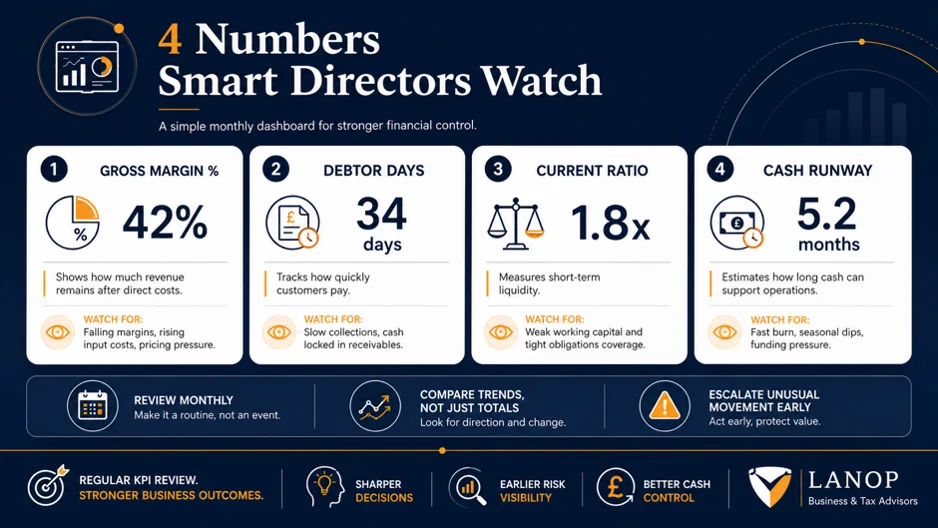
One more habit helps. Each month, glance at unusual transactions and any approval issues. It can catch problems while they’re still small. It doesn’t have to be time-consuming. Having the right reports often means that, with a few minutes a month, you can see whether there are warning signs and whether the business is on track.
Four useful figures for that review are gross margin, debtor days, the current ratio, and cash runway, which are mentioned below.
What is the most common financial governance mistake UK businesses make?
A common mistake is simple. People lean on accounting software and skip the human review. Software records transactions well. But it won’t always warn you about the real risks. It may not flag that VAT money quietly went on payroll. It may not tell you that a big customer hasn’t paid in three months.
Here’s a close cousin of that mistake. Some owners treat VAT, PAYE, or Corporation Tax money as spare cash. It isn’t. That habit can contribute to a cash crisis, and the risk is often avoidable.
Another common trap is leaving things to year-end. That means bookkeeping, receipts, and reconciliations all at once. A five-minute monthly job becomes a stressful few days. It also raises the chance of errors.
Many directors also rely on their accountant to catch problems. But the timing of the review matters. Where an accountant receives the figures only when a return is due, they may not see the numbers in real time. So early warning signs can be missed. Weak spots in cash flow, debtors, and tax reserves can pile up. It’s rarely one failure. It’s usually several small issues stacking up.
Which HMRC and Companies House duties should your governance system protect?
Part of the job is protecting directors. You carry real duties in person. Many of them can’t be passed to someone else. For Corporation Tax purposes, companies normally need to keep accounting and supporting records for six years. Separate Companies Act retention periods also apply. As a director, you remain legally responsible for the company’s records.
Companies House deadlines
Companies House wants a confirmation statement at least once every twelve months. A private company must also file annual accounts. The deadline is nine months after your accounting reference date. Miss it, and the penalty is automatic. It starts at £150. It rises to £1,500 for accounts more than six months late. And it doubles if you file late for two consecutive years.
Tax deadlines you can’t miss
Corporation Tax has two deadlines, not one. For companies outside the quarterly instalment-payment rules, payment is usually due nine months and one day after the accounting period ends. The Company Tax Return is due twelve months after the period ends.
VAT-registered businesses must file and pay on time. Late submission uses a points-based system for accounting periods starting on or after 1 January 2023. Each late return normally adds a penalty point. Once the threshold for the business’s filing frequency is reached, HMRC charges £200, with a further £200 for each subsequent late return while the business remains at the threshold. Separate late-payment penalties and interest can apply when VAT is paid late.
Employers have PAYE reporting duties every pay period. Directors, sole traders, and landlords who need to file Self Assessment must meet the relevant deadline: normally 31 October for paper returns and 31 January for online returns and payment. Poor records carry more than just the risk of penalties. They can also weaken valid claims for expenses and reliefs. That’s a real cost if HMRC asks questions.
What recent HMRC and Companies House changes should growing businesses prepare for?
A few changes are landing right now. It’s worth building them into your plans early.
Making Tax Digital and director ID checks
Making Tax Digital for Income Tax is being rolled out in stages. It covers sole traders and landlords. If your qualifying income for 2024 to 2025 was over £50,000, you should have started using it from 6 April 2026. If your qualifying income for 2025 to 2026 is over £30,000, you will need to use it from 6 April 2027. The threshold then falls to £20,000 for qualifying income in 2026 to 2027, with use required from 6 April 2028. In practice, that means keeping digital records, sending quarterly updates, and submitting an annual tax return through compatible software.
Companies House identity verification became a legal requirement for directors and people with significant control from 18 November 2025. That date marked the start of a 12-month transition period, not one deadline for everyone. Existing directors generally provide their Companies House personal code when the company files its next confirmation statement after that date, while PSCs follow separate requirements. HMRC’s free joint online company accounts and Corporation Tax filing service ended on 31 March 2026. From 1 April 2026, companies that previously used that service must submit Company Tax Returns to HMRC, along with computations and accounts where applicable, using commercial software. If HMRC rejects a return, it must be corrected and re-filed promptly; a rejected return does not count as successfully filed.
Accounts filing changes ahead
Accounts filing changes will take effect from 1 April 2028. All UK-registered companies will have to file accounts using commercial software in iXBRL format, and the web and paper filing routes for accounts will close. Small and micro-entity companies will need to file profit and loss information, and the abridged accounts option will end. They will, however, be able to opt out of having their profit and loss accounts published on the public register.
There’s one more change to note. It’s the failure-to-prevent-fraud offence. It sits under the Economic Crime and Corporate Transparency Act 2023. It has applied to large organisations since 1 September 2025. Growing businesses are not directly within scope unless they meet the statutory size thresholds. However, businesses that supply large organisations may still be asked about their fraud-prevention and risk-management controls as part of a client’s due-diligence process.
When should you get professional help with financial governance?
There’s usually a clear tipping point. It’s when the business outgrows what the founders can do alone. Maybe bookkeeping no longer gives you enough to make a confident decision. Or maybe VAT, payroll, and Corporation Tax all fight for the same person’s time.
Other signs are just as clear. You might need monthly management accounts. You might need a proper cash flow forecast, not a rough spreadsheet. Or you might be getting ready for finance, investment, expansion, or a sale. Each of those calls for financial discipline. And that’s hard to build from a standing start.
Repeated mistakes are a warning too. So are late filings, or records nobody quite trusts. They show the current approach has run its course. In that case, it could make more sense to seek out a finance function outsourcing or finance CFO services rather than establishing an entire in-house finance department too early. This works particularly well for a company that requires more financial oversight but isn’t yet prepared to make a long-term decision about filling a senior finance position.
How Lanop helps UK businesses improve financial governance
At Lanop, we help growing UK businesses get this right. First, we review your current bookkeeping, tax, and reporting. Then we set up financial governance that fits your size. It won’t be a template built for a much larger firm. We prepare management accounts, cash flow forecasts, and director-level reports. We support VAT, Corporation Tax, PAYE, Self Assessment, and Companies House compliance as those duties grow. And we help directors understand their responsibilities, so avoidable penalties don’t happen.
We also cover the practical side of the changes above. That includes the Making Tax Digital software setup. It includes digital records. And it includes filing readiness ahead of each deadline. Need more than the odd bit of advice? We provide outsourced finance, tax advice, and wider business growth support on an ongoing basis.
Frequently Asked Questions
Directors should review management accounts monthly to spot cash flow issues, changes in profit, and overdue debts early. For a faster-growing business, a shorter weekly cash check helps too.
It should include your VAT, PAYE, Corporation Tax, and dividend records, plus the bank transfer or spreadsheet showing the money set aside. Keep copies of tax returns, payment dates, and any HMRC correspondence as well.
You need it once one person is handling too many financial tasks, especially payments, approvals, and reconciliations. It matters as soon as spending and risk rise, even with a small team.
If HMRC rejects a Corporation Tax Return, it has not been successfully filed. Correct the issue and resubmit promptly to reduce the risk of late-filing penalties.
It should set out who approves spending, who reviews reports, how often controls are checked, and how exceptions are handled. It should also cover record keeping, tax reserves, deadlines, and escalation steps if something looks wrong.
Conclusion
Financial governance isn’t a one-off job. It’s a habit. Keep accurate records. Review them often. Stay ahead of tax and Companies House deadlines, rather than reacting to them. Strong governance can make funding due diligence smoother. It can help you spot problems sooner. And it gives directors more confidence in the numbers behind each decision. Do your current processes still fit? If they were built for a smaller business than the one you run now, that’s your sign to review them.
So, let’s get in touch with our team by contacting Lanop today about your financial governance, accounting, tax, and business advisory needs. Together, we’ll build a system that keeps you tax-ready, funding-ready, and director-safe as you grow.