
Losing a parent is hard. Then a house shows up. It’s shared with your siblings. Suddenly there’s probate to deal with. There are valuations to sort out. There are tax bills too. And there are family talks you never wanted to have. This guide walks you through it all. It covers an inherited property split between siblings in the UK, step by step.
At Lanop Business and Tax Advisors, we help families with tax planning. We cover Capital Gains Tax and property choices. We keep things simple.
What Happens When Siblings Inherit a Property in the UK?
Here’s the short answer. Siblings often become joint owners once probate finishes. Ownership depends on the will. If there’s no will, fixed rules apply instead. Until the grant arrives, the executor is in charge. The beneficiaries are not, not yet. This order matters a lot. Let’s break it down.
Who legally owns the property after someone dies?
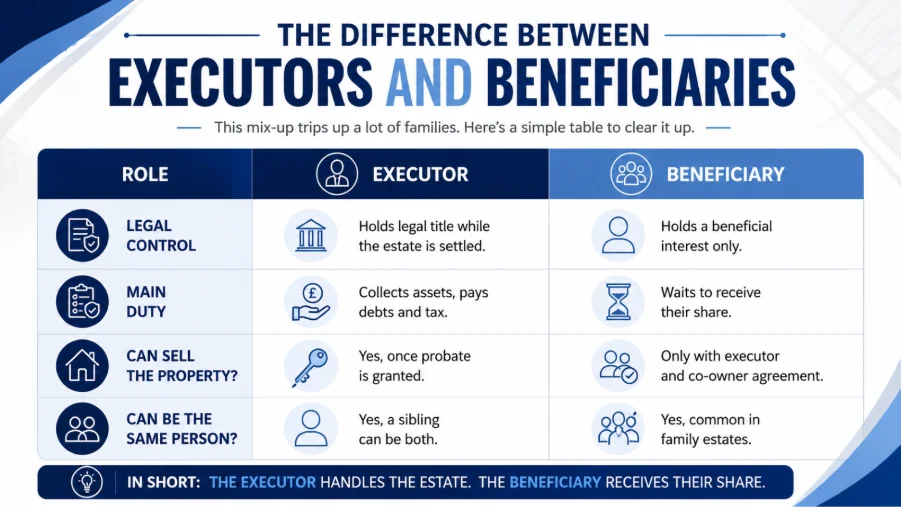
The estate owns the property until probate ends. The executor holds legal title as a trustee. They act for the people named in the will. Beneficiaries hold what’s called a beneficial interest. That’s a right to the property, not full ownership yet. So, they can’t sell or move anything just yet.
What changes if there is a will?
A valid will says who inherits and how much each person gets. If it splits things equally, you each get an equal share. If shares are unequal, the will decides that split. Opinion doesn’t come into it.
What happens if there is no will?
Without a will, fixed rules take over. These are set by law, not by the family. Children often inherit equally. This happens once any surviving spouse gets their share first. This still runs through the inherited property probate process. But it follows the law, not a will.
When do beneficiaries become legal owners?
Beneficiaries become legal owners once the executor moves the property into their names. This often happens through an assent. It’s then logged at HM Land Registry.
Understanding the Probate Process for Inherited Property
In short, probate confirms who can deal with the estate. For a house, the executor can’t sell or move it until the grant arrives. Probate timelines vary depending on the complexity of the estate, whether Inheritance Tax reporting is required, and whether any issues arise during the application process. The grant of probate is only one stage of the wider process.
What probate means for inherited property
Probate confirms the executor’s power over the estate. Only after that can the property be sold or handed to beneficiaries.
Can a property be sold before probate?
Yes, in a way. A property can be listed early. It can even reach an accepted offer before probate ends. But the sale can’t legally close yet. That has to wait until the inherited property probate process is finished. The executor needs the grant first. Only then can they sign the transfer papers.
The probate property sale timeline
Online and postal probate applications can take different lengths of time depending on the circumstances of the estate. Complex estates or incomplete information can lead to longer processing times.
The full process, including probate and selling the property, can take several months and may take longer where estates are complex or disputes arise. Here’s what that looks like, step by step.
- Apply using form PA1P (or PA1A without a will) through GOV.UK.
- Pay the current £300 court fee for estates over £5,000.
- Report Inheritance Tax figures, or complete IHT400 for larger estates.
- Wait for the grant before marketing progresses to exchange.
Common reasons probate is delayed
Missing paperwork slows things down. So do part-finished IHT forms and unclear wills. Family rows cause delays too. So does a missing beneficiary.
- Incomplete or incorrect PA1P application forms.
- Complex estates requiring a full IHT400 submission.
- Disputes between siblings or challenges to the will.
- A beneficiary who cannot be located or contacted.
What executors can and cannot do
Executors can secure the property early on. They can set up insurance. They can pay urgent bills from estate funds. But they can’t sell, move, or hand out the property until probate is granted.
Ownership Rights When Siblings Inherit a House Together
Here’s how it often works. Siblings who inherit a house together may commonly hold it as tenants in common, with each person owning a defined share. Major decisions about the property usually require agreement between the owners. If disagreements cannot be resolved, legal remedies such as TOLATA may become relevant.
Equal and unequal ownership shares
A will can split things equally, or unevenly between siblings. Unequal shares are still valid. They mean any proceeds, or rent, split the same uneven way.
Joint tenants vs tenants in common
| Feature | Joint Tenants | Tenants in Common |
|---|---|---|
| Ownership shares | Equal, undivided interest | Can be equal or unequal, fixed shares |
| On death of an owner | Automatically passes to survivors | Passes according to the will or intestacy |
| Can you sell your share alone? | No, only the whole together | Yes, your share can be sold or willed separately |
| Common for inherited property | Less common between siblings | Most common structure for siblings |
Can one sibling make decisions alone?
No, and this catches people out a lot. Selling, renting, or major repairs all require every owner to be on board. Acting alone risks breaking beneficiary rights. That can easily lead to a dispute.
Can one sibling live in the property?
Yes, but only with the others’ agreement. Living there doesn’t create extra ownership rights on its own. The other siblings can still ask for rent. That’s true if it drags on or feels unfair.
Who is responsible for the property’s ongoing costs?
Insurance, council tax, bills, and repairs are often shared in proportion to ownership share. Keep clear records from day one. That simple habit saves a lot of arguments later.
Your Options When You Inherit a Property with Siblings
You have five main choices here. Sell or buy out the others. Keep it jointly, rent it out, or move it into one name. The right path depends on your finances. It also depends on whether anyone wants to keep the home.
Selling the inherited property
Selling suits families who all want cash. It gives all sides a clean, final split.
One sibling buying out the others
A buyout lets one sibling keep the home. They pay the others their share in cash.
Keeping the property as a joint investment
Some families choose to hold the property together. They then share the rent between them, which brings its own landlord accounting obligations.
Renting out the inherited property
Renting brings in cash while you decide on a longer plan. But it adds landlord duties. It adds tax reporting too.
Transferring ownership instead of selling
An inherited property transfer in the UK between siblings can settle shares without a sale. It’s often used with a buyout too.
Here’s a quick side-by-side look at the two most common routes.
| Factor | Buyout | Selling |
|---|---|---|
| Best for | One sibling who wants to keep the home | Families who all want cash |
| Speed | Can be quicker, no open market waits | Depends on the property market |
| Costs involved | Valuation, legal fees, possible mortgage | Estate agent fees, legal fees, marketing |
| Tax impact | May trigger Stamp Duty on the buyer’s share | Capital Gains Tax may apply on any gain |
Selling an Inherited Property Split Between Siblings
Selling an inherited house split between siblings works like any house sale. But it can only happen once probate ends.
Each sibling’s share then splits the proceeds. That happens once costs and any taxes are taken out.
The process for selling inherited property
- Agree to sell as a family, in writing where possible.
- Instruct an estate agent and get an up-to-date valuation.
- Wait for the grant of probate before exchanging contracts.
- Instruct a conveyancing solicitor to handle the legal transfer.
- Complete the sale and settle any outstanding mortgage.
- Divide the remaining proceeds between siblings.
How sale proceeds are divided
Proceeds split by ownership shares. These come from the will, or from fixed rules if there’s no will. The estate agent, solicitor, and any Capital Gains Tax come out first.
What happens if one sibling refuses to sell?
Try mediation first, before anything else. If that fails, a co-owner can ask a court for an Order for Sale.
Can a court order the sale of inherited property?
Yes, it can. TOLATA is short for the Trusts of Land and Appointment of Trustees Act 1996. It lets a court order a sale. This happens when co-owners just can’t agree. The court then weighs up each owner’s needs.
Mediation before legal action
Mediation is faster than court. It’s much cheaper too. A neutral mediator helps siblings agree on a sale, a buyout, or a fair deal. It won’t damage family ties either.
How an Inherited Property Buyout Works
An inherited property buyout in the UK lets one sibling pay the others for their share. That way, the home stays in the family. It starts with an outside valuation. Then comes a share sum. Then legal transfer and Land Registry updates follow.
How to value an inherited property
A professional RICS valuation can provide supporting evidence of the property’s market value. This inherited house valuation in the UK may be used for probate purposes and can help establish the value for any later Capital Gains Tax position.
Calculating each sibling’s share
Multiply the value by each sibling’s share. Any remaining mortgage balance is paid off first.
Worked example: a property buyout
Three siblings inherit a house worth £450,000, which is split equally among them. Each share works out at £150,000. If one sibling buys out the other two, they pay £300,000 in total. That can come from savings, or from a mortgage.
Financing a sibling buyout
Most buyouts use what’s called a transfer-of-equity mortgage. Lenders check the buying sibling’s income first. They also check the property’s value.
Legal documents required
- A TR1 transfer form to change legal ownership.
- A signed deed of assent from the executor, if not already completed.
- Mortgage offer documents, if the buyout uses lending.
- A written agreement setting out the final buyout figure.
Updating ownership with HM Land Registry
Once the contracts are complete, the solicitor logs the change with HM Land Registry. That confirms the buying sibling as the sole legal owner.
Taxes on an Inherited Property in the UK
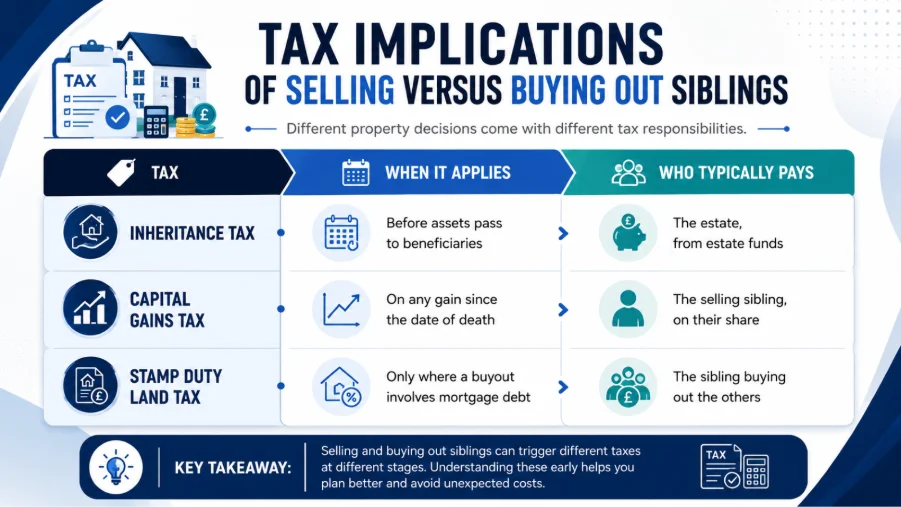
Inheritance Tax is often paid by the estate first. This happens before anything reaches the siblings. Capital Gains Tax comes later, and only on any rise in value after death. Understanding this alongside broader inheritance tax planning can help the whole family prepare in advance.
How Inheritance Tax works
Inheritance Tax on UK property is charged at 40% above a set threshold. For 2026 to 2027, the threshold is £325,000 per person. It’s frozen until April 2031.
A second allowance of £175,000 can also apply. This is when a home passes to children or grandchildren. It tapers off above £2 million.
When Capital Gains Tax applies
Capital Gains Tax kicks in on a sale above the value at death. This applies to a sibling’s share as well. Capital Gains Tax rates and annual exempt amounts can change, so the latest HMRC guidance should be checked before calculating any liability. The rate applied depends on the individual’s circumstances and taxable income.
This must be reported within 60 days of completion, typically alongside your Self Assessment records. That deadline catches a lot of people out. So, mark it down early.
Worked example: Capital Gains Tax on an inherited sale
A house is valued at £400,000 at death. It’s later sold for £430,000. That £30,000 gain splits equally, giving £15,000 to each sibling. After the £3,000 tax-free amount, each sibling pays tax on £12,000. The rate is 18% or 24%.
Stamp Duty Land Tax considerations
Inheriting a property doesn’t often trigger Stamp Duty Land Tax on its own. But a buyout that takes on mortgage debt can count as a taxable step. So SDLT may apply. A solicitor should always check this before completion.
Common tax mistakes to avoid
- Selling quickly without confirming the probate valuation first.
- Missing the 60-day Capital Gains Tax reporting deadline.
- Forgetting that unequal shares mean unequal tax bills.
- Not checking Stamp Duty Land Tax rules before a buyout.
Costs to Expect When Inheriting and Selling Property
Typical costs for inherited property in the UK include probate, solicitor, and valuation fees. Running bills add up too. These often come from the estate first. Then they are shared out according to ownership share.
Probate fees
The current probate fee is £300. That’s for estates worth more than £5,000. Extra sealed copies cost £16 each.
Solicitor and conveyancing costs
Solicitor and conveyancing costs vary depending on the complexity of the estate, the work required, and the firm’s charging structure. Some providers charge fixed fees, while others charge based on time spent.
Estate agent fees
Estate agent fees vary depending on the agent, location, and service package selected. These costs should be confirmed before marketing the property.
Property valuation costs
A RICS valuation for probate often costs between £250 and £500. The exact price depends on the property itself.
Insurance, council tax, utilities, and maintenance
An empty inherited property still needs cover in place. It also needs council tax paid, and basic bills kept running. These small costs add up fast during a long wait.
How these costs are normally shared
Most families split ongoing costs by ownership share. A simple shared list helps too. It stops arguments later about who paid for what.
What Happens if Siblings Disagree?
An inherited property dispute between siblings often starts small. It’s often over selling, value, or who lives in the home. Most disputes settle through a chat or mediation, well before court.
One sibling refuses to sell
Try mediation first. If that fails, any co-owner can ask a court for a TOLATA Order for Sale.
One sibling wants to live in the property
Agree on a fair deal between everyone. Decide whether rent will be paid and put it all in writing.
Disagreements over property valuation
An independent professional valuation can provide a neutral figure and may help siblings reach an agreement.
Disputes involving executors
An executor who also inherits must still act fairly for everyone. A solicitor can help if a sibling suspects favouritism.
Resolving disputes through mediation or court
Mediation is quicker than court. It’s cheaper too, and much kinder to family ties. A TOLATA claim should really be a last resort
Common Real-Life Scenarios and Their Solutions
These situations come up again and again. Families weighing siblings’ inheritance options for a house hit the same few problems. Let’s go through them one by one.
My brother refuses to sell the inherited house
Start with an honest chat about everyone’s needs. If talking doesn’t work, try mediation before any TOLATA claim.
My sister wants to buy my share
Agree on an outside valuation first. Then confirm the buyout figure. Sort financing before you instruct solicitors.
One sibling has moved into the property
Set out clear terms in writing. Include any occupation rent and agree a realistic date to review it.
The inherited property still has a mortgage
The mortgage must be repaid or transferred before the shares are finalised. A buyout often needs its own separate mortgage arrangement.
We inherited different ownership percentages
Unequal shares are entirely valid. They just mean the split isn’t equal. Proceeds, costs, and tax bills follow that same ratio.
Step-by-Step Checklist for Splitting an Inherited Property
This inherited property checklist 2026 keeps every sibling on the same page. It runs from probate right through to the final payout.
- Secure the property, plus insurance and utilities.
- Apply for probate using PA1P or PA1A.
- Obtain a professional RICS valuation.
- Agree on the preferred option together: sale, buyout, or keeping it.
- Calculate Inheritance Tax, Capital Gains Tax, and other costs.
- Complete the transfer or sale through a solicitor.
- Distribute the proceeds according to agreed shares.
Common Mistakes That Delay or Reduce an Inheritance
Small slips often cost families the most, in time and money. Watch for these common errors.
- Delaying the probate application unnecessarily.
- Selling without understanding Capital Gains Tax first.
- Skipping a professional valuation to save a small fee.
- Failing to record shared expenses properly.
- Relying on verbal agreements instead of written ones.
- Waiting too long to resolve a growing dispute.
Frequently Asked Questions
Not alone, no. Co-owners don’t always agree. If not, one can ask a court for a TOLATA Order for Sale. Mediation is tried first, since it’s faster and cheaper.
It can be listed before probate, yes. But the sale can’t complete until the grant comes through. The executor needs that power to sign the transfer papers.
The estate pays it, from estate funds. This happens before any money reaches beneficiaries. Executors handle the reporting and settle this with HMRC.
An independent RICS valuation gives a fair figure. It’s used for probate, tax, and any buyout. It also sets the base cost for Capital Gains Tax.
Insurance, council tax, and bills are often shared according to ownership share. This starts once probate confirms each sibling’s interest.
Capital Gains Tax may apply on any gain since death. Inheritance Tax is settled by the estate earlier. A buyout using mortgage debt can also trigger Stamp Duty Land Tax.
Your Next Step: A Practical Decision Guide
Every family’s case is different. Here’s a simple way to think it through. If everyone wants cash, selling is often the cleanest route.
If one sibling has a strong reason to stay, a buyout often works better. That’s true as long as the money side is realistic.
Joint ownership suits siblings who get on well and want rent coming in. But it needs clear written terms from the start. Mediation is worth trying whenever a disagreement pops up. Try it before costs and tension start to build.
Expert advice becomes key once tax, mortgages, or unequal shares come into play, and this is often where wider estate planning support proves valuable. Whatever path you pick, good information helps. It protects your money and your family far better than guesswork ever will.
Speak to Lanop Before You Decide
Every inherited property split between siblings brings its own tax questions. It brings its own family issues too. Lanop Business and Tax Advisors helps families plan for Inheritance Tax. We work out Capital Gains Tax with care. We handle probate money matters with confidence.
Contact Lanop today for a personal, no-pressure chat. Let’s talk through your inherited property. We’ll find the best next step for your family and book a free consultation with one of our chartered tax advisors.