Introduction
It is easy to be self-employed as a sole trader in the UK in 2026. The sole trader business model provides flexibility, an easy start-up, and complete control over your work, whether you are a freelancer managing your own client work, have a side business, or are starting your own business. It is relatively easy to get started. You register with HMRC, monitor your income and expenditure and manage your own tax returns via self-assessment.
There are no Companies House registrations or complicated company administration procedures involved, unlike with a limited company, making it an appealing option for many business owners starting out. Most sole traders do their own taxes, records and compliance. However, some find it much easier once they have the right systems and habits established.
What is a Sole Trader Business?
The easiest type of business to work for yourself in the UK is a sole trader business. You are a sole trader, and after tax, you have all the profits. Used by freelancers, consultants building an independent practice, tradespeople and small business owners who want to start without too much admin. There is no need to form a company with Companies House or to prepare complex annual accounts. You can register in no time, start trading, and grow from it. While you must keep track of your earnings and spending and complete a self-assessment return with HMRC annually, many people feel this is a fair return on the freedom it provides.
The Key Advantages
There are several good reasons to choose the sole trader structure. It is fast to set up, often within a day. There are fewer ongoing reporting requirements than with a limited company. You have full control over your decisions and can build direct relationships with your clients.
Costs are lower, too. You can put more time and money into growing your business rather than managing admin. And if you want to change what you offer or how you work, you can do it without going through complicated legal processes.
Sole Trader vs Limited Company
Before you make your decision, it’s important to understand the difference between the two. As a sole trader, it’s simpler and cheaper, but it means that you are personally liable for any business debts. A limited company is limited liability, meaning that if something goes wrong, your assets are protected, and it can be tax efficient as your income increases.
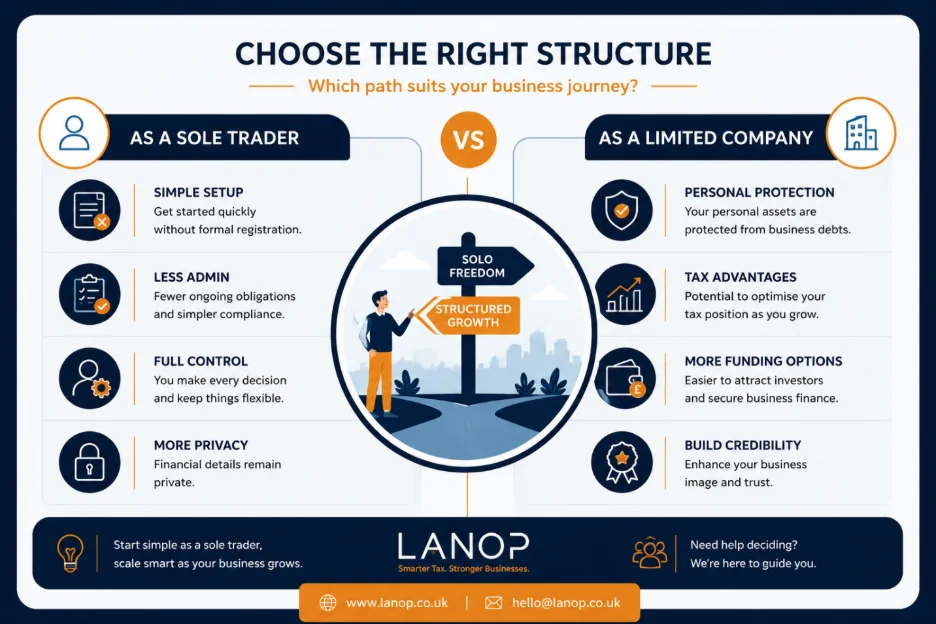
People often begin trading as sole traders to test an idea, and may later switch to a limited company once they are making more money and need additional protection. You can read more about when to make this switch later in this guide.
How to Set Up as a Sole Trader in the UK
The registration process is straightforward. Here is what you need to do.
Register with HMRC
You’ll need to inform HMRC that you’re self-employed. This can be done online via the government website. Information about yourself and the kind of work you do will be shared.
If you register, HMRC will register you for the self-assessment. Earnings and taxes are reported annually. On registering, HMRC will provide you with a Unique Taxpayer Reference (UTR). Write down this number. It will be required each time a return is filed.
The great thing about it is that you can start trading immediately. No waiting period is required. After you’ve alerted HMRC, you can start offering your services, issuing invoices, and accepting clients.
Selecting a Business Name
You may use your own name for your business, or choose a name that represents what you do. If you use a business name, be sure that no other business uses it and that it is not restricted. The name of the sole trader is not on an official register, so the best way to find out whether the one you want is taken is to do a quick online search. It is advisable to secure a website domain that matches your brand as soon as possible, before someone else does, if you are planning to build a brand.
Licences and Insurance
Certain licences may be required before you start, depending on your occupation. Local Councils have requirements for food businesses and beauty services, for example. Before starting trade, it’s certainly important to understand what applies to your industry.
Public liability insurance should also be taken into account. It shields you and your enterprise against issues that arise with clients or on an assignment. While not the law for most sole traders, it is a good protection. You may also need to register to pay PAYE to HMRC and ensure that you pay employees, apprentices or casual workers at least the National Minimum Wage or National Living Wage rates if you plan to employ anyone. If these commitments are not fulfilled, they may incur substantial fines.
Knowing Your Tax Obligations
As a business owner, you need to manage your own taxes. It may seem strange at first, but after a while, it becomes a normal part of running your business.
What Tax Do Sole Traders Pay
As a sole trader, you pay Income Tax on your profits and make National Insurance contributions. Unlike employment, where your employer handles deductions through PAYE, it is now your job to track what you owe and pay it on time. Working with a specialist in personal tax planning for the self-employed can help ensure you are not paying more than you need to.
For the 2025 to 2026 tax year, the personal allowance is £12,570, meaning you pay no Income Tax on the first £12,570 of profit. Above that, the basic rate of 20% applies up to £50,270, with higher rates kicking in beyond that. These thresholds have been frozen by the government and are expected to remain in place through the 2026 to 2027 tax year.
You will also pay Class 4 National Insurance on profits above £12,570, currently at 6%, and a flat rate of Class 2 National Insurance if your profits are above the small profits threshold of £6,725 per year.
Tax rates and thresholds can change over time, so it is always worth checking the latest figures directly on HMRC’s website or gov.uk before filing your return.
Filing Your Self-Assessment Return
Every sole trader in the UK must file a self-assessment tax return with HMRC each year. You report your income, deduct your allowable business expenses, and pay tax on what is left.
The deadline for filing online is 31 January following the end of the tax year. So for the 2025 to 2026 tax year, your return must be submitted by 31 January 2027. Missing this deadline results in an automatic £100 fine, with further penalties if the delay continues.
Most sole traders file online and manage their own affairs. If the process feels daunting, speaking to an accountant can help you avoid mistakes and make sure you are claiming everything you are entitled to.
Payment on Account
One thing that catches many new sole traders off guard is Payment on Account. If your tax bill is over £1,000, HMRC will ask you to pay half of next year’s estimated tax bill upfront, twice a year. The payments fall on 31 January and 31 July.
It is not an extra tax. It is just an advance payment. But it can feel like a big bill if you are not expecting it. Setting aside a portion of every payment you receive makes this much easier to manage.
Pension Responsibilities and Retirement Planning
Many self-employed individuals neglect to plan for retirement when they first become self-employed. Although the rules of the conventional workplace pension system primarily benefit employers, the self-employed should be mindful of creating a long-term pension plan for themselves, with the option of using a SIPP, which allows them to claim tax relief on contributions.
If you hire employees in your business, you may be considered an employer and subject to the requirements of workplace pension auto-enrolment.
VAT Registration for Sole Traders
You do not need to register for VAT straight away. But if your turnover goes above the current threshold of £90,000 in any rolling 12-month period, registration becomes a legal requirement.
Once registered, you will charge VAT on your sales and can reclaim VAT on eligible business costs. You must also submit VAT returns to HMRC, usually every quarter, using Making Tax Digital-compatible software.
Some sole traders choose to register voluntarily before reaching the threshold. This can make sense if your clients are VAT-registered businesses, as they can reclaim the VAT you charge, and it can make your business look more established. If most of your clients are individuals or small businesses that cannot reclaim VAT, voluntary registration may not be worth it.
If you are not near the threshold yet, keep an eye on your turnover as you grow so you can register in time and avoid penalties. Our downloadable guides on VAT and self-employment cover this in more detail if you want to go deeper.
Your Financial Management Daily Habits
Managing your finances doesn’t have to be difficult. Getting things done will save you stress in the future, particularly when tax season approaches.
Keeping Records
Keep track of all payments received and costs of any business since you began trading. No special software is needed for this. When you’re just beginning, a spreadsheet or even a notebook is fine.
HMRC requires sole traders to keep records for 5 years from 31 January for the tax year in which they file their tax return. This means that keeping things organised isn’t something you should do; it’s something you have to do!
From the beginning, keep all the details of your business transactions, receipts, bank statements, expense logs and invoices. Proper record-keeping can help protect you when HMRC requests records or audits you.
It is also crucial to be aware of IR35 rules if you are a contractor, whether working through an agency or for a larger organisation. Depending on the contract, you could be regarded as essentially ‘worked’ for tax and National Insurance purposes, which could impact the amount of tax and National Insurance you are liable for. If you work in tech, understanding how IR35 applies to software developers and contractors is particularly important. The CEST tool is useful for determining your employment status for tax purposes.
Claiming Business Expenses
There are lots of expenses that you incur on the functioning of your business that can be deducted from your income before you calculate your taxes. These are known as allowable business expenses and can make a huge difference to your tax bill.
This can include travel expenses for work, professional memberships, office equipment, tools, telephone and Internet expenses, and a laptop or computer. If you run your own business from home, you might be able to deduct a part of the cost of running your business from your home.
This rule is simple. The cost should be for the sole benefit of the business. If the activity is a combination of both business and personal, only the business portion is allowable.
Separating Your Money
As a sole trader, having a separate bank account for your business is one of the most helpful things you can do. While there is no legal obligation to do so, it does make your record keeping a lot easier and provides you with a clear picture of how your business is doing.
It also allows you to save more easily for your tax bill. The general rule of thumb is to save 25-30% of every payment that you receive. This means you’ll have the funds ready when your tax bill comes in the mail.
Creating a Budget for Quieter Months
Being a sole trader often has an uncertain income, particularly in the initial stages. There will be periods of high and low workload. It’s better to be prepared rather than caught off guard.
Consider the usual costs you incur and any anticipated big bills. If you learn that you will be going through a quiet period, plan accordingly. Setting aside some cushion can mean the difference between calm and panicky.
Making Tax Digital for Business (Sole Trader)
Sole traders with income above £50,000 will be affected from April 2026 when they will be expected to use Making Tax Digital for Income Tax Self-Assessment (MTD for ITSA). This involves maintaining digital records and providing quarterly updates to HMRC using compatible software, rather than an annual return.
This will then apply to sole traders with earnings above £30,000 from 1st April 2027. The government has said that the thresholds will be reduced in subsequent years.
If you make more than these amounts, it’s time to explore software that suits your needs and begin to plan! QuickBooks, Xero, FreeAgent and Sage are popular choices. There are a number of these with low-cost plans specifically tailored for the single self-employed person.
It is worth considering switching to digital record-keeping even if you do not meet the threshold. This saves time, minimises mistakes, and prevents you from having to rush if the rules ever come up.
Running and Growing Your Business
Starting a business is a lot of work. It is important to be consistent when keeping it growing. Fortunately, there is no need for complicated growth.
Building Your Reputation
Word of mouth is, for the most part, the best source of new work for most sole traders. All the time, doing a good job and being easy to work with will be your best marketing tool.
Request a quick review or testimonial from your client after a job is done. The power of a few sincere words on Google or your website goes far to build your reputation than any paid advert. Humans believe in other people.
Consistency is important, too. Prompt response, timely deadlines and integrity in the event of failure will make you stand out from the pack.
Getting Found Online
Most people look online before signing any contracts with any company. Even a simple website can make a big impact. The basic site with information on what you do, who you help, and how you reach them is a great place to begin. You can create a Google Business Profile for free and get found by people in your area in search results in under an hour. Staying current with your hours, services, and recent reviews will help it work for you over time.
Keeping Up with Your Industry
The best sole traders are always continuing to learn. It’s not a matter of expensive courses or hours spent every week in training. It might be minor, like reading articles on changes in your business area, experimenting with a new tool, or talking with someone who works in a similar field. Little changes over time are a lot of changes. It’s important to continue being curious about your craft, as this can help you stay competitive and may even inspire new ideas and opportunities.
Staying Compliant with HMRC
Being on the right side of HMRC doesn’t have to be stressful. It is primarily about documentation, timeliness and avoiding last-minute situations. Understanding your statutory compliance obligations as a business owner from the start will save you considerable worry down the line.
Make reminders for important tax dates every year. Complete your return as early as possible before 31 January. Maintain receipts and records regularly, don’t catch up at the end. Any letter you receive from HMRC should be taken seriously, and you must respond as soon as you can.
When in doubt, an accountant or tax adviser can provide clarity. “It’s always cheaper to get a good piece of advice than to get a bad one and wish you hadn’t.”
When to Switch to a Limited Company
As your income grows, there may come a point when moving from a sole trader to a limited company makes financial sense. This usually becomes worth exploring when your profits are consistently above £40,000 to £50,000 per year, though the right figure depends on your personal circumstances.
A limited company pays Corporation Tax on its profits rather than Income Tax. For the 2025 to 2026 tax year, the small profits rate of 19% applies to profits up to £50,000. For sole traders earning in the higher Income Tax band, this difference can result in meaningful savings.
Limited liability is the other major advantage. As a sole trader, there is no legal separation between you and your business. If your business runs into financial trouble, your personal assets are at risk. A limited company creates a legal boundary between the two. If you are thinking about more complex structures further down the line, group structuring and holding company advice may also become relevant as you grow.
The trade-off is more admin. A limited company must be registered at Companies House, file annual accounts, and meet additional reporting requirements. Running costs are higher, and you will almost certainly want an accountant to help manage things.
If you think you are approaching this point, speaking with an accountant before making the switch is strongly recommended. The timing matters, and getting it right can make a real difference to what you keep.
How Lanop Can Help
Running a business on your own means wearing a lot of hats. At Lanop, we help sole traders in the UK get properly set up, stay on top of their numbers, and make confident decisions as their businesses grow.
We can guide you through the registration process, help you understand what you can and cannot claim, and make sure your tax returns are accurate and filed on time. If you are thinking about whether a limited company might suit you better, we can talk through the numbers and help you decide.
Having the right support in place means fewer surprises and more time focused on the work you actually enjoy.
Prefer watching instead?
Here’s a video summary for you


Conclusion
One of the most viable routes to take in 2026 is to start your business as a sole trader in the UK. It’s flexible and a great way for freelancers, consultants, tradespeople, and growing businesses to transition to self-employment with low setup costs, straightforward registration, and full control over their work.
The secret is making sure to build the right foundation in the beginning. Get registered with HMRC early on, maintain and keep good financial records, keep business finances separate and save for tax regularly. The little things help to save some of the greater stresses as your business grows.
Lanop can assist you with registering, bookkeeping, self-assessment tax returns, VAT and/or business advice. We help sole traders throughout the UK keep their finances tidy and their business on track. For more information or to speak with our staff, please get in touch with Lanop.
FAQs
Is it possible to work as a self-employed individual with a full-time job in the UK?
There is no restriction on being both an employee and self-employed. Any sole trader’s income is a separate declaration to HMRC.
What are the most frequent tax errors that new sole traders make?
The worst errors made are late payments, failing to keep records and not saving for taxes.
Do sole traders employ staff or subcontract jobs in the UK?
Yes, sole traders may employ workers or have subcontractors. You might have to register if you are employing anyone, and comply with employment rules and regulations.
Can I have multiple sole trader businesses going at the same time?
Yes, it is possible to trade as a business under multiple names. HMRC remains your sole trader for tax purposes.
Will accounting software for a sole trader be necessary in 2026?
Spreadsheets will suffice until you are ready for digital records and Making Tax Digital, at which point accounting software will be better.