Introduction
Here is what most guides about Relocating to Luxembourg won’t say first. Luxembourg has no wealth tax. No annual charge on your net assets. But it does tax your income hard. The top rate hits nearly 46% when you add surcharges. And it taxes your world income from day one of residency. So, the pitch you’ve probably heard is only half the truth. You need both sides before you make any move.
You can’t just leave and shed UK inheritance tax if you’ve been a long-term resident. You need to know exactly when your exposure ends. It doesn’t end on moving days.
Why UK HNWIs Are Relocating to Luxembourg
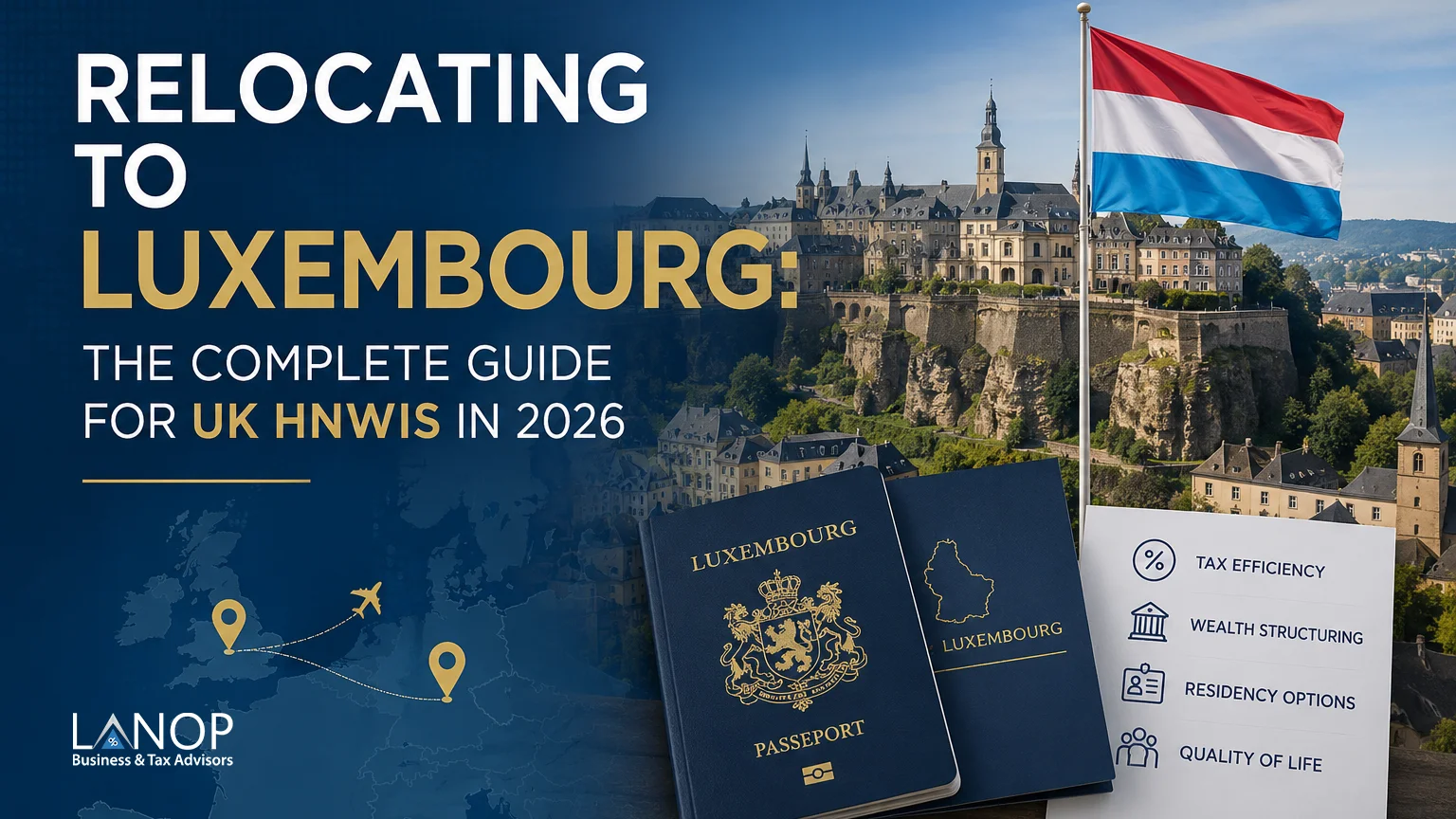
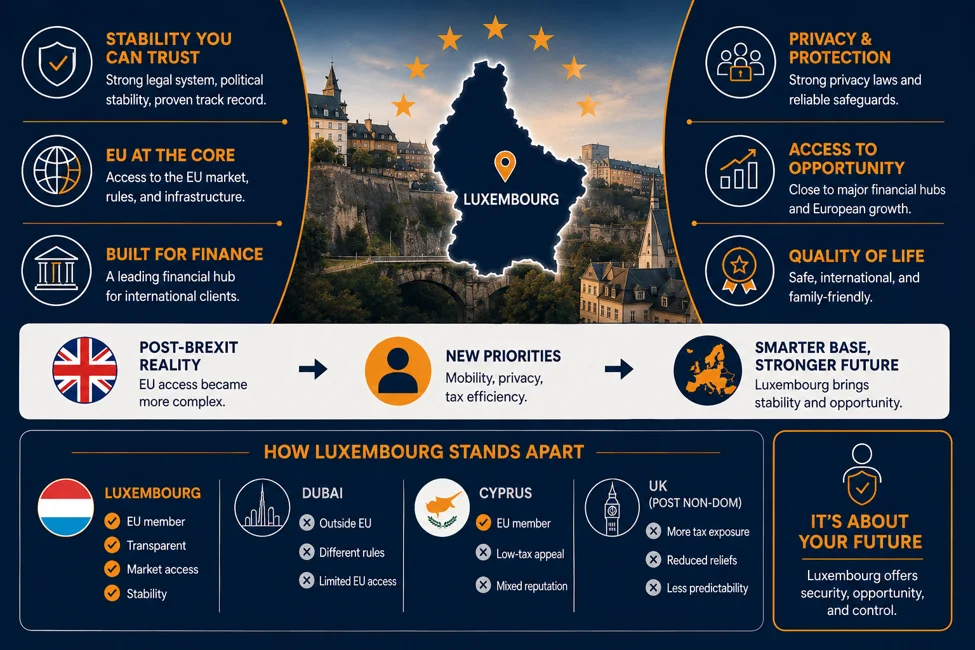
Luxembourg is a real EU option. It’s not an offshore tax haven. It’s a regulated EU member state with a strong finance sector. It has a long track record of political and legal stability. Since Brexit, UK nationals have been watching it more closely. The non-dom changes have turned that interest into real planning.
For context on why so many UK high-net-worth individuals are now reassessing their base, our guide on what UK HNWIs are doing after non-dom abolition covers the full picture of the options people are weighing, from staying and restructuring to leaving entirely.
Luxembourg positions itself differently from places like Dubai or Cyprus. You’re inside the EU. You keep access to EU markets, EU funds, and EU financial infrastructure. For British nationals who lost EU access after Brexit, that matters.
Understanding Luxembourg Tax Residency
You become a Luxembourg tax resident in one of two ways. Either you set up your tax home there, or you spend more than 183 days a year there. Once you cross that line, you declare world income. No remittance basis exists. Your salary, dividends, rental income, and overseas gains all come into scope.
One thing that often surprises people is Luxembourg’s household tax class system. Married couples are taxed as Class Two in most cases. That can cut your net bill a lot on high income. Model your actual position with a Luxembourg tax adviser before you assume anything about your rate.
Luxembourg Income Tax: What the Numbers Actually Mean
The top income tax rate is 42%. Add a 9% solidarity surtax on that. The real top rate comes to roughly 45.78% on income above around €200,000. That’s not low. But how much you pay depends on your income structure, your family setup, and whether you get the impatriate scheme.
It’s also worth noting that the first €13,230 of income is exempt from tax in 2026. Luxembourg’s tax brackets are progressive, so not all your income hits the top rate. Your effective rate, once you factor in exemptions and the household class system, can be meaningfully lower than the headline.
The Impatriate Regime: Luxembourg’s Real Tax Story for UK Professionals
Since January 2025, Luxembourg runs a clean tax deal for skilled workers from abroad. If you qualify, you get a 50% income tax break on your gross annual salary. The break applies up to a salary of €400,000 a year. That means a max yearly tax saving of €200,000. The deal runs for up to eight years. Your real rate can be far lower than the headline.
To qualify you need at least €75,000 in base salary. You must not have been a Luxembourg tax resident in the five years before you arrive. You also can’t have lived within 150 kilometres of the border in those five years. Most UK people planning a clean move will pass those tests.
This is why Luxembourg works well for senior finance, fund, and legal talent. High salaries plus a 50% break means strong take-home pay. It often beats what you’d net in France, Germany, or the UK after the new rules came in.
Luxembourg No Wealth Tax: What It Actually Covers
There is no personal wealth tax in Luxembourg. Zero. If you hold stocks, offshore funds, or foreign property, no annual tax falls on the value of those assets just for being resident. That is a clear contrast with Spain or Norway, which charge annual wealth taxes on residents.
Companies do pay a corporate net wealth tax in Luxembourg, but that’s a business charge, not a personal one. As an individual, your assets aren’t taxed for simply existing in your name.
Gains on shares held more than six months are usually tax-free for individuals. Short-term gains face income tax. Gains on Luxembourg property follow their own set of rules.
Luxembourg Inheritance Tax for UK Expat Estates
For inheritance, direct heirs do very well. Children and spouses pay little or nothing. The basic rates run from 0% for direct heirs up to 15% for people with no family link. Foreign real estate is not included in Luxembourg’s estate tax. If you own a home in Spain, France, or the UK, it stays outside Luxembourg’s scope when you are resident. For wealthy people with homes across Europe, that matters a great deal.
But don’t forget the UK’s ten-year IHT tail. You still need UK and Luxembourg advisers working in sync. The point at which you exit the UK IHT net is not the day you leave. It depends on your full residency history.
How the UK-Luxembourg Double Tax Treaty Affects You
A new UK-Luxembourg tax treaty came into force in 2024. It replaced one from 1967. This matters for people with UK and Luxembourg assets or income.
Dividends between UK and Luxembourg entities now face zero withholding tax in most cases. You just need to be the true owner of the income. That is a big win for people with cross-border structures.
The treaty also added a property clause. If you hold shares in a firm that gets more than half its value from UK real estate, gains on those shares can now be taxed in the UK. This closed a gap that used to exist. If UK property is part of your wealth base, our guide on cross-border property wealth structuring explains how non-resident capital gains rules now interact with treaty changes. Get specific advice on how the new rules hit your setup before you act.
Royalties between the UK and Luxembourg also face zero withholding tax now. That helps anyone with IP held in Luxembourg tied to UK income.
Luxembourg Cost of Living for a UK National
Luxembourg is not cheap. It’s among the most costly countries in Europe. Don’t arrive with a budget mindset.
Rent is the biggest cost. As of early 2026, a flat in Luxembourg City averages around €35.61 per square metre per month. A one-bed flat runs between €1,800 and €2,200 a month. Two-bed and family flats cost more. The market is very tight. Good flats near the city go within 48 hours of being listed. Competition is real.
A single person needs roughly €3,100 to €4,300 a month for a decent life, not counting major extras. Families with school fees will spend much more. Fees at the main international schools run between €15,000 and €30,000 a year per child. If you have two or three children, that is a big line item.
But there are real upsides. Public transport is free across the whole country. Buses, trams, and trains are all included. Healthcare is strong. VAT is just 17%, the lowest standard rate in the EU. Day to day food and shopping costs are high but not as sharp as central London.
Choosing Where to Live in Luxembourg
Most expat workers end up in the capital, in areas like Belair, Limpertsberg, or Kirchberg near the finance zone. These are the priciest areas. Kirchberg has a high share of EU and finance sector workers.
Families often look just west of the city, in Strassen or Bertrange. Some people live just over the border in France, Germany, or Belgium where rents drop a lot. But that creates cross-border tax issues fast. If you work in Luxembourg but live in France, a specific treaty governs your tax. It’s quite different from full Luxembourg residency. Get advice before you sign a lease.
If you’re still comparing European destinations, our overview of the best low-tax countries in Europe for UK high earners sets out how Luxembourg stacks up against Italy, Cyprus, Switzerland, and others on both tax and lifestyle grounds.
The Investor Route to Luxembourg Residency
If you’re not moving for a job but want to live in Luxembourg, there’s an investor permit. The main route needs at least €500,000 of investment, usually into a Luxembourg-based business or fund. This takes around six months from start to permit.
It can lead to full permanent residency after five years. Citizenship comes after another five years of permanent residency. A Luxembourg passport is an EU passport. That has real value for British nationals after Brexit.
How to Move to Luxembourg from the UK: Step by Step
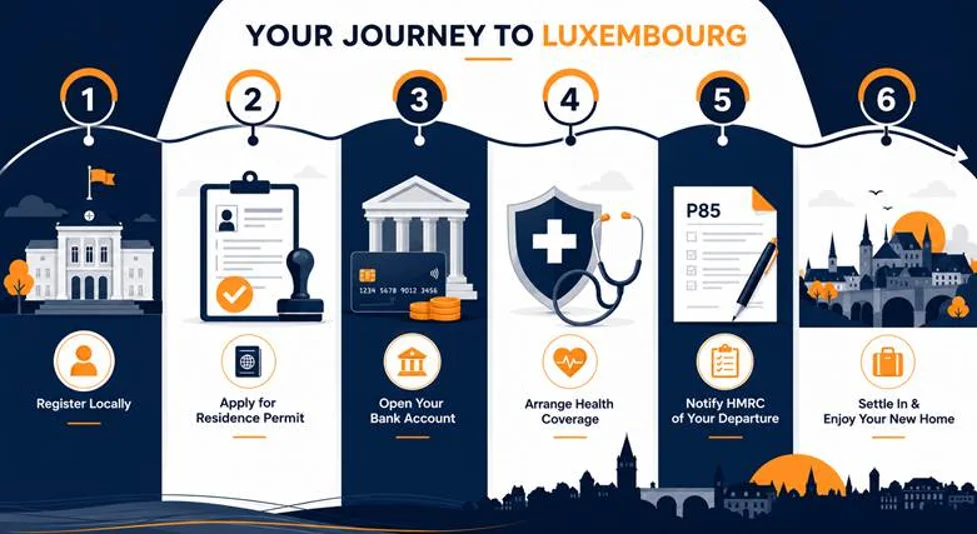
The steps to relocate to luxembourg following a clear order.
First, register at your local commune within three months of arriving. You need your passport, proof of a home address, and proof you can support yourself. The commune record is the key step that unlocks most other things.
Next, apply for your residence permit through the Immigration Office. For work-based moves, a work permit may come as part of that process. Investors go through the Ministry of Economy or Ministry of Finance.
Then open your bank account. Luxembourg hosts major private banks. As a UK national with clear wealth and income, getting an account is usually straightforward here.
Get health cover sorted too. If you work and pay into the social system, the state covers you. If not, buy private cover. The state system is excellent, but private options are available and widely used by expats.
Lastly, tell HMRC you’ve left. File a P85. Make sure you clearly pass the UK Statutory Residence Test for non-residence. Just leaving doesn’t cut it. You need to meet the tests and document your move. This step is vital if you still have UK income, UK property, or family ties in the UK.
Understanding how the UK Statutory Residence Test works before you depart is one of the most practical things you can do to protect your position.
Luxembourg Private Banking for UK Expats
The private banking scene in Luxembourg is world-class. The country holds over €6.4 trillion in fund assets as of early 2026. Being resident gives you direct access to a finance world that’s hard to reach from outside. Top private banks, fund firms, legal experts, and family offices are all close by.
Private banking here is deep. Advisers know how to handle cross-border wealth, estate plans, and multi-currency assets. Major names are all present with strong local teams.
UCITS funds, widely used across Europe, are also open to Luxembourg residents in ways they may not be for UK residents. If you’re rebuilding your wealth structure after the non-dom changes, being near that level of finance know-how is a real edge.
Many people at this stage also take a closer look at how they hold assets across jurisdictions, using trusts, foundations, or holding companies to manage succession and tax across borders.
Conclusion
Relocating to Luxembourg a move like this is not just an admin task. The links between leaving the UK, setting up in Luxembourg, managing IHT timing, and rebuilding your wealth structure all connect. Getting one part wrong can cost you.
Our team at Lanop works with UK high-net-worth clients on exactly these cross-border tax and planning questions, including navigating the shift after the non-dom changes. If you’re thinking seriously about the move, talk through your specific setup before you trigger anything.
Frequently Asked Questions
You’re resident if you set up your tax home there or if you spend more than 183 days a year there. A permit alone doesn’t make you tax resident. Your real presence and where your life is based matter most.
Yes. Once you’re a tax resident there, you report all world income. There’s no remittance basis. The impatriate scheme gives a 50% salary break to those who qualify, but other income types follow normal rules.
Yes, but the route differs. You’ll need to register a business or apply for a self-employed permit. The impatriate scheme doesn’t cover self-employed people, so tax planning gets more complex.
For direct heirs on their legal share, it can be very low or zero. Foreign real estate is fully outside the scope of Luxembourg estate tax. But UK IHT still needs to be managed if you’re leaving long-term UK residency.
Work-based moves can be done in weeks once you register at the commune. Investor permits take around six months from start to finish.
Very much so. You stay inside the EU. You keep access to EU funds, EU markets, and EU financial rules. For UK people who lost EU access after Brexit, Luxembourg residency gives a lot of that back on a personal level.