Why UK High Net Worth Individuals Are Relocating to Greece
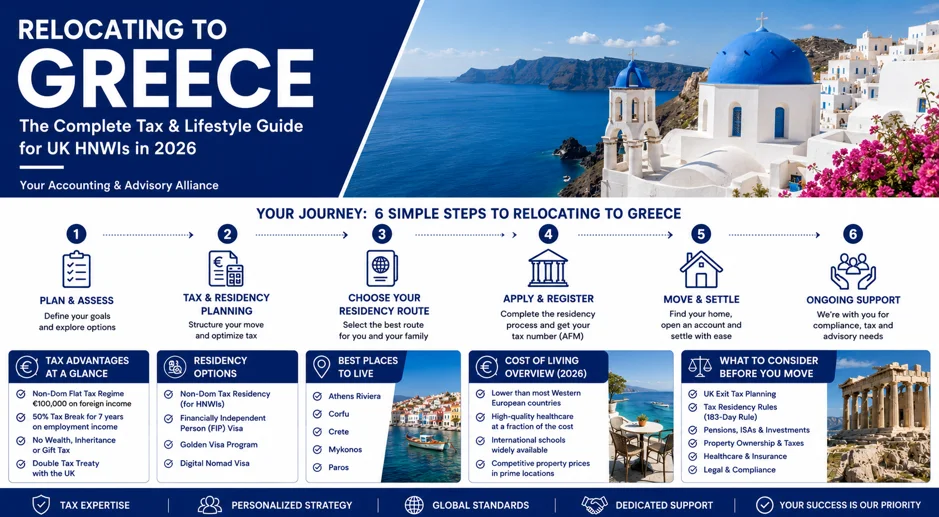
The time when Greece was merely a tourist country is long gone. There are tax advantages, easy access to the EU post-Brexit, increasing property prices, and a lifestyle that is extremely difficult to duplicate at such low prices.
There was a huge influx of UK citizens applying for Greek residence from 2024 to 2026. This had been spurred by the domicile rules changes introduced in the UK in April 2025. Britain had scrapped its non-dom system. This deprived many HNWIs of an important tax planning avenue.
Greece stepped in with something compelling. A flat annual tax on foreign income. Strong healthcare. Warm climate. A growing number of international schools. And property prices that still undercut the South of France and Portugal.
Who Benefits Most from a Move to Greece
• Investors with large foreign income, dividends or portfolio gains
• Retirees drawing defined benefit pensions or SIPP income
• Entrepreneurs who have sold or plan to sell a business
• Families who want international schooling and a safer environment
• Business owners who want to restructure wealth after an exit
Leaving the UK Tax System Correctly
Relocating to Greece is the easy part. Leaving the UK tax system is where most people go wrong. The mistakes happen in the year of departure. Getting the sequence right matters more than the destination itself.
The Statutory Residence Test
The UK Statutory Residence Test decides whether you are still taxable in the UK. It is not a simple day count. If you were a UK resident in any of the previous three tax years, spending more than 45 days in the UK can keep you in the UK tax net.
With no UK ties and no prior UK residence in three years, that safe limit rises to 183 days. But most HNWIs keep some ties after they leave. You might keep a property. Your family may stay behind for a while. You might have UK business activity. Each tie cuts your safe day count down.
Split Year Treatment
Split Year Treatment divides your tax year into two parts. One part is a UK resident. The other is overseas. This means HMRC only taxes your worldwide income for the UK portion. It applies automatically if you meet the conditions. You still need to claim it on your Self-Assessment return and keep good records.
The Temporary Non-Resident Rules
This is a trap many people miss. If you were a UK resident in at least four of the seven years before you left, and you come back within five years, HMRC can recapture capital gains you made abroad during your time away. This affects business sellers, investors, and anyone who plans a big disposal while living in Greece.
UK Exit Planning Checklist
• Map your five UK ties before your departure date
• Work out your maximum safe UK days based on your remaining ties
• Set up a home in Greece and sell or let your UK property
• Notify HMRC using form P85 when you leave
• File your final UK Self-Assessment for the split year
• Time your asset sales around your departure date
• Check whether the Temporary Non-Resident rules apply to you
Greece Tax Residency Explained
The 183 Day Rule
You become a Greek tax resident if you spend more than 183 days in Greece in a calendar year. You also qualify if your main home and family are based there. Once you are a resident, Greece taxes your worldwide income. That is the standard position unless you qualify for one of the special regimes below.
Standard Income Tax Rates for 2026
Greece updated its income tax bands under Law 5246/2025. The new rates are more favourable at higher income levels. Here is how they look:
Annual Income
Tax Rate 2026
Up to €10,000
9%
€10,001 to €20,000
20%
€20,001 to €30,000
26%
€30,001 to €40,000
34%
€40,001 to €60,000
39%
Above €60,000
44%
There has been suspension of solidarity surtax since 2023. Capital gains from property taxes are 0 percent for individuals for the year 2026.
The UK Greece Double Tax Treaty
The UK Greece Double Tax Treaty stops you from paying full tax in both countries. It splits taxing rights based on income type. UK rental income, pension payments, and some dividends may still face UK tax. The treaty manages the overlap. It does not remove all UK obligations.
Greece Tax Residency Checklist
• Spend more than 183 days in Greece per calendar year
• Register at your local Greek tax office
• Get a Greek Tax Number called an AFM
• File a Greek tax return that covers your worldwide income
• Tell HMRC you have changed your tax residency
• Check the treaty position for each type of income you receive
The Greece Non-Dom Tax Regime for High-Net-Worth Individuals
This is the most powerful tax planning tool Greece offers. It is clear, predictable and potentially very valuable. But it is not right for everyone.
What the Regime Offers
Under the Greece Non-Dom Regime, you pay a flat annual tax of 100,000 euros on all your foreign income. It does not matter how much you earn abroad.
Regardless of whether your foreign earnings are 500,000 euros or 5 million euros, the tax rate does not change. You can include relatives for 20,000 euros each per year.
The regime lasts for up to 15 years. That is a long runway for serious tax planning.
Planning Your Move to Greece?
Book a free consultation with our international tax specialists to discuss your relocation strategy, UK departure planning, and Greek tax residency. We'll help you build a compliant, tax-efficient plan that protects your wealth while supporting your long-term personal and business goals.
• You must not have been a Greek tax resident in 7 of the last 8 years
• You must move your tax residency to Greece
• You must make a qualifying investment of at least 500,000 euros in Greek assets
• You must apply formally to the Greek tax authority with supporting documents
The Separate Regime for Retirees
Foreign pensioners who move their tax residency to Greece can access a different track. You pay a flat 7% tax on all foreign pension income for up to 15 years. For a UK national receiving a 100,000-pound annual pension, that is a much better outcome than UK marginal rates or standard Greek rates.
Our detailed guide on Greece’s 7% pension tax regime for UK retirees walks through exactly how to claim it, what the application window is, and the common mistakes that cost people money.
Non-Dom vs Standard Tax Briefly
Feature
Non-Dom Regime
Standard Greek Tax
Foreign Income Tax
€100,000 flat annual charge
Progressive rates up to 44%
Regime Duration
Up to 15 years
Ongoing
Foreign Pension
€100,000 flat charge or 7% regime for qualifying pensioners
Progressive tax rates apply
Greek Source Income
Standard Greek tax rates apply
Standard Greek tax rates apply
Property Capital Gains
0% in 2026
0% in 2026
Family Members
Additional €20,000 annual charge per family member
Individual tax rates apply
Investment Needed
€500,000 investment in a qualifying asset
No minimum investment requirement
What Happens to UK Pensions, ISAs and Investments
Your UK State Pension
Your UK State Pension keeps getting paid when you live in Greece. It does not freeze or stop. But Greece does not apply the annual triple lock increase to overseas payments the same way the UK does. Check your position with the DWP before you leave.
Defined Benefit and Defined Contribution Pensions
UK pension income paid to a Greek resident is generally taxable in Greece. The treaty also gives the UK some withholding rights depending on the pension type. If you have a large defined benefit scheme, model the net outcome under both the standard Greek rates and the non-dom regime before you decide.
SIPPs and Drawdown
SIPP drawdown is normally treated as pension income under the treaty. Lump sum payments may be treated differently. Timing your drawdown around your Greek residency start date can make a real difference to the tax you pay.
What Happens to Your ISA
ISAs stay open when you move abroad. The UK tax-free status is preserved in the UK. But once you are a Greek tax resident, Greece can tax the interest, dividends and gains inside the ISA. Greek tax law does not recognise ISA wrappers. You do not lose the account, but the shelter does not travel with you.
Investment Portfolios and Dividend Income
Under the non dom regime, dividend income from foreign holdings is covered by the flat 100,000-euro charge. Under standard Greek rates, dividends are taxed at 5%. If you draw significant dividend income, the non dom regime is likely to save you a lot of money.
Should You Sell Assets Before or After Relocating?
The timing of asset sales is one of the biggest financial decisions you will make during a move. The key factors are UK Capital Gains Tax, Greek CGT, and the Temporary Non-Resident rules.
Decision Framework for Asset Disposals
Asset Type
Sell Before Departure
Sell After Greek Residency
UK Residential Property
UK Capital Gains Tax (CGT) applies at up to 24%
UK CGT continues to apply to UK residential property
UK Trading Company
Business Asset Disposal Relief (BADR) may apply
Returning to the UK within five years may trigger tax recapture rules
Investment Portfolio
UK CGT at 18% or 24% may apply
Gains may be covered by the Greek Non-Dom flat tax regime
Foreign Property
UK CGT may apply if you remain UK tax resident
Tax treatment depends on the relevant tax treaty and Greek tax rules
Company Shares
Review eligibility for Business Asset Disposal Relief before disposal
Greek tax rates of 5% to 15% may provide a more favourable outcome
UK residential property stays taxable in the UK no matter where you live. For other asset classes, setting up Greek non dom status before you sell can cut the overall tax bill. Get advice on the specific sequence before you sign anything.
Greece Residency Options for UK Nationals in 2026
UK citizens do not have the right to reside in EU member states visa-free since Brexit. You need to apply for a formal residency permit. Greece has four main routes.
Residency Route Comparison
Route
Best For
Key Requirement
Processing Time
Financially Independent Person (FIP) Visa
Retirees and individuals with passive income
Proof of monthly income exceeding €2,000
2 to 4 months
Digital Nomad Visa
Remote workers and freelancers
Monthly income exceeding €3,500 and a qualifying remote work contract
1 to 3 months
Golden Visa
Investors and property buyers
€400,000 to €800,000 qualifying property investment or €350,000 investment in eligible funds
4 to 8 months
Greek Company Director Route
Entrepreneurs and business owners
Establish a registered Greek company and provide a viable business plan
3 to 6 months
Golden Visa Programme in 2026
Programme had a number of reforms in 2024. Investment requirements are now categorized according to geographic region:
• 800,000 euros in Athens, Thessaloniki, Mykonos, Santorini, and islands with more than 3,100 inhabitants;
• 400,000 euros in any other areas of the Greek mainland and islands;
• 250,000 euros exclusively for conversion/restoration projects.
A Golden Visa provides you with a five-year permit, which is renewed provided that the investment remains valid. It applies to your spouse, children up to the age of 21, and your parents.
Short term rental of Golden Visa properties is no longer allowed under the 2024 rules.
Financially Independent Person Visa
For most retirees and passive income holders, the Financially Independent Person Visa is the simplest path. You need to show stable monthly income of at least 2,000 euros. Add 20% for each extra family member. Private health insurance is required.
If you are also considering setting up a business structure in Greece, our business registration in Greece service covers company formation, banking, and local compliance for UK nationals making that move.
Best Areas to Live in Greece for UK HNWIs
Athens Riviera, Glyfada and Vouliagmeni
The Athens Riviera is considered the most exclusive place for rich families living below the city. The area of Glyfada provides upscale dining options, yachting harbors, and good access to international schools. On the other hand, Vouliagmeni is an exclusive area situated near a thermal lagoon. It takes less than 40 minutes from both areas to the city’s airport.
Area Comparison for Affluent Families
Area
Property Range
Best For
International Schools
Glyfada
€4,000 to €8,000 per sqm
Families, city access, and dining
Yes, multiple options available
Vouliagmeni
€6,000 to €12,000 per sqm
Privacy and waterfront lifestyle
Nearby schools available in Glyfada
Corfu
€2,000 to €6,000 per sqm
Rural luxury, sailing, and privacy
Limited options; private tutoring commonly used
Crete (Elounda)
€3,000 to €7,000 per sqm
Year-round living and resort facilities
Limited availability
Mykonos
€6,000 to €15,000 per sqm
High-season lifestyle and investment opportunities
No permanent international schools; seasonal options only
Paros
€3,000 to €7,000 per sqm
Quiet island living and entrepreneurial lifestyles
No
Peloponnese
€1,500 to €4,000 per sqm
Rural estates, privacy, and lower living costs
No
Corfu and Crete appeal to people who prefer lifestyle to city proximity. Paros has had remarkable increases in price and is a popular destination among entrepreneurs looking for a place of creativity. The Peloponnese boasts superb value for private properties in stunning, remote surroundings.
Cost of Living in Greece for Affluent Families
Greece costs a lot less than the UK across most spending categories. Prices have risen in premium areas but remain well below London. Here is a realistic picture for HNWI households:
Category
Monthly Cost (Approx.)
Luxury Villa Rental (Athens Riviera)
€4,000 to €10,000 per month
Household Utilities (Large Property)
€300 to €600 per month
Private Healthcare (Family Cover)
€400 to €900 per month
International School Fees (Per Child)
€12,000 to €22,000 per year
Groceries and Household Spending
€1,500 to €3,000 per month
Dining, Entertainment, and Leisure
€1,000 to €3,000 per month
Private Transport or Driver
€600 to €2,000 per month
Domestic Staff (Cleaner and Gardener)
€800 to €2,500 per month
A family of four living well in Glyfada or Vouliagmeni can expect annual costs of between 120,000 and 220,000 euros. That is roughly 30 to 50% less than a similar lifestyle in London.
Greece vs Italy vs Cyprus: Which Is Right for UK HNWIs?
Factor
Greece
Italy
Cyprus
Non-Dom Tax Charge
€100,000 flat annual tax on foreign income
€200,000 flat annual tax
60-day rule with 0% tax on dividends and capital gains
Regime Duration
Up to 15 years
Up to 15 years
Up to 17 years
Pension Tax
7% flat tax regime for qualifying retirees
Standard Italian income tax rates apply
Low rates or exemptions may apply in many cases
Property Entry Cost
€400,000 to €800,000 for Golden Visa property investment
No minimum investment required for residency
Approximately €300,000 for permanent residency
EU and Schengen Access
Yes, full Schengen access
Yes, full Schengen access
EU member state but not currently part of the Schengen Area
English Spoken
Moderate usage in cities and islands
Limited outside major cities
Widely spoken
Property Market
Rising market with strong demand
Market conditions vary significantly by region
Strong demand with limited housing supply
Greece at 100,000 euros beats Italy at 200,000 for most income levels. Cyprus has arguably the most generous regime for investors, with no capital gains tax on share sales. But Cyprus is not in Schengen. For UK nationals who want EU mobility combined with strong tax planning, Greece offers the best overall package.
Buying Property in Greece as a UK Expat
Can UK Citizens Buy Property in Greece?
Yes, they can. Post Brexit, UK nationals can buy property on the Greek mainland and most islands with no restrictions. Some border islands may need prior approval, but this rarely creates a problem in practice.
Property Purchase Costs to Budget For
• Transfer tax: 3.09% on most residential properties
• Legal fees: 1 to 2% of purchase price
• Notary fees: around 0.8 to 1%
• Real estate agent: typically, 2 to 3% plus VAT
• Total purchase costs: roughly 6 to 8% on top of the price you pay
Key Due Diligence Steps
• Hire a Greek lawyer who is independent of the vendor and the agent
• Run a full title search at the Land Registry
• Check planning permits and structural compliance
• Get your AFM Greek Tax Number before you exchange contracts
• Open a Greek bank account to transfer your purchase funds
The Most Common Mistakes UK HNWIs Make When Relocating to Greece
• Thinking 183 days is the only UK residency test. UK ties can cut your safe threshold to as few as 15 days.
• Not filing a final UK Self-Assessment return. You must file for the year you leave. Include the split year treatment claim.
• Assuming ISAs are tax free in Greece. Greek tax does not respect ISA wrappers. Interest and gains inside the ISA can become taxable once you are a Greek resident.
• Triggering the Temporary Non-Resident rules. If you sell assets after leaving but return to the UK within five years, HMRC can bring those gains back into charge.
• Not planning pension drawdown timing. The tax year you establish Greek residency and the date you draw income can make a big financial difference.
• Picking the wrong residency route. Choosing the Financially Independent Person Visa when you have qualifying capital means missing out on Golden Visa benefits.
• Not making the 500,000 euro qualifying investment before applying for non dom status. This is a hard rule. There is no workaround.
• Thinking non dom status is automatic. It requires a formal application to the Greek tax authority. Approval takes time and is not guaranteed.
• Renting out a Golden Visa property on a short-term basis. This is not allowed under the 2024 rules. It can cost you your visa.
• Moving without a coordinated UK and Greece tax plan. The transition year is where the most financial damage happens if you are not advised properly.
Frequently Asked Questions
You keep paying UK tax on UK source income. That includes UK rental income, some pensions and UK employment income. Your worldwide income stops being taxable in the UK once you pass the Statutory Residence Test. A proper exit plan is not optional.
Yes. UK pensions keep getting paid to Greek residents. The UK Greece treaty sets out which country taxes each type of pension. State pensions are generally taxed where you live. Defined benefit and SIPP income follow slightly different treaty rules depending on the pension type.
There is no income threshold. The 100,000-euro flat tax covers all foreign income no matter how much you earn. But you must make a qualifying investment of at least 500,000 euros in Greek assets to be eligible.
Your ISA stays open. HMRC treats it as tax free from their side. But Greece does not recognise ISA wrappers. Income and gains inside the account can be taxed under Greek law. Do not close the ISA without advice. Get professional guidance on how to handle withdrawals.
For the 100,000 euro non dom regime, there is no minimum stay rule. You do need to meet Greek tax residency criteria, but residency can be established through your domicile and family base rather than day counts alone.
Plan for 6 to 12 months from decision to settled residency. That covers UK exit planning, the Greek residency application, property purchase, AFM registration, bank account setup, and non dom tax approval. Rushing any stage creates problems. A phased approach with the right advisers is the safest path.
Conclusion: Is Relocating to Greece the Right Decision for You?
Greece is not the right move for every UK HNWI. But for the right profile, it offers a rare combination. Low tax on foreign income. Strong lifestyle. EU mobility. All at a cost well below comparable European alternatives.
Retirees with large pension income benefit most from the 7% flat regime. Investors drawing dividends or gains from overseas assets can save very significantly under the 100,000 euro non dom charge. Entrepreneurs with fresh liquidity from a business sale can invest in a qualifying Greek asset, get their Golden Visa, and make a clean break from the UK tax system at the same time.
Families get a safe environment, improving international schools, strong private healthcare, and a cost of living that stretches capital further than London or the Southeast.
The hard part is the transition year. Dual residency, badly timed asset sales, missed claims, and the wrong visa route are where the damage happens. Getting the sequence right is more important than the destination itself.
If you are seriously thinking about a move, start by modelling your own position. Look at your income sources, your assets, your likely UK ties after you leave, and the lifestyle you want. That analysis will tell you whether Greece is the right fit and what the best approach looks like for your situation.
Lanop is ready to help you work through that analysis. Contact us to arrange a confidential consultation.
Trustindex verifies that the original source of the review is Google.
We're a small company in business for 23 years. We've been with Lanop for over a year now. From the outset they listened carefully to our somewhat complex bookkeeping needs (we sell products and services with different tax codes); they've provided a tailored solution that they execute with precision and in a timely manner. We hired them to provide combined bookkeeping, payroll and accountancy service, and they're a dream to work with on all aspects. They are careful and conscientious, and never last minute. Excellent measured responses when I ring up with questions - always so friendly, too. The price is very reasonable, not least given the high standard of service and the peace of mind we have. Top drawer.
Posted on Google
Rob Holroyd
Trustindex verifies that the original source of the review is Google.
I'm in the early stages of a startup and got in touch with Lanop, who looked to be very knowledgeable in my niche. I booked a 30-minute consultation with Muhammad, who was great and understood all the challenges i'd be facing and what direction i need to go.
I was very impressed with his advice, and i came away with confidence and reassurance that this is someone i need to be working with as i scale up.
Posted on Google
Soliu Fatai
Trustindex verifies that the original source of the review is Google.
The Free 30 mins call was exactly what I needed to understand my situation better and the team was really helpful in providing advise and recommending next step. I look forward to working with them long term
Posted on Google
Andrew Burton
Trustindex verifies that the original source of the review is Google.
It has been an absolute pleasure working with Lanop. Excellent!
Posted on Google
Amanda Ribeiro
Trustindex verifies that the original source of the review is Google.
I reached out to Zaib with some business and visa compliance related questions. Zaib was extremely kind and efficient in sharing his knowledge to my specific circumnstance and beyond helpful with helping us understand how to set up our business and ensure we were being tax efficient. Thanks, Zaib and team.
Posted on Google
Lindsay Teske
Trustindex verifies that the original source of the review is Google.
I was so lost in the woods with taxes and accounts, and on top of that, I had a limited company I was eager to get off my hands. Lanop was fabulous from start to finish and got everything taken care of. I went from being a bundle of nerves about anything financial to feeling totally at ease. I never thought I'd see the day! Everything occurred in a timely manner and I was always updated on everything that was going on, which was lovely. I was also quoted really fairly for everything as well! Above all else, Lanop gave me incredible peace of mind. If you work with them, you'll certainly be in good hands.
Posted on Google
Dub Station
Trustindex verifies that the original source of the review is Google.
Had a great meeting with Mohammad. Cleared up all questions we had surrounding “Gift with Reservation of Benefits”. Very calm and clear communicator. Thank you.
Posted on Google
E B
Trustindex verifies that the original source of the review is Google.
Very happy to recommend Lanop accountants at 389 Upper Richmond Road. They were very communicative, helpful and efficient.
Posted on Google
Diamantino
Trustindex verifies that the original source of the review is Google.
I am a new owner to a company and they have really helped in supporting me in the startup of my business
Posted on Google
Gurmehar Bhasin
Trustindex verifies that the original source of the review is Google.
Excellent service, timely delivery, and response are a few words that describe Lanop tax advisors at best. I had seamless communication with Florentina, and Sohaib. They both accommodated me well and it was a hassle free experience overall. Quick resolution too! Highly recommend their services.
Thinking About Starting a Business in Greece?
Book Your FREE Greece Business Setup Consultation
Enter Your Name & Email Address for a Free Consultation