
Do you run a limited company? Then you know that choosing between dividends and salary can feel hard. The good news is that the best answer for many UK directors is simple. Take a small salary, then add dividends from company profits.
Why does this work? A salary gives you steady pay and State Pension cover. Dividends, on the other hand, help you avoid National Insurance costs.
In 2026/27, many directors take £12,570 as salary. They then take the rest as dividends. You work hard for your profit, so you should keep more of it.
But here’s the catch. One wrong choice can cost you hundreds of pounds every single year. So, this guide will walk you through all the numbers, rules, and best choices for 2026/27.
Which Is Better for a UK Company Director: Salary or Dividends?
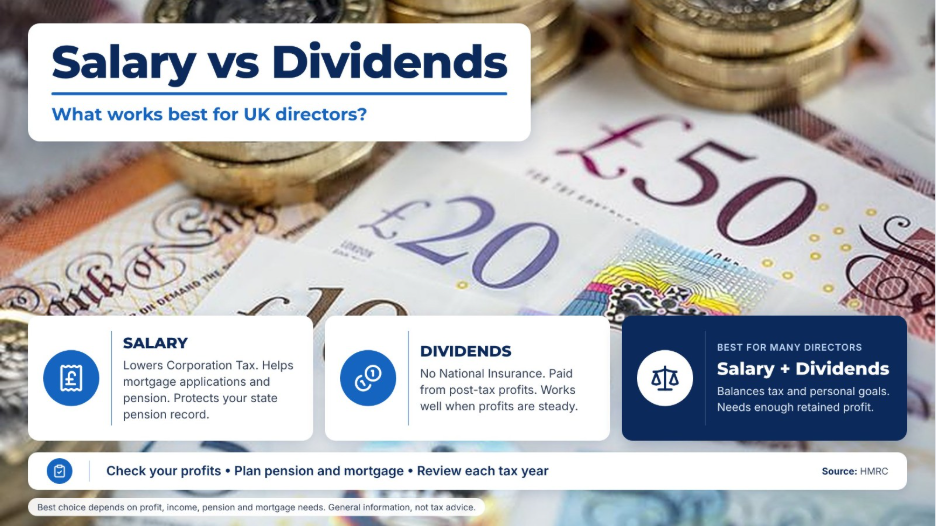
For most directors with enough profit, a mix of salary and dividends is the best plan. Why? Because salary and dividends solve different problems.
Salary is a business cost. That means it lowers the tax your company pays on its profit.
Dividends, by contrast, skip National Insurance. But they come from profit that has already been taxed. So, any salary vs dividends plan for a business owner should start with your yearly profit.
Your company must also have enough profit left over after Corporation Tax. On top of that, your other income, pension plans, and mortgage needs can change the best answer. Here’s a quick look at when each option works best for you.
- Choose a salary when you need proof of income for a mortgage or want bigger pension payments.
- Pick dividends when profit is steady and you want to skip National Insurance.
- Choose both when you want to pay less tax and still build a secure State Pension.
What Is the Difference Between Salary vs Dividends?
Let’s start with the basics. Salary is paid each month through payroll, and tax comes off before you get paid.
Dividends work in a different way. They are a share of company profit that goes to the owners. The table below sets out the main gaps in plain terms.
| Factor | Salary | Dividends |
| Payment method | Salary usually runs through PAYE payroll each month | Dividends usually follow company approval and payment records |
| Company tax effect | Salary lowers the company’s taxable profit before Corporation Tax | Dividends come from profits left after Corporation Tax |
| Personal tax | Salary uses normal Income Tax bands and allowances | Dividends use their own tax rates after allowances |
| Basic rate tax in 2026/27 | 20% | 10.75% |
| Higher rate tax in 2026/27 | 40% | 35.75% |
| Employee National Insurance | 8% above £12,570 | None |
| Company National Insurance | 15% above £5,000 | None |
| Profit needed | Salary does not need profits the company can pay out | Dividends need profits the law lets the company pay out |
| Share ownership | You do not need to own shares to get a salary | You usually need to own the right shares to get dividends |
| Income records | Payroll gives clear, regular records of salary paid | Dividend vouchers and returns back up each payment |
So, dividends cost you less tax. But keep in mind that they never cut your company’s profit tax.
Company profit tax is 19% on profits up to £50,000. It is 25% on profits above £250,000 each year.
What about profits in between? They get a gradual relief scale known as marginal relief. Also, note that these limits are lower if your company has associated companies.
How Much Salary Can a Director Take Tax-Free in 2026/27?
Your personal allowance is £12,570. That means you pay no Income Tax on that much salary.
On top of that, employee National Insurance also starts at £12,570. So, you pay none below it.
Your company, however, starts paying its own National Insurance at £5,000 a year. The rate is 15% on every pound above that figure each year. And here’s a bonus: a salary of £6,708 or more also earns you a full year of State Pension.
| Yearly salary | Income tax | Employee NI | Company NI | State pension year |
| £5,000 | £0 | £0 | £0 | No |
| £6,708 | £0 | £0 | £256.20 | Yes |
| £12,570 | £0 | £0 | £1,135.50 | Yes |
Important Salary Thresholds for 2026/27
- £12,570: Personal allowance and employee National Insurance threshold.
- £5,000: Employer National Insurance threshold (the secondary threshold).
- £50,270: The point where the basic-rate Income Tax band ends.
- £6,708: Lower Earnings Limit for State Pension qualifying years.
Employer National Insurance is 15% on salary above £5,000. So, for a £12,570 salary, that cost is £1,135.50. The sum is simple: 15% of £7,570.
Some companies can use the Employment Allowance to cut their employer National Insurance bill. But there’s a catch. A company with only one director on the payroll usually cannot claim it.
What Dividend Tax Rates Apply to Company Directors in 2026/27?
If you’re still using last year’s dividends vs salary UK guide, it’s out of date. Dividend tax rates rose by two points from April 2026 for most people.
The good news? The first £500 of dividends each year is tax-free for every person.
| Tax band | Rate in 2025/26 | Rate in 2026/27 |
| Basic | 8.75% | 10.75% |
| Higher | 33.75% | 35.75% |
| Additional | 39.35% | 39.35% |
Do Directors Pay National Insurance on Salary and Dividends?
In short, directors pay National Insurance on salary, but not on dividends.
Employee National Insurance is 8% on salary between £12,570 and £50,270. After that, it drops to 2% on salary above £50,270.
Your company also pays employer National Insurance at 15% on salary above £5,000. Dividends, on the other hand, don’t trigger any employee or employer National Insurance. But remember, dividends are paid from profit that has already faced Corporation Tax.
National Insurance Key Factors
- Salary above £12,570: Employee pays 8% up to £50,270.
- Salary above £50,270: Employee pays 2% on the extra amount.
- Salary above £5,000: Company pays 15% employer National Insurance.
- Dividends: No National Insurance for the director or the company.
What Is the Most Tax-Efficient Salary and Dividend Mix?
Good salary vs dividends choices need real numbers, not rough guesses. So, let’s look at one simple example with total pay of £50,270.
In this case, the owner takes £12,570 as salary. The other £37,700 comes as dividends.
| Item | Amount |
| Salary | £12,570 |
| Dividends | £37,700 |
| Income tax on salary | £0 |
| Employee National Insurance | £0 |
| Tax-free dividend allowance | £500 |
| Taxable dividends | £37,200 |
| Dividend tax at 10.75% | £3,999 |
| Take-home pay | £46,271 |
Keep in mind that this £46,271 is your own take-home pay only. Your company also pays £1,135.50 in employer National Insurance on the salary. On top of that, it pays Corporation Tax on the profits used for the dividends.
When a Small Salary Works Best
- Your company has enough money to run payroll.
- You want to protect your State Pension record.
- You have no other income using your personal allowance.
- You want a clear and steady income to show lenders.
- You plan to make personal pension payments.
When Dividends Work Best
- Your company has enough profit left after tax.
- You want to avoid employee and employer National Insurance.
- Your income stays within the basic rate tax band.
- You want to choose when you pay yourself during quiet trading months.
- You do not need a high salary for borrowing or pensions.
When a Higher Salary May Be Better
- You want to pay more into a personal pension.
- You need proof of stable PAYE income for a mortgage.
- Your company has low profits but can still pay wages.
- You want to lower the company’s taxable profit through salary costs.
Can I Take Dividends Instead of a Salary from My Limited Company?
Yes, you can take dividends instead of salary, as long as your company has enough profit to pay out. But this is not always the smartest choice.
Why not? A dividend-only plan can leave your State Pension record unprotected.
What’s more, dividends cannot be paid if the company has no profits left over. And if you take money out of the company with no profit or paperwork, it can turn into a director’s loan issue. That can lead to extra tax and pressure to pay the money back.
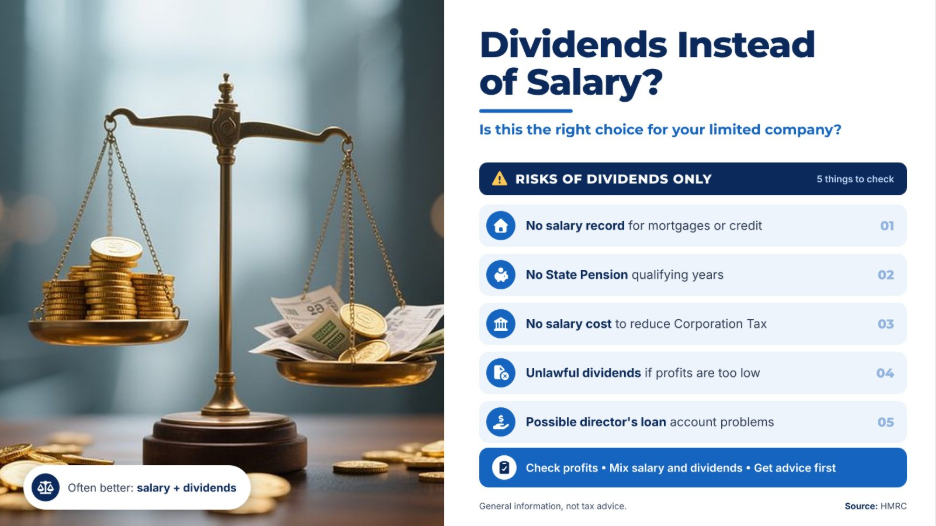
Risks of Taking Dividends Only
- No salary record for mortgage or credit applications.
- No State Pension qualifying years from earnings.
- No salary cost to lower the company’s taxable profit.
- Risk of illegal dividends if profits are too low.
- Possible director’s loan problems if money is taken the wrong way.
What Are the Rules for Taking Dividends from a UK Limited Company?
Before you pay yourself dividends, you need to follow a few steps. First, know that dividends can only come from real profits kept in the business. These are the profits left after Corporation Tax and past losses.
Also, keep in mind that cash in the bank does not always mean you have a profit to pay out.
Steps to Pay Dividends Correctly
- Check the company has enough profit kept back to pay out.
- Hold a board meeting, or record board approval in writing.
- Prepare a dividend voucher for each shareholder.
- Pay dividends based on each person’s shares.
- Keep board minutes, accounts, and vouchers safe.
- Report dividend income through Self Assessment if needed.
A dividend voucher should show the payment date, the amount, the shareholder’s name, and company details. Good records protect you if HMRC asks questions later.
But be careful. If you take dividends without enough profit, they may be treated as a loan to you.
An overdrawn director’s loan account can then trigger an extra Section 455 tax charge. That’s why every dividend vs salary plan should be checked again when April starts.
Section 455 Tax on Director’s Loans in 2026/27
Section 455 tax rose from April 2026, in line with the higher dividend tax rate. Here’s how the charge works.
- The rate is 35.75% on loans made on or after 6 April 2026, up from 33.75%.
- The charge applies if the loan is not repaid within nine months and one day of your company’s year end.
- Your company pays the charge, not you as the director.
- Your company can claim it back from HMRC once the loan is repaid, released, or written off.
What Mistakes Should Directors Avoid?
Many owners lose money through small slips that are easy to avoid. Watch out for these:
- Using last year’s tax rates instead of the new rates for 2026/27.
- Paying dividends without a written voucher or a board note on file.
- Pulling cash from the company bank account with no record of why.
- Ignoring the £100,000 income point where your tax-free allowance starts to shrink.
How Lanop Helps Directors Choose the Right Pay Mix
Deciding whether to pay yourself dividends or salary doesn’t have to be a guessing game. The accountants at Lanop look at your business profits, payroll, tax bands, and future plans. Then, we help you build a plan that fits.
Lanop offers a full range of accounting services. These include payroll, bookkeeping, tax planning, and help with Self Assessment. Our team works with Xero and QuickBooks and helps keep all your data in one place.
Lanop Can Help You
- Review your current salary and dividend setup.
- Work out employer and employee National Insurance.
- Prepare payroll and dividend paperwork the right way.
- Plan dividends around Corporation Tax and the profit you have kept.
- Support Self Assessment and dividend tax reporting.
- Advise on pensions, cash flow, and how to take profit out.
Frequently Asked Questions
A mix is often best for directors with enough company profit. Many take a £12,570 salary and use dividends for extra income. That said, your profits, pension plans, and other income can change the best answer.
The 2026/27 dividend rates are 10.75%, 35.75%, and 39.35%. The first £500 of dividend income is covered by the dividend allowance. Plus, any dividends that fall within your personal allowance are also tax-free.
A £12,570 salary plus dividends works well for many directors. It uses your personal allowance and avoids employee National Insurance. Still, an accountant should check employer National Insurance and your full tax position.
You can take dividends as often as you like, as long as your company has enough spare profit. Many owners pick a monthly or quarterly plan to keep their income steady. Just remember that each payment needs its own board minutes and a dividend voucher for the shareholders.
Yes, in most cases you need to run payroll and tell HMRC each time you pay. You must register for PAYE once any employee earns £6,708 a year or more. This applies even when your pay is too low to owe any tax. Plus, good payroll records help you prove your income to lenders and to HMRC.
You report your dividends on a Self Assessment return after the tax year ends. The online return and the tax bill are both due by the next 31 January.
If your tax bill is over £1,000, HMRC may also ask for payments on account on 31 January and 31 July. And if you pay late, HMRC adds a penalty plus interest on the amount you owe.
Final Thoughts: Choose the Right Pay Mix with Lanop
Choosing between dividends and salary is one of the biggest money choices a UK director makes. The right mix can protect your State Pension, cut your National Insurance, and keep more profit in your pocket.
On the flip side, the wrong mix can lead to tax you didn’t need to pay, paperwork problems, or even illegal dividend issues. That’s why paying yourself through salary and dividends should never be a guess.
Lanop’s accountants use their skills to turn complex tax rules into a clear, simple plan. At Lanop, we look at your profit, payroll, pension plans, and personal tax. Then we suggest the best mix of salary and dividends for you.
Want to feel sure about your salary and dividend pay in 2026/27? Call Lanop today.