

If you earn money abroad and live in the UK, tax rules can feel confusing and scary. The FIG regime gives new UK residents 4 years of tax-free foreign income. It took over from the old non-dom system on 6 April 2025.
You must have lived outside the UK for 10 tax years first. If you are moving to the UK, this rule can save you thousands. But a missed claim can cost you the whole benefit for that year.
This guide explains the new FIG regime in simple words so you can plan with confidence. You will learn who qualifies, how much foreign income can be tax-free, and what changes.
What is the FIG regime in the UK?
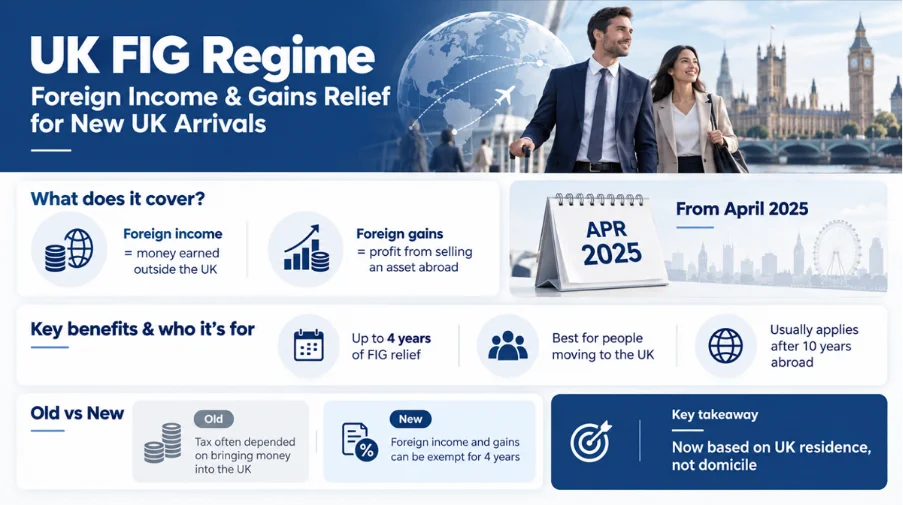
FIG means foreign income and gains, which is money earned outside the UK. Foreign income is any money you earn from a source outside the UK. Foreign gains are profits you make when you sell an asset abroad.
Since April 2025, the UK has taxed this money under the FIG regime. Under the foreign income and gains regime, you get relief for 4 years. It suits people who move to the UK after 10 years abroad. Many people call the FIG regime the new tax regime for arrivals. The full rules are in the HMRC Residence and FIG Regime Manual.
In simple terms:
- Old rules taxed foreign income only if you brought it into the UK.
- New rules tax UK income fully but can exempt foreign income and gains for 4 years.
- The system is now based on residence, not on domicile status for income tax.
UK Non-Dom Tax Changes: What Is Different in 2026?
The old non-dom tax rules let many people pay little UK tax. For years, non-doms paid UK tax only on foreign money they brought in. That system is called the remittance basis, and it ended in April 2025.
Your tax now depends on how long you have lived in the UK. Where you were born or where your parents came from no longer matters. These UK non-dom tax changes affect both new arrivals and long-term residents.
The biggest non-dom changes hit people who lived here for many years. Long-term residents are now taxed on their worldwide income and gains in full.
| Feature | Old non-dom remittance basis | New FIG regime (from 2025) |
|---|---|---|
| Main test | Domicile status and remittance behavior | Residence history and 4-year window |
| Foreign income tax treatment | Taxed only if remitted to the UK | Can be fully exempt for 4 years |
| Maximum relief period | Potentially indefinite for long-term non-doms | Fixed at 4 UK tax years only |
| Yearly fee | £30,000 or £60,000 for long-term users | None |
| Reporting | Foreign income reported if remitted | Worldwide income reported every year |
| Inheritance tax test | Domicile and deemed domicile | 10 of the last 20 years in the UK |
| Relevance of domicile | Central for income tax and IHT | Much less relevant for income tax |
| Start date | Used for many decades before 2025 | Applies from 6 April 2025 onwards |
What Happens to Non-Dom Tax Status Under the New UK Rules?
Non-dom tax status no longer decides how HMRC taxes your foreign income. The remittance basis has ended, and the FIG regime is the main replacement. Parliament changed the old rules by passing the Finance Act 2025.
The UK government abolished the non-dom remittance basis for most new claims from April 2025. Domicile is no longer the main factor for income tax and capital gains tax from 2025 to 26.
From 2026 to 27 onwards, most former non-doms will be taxed on worldwide income and gains. Only those who meet with the new residence-based tests can use the 4-year FIG relief window. This is a major shift from the old non-dom tax rules that lasted for over 200 years.
What changed compared to the old system:
- Old system: Non-doms could avoid UK tax on foreign income unless remitted to the UK.
- New system: FIG gives a 4-year exemption based on residence, not on domicile status.
- Old system: Domicile also shaped inheritance tax planning for many wealthy international families.
- New system: Inheritance tax will also move towards a long-term residence-based model over time.
Who Is Eligible for the FIG Regime in the UK?
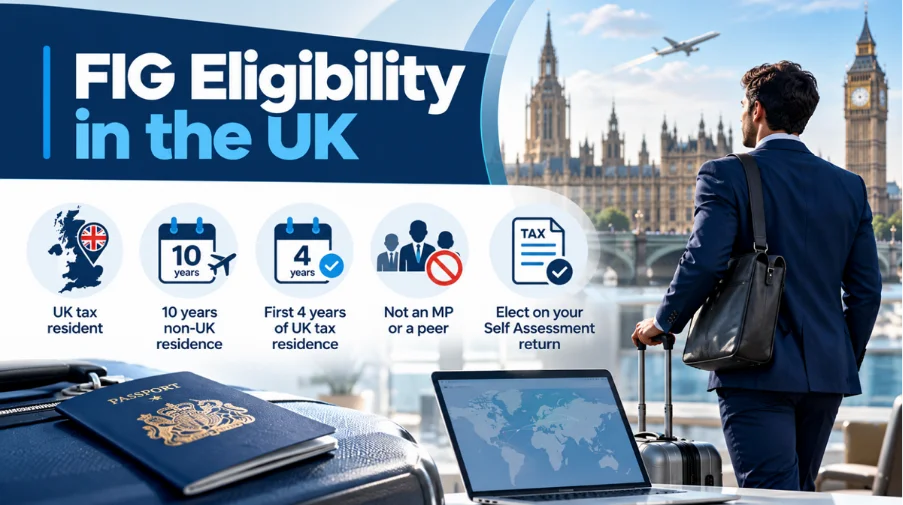
Not everyone in the UK can use the foreign income and gain regime for tax relief. You must be a UK tax resident and a qualifying new resident under HMRC rules. This means you were not a UK tax resident for at least 10 full tax years in a row.
You also must be within your first 4 years of UK tax residence after that gap. Members of Parliament and members of the House of Lords cannot claim this relief at all. If you meet these tests, you can elect for FIG on your Self-Assessment tax return.
Key eligibility checklist:
- You are a UK tax resident for the year you want to claim FIG relief.
- You have at least 10 consecutive tax years of non-UK residence before arriving.
- You are in year one, two, three, or 4 of UK tax residence.
- You are not an MP, a peer, or otherwise excluded by specific anti-avoidance rules.
- If you arrived in 2022 to 2025, your first 4-year window may still apply.
- You can use FIG from 2025 to 26 onwards if you are still within those 4 years.
How Do You Know If You Are a UK Tax Resident?
You are a UK resident if you spend 183 or more days here. Fewer days can still make you resident if you have strong UK ties. Ties include a UK home, close family, or a job here. The Statutory Residence Test is the official tool that checks all of this. Keep a diary of your travel days to prove your status later.
Can New UK Residents Claim the FIG Regime for Overseas Income and Gains?
Yes, new UK residents can claim it if they meet the 10-year non-residence and 4-year residence tests. This includes professionals, business owners, and investors who move to the UK from abroad. You must make the claim yourself because HMRC will not apply for it.
Returning British expats can also qualify if they spent 10 full tax years living outside the UK. During the first 4 UK tax years, most foreign income and gains can be tax-exempt. After year 4, worldwide income and gains are normally taxed in the UK on the arising basis. Follow these steps each tax year to claim FIG relief on time:
- Check that you were non-resident for the 10 tax years before arrival.
- Register for Self Assessment by 5 October after your first UK tax year.
- Fill in the foreign section of your return and claim FIG relief.
- Pay any UK tax due on your UK income by 31 January.
- Keep bank records that show where each foreign payment first came from.
Important Tip: If your first UK tax year was 2025 to 2026, your deadline is 5 October 2026. You can choose to claim in some years and skip it in others.
How Does the New FIG Regime Apply to Foreign Income and Gains?
FIG relief covers most kinds of money you earn from outside the UK.
- Rent from a home or piece of land that you own abroad
- Interest paid by a bank account that is held outside the UK
- Dividends paid to you by companies that are based outside the UK
- Profits made when you sell shares or property that you hold overseas
Relief applies even if you bring the money into the UK. UK income and UK gains are still taxed in the normal way. A UK rental flat or UK job pay never counts as foreign income. Foreign income and gain relief does not reduce tax on UK earnings.
How Much Foreign Income Is Tax Free in the UK Under FIG?
There is no fixed cash limit or allowance for foreign income and gains under FIG relief. If you qualify and claim FIG, almost all your foreign income and gains can be exempted. The key is your residence history and making the correct election each tax year on time.
This applies to foreign employment income, dividends, interest, rental profits, and most capital gains. The relief is not a small allowance but a full exemption for qualifying foreign income and gains.
A £50,000 foreign dividend payout can be fully covered for 4 years. The relief lasts for 4 tax years, and it cannot be extended. You lose some allowances in any tax year when you claim relief.
Important points to remember:
- There is no set figure like “£10,000 tax-free” for foreign income under FIG rules.
- The exemption depends on your status, not on the size of your foreign income pot.
- Pre-6 April 2025 foreign income and gains do not qualify for this 4-year relief.
- In 2025 to 26, some former non-doms face a special 50% charge on certain foreign income.
| Item | If you do not claim | If you claim FIG relief |
|---|---|---|
| Personal allowance | £12,570 | Not available |
| Capital gains allowance | £3,000 | Not available |
| Tax on foreign income and gains | Normal UK rates | £0 for 4 years |
| Tax on UK earnings | Normal UK rates | Normal UK rates |
How Do You Claim the FIG Regime on Your UK Tax Return?
Claiming the foreign income and gain regime relief requires action on your Self-Assessment tax return. You must register for Self-Assessment if you have not filed a UK tax return before.
You then complete the foreign income pages and any capital gains supplements for the tax year. In the relevant sections, you make the FIG election claim relief on qualifying foreign amounts. HMRC expects you to report worldwide income and gains even when you claim full FIG relief.
Step-by-step claim process:
- Check that you were non-resident for the 10 tax years before arrival.
- Register for Self-Assessment by 5 October after your first UK tax year and get your Unique Taxpayer Reference number from HMRC.
- Gather records of all UK and foreign income and gains for the tax year.
- Split your income and gains into UK-source and foreign-source amounts clearly and accurately.
- Complete the SA106 foreign pages and any capital gains summaries in your online return.
- Make the FIG election in the correct boxes to claim relief on foreign income and gains.
- File your return by the deadline and pay any UK tax due on UK-source income by 31 January.
Keep detailed records of your residence history, travel days, and source of each income stream. These records help prove you meet the 10-year non-residence and 4-year residence conditions if queried. Keep bank records that show where each foreign payment first came from.
Tip: If your first UK tax year was 2025 to 2026, your deadline is 5 October 2026. You can choose to claim in some years and skip it in others.
Key Dates to Remember
| Date | What happens |
|---|---|
| 5 October 2026 | Tell HMRC you need to file for the 2025 to 2026 year |
| 31 January 2027 | File your 2025 to 2026 return online and pay the tax due |
| 5 April 2027 | Last day of the 2026 to 2027 tax year at the 12% TRF rate |
| 6 April 2027 | The TRF rate moves to 15% in the 2027 to 2028 tax year |
Common FIG Claim Mistakes to Avoid
Avoid these common errors when you claim FIG relief for the first time:
- Forgetting to claim because HMRC does not apply the relief on its own
- Miscounting your 10 years of non-residence before you arrived in the UK
- Mixing UK income with foreign income in the wrong boxes of the return
- Missing the loss of the personal allowance when you do claim relief
- Leaving it too late to use the cheaper 12% TRF rate before 2027
- Ignoring foreign tax credits and paying tax twice on the same income
UK Tax on Foreign Income After the 4 Years
After year 4, you pay UK tax on foreign income as normal. Income tax on foreign income uses the same rates as UK earnings. The tax on foreign income UK residents pay depends on total income.
Taxable foreign income means any money you earn abroad that is not exempt. HMRC treats taxable foreign income UK residents receive like income earned at home.
Foreign Income Tax UK Rates (indicative, based on recent years)
| Type of income | Basic rate | Higher rate | Additional rate |
|---|---|---|---|
| Wages, rent and interest | 20% | 40% | 45% |
| Dividends | 10.75% | 35.75% | 39.35% |
| Gains on shares and assets | 18% | 24% | 24% |
What Is the Temporary Repatriation Facility?
The TRF lets eligible former non-doms pay a low flat rate on certain old foreign money. You pay 12% in 2025 to 2026 and 2026 to 2027 years. The rate then rises to 15% in the 2027 to 2028 tax year. It covers money earned before 6 April 2025 under the old rules.
| Tax year | TRF rate | Tax on £100,000 |
|---|---|---|
| 2025 to 2026 | 12% | £12,000 |
| 2026 to 2027 | 12% | £12,000 |
| 2027 to 2028 | 15% | £15,000 |
Do Inheritance Tax and Overseas Workday Relief Change?
You join the long-term resident group after 10 of the last 20 tax years in the UK. Then UK inheritance tax of 40% can apply to your worldwide assets. After you leave the UK, inheritance tax exposure can continue for up to 10 years. Overseas Workday Relief ended for new arrivals from 6 April 2025 under the non-dom reforms.
Frequently Asked Questions
It is a 4-year tax relief for new UK residents with income abroad. You must have been non-resident for 10 years and then claim each year.
You qualify if you become a UK resident after 10 years of living abroad. You must also file a Self-Assessment return and claim relief.
It removes UK tax on your foreign income and gains for 4 years. You can also bring that money into the UK without any extra tax.
All of it is tax-free for 4 years with no upper limit. After that, you pay normal UK tax on all your foreign income.
Yes, they can if they have been non-resident for the last 10 years. The claim is made every year on the Self-Assessment tax return.
Non-dom status no longer sets how you pay tax on foreign income. Your years of UK residence now decide your tax and inheritance tax position.
Final Thoughts: Get Your FIG Claim Right
In short, the FIG regime gives you 4 tax-free years on foreign money. But the rules are strict, and one small error can cost you dearly. You may be wondering if you qualify or how to file the claim. That is where Lanop business and tax advisors can help you and take the stress away.
Our tax advisers will check your 10-year history and prepare your return. We will also show you how to save more under the new rules. Contact Lanop today and let us turn these new rules into real savings.