
Introduction
The global rules for high-net-worth capital are shifting fast. Wealthy families face disappearing tax perks and advanced transparency rules. To secure your legacy, you must act now. Relying on a single country risks everything.
Smart families use international wealth structuring to split their risk and place different assets in different regions. Casual setups no longer work. You need an expert multi-jurisdictional plan to keep your capital safe and compliant.
Why Wealthy Families Are Moving Assets Offshore
Global wealth management is changing rapidly. Many nations are rewriting their tax codes to tax the rich more heavily. For example, the United Kingdom made massive changes to its old tax systems. These shifts sparked a major HNWI wealth migration. Wealthy individuals are packing their bags to find stable homes for their capital.
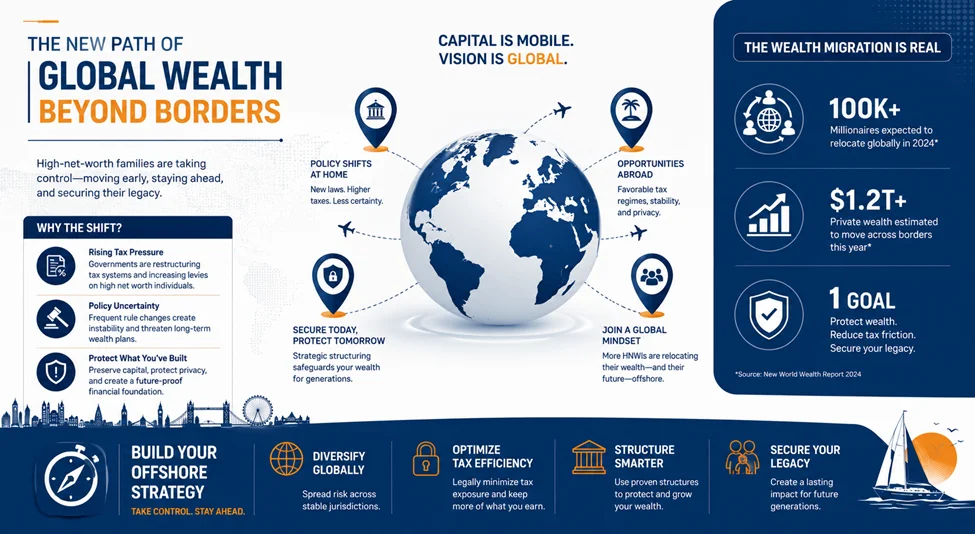
The movement of cash is very real. You can see it in every major financial hub. Wealthy people do not just sit and wait. They move their funds before new laws take effect. This proactive shift is the core of offshore wealth structuring today. You must watch these trends closely. Your current home might change its laws next year.
Where Wealthy Individuals Are Moving Their Money Now
The data shows a clear trend. Capital is leaving Europe. People want to know about wealth migration UK 2026, where HNWI are moving. The top spots are clear. Many families choose the United Arab Emirates. The UAE offers safety, luxury, and zero income tax. It is a perfect spot for global business owners.
Singapore is another top choice. It acts as a gateway to Asia. Singapore has strong laws and stable banks. It offers great corporate setups. Switzerland also remains popular for its privacy traditions. Wealthy individuals move to these spots to escape high European tax rates. They want predictability for their businesses.
Why Old Tax Privileges Are Disappearing
The old UK non-dom status is gone. That system lets foreigners live in the UK without paying tax on offshore cash. Now, that rule is history. The new system targets foreign earnings quickly. This change forced families to seek wealth structuring advice. They must redesign their entire asset network.
Other countries are responding to this trend. They are creating new visa tracks to attract your capital. They offer golden visas and quick corporate setup options. You can use these global options to your advantage. You just need to select the right mix of regions.
How to Set Up a Secure Holding Structure for Global Assets
A good wealth management structure acts like a shield. It holds your operating firms, liquid cash, and property. It separates your personal life from your commercial risks. If a business unit fails, your private wealth stays safe. This design is the foundation of structured wealth management.
To build this shield, you need specific legal entities. You cannot hold everything in your own name. That creates a massive risk of liability. It also invites heavy estate taxes when you pass away. Instead, you use a mix of holding units and trusts.
How a UK Offshore Holding Company Protects Your Profits
An offshore holding company UK HNWI tax efficient plan works well. You set up a holding company in a neutral place like the British Virgin Islands or Guernsey. This company holds the shares of your UK trading businesses.
This setup stops direct tax hits on global dividends. The cash flows up to the offshore holding unit. It can stay there for future investments. It does not trigger immediate personal income tax. This tool gives you ultimate control over when you take a payout. It keeps your global capital working for you.
How to Separate Corporate Risks From Personal Wealth
Good private wealth structuring looks at growth alongside safety. You need your assets to beat inflation. But you also need them behind strong legal walls. You can achieve this balance by using underlying corporate cells. These cells hold distinct types of investments.
For example, you put stocks in one cell. You put venture funds in another cell. This separation protects each asset class from the other. If one market crashes, the other cells remain untouched. It is a clean way to manage risk across continents.
The Best Legal Structures for Asset Protection and Defense
Asset protection is not about hiding money. It is about legal defense. You use valid laws to guard your hard work from unfair lawsuits. Creditors always look for easy targets. A naked asset pool in your personal name is an easy target.
The best asset protection structure uses distinct legal layers. These layers break the link between you and the asset. You do not own the asset directly anymore. A trust or a foundation owns it. Yet, you still control how the asset functions.
Why Foreign Trusts Offer the Strongest Court Shielding
To structure wealth correctly, you must use foreign trusts. The Cook Islands and Belize have the strongest trust laws. Their courts do not recognize foreign civil judgments. If someone sues you in your home country, they lose. They must travel to the island to fight you.
They must prove their case beyond a reasonable doubt. That process is very costly. It stops most frivolous lawsuits before they start. The trust holds an underlying company. The company holds your bank accounts. This two-tier system is incredibly tough to break.
How to Protect High-Value Assets Like Yachts and Private Jets
High-value toys need special care. You should never own a superyacht in your own name. The same rule applies to private planes. These assets carry massive operational risks. If a yacht damages a dock, you could face personal lawsuits.
Smart owners use luxury asset structuring solutions. They place each vessel in a specific limited company. Malta and the Cayman Islands are great for boat registration. They offer clean tax rules and respected flags. This strategy limits your risk to that single vessel. It keeps your main wealth safe.
Understanding Global Tax Treaties and Compliance Rules
Tax treaties are agreements between two nations. They stop you from paying tax twice on the same income. If you live in country A but make money in country B, you look at the treaty. Proper multi-jurisdictional tax treaty planning HNWI steps can lower your global tax burden.
You can route your business income through a country with good treaties. This choice reduces withholding taxes on dividends. It also keeps your corporate structures fully legal. You must align your setup with these international agreements.
| Tie Type | Example | Effect on Day Count |
|---|---|---|
| Family tie | Spouse or child is UK resident | Lowers the threshold by a lot |
| Home tie | A UK home you can use, even rented | Counts as a tie |
| Work tie | Working 40 or more days in the UK | Counts as a tie |
| 90 day tie | 90 or more UK days in a prior year | Counts as a tie |
How Modern Transparency Laws Impact Your Offshore Accounts
Tax compliance is mandatory. The days of secret bank accounts are over. The Common Reporting Standard (CRS) ensures global data sharing. Over one hundred countries send account data to your home tax office automatically.
HMRC CRS FATCA offshore reporting 2026 systems are highly advanced. AI tools scan these reports for mismatches. If your offshore company makes money, HMRC will know. You must report every single structure. True protection comes from legal tax optimization, not from hiding things.
How UK Residents Can Use Family Investment Companies
If you retain ties to the UK, you need a solid plan. A private family office structure UK tax planning method uses Family Investment Companies (FICs). An FIC is a standard UK limited company with customized articles of association.
Parents keep voting control over the assets. The children hold non-voting shares. This setup allows you to pass wealth to the next generation without triggering immediate inheritance tax. The company pays corporate tax on profits. Corporate tax rates are lower than personal income tax rates. It is an efficient way to grow family capital.
How to Organize Real Estate, Private Equity, and Crypto Assets
Modern portfolios do not just hold stocks and bonds. They contain real estate, private equity, and digital tokens. Each asset type needs a different corporate home. You cannot mix high-risk crypto tokens with stable physical property.
Applying cross asset structuring means matching the asset to the right legal entity. You look at where the asset sits physically. Then you look at who buys it. This method builds a clean matrix of corporate ownership.
Structuring Foreign Real Estate Deals to Reduce Taxes
Physical property is hard to move. It sits in a specific country and faces local property taxes. When you hold private equity real estate across jurisdictions, you use local SPVs (Special Purpose Vehicles).
An offshore holding unit owns these local SPVs. For instance, a Jersey company might own a UK commercial building. When you sell the building, you do not sell the bricks. You sell the shares of the Jersey company. This route can reduce transfer taxes and stamp duties legally.
How to Manage Cross-Border Taxes on Crypto and Digital Assets
Crypto assets present unique challenges. They do not have a physical home. Tax offices look at where the owner lives to determine tax rules. The digital assets crypto UHNWI cross-border tax rules are becoming strict in 2026.
To manage this risk, you can place your digital assets inside a Swiss or UAE foundation. These entities hold the private keys safely. The foundation treats crypto trades under local corporate rules. This method protects you from volatile personal capital gains taxes. It also provides institutional-grade custody options.
Managing a Multi-Jurisdictional Family Office Command Center
If your family spans several continents, you need a central command center. A multi-jurisdictional family office is that center. It manages investments, legal needs, and travel schedules for the whole family. It ensures everyone follows the same master plan.
The family office multi-jurisdiction structure UK framework often relies on a hub-and-spoke model. The main management team sits in a major city like London. But the asset holding companies sit offshore. This layout gives you the best of both worlds: top talent in London and excellent tax efficiency offshore.
Creating Family Foundations for Long-Term Governance
A resilient asset management structure needs clear rules. You must write a clear family constitution. This document states who gets what and when. It defines how the family office makes big investment choices.
The structure must also survive your passing. You use foundations to ensure continuity. The foundation goes on forever. It does not stop when a family member dies. This setup prevents messy public probate court battles. It keeps your family matters private.
Using Asset Structured Finance to Generate Liquidity
Large estates often use debt to optimize cash flow. You do not want to sell a great stock portfolio just to buy a new property. Selling stocks triggers capital gains taxes. Instead, you borrow money against your assets.
This technique is part of asset structured finance. A private bank lends you cash using your offshore stocks as collateral. You use that cash to buy new real estate. The interest on the loan can sometimes offset your rental income. This smart move expands your wealth without triggering new tax bills.
Building a Three-Region Asset Allocation Structure
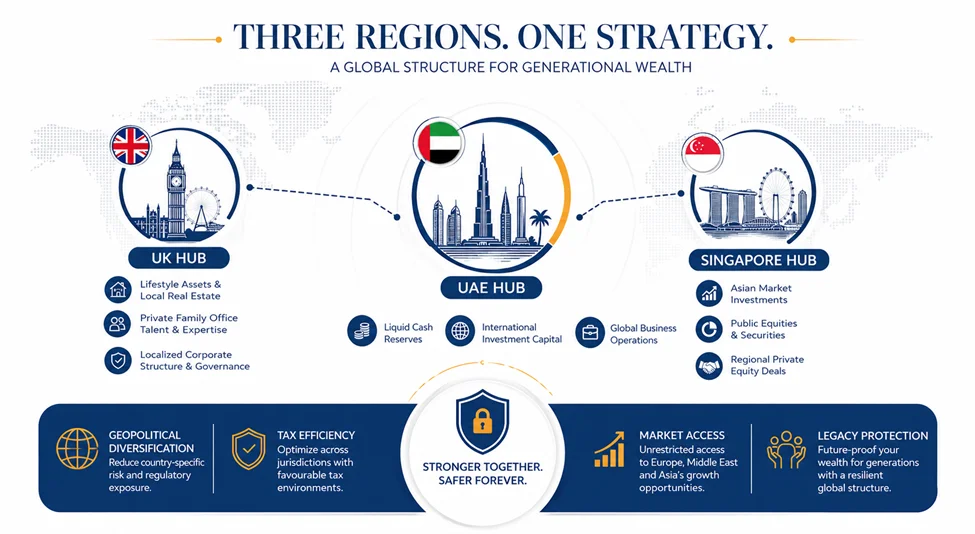
The ultimate modern layout uses three main hubs. It combines the strengths of the UK, the UAE, and Singapore. This UHNWI UK UAE Singapore asset allocation structure is the gold standard for 2026. Each region handles a specific piece of your wealth puzzle.
How to Split Your Wealth Across the UK, UAE, and Singapore
- The UK Hub: You keep your lifestyle assets, private family office talent, and local real estate in a localized UK corporate structure.
- The UAE Hub: You place your liquid cash reserves, international investment capital, and global business operations in a tax-free UAE free zone firm.
- The Singapore Hub: You route your Asian market investments, public equities, and regional private equity deals through a compliant Singapore family office.
Why Geographic Diversification Shields Your Capital
This geographic split protects you from a crisis in any single region. If one country passes a bad law, only a portion of your wealth is affected. The rest of your capital remains safe and functional. It balances European presence, Middle Eastern tax optimization, and Asian market access.
How Lanop Can Help You Setup and Protect Global Wealth
Building a multi-jurisdictional wealth framework is too complex for a solo effort. A single mistake can lead to heavy penalties or asset loss. You need an elite team to design and maintain your corporate shield. Lanop provides the exact expertise you require.
Designing Secure Corporate Frameworks and Asset Management Structures
Lanop specializes in helping ultra-high-net-worth individuals establish robust global corporate frameworks. We understand the operational realities of 2026. Our team guides you through the complex world of cross-border asset management structure design. We ensure your assets sit in the most secure, tax-efficient locations available.
We handle the entire setup process for your international structures. Lanop helps you establish tax-efficient offshore holding companies. We also configure resilient private family offices that comply with modern rules. We balance asset protection with absolute regulatory compliance. This means your structures withstand scrutiny from agencies like HMRC.
Navigating Global Compliance and CRS Disclosures Safely
Lanop also assists with complex reporting requirements. We ensure your multi-jurisdictional systems align perfectly with CRS and FATCA rules. We help you avoid costly compliance errors while preserving your family legacy. Protect your hard-earned capital from global volatility. Contact Lanop today to schedule a private consultation with our international structuring experts.
Final Thoughts
Managing significant wealth nowadays requires continuous adaptation. The old methods of using a single offshore bank account are obsolete. Modern asset protection requires an integrated, multi-jurisdictional approach. You must combine holding companies, foreign trusts, and strategic tax planning to achieve true financial safety.
Securing Your Capital Against Sudden Policy Changes
The shift in UK tax laws highlights how quickly your financial security can change. By diversifying your structures across the UK, the UAE, and Singapore, you protect your family against sudden legal updates. This geographic balance ensures your wealth continues to grow under professional management.
Maintaining Total Compliance While Optimizing Value
Compliance must remain a core component of your offshore wealth structuring plan. Advanced tracking tools mean total transparency is mandatory. True wealth security relies on smart, legal optimization.
Work with expert advisors to keep your structures resilient, compliant, and optimized for future generations. Start reviewing your international framework today to secure your global legacy.
Frequently Asked Questions
It is legally organizing your wealth across different countries using trusts, foundations, and holding companies to protect your capital from localized lawsuits, political instability, and aggressive tax changes.
To diversify risk. Spreading assets across multiple regions ensures that a sudden policy shift, economic crisis, or unfavorable tax law change in one country cannot destroy the entire family legacy.
The UAE for zero-tax offshore income, Singapore for stable Asian market investments, the Cook Islands for bulletproof asset protection trusts, and the Cayman Islands for corporate holding structures.
Yes. It is entirely legal financial planning focused on asset defense and tax optimization. True protection relies on full transparency and reporting all structures to your home country’s tax authorities.
They break personal ownership links. By transferring assets to a foreign trust or holding company, you no longer legally own them. Consequently, courts and creditors cannot easily seize them.
They have eliminated financial secrecy. These automated global networks force foreign banks to report your account data directly to your home tax authority, making total regulatory compliance mandatory.