
Moving to Malta does not automatically make you a non-UK tax resident. You must first meet HMRC’s tax residency rules. The main test is the Statutory Residence Test. Malta also has its own tax rules, so you need to plan your move carefully.
Lanop Business & Tax Advisors helps UK landlords and business owners plan their move abroad. We also support people who live and work in different countries. We help you plan early to avoid unexpected tax problems. Good advice can help protect your income and property.
It can also help protect the assets you leave to your family. This guide explains how to leave UK tax residency step by step. It also covers Malta’s tax rules and the UK taxes that may still apply after you move.
What Does Non-UK Tax Resident Status Mean?
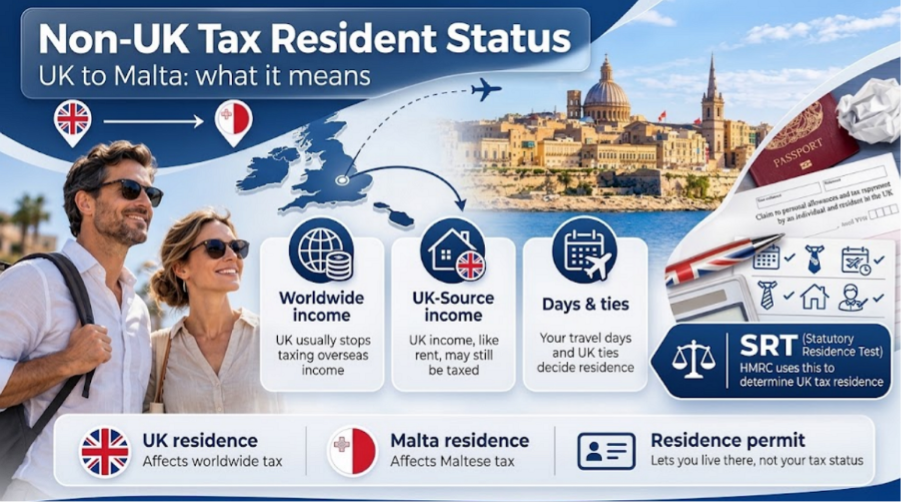
Non-UK tax resident status means the UK generally stops taxing your foreign income. However, you may still need to pay UK tax on income from UK sources.
HMRC uses the Statutory Residence Test (SRT) to decide your tax status. This test applies to income tax, capital gains tax and inheritance tax. The UK tax year runs from 6 April to 5 April.
Simply leaving the UK does not end your UK tax residency. Your days in the country and personal connections also matter. The date you fly out is not always the date your UK tax residence ends.
You need to understand three separate things before moving:
- UK tax residence: Determines whether HMRC can tax your income from around the world.
- Malta tax residence: Determines how Malta taxes your income.
- Residence permit: Allows you to live in Malta legally. Having one does not automatically make you a Maltese tax resident.
What Are the UK Tax Residency Rules When Moving Abroad?
Before you leave the UK, check how HMRC will treat your tax residence. HMRC uses the Statutory Residence Test (SRT). It looks at your time in the UK, where you live, and your personal connections.
You need to pass this test for each UK tax year. This is important because your residence status can change from one year to the next. The UK tax year runs from 6 April to 5 April.
Which Automatic Overseas Tests Help Leavers?
Some people can become non-UK residents by meeting an automatic overseas test. You qualify if either of these conditions applies:
- You were a UK resident in at least one of the previous three tax years but spend fewer than 16 days in the UK.
- You work full-time abroad, spend fewer than 91 days in the UK and work there for fewer than 31 days.
Which Automatic UK Tests Can Make You a UK Resident?
Even after moving abroad, you may remain a UK tax resident. HMRC treats you as resident if you meet any of these conditions and do not qualify under an automatic overseas test:
- You spend 183 days or more in the UK during the tax year.
- You have a UK home but no real home in another country.
- You work full-time in the UK.
How Many Days Outside the UK Make You a Non-UK Resident?
Spending fewer days in the UK can help you become a non-resident, but the total alone does not decide your status. HMRC also looks at your personal connections. A day generally counts if you are in the UK at midnight.
Your UK ties become more important as your days in the country increase. The table below shows how many ties can make you resident if you have left the UK.
| Days spent in the UK | Ties needed to become a UK resident |
| Under 16 | None, so you are non-resident |
| 16 to 45 | 4 or more |
| 46 to 90 | 3 or more |
| 91 to 120 | 2 or more |
| 121 to 182 | 1 or more |
| 183 or more | You are resident |
HMRC looks at five main ties when assessing people who leave the UK:
- Family tie: Your partner or young children continue to live in the UK.
- Accommodation tie: You have somewhere to stay in the UK that is available for your use.
- Work tie: You work in the UK for enough days during the tax year.
- 90-day tie: You spent at least 90 days in the UK in either of the previous two tax years.
- Country tie: You spend more nights in the UK than in any other country.
What Is UK Tax Residency Split-Year Treatment?
You may not be treated as a UK resident for the whole tax year in which you move abroad. Split-year treatment can divide that year into a UK-resident period and a non-resident period.
However, you cannot claim this treatment just because you have moved to Malta. You must meet the legal conditions. Three common situations for people leaving the UK include:
- Starting full-time employment abroad.
- Moving abroad with your partner.
- Giving up your UK home and settling in another country.
If you qualify, income from the overseas part of the year will usually fall outside UK tax. Double tax treaty rules may still affect your position.
How Do You Leave UK Tax Residency Step by Step?
Leaving UK tax residence takes more than changing your address. You need to review your UK connections, keep records, and complete the right HMRC paperwork.
Here are seven steps to follow:
- Count your UK days. Record every day you spend in the UK, including your arrival and departure dates.
- Check the automatic tests. See whether you meet an overseas test. If not, review the automatic UK tests.
- Review your five UK ties. Look at your family, accommodation, work and time spent in the country.
- Reduce your UK ties. Where possible, move your family, end your UK work and rent out your UK home under a long-term agreement.
- Contact HMRC. Submit form P85 when you leave the UK.
- Complete your final UK tax return. Include the residence pages in your Self Assessment return.
- Keep supporting records. Save flight records and Malta bills for at least six years.
Not sure which forms you need? Our personal tax planning team can review your circumstances and help you plan your departure year.
What Are the Malta Tax Residency Requirements?
Malta looks at where you actually live when deciding your tax residence. Its rules do not rely on one fixed day-count test. You may become resident if you live in Malta, allowing for reasonable short absences.
Spending more than 183 days in Malta during a year will usually make you a tax resident. You may also become resident from your arrival date if you move there with the intention of settling.
There is another point UK citizens need to consider. Since Brexit, UK nationals are treated as non-EU nationals. Most people moving from the UK therefore need a Maltese residence permit.
You may need to provide documents showing that Malta is your main place of living. These can include:
- A signed rental agreement or property deed.
- Utility bills in your name.
- A Maltese bank account and records of everyday spending.
- Health insurance cover.
- Proof of where you work.
What Is the Difference Between UK and Malta Tax Residence?
Moving to Malta does not mean both countries will use the same rules to assess your tax status. The UK focuses on the Statutory Residence Test, while Malta considers your circumstances and connections.
| Tax point | United Kingdom | Malta |
| Main residence test | Statutory Residence Test | Facts and circumstances |
| Tax year | 6 April to 5 April | 1 January to 31 December |
| Day-count rule | Several day limits apply | More than 183 days can trigger residence |
| Personal connections | Family, home and work ties | Personal and economic connections |
| Foreign income | Usually taxable if you are a UK resident | Depends on residence, domicile and remittance rules |
Both countries may treat you as a tax resident under their own domestic rules. This can create a dual tax residence situation.
The UK and Malta have a double tax treaty to help deal with cases where both countries claim tax on the same income. It considers factors such as your permanent home and personal connections to decide which country has the stronger claim.
A Maltese tax residence certificate is useful evidence, but it does not automatically end your UK tax residence. You still need to meet HMRC’s requirements.
How Does Malta Minimum Tax Work for Non-Domiciled People?
The Global Residence Programme (GRP) is one option for eligible non-EU nationals moving to Malta. It offers a special tax arrangement for qualifying residents who are not domiciled there. The programme also requires a minimum annual tax payment.
The rules are changing soon. From 1 January 2027, the minimum tax and qualifying property requirements will increase. However, people who receive GRP status by 31 December 2026 can retain it until 31 December 2031.
The following table shows the current requirements and the changes planned for 2027.
| Item | Current rules | New rules from 2027 |
| Minimum yearly tax | €15,000 | €35,000 |
| Property purchase | €275,000 or more | €700,000 |
| Yearly rent | €9,600 or more | €14,000 |
| Admin fee | €6,000 | €8,500 |
| Term | Runs to 31 December 2031 | Five years and renewable |
The current property purchase and rental limits are lower in Gozo and southern Malta.
Foreign income transferred to Malta may face a 15% tax rate under this status. Foreign capital gains are generally not taxed for non-domiciled residents.
There is also an important point for UK company owners. Salary earned from work carried out in Malta usually counts as Maltese income and may face tax at 35%. Dividends can receive different tax treatments.
What Is the Malta Tax Residency Application Process?
People moving to Malta often confuse three separate things:
- Global Residence Programme (GRP) status
- A Maltese residence card
- A Maltese tax residence certificate
Each has its own application process and requirements.
| Stage | What happens | Time |
| Eligibility check | You review your nationality and income | Days |
| Application | An authorised agent submits your application | About 2 months for checks |
| Approval in principle | You secure qualifying property and pay the minimum tax | Up to 12 months |
| Status confirmed | You receive a Maltese tax number | After step 3 |
| Residence card | You apply after receiving approval | At least 2 months |
| Tax residence certificate | You provide proof that you live in Malta | Allow about 3 months after moving |
These estimated times come from a Maltese law firm. They may change, so always confirm the latest requirements with the Maltese tax office.
What UK Tax Obligations Remain After Moving Abroad?
Leaving the UK does not end every tax obligation. HMRC may still tax certain types of UK income and assets.
Here are the main areas to review before moving.
| Area | Does the UK still tax it? | Your main duty |
| UK property sale | Yes | Report within 60 days |
| Short stay abroad | Possibly | Check the five-year rule |
| Your estate | Possibly | Check the long-term resident test |
| UK rent | Yes | Use the Non-Resident Landlord Scheme |
| UK company | Depends | Check where you work and manage the business |
What Happens to UK Capital Gains Tax After Leaving?
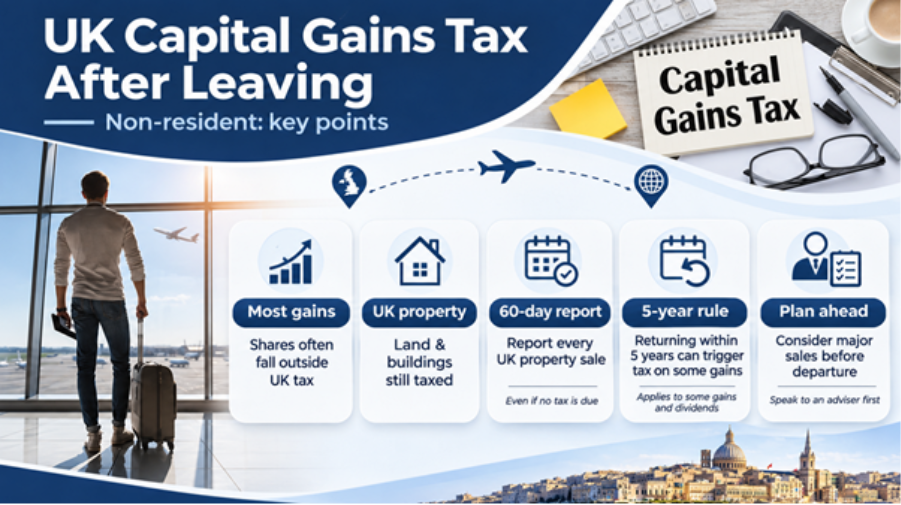
Most gains from assets such as shares fall outside UK capital gains tax once you become a non-UK resident. However, UK property is a major exception. The UK can still tax gains from land and buildings located in the country.
If you sell a UK property while living abroad, you must report the sale to HMRC within 60 days. You must also pay any capital gains tax due within this period. This reporting requirement applies even when you have no tax to pay.
You should also check the temporary non-residence rules before making major financial decisions.
These rules may apply if you return to the UK within five years. They can affect you if you were a UK resident in four of the seven tax years before leaving. HMRC may then tax certain gains and dividends when you return.
What should you do?
Plan major asset sales before leaving the UK. If you think you may return within five years, speak to a tax adviser before selling assets.
Does UK Inheritance Tax Apply After Moving Abroad?
Yes. UK inheritance tax may still apply after you move to Malta.
You become a long-term UK resident if you have been a UK resident for 10 of the previous 20 tax years. Your worldwide assets may then remain within the UK inheritance tax system after you leave.
The following table shows how long your worldwide assets may remain within the scope of UK inheritance tax.
| Years you lived in the UK | Years of UK inheritance tax after leaving |
| 10 to 13 | 3 |
| 14 to 19 | Adds 1 year for each extra year |
| 20 or more | 10 |
UK property remains within the scope of UK inheritance tax regardless of where you live.
Our inheritance tax planning team can review your estate and help you understand your potential tax exposure.
How Does UK Non-Resident Tax on Rental Income Work?
Rental income from UK property remains taxable in the UK, even after you move to Malta.
Under the Non-Resident Landlord Scheme, your letting agent or tenant normally deducts 20% tax from your rent. You can apply to HMRC to receive your rental income without this deduction.
However, you must still report your rental income through a UK tax return.
What If You Own a UK Company?
Your location and role in the company both matter.
If you move to Malta and manage your UK company from there, it may affect the company’s own tax position. The way you make business decisions and control daily operations can also matter.
Get advice on both UK and Malta tax rules before moving your business activities abroad.
What Should Be on Your UK Tax Exit Checklist?
Use this checklist to prepare for your move to Malta and manage your UK tax responsibilities.
- Count your UK days for the current tax year.
- List your five UK ties.
- Check whether you qualify for split-year treatment.
- Submit form P85 to HMRC.
- Join the Non-Resident Landlord Scheme if you rent out UK property.
- Plan any UK property sale for the right tax year.
- Check your risk of returning within five years.
- Review your inheritance tax exposure.
- Sign your Malta rental agreement and open a Maltese bank account.
- File your Self Assessment return with the residence pages.
What Mistakes Should You Avoid When Moving to Malta?
Moving abroad involves more than booking a flight and finding a new home. Small mistakes in your tax planning can lead to unexpected bills.
Watch out for these common problems:
- Assuming 183 days is the only UK test: HMRC also checks your work, home, and personal connections.
- Keeping too many UK ties: A UK home or family connection can affect your tax residence.
- Ignoring split-year rules: You may miss tax relief if you do not claim it correctly.
- Confusing a residence permit with tax residence: These are separate legal and tax matters.
- Ignoring UK property income: Rental income from UK property can remain taxable after you leave.
- Moving money without checking Malta’s rules: The source and type of funds can affect how Malta taxes them.
- Forgetting temporary non-residence rules: Some income and gains may become taxable if you return within five years
Frequently Asked Questions About Moving to Malta from the UK
Yes, if you qualify as self-sufficient or hold a Nomad Residence Permit. You’ll need to show income, a home, and health cover.
There’s no single safe number. If you were recently a UK resident, you can pass an automatic test with fewer than 16 days, but your ties can change the limits.
No. Foreign income you remit is taxable, though foreign capital gains aren’t. Income from UK sources stays taxable in the UK.
Yes, but keep an eye on where key decisions are made, so Malta doesn’t claim control of the company.
Mostly yes, though residents aged 61 and over can be exempt up to €37,104. Government service pensions stay taxable in the UK.
Not straight away. Long-term residence rules can keep your estate exposed for 3 to 10 years, and UK property stays in scope.
Planning Your Move to Malta in 2027? Get Your Tax Position Right First
So, can you make the move to Malta while keeping your finances in order? You can, with the right plan. That plan depends on your income, assets, UK residence history, and long-term goals.
If you’re retired, review pension tax, transfer charges, and estate planning before April 2027. Business owners should review company residence, payroll, and dividends. If you own property or investments, check UK rental income, asset sales, remittances, and Inheritance Tax. If you’re an employee or remote worker, confirm your residence permission, income tax, and social security.
It is far more expensive to sort out issues after you have gone than before you move to Malta from the UK, knowing that you will be relocating in 2027. LANOP can assist you in reviewing your UK tax position, understanding your cross-border obligations, and planning your way forward. Contact Us to book a free consultation and discuss your situation.