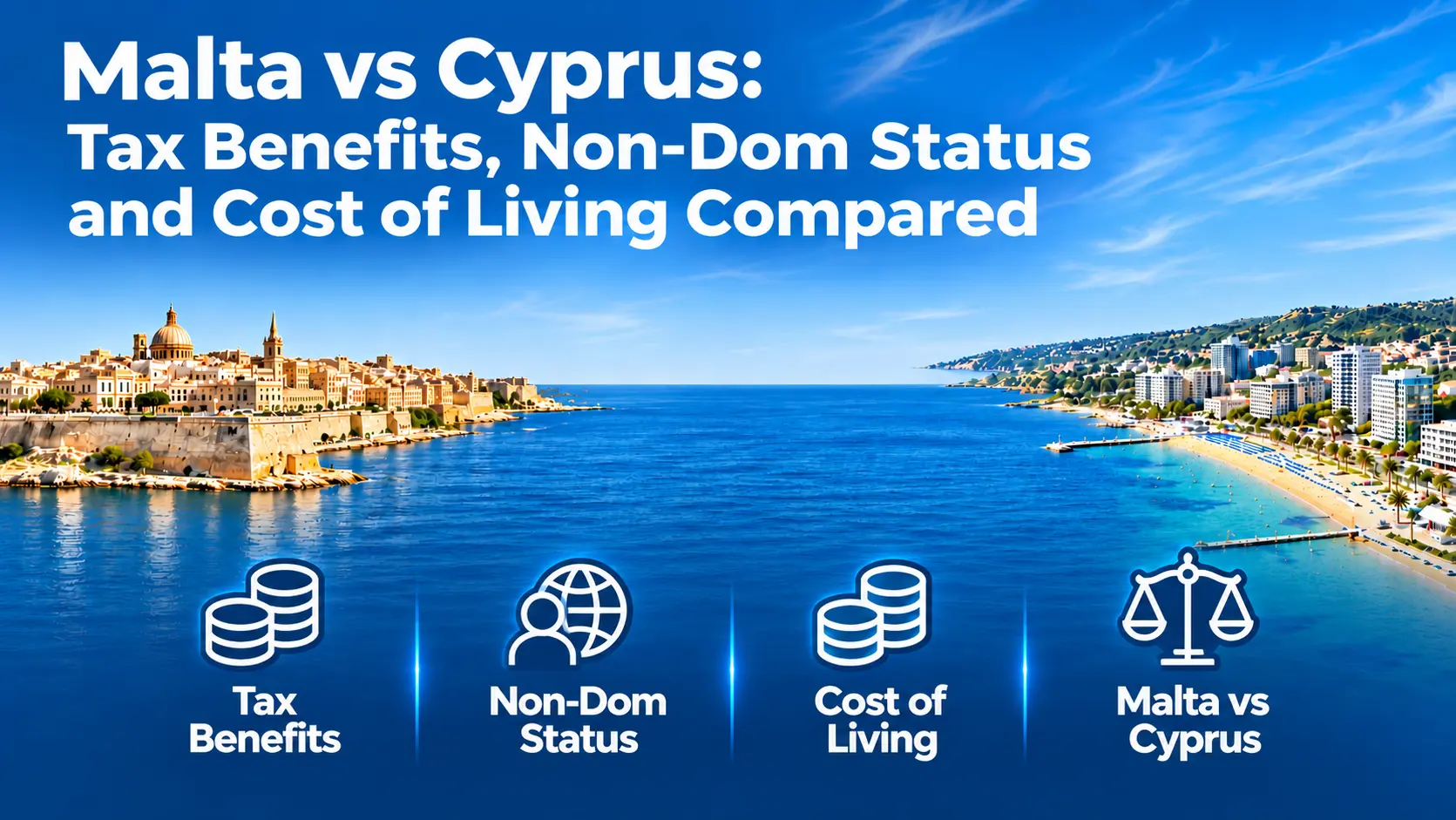
Malta and Cyprus both offer attractive tax rules for UK expats. Cyprus is usually better for people with large investment income because of its non-dom regime.
Malta can suit people who want a simpler remittance-based system and a strong English-speaking base. The right choice depends on your income, family, property plans, and how many days you can spend abroad.
This guide compares the main tax rules and living costs in both countries. It also explains the non-dom benefits and residency tests. At Lanop, we help UK clients compare moves like this before they commit.
What Are the Main Differences Malta vs Cyprus?
The biggest differences relate to foreign income, tax residency, and personal taxation. Cyprus offers a higher tax-free income allowance and a longer non-dom period. Malta has its own advantages, particularly for people who want to use a remittance-based system.
Here is how the main Malta vs Cyprus tax benefits compare.
| Feature | Malta | Cyprus |
|---|---|---|
| Standard residency test | 183 days or more in a year | More than 183 days, or the 60-day rule |
| Tax-free income (single person) | First €12,000 | First €22,000 |
| Top income tax rate | 35% above €60,000 | 35% above €72,000 |
| Non-dom benefit | Foreign income taxed only if you bring it in | 0% defence tax on dividends and interest for 17 years |
| Special tax route | Global Residence Programme at 15% | Most newcomers qualify, but you must declare it |
| Sale of local property | 8% final tax on the price (5% if sold within 5 years) | 20% on the gain |
| Foreign capital gains | Not taxed for non-doms | Not taxed |
| Inheritance tax | None | None |
| Foreign pension | 15% under the Retirement Programme | 5% above a tax-free amount |
What Are the Tax Residency Requirements in Malta and Cyprus?
Before looking at the tax savings, you need to understand when each country considers you a tax resident. Spending enough time in Malta or Cyprus can establish residency, but neither country relies on the same rules.
This is particularly important if you regularly travel between countries or still have a home in the UK.
How Do You Meet Malta Tax Residency Requirements?
Under the main test, you become resident if you spend 183 days or more in Malta in a calendar year. You can also become a resident from the day you arrive if you plan to settle there.
Special programmes work a little differently:
- Global Residence Programme (GRP): There is no minimum stay in Malta. You must not spend more than 183 days a year in any other country.
- Malta Retirement Programme: You must keep qualifying property and spend at least 90 days a year in Malta, averaged over five years. Your pension must be at least 75% of your chargeable income.
- UK passport holders: After Brexit, UK nationals count as non-EU. This is why many use the GRP.
How Do UK Tax Rules Affect Your Move to Malta or Cyprus?
Leaving the UK does not automatically end your UK tax residency. HMRC looks at several factors, including your time in the country, where you live, and your family connections.
Another point which is usually missed is the inheritance tax.
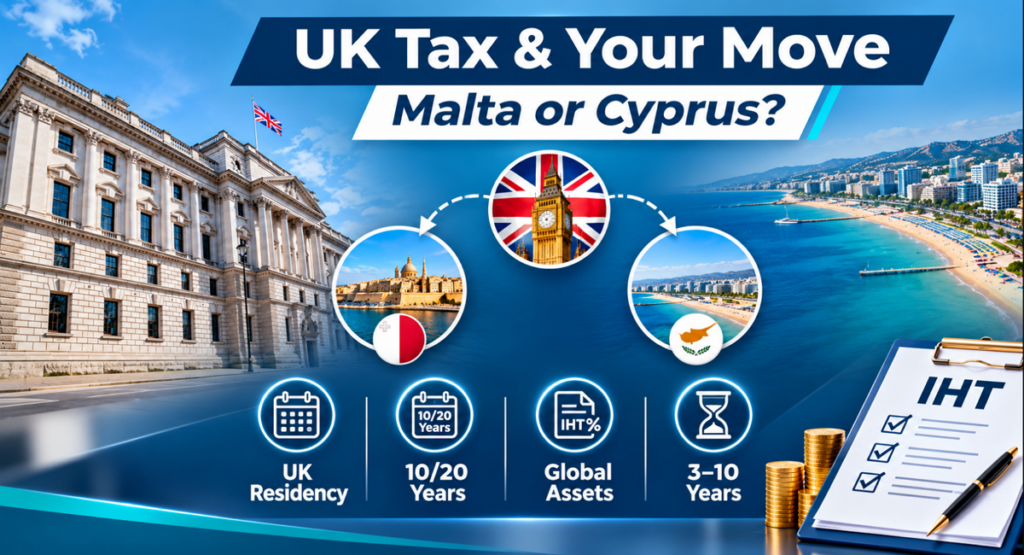
Starting from 6th April 2025, the UK uses a long-term residence test. You are a deemed long-term UK resident if you have resided in the UK for a minimum period of 10 out of the last 20 tax years.
Accordingly, your assets all around the world would still be taxable by the UK in terms of inheritance tax after the period you leave.
The length of this period depends on your residence history:
- If you lived in the UK for 10 to 13 years, the period is three years.
- Each additional year of UK residence adds another year.
- The maximum period is ten years.
- UK assets remain within the scope of inheritance tax at all times.
This is worth checking before you move. Malta and Cyprus do not charge inheritance tax, but that does not mean your UK inheritance tax responsibilities disappear when you become resident elsewhere.
Our inheritance tax planning team can help you work out how long the UK rules may apply to your estate. You can also read our guide to the UK non-dom rules and the FIG regime.
How Do You Meet Cyprus Tax Residency Requirements?
Cyprus has two residency tests. The standard option requires you to spend more than 183 days in the country during a calendar year. Exactly 183 days will not qualify.
The alternative is the 60-day rule. This is useful for business owners and people who divide their time between different countries.
For 2026, you generally need to meet all four conditions:
- Spend at least 60 days in Cyprus during the tax year.
- Have a job, business, or director role connected to Cyprus.
- Own or rent a home in Cyprus.
- Spend no more than 183 days in any other single country.
A fifth condition applied before 2026. You could not be a tax resident of any other country. That condition was removed from 1 January 2026. If you are planning to use this route, check the current requirements with a tax adviser first.
Malta vs Cyprus Income Tax: What Will You Pay?
Cyprus gives a bigger tax-free slice. Malta reaches the top rate sooner. These are the 2026 bands for a single person.
| Rate | Malta | Cyprus |
|---|---|---|
| 0% | Up to €12,000 | Up to €22,000 |
| 15% | €12,001 to €16,000 | Not used |
| 20% | Not used | €22,001 to €32,000 |
| 25% | €16,001 to €60,000 | €32,001 to €42,000 |
| 30% | Not used | €42,001 to €72,000 |
| 35% | Above €60,000 | Above €72,000 |
Malta has other bands for married people and parents. Cyprus also adds social insurance and a health levy. Cyprus raised its corporate tax from 12.5% to 15% in 2026. That matters if you pay yourself through your own firm.
Cyprus vs Malta Non-Dom Regime ComparedWith Malta?
The difference between the Cyprus and Malta non-dom systems can have a major effect on your tax bill.
Both countries offer special treatment to people who live there but are not domiciled locally. However, the way they tax overseas income is quite different.
What Are the Cyprus Non-Dom Tax Benefits?
You can qualify for non-dom status in Cyprus if you become a tax resident without being domiciled there. Most UK newcomers can meet this requirement.
The status lasts for 17 tax years. During this period, you can benefit from several tax advantages:
- Dividends and interest: No special defence tax applies to these income sources.
- Rental income: Defence tax no longer applies to rental income for anyone from 2026.
- Health contribution: Dividends attract a 2.65% health contribution. The annual amount is capped at €4,770. The cap applies to your total income, not to dividends alone.
- Extended status: You can pay €250,000 for each additional five-year period. Two extensions are available, allowing you to extend the status to 27 years.
There is an important limitation. Non-dom status does not make all your income tax-free. Your salary and trading profits remain subject to the normal income tax rules.
How Does Malta Non-Dom Status Work?
A person who lives in Malta but is not domiciled there pays tax on two things. The first is income from Malta. The second is foreign income that they bring into Malta. Foreign capital gains are not taxed at all. This holds even if you bring the money in. There is one catch. If your foreign income is €35,000 or more and you do not bring all of it in, a minimum tax of €5,000 a year applies.
The Global Residence Programme adds a 15% flat rate on foreign income you bring in. Income from Malta still faces rates up to 35%. There is a minimum yearly tax of €15,000 for the whole family.
Should You Apply for the Malta GRP Before 31 December 2026?
Maltese law firm GVZH reports that the GRP will be replaced from 1 January 2027. People who apply by 31 December 2026 keep today’s terms until 31 December 2031. The 15% rate stays. Almost everything else gets stricter.
| Point | GRP Today | New Rules from 2027 |
|---|---|---|
| Application fee | €6,000 (€5,500 in some cases) | €8,500 |
| Buy a home | €275,000 (€220,000 in the south or Gozo) | €700,000 |
| Rent a home | €9,600 a year (€8,750 in the south or Gozo) | €14,000 a year |
| Minimum yearly tax | €15,000 | €35,000 |
| Length of status | No fixed end | 5 years, then renewable |
Malta vs Cyprus Foreign Income Tax: Which Island Treats Overseas Money Better?
The two systems work from opposite ends. Cyprus taxes you on worldwide income but exempts most passive income for non-doms. Malta taxes only what you bring in. Here is a simple example with €200,000 of yearly foreign dividends.
- Cyprus non-dom: The 2.65% health levy would be €5,300. The cap cuts it to €4,770.
- Malta GRP, all brought in: 15% is €30,000.
- Malta GRP, only €40,000 brought in: 15% is €6,000. The €15,000 minimum applies instead.
So Cyprus is often cheaper for dividend-heavy people. Malta can suit someone who lives off savings and keeps other income abroad. These numbers are only a guide. Your own mix of income will change them.
Malta vs Cyprus Capital Gains Tax: What Happens When You Sell?
Property owners should look closely at capital gains tax before choosing either country.
Both Malta and Cyprus offer favourable treatment for many foreign gains. However, profits from local property sales are treated differently.
Cyprus charges a 20% capital gains tax on gains from property located in the country. In 2026, individuals have a lifetime exemption of €30,000. The exemption for a main home is €150,000.
Malta generally charges a final tax when you sell property located there. The standard rate is 8% of the transfer value. This falls to 5% if you sell within five years of buying, as long as the property is not part of a development project.
Buyers also need to budget for stamp duty:
- Standard stamp duty: 5%.
- Gozo stamp duty: 5%. The old 2% Gozo rate ended in January 2024.
If you expect to buy and sell property after moving, include these costs in your calculations.
Malta or Cyprus for Retirees: Which Pension Rules Are Better?
Cyprus is very friendly to foreign pensions. You can pay a flat 5% on the amount above a tax-free allowance. Recent guidance sets that allowance at €5,000 for 2026. It was €3,420 before. You choose each year between this flat rate and the normal tax bands, so you can use whichever is cheaper. On smaller pensions the normal bands often win. UK government service pensions are treated differently.
Malta offers a 15% flat rate under its Retirement Programme. The minimum yearly tax is €7,500, plus €500 for each dependant. It rises to €15,000 for new retirees from 2027.
Here is a simple case with a €50,000 pension:
- Cyprus: 5% of €45,000 is €2,250.
- Malta: 15% of €50,000 is €7,500. This also equals the minimum.
Check which Malta programme fits your passport and income first.
Is the Cost of Living Lower in Malta or Cyprus for UK Expats?
Living costs are fairly close in both countries. The figures also vary between comparison websites, so it is difficult to say that one island is always cheaper.
One cost tracker estimates that a single person spends around $1,631 per month in Cyprus. The equivalent figure for Malta is approximately $1,725.
The same source estimates monthly rent at:
- Cyprus: Around $952.
- Malta: Around $1,033.
Another comparison website reaches a different conclusion, reporting that Cyprus is 3.4% more expensive than Malta overall.
The Malta vs Cyprus cost of living comparison becomes clearer when you look at individual cities. Limassol, for example, has estimated monthly living costs of around $2,086. In Larnaca, the figure is closer to $1,440.
A one-bedroom flat in a central location can cost between €900 and €1,500 on either island.
Your daily routines will also influence your cost of living between Malta and Cyprus. Eating out, transport costs, and even electricity expenses may end up influencing your overall budget.
Malta vs Cyprus Property Costs: How Much Does a Home Cost?
Property costs are particularly important if you plan to use Malta’s Global Residence Programme.
The present requirements under the GRP scheme include buying a property valued at a minimum €275,000 or renting a property at a minimum annual value of €9,600. Reduced thresholds apply to properties south of Malta and Gozo.
Average property prices in Malta are around:
- €3,630 per square metre in central areas.
- €2,815 per square metre outside the centre.
Renting properties in popular places is also costly. In tourist destinations like Sliema and St Julian’s, small apartments cost about €950 per month.
There is no minimum value of property for tax residency in Cyprus. It varies depending on where you want to live and how much property you want to buy.
Living in Malta vs Cyprus: Which Lifestyle Fits You Better?
The two islands offer different living environments, and this can matter just as much as the tax benefits.
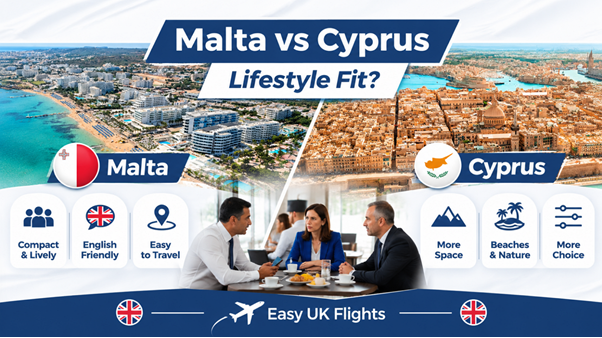
Malta is relatively small and densely populated. English is an official language, which makes daily life easier for many British residents. Its smaller size can also make travelling around the island more convenient.
Cyprus is larger and has more open space. You can find coastal towns, beaches and mountain areas, giving residents a wider choice of surroundings.
Both countries have convenient flight connections to the UK. Think about the kind of environment you want, how often you plan to travel, and what your everyday routine will look like.
What Is the Best Tax Residency for UK Expats? A Quick Guide
The best country depends on your financial position. A destination that works well for an investor may not offer the same benefits to a retiree or business owner.
These are some general comparisons based on different financial situations:
- High-net-worth investors: Cyprus often has an advantage for people receiving dividends and interest. Malta may be suitable if you can keep most foreign income outside the country.
- Retirees: Cyprus offers a lower tax rate on qualifying foreign pension income. Malta provides an English-speaking environment and established healthcare services.
- Business owners who travel: Cyprus offers flexibility through its 60-day residency rule.
- People who prefer fixed tax arrangements: Malta’s GRP offers a 15% flat rate for eligible applicants who apply in time.
If you are comparing Malta tax for UK residents with Cyprus tax for UK residents, do not look at local tax rates alone. Your UK residence position and any remaining UK tax obligations also need attention.
What Steps Should You Take Before You Move?
Moving to another country is much more than simply acquiring a property and arranging for a flight. It will be better for you if you sort out your taxes before leaving.
Consider the following matters before you make your decision:
- Write down all your income sources: dividends, pensions, rent.
- Find out how long you have been a resident of the UK and how long your inheritance tax period is.
- Choose the country and its particular tax scheme according to your financial situation.
- Get a qualifying property if the scheme you have chosen has such a requirement.
- Make a list of the days you are staying in each country.
- Inform HMRC and file tax returns in both countries.
You don’t need to deal with everything yourself. The Malta specialists of our company and Cyprus specialists will be of great help to you.
We also provide personal tax planning for UK expats who need advice on their wider tax position.
FAQs
Cyprus is often better for dividends and interest. Non-dom status brings 0% defence tax for 17 years. The health levy is capped at €4,770 a year. Malta can suit those who want a fixed 15% rate or who keep most income abroad. Your income mix decides the winner.
Malta taxes foreign income only when you bring it in. Foreign gains are not taxed. Cyprus taxes worldwide income but exempts dividends and interest for non-doms. Cyprus non-dom status lasts 17 years and can be extended. Malta’s GRP adds a 15% flat rate with a minimum tax.
Malta needs 183 days or more in a calendar year. The GRP has no minimum stay. Cyprus needs more than 183 days. The 60-day rule needs only 60 days if you meet the other conditions.
It depends on your income. A person with €200,000 of dividends might pay about €4,770 in Cyprus as a non-dom. The same person might pay up to €30,000 under the Malta GRP if all income comes in. A retiree with a €50,000 pension might pay about €2,250 in Cyprus and €7,500 in Malta. These are examples and not promises.
The two are very close. Some trackers show Cyprus slightly cheaper. Others show Malta slightly cheaper. Your city and your rent will matter most. Limassol costs more than Larnaca.
Final Thoughts: Ready to Choose Between Malta and Cyprus?
Both Malta and Cyprus can be good choices for UK expats. Cyprus frequently attracts investors due to the non-dom regime in place there. Malta may be a good choice for those looking to remit foreign income.
The correct choice depends on your personal situation. Income, assets, business, family, and UK connections will all play a role in determining your choice. LANOP can help you evaluate your financial situation, plan your relocation, and structure your life for the future. In order to be able to qualify for Malta’s current GRP terms, you need to apply by 31 December 2026. Book your free consultation and let us build your plan together.