
Introduction
You built a great firm. Now you want to sell your business. You want to get the best price. You also want to keep your cash safe. The year 2026 brings big changes to the UK market. Tax laws are tight now. If you do not plan well, you will lose a large part of your payout.
Selling a business wide takes clear thought. It is not just about the final sale price. It is about what you keep in your bank account after the deal ends. Many founders fail to see this point. They focus only on the buyer. They forget about the tax man. That is a costly mistake.
You need a strong business exit strategy today. You must look at your structure now. You must check your accounts. This guide helps you clear the hurdles. It shows you how to sell UK company assets safely. You will learn to shield your hard work from high tax rates.
The New Rules for Selling a Business in UK
The UK tax rules look very different this year. Past strategies do not work well now. You must adapt fast to save your funds.
Understanding Capital Gains Tax Business Sale Changes
Capital gains tax business sale rates are up. The main rate for higher earners is steep. When you sell company shares, the tax hits your profits hard. You pay tax on the growth of the firm’s value.
This tax applies to most sales. It covers share deals. It covers asset sales, too. You must know your exact base cost. (Your base cost is what you put into the firm at the start). The tax applies to the gain above this cost.
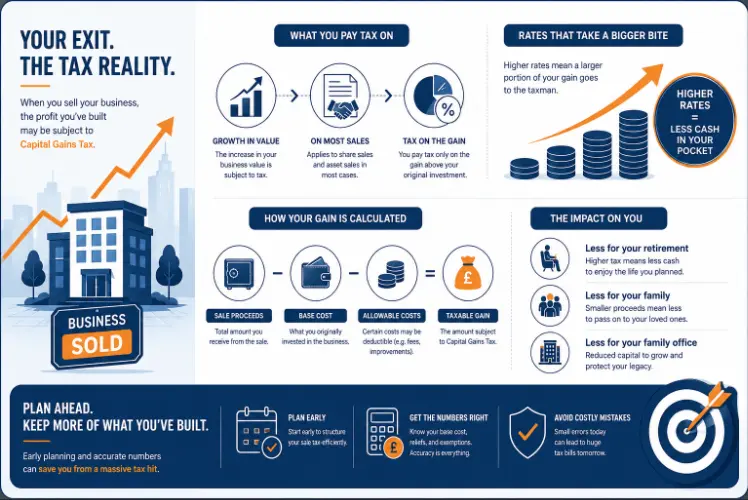
A high CGT business sale UK rate means less cash for your retirement. It means less money for your family’s office. You cannot guess these numbers. You must calculate them early. Small errors lead to huge tax bills later.
The Business Asset Disposal Relief BADR Rules
Business asset disposal relief BADR 2026 rules have changed. This relief was once called Entrepreneurs’ Relief. It used to offer a low ten percent tax rate. Those days are gone.
The lifetime limit is still one million pounds. But the rate is much higher now. You pay more for the same gain. The relief helps, but it does not shield you like it used to.
You must meet strict tests to qualify for this relief. You must hold five percent of shares. You must hold them for two full years before the sale date. You must also be an employee or an officer of the firm. Missing one rule destroys your claim.
Why the BADR 18% Rate Demands Quick Action
The BADR 18% rate, what to do after April 2026, question is on every mind. The rate jumped to eighteen percent this April. This change shrinks your net payout.
Old BADR Rate: 10% or 14% (Past Years)
Current BADR Rate (Post-April 2026): 18%
You must change your approach because of this new rate. You cannot rely on BADR to solve your tax issues alone. The relief covers only your first million pounds of capital gains. Anything above that level faces the full standard capital gains tax rate.
You need extra tools now. You need deep business sale tax planning. You must look at structures that go beyond basic relief. Do not wait for the buyer to make the first move. Act now to beat the high-rate impact.
Ready to Sell Your UK Business?
Book a free consultation with our business exit specialists to discuss your exit strategy, protect your proceeds, and maximise the value of your business. We’ll help you plan every stage of the process with confidence.
📅 Book an AppointmentPlanning Your Business Exit Strategy Step by Step
A good exit takes time to build. It does not happen in a few weeks. It often takes months or even years of prep work.
How to Prepare for Business Sale Due Diligence Early
Buyers will check every part of your firm. This process is called business sale due diligence. It is often long and stressful. The buyer will look at your books. They will check your staff’s contracts. They will read your client’s agreements.
Clean up your files before they look. Fix any legal gaps now. Pay off old debts if you can. Clear up any outstanding staff disputes.
If your books look messy, the buyer will ask for a lower price. They might even walk away from the deal entirely. Good organization proves your firm has real value. It keeps the deal moving forward fast.
Business Sale Tax Planning Before You Find a Buyer
You must start selling business tax planning early. Do not wait for a letter of intent. By then, your options are thin. You cannot change your structure easily at that stage.
Look at your shared classes now. Can you split ownership with your spouse? (This move can double your tax relief if done right). You must follow the rules closely, though. The transfer must be a real gift with no strings attached.
Think about the timing of your sale. Will the deal close in this tax year or next? The timing changes your cash flow. It changes when you must pay the tax office.
Exit Planning for Founders with High Net Worth
An entrepreneur’s exit tax HNWI strategy requires extra care. High net worth individuals face deep scrutiny from the tax office. The state tracks big wealth transfers very closely.
You should view your firm as part of a wider wealth pool. How does the sale affect your total estate? You might need to set up trusts before the sale happens.
High Net Worth Exit Path:
-> [Pre-Sale Restructuring]
-> [Corporate Share Sale]
-> [Family Office Funding]
You could also use holding firms to defer the tax bill. A holding company can receive the sale of cash without an instant tax hit. This gives you time to plan your next venture. It lets you deploy capital without immediate losses.
Tax Efficient Business Exit Paths for Different Structures
Your business structure changes how you sell. A limited firm operates differently from a sole trader’s setup.
Selling a Limited Company via Share Sales
When selling a limited company, you usually want a share of the sale. A share sale means the buyer takes the whole corporate entity. They buy shares from you directly.
This path is great for tax efficiency. The cash goes straight to you as an individual. You can apply for BADR on these gains easily. The buyer takes on all the past liabilities of the firm, too.
Buyers sometimes fear sharing deals. They worry about hidden past problems. You must give strong warranties to make them feel safe. This balances the risk between both sides.
Selling a Sole Trader Business Rules in UK
Selling a sole trader business in UK is a different process. You do not own shares. You own individual assets instead. These assets might include land, tools, stock, or goodwill.
You sell these items one by one to the buyer. You pay tax on the gain of each asset. Some assets face capital gains tax. Others might face income tax rules.
You can still claim BADR on a sole trader for sale. You must sell the entire business or a distinct part of it. You cannot just sell a few old tools and claim relief. The rules are precise.
Selling Your Business Asset Deals vs Share Deals
You must understand the split between asset deals and share deals. In an asset deal, your limited firm sells its assets to the buyer. The cash lands inside your company account, not your personal bank.
How the Money Moves
Share Deal: Buyer → Pays You Directly
Asset Deal: Buyer → Pays Your Company → Taxes Applied → Remaining Cash Goes to You
An asset deal can trigger double tax. The firm pays tax on the asset sale first. Then, you pay tax when you draw the cash out of the firm. Avoid this structure if your goal is personal wealth protection. Always push for a share deal when you can.
How to Protect Business Sale Proceeds UK Tax Plans
Once the deal closes, your job is not done. You now have a large pile of cash. You must protect it from inflation and state duties.
Inheritance Tax After Exit and Wealth Preservation
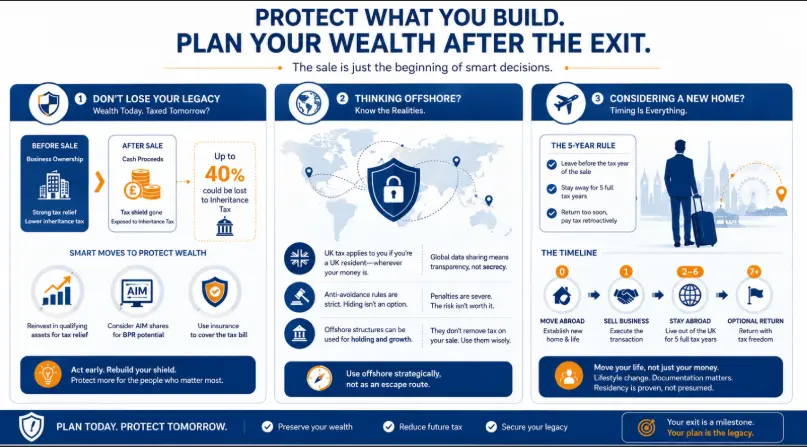
Before the sale, your firm’s shares probably qualified for Business Property Relief. (This relief often slashes inheritance tax to zero percent). Once you sell, that safety shield drops away completely.
Your cash is now part of your taxable estate. If you pass away, the state takes forty percent of that wealth above the threshold. This surprises many founders. They trade a tax-free asset for a heavily taxed cash pile.
You must fix this gap quickly. You can invest in new assets that qualify for relief. You can look at shares on the Alternative Investment Market (AIM). You can also use insurance policies to cover the potential tax bill.
Offshore Tax After Business Sale Realities
Some founders consider offshore tax after business sale ideas. They want to move cash to low-tax zones. You must tread very carefully here. The UK has strict anti-avoidance rules.
If you are a UK resident, you pay UK tax on your global gains. Moving money to a foreign bank does not stop the tax bill. The UK tax office will find out via global sharing deals.
You can use offshore structures legally to hold assets. But they do not erase the tax you owe on the initial business sale. Use them for future growth management, not for hiding past gains.
UK Entrepreneur Relocating After Business Sale Plans
You might think about leaving the country. A UK entrepreneur relocating after a business sale plan can work well. But you must manage the timing perfectly.
To escape UK tax on your sale, you must leave before the tax year of the sale starts. You must also stay away for at least five full years. If you return early, the UK taxes you retroactively.
Tax Exile Timeline:
-> [Year 0: Move Abroad]
-> [Year 1: Sell Business]
-> [Years 2-6: Stay Abroad]
-> [Year 7: Optional Return]
Moving your life is a major step. You must shift your home, your family, and your daily habits. The tax office checks your flight logs and utility bills. They will test your residency status thoroughly.
Professional Support for Selling Your Business
You cannot manage this process alone. The risk of error is far too high. You need a team of experts by your side.
A business exit advisor UK expert guides your strategy. They help you find the right buyers. They manage the initial talks. They ensure you get a fair market valuation.
Good advisor understands your specific sector. They know who is buying firms right now. They know how to position your company to trigger a bidding war. More bids mean a higher price and better deal terms.
Do not hire a general broker. Find someone who works with firms of your exact size. They will understand the unique pressures you face in 2026.
Working with a UK Founder Exit Tax Planning Accountant
You also need a specialist. This professional focuses purely on math and law. They run the simulations for your tax returns.
They check your BADR status line by line. They communicate with your legal team during the contract stage. They ensure the sale of contracts uses tax-friendly language.
Your regular bookkeeper is great for daily tasks. (They know your payroll and your VAT invoices well). But an exit demands advanced structural knowledge. Hire a specialist to review the final transaction documents.
How Lanop Protects Your Wealth and Capital
Lanop helps wealthy individuals navigate these complex corporate shifts. We design robust corporate frameworks that stand up to tax office scrutiny. Our team optimizes your cross-border assets, so your wealth works efficiently worldwide.
We guide you through the maze of global tax compliance without any guesswork. If you want to protect family office capital, Lanop builds the necessary legal shields. We ensure your business exit leads to lasting, multi-generational security.
We look at your complete financial footprint. We connect your corporate sale to your long-term estate planning goals. Let us handle the technical details while you focus on your next chapter.
Take Action Today: Your hard work deserves top-tier protection. Contact Lanop right now to schedule a private, detailed review of your business exit strategy.
Final Action Steps
Selling your firm is a major life event. The 2026 tax landscape makes the process tougher than before. The new eighteen percent BADR rate means you must plan with total precision.
Do not leave your payout by chance. Clean up your business records early. Review your corporate share structure today. Look at where your cash will land before you sign the final deed.
Get the right team in your corner now. With clear planning and expert advice, you can secure a profitable exit. You will protect your hard-won wealth for the years ahead.
Frequently Asked Questions
The Business Asset Disposal Relief rate is 18% on qualifying capital gains up to a strict lifetime allowance of £1 million.
Any capital gains that exceed your personal £1 million BADR lifetime cap are taxed at the standard higher-tier Capital Gains Tax rate of 24%.
You must meet all statutory qualifying conditions, including holding a minimum of 5% shareholding and voting control, for at least two full years before the sale.
Yes, you must be a formal employee or a registered company director of the business during the consecutive two-year period leading up to the transaction.
Transferring shares to a spouse can potentially utilize two separate £1 million BADR limits, but the transfer must be a genuine, unconditional gift completed well in advance of deal talks.
Active trading shares that qualify for 100% Business Property Relief lose this protection upon sale, turning into cash proceeds that are fully exposed to the standard 40% Inheritance Tax rate.
A share sale is generally superior for a seller because the money goes directly to you as an individual and avoids the corporation tax layers often triggered during an asset sale.