
You work hard to grow your money. You pay your taxes. But the numbers still do not add up. Your income goes up. Yet what you keep does not rise at the same rate. That gap is not normal. For most high earners in the UK, it is a planning problem. Planning problems have clear solutions.
This guide covers the key steps for 2026. You will learn how to cut income tax legally. How to protect your estate from IHT. How to structure your assets well. And how to pass money to your family without losing a large chunk to HMRC.
Why Wealthy People Pay More Than They Should
The UK tax system is not kind to high earners. As your income grows, your tax rate climbs fast. Frozen bands and reduced tax-free amounts create a trap. A small rise in income can mean a large rise in tax. Most people only see this when they get the bill.
The £100,000 Income Tax Trap
Once your income goes over £100,000, HMRC starts to remove your tax-free amount. You lose £1 for every £2 you earn above that level.
By £125,140, the full tax-free amount is gone.
The result is a 60% income rate in this range. That is not just the 40% higher rate. National Insurance adds more on top. Most earners at this level do not know this until they see the figures.
The main ways to deal with this trap are:
- Pay more into your pension to bring your net income below £100,000
- Use unused pension limits from the past three tax years
- Set up a salary swap with your employer (note: from 2029/30, only the first £2,000 of pension contributions made by salary sacrifice each year will be free of National Insurance, contributions above this will attract employee and employer NICs)
- Delay a bonus to next tax year if your contract allows
Frozen Tax Bands and the Drag on Your Pay
The higher rate band has been frozen since 2021. At the Autumn Budget on 26 November 2025, the freeze was extended again, and income tax and National Insurance thresholds are now frozen until 5 April 2031. The personal allowance (£12,570), higher rate threshold (£50,270), and additional rate threshold (£125,140) stay fixed throughout this period.
Wages rise with prices. More people fall into higher tax bands. Their pay goes up, but so does their tax bill. Real spending power barely moves. This is fiscal drag.
For those already above key levels, the effect builds up. Your tax bill keeps growing with no change to the rules. Regular income planning is now a must.
Tax Planning Steps That Actually Work
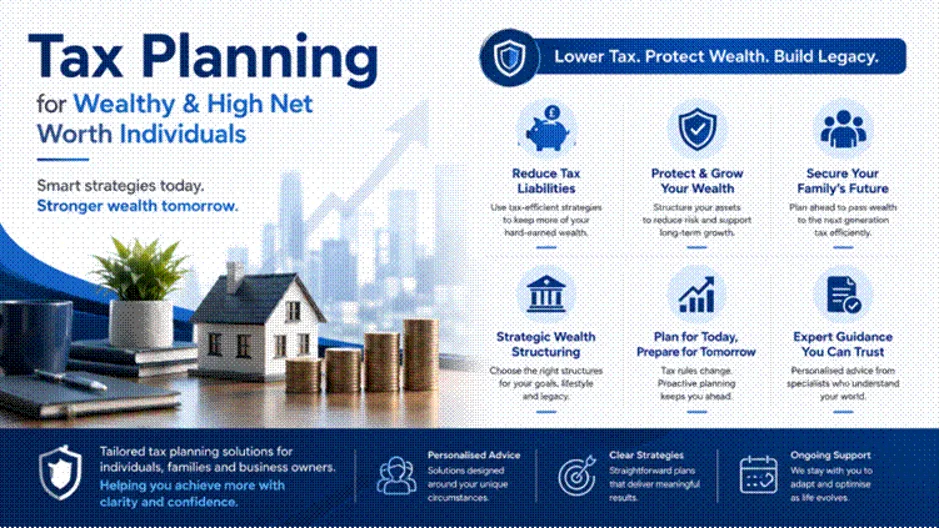
Good tax planning for high-net-worth individuals is not about risky schemes. It means using the rules as Parliament intended.
Pension Saving: Still the Most Powerful Tool
Pension saving is the most tax-smart way to cut your income tax. You get tax relief at your top rate.
A £10,000 pension payment costs a 45% taxpayer just £5,500 after relief. That is a strong return before any investment growth.
The annual pension limit is £60,000. You can carry forward unused limits from the last three tax years. Company pension payments are also deductible for corporation tax.
ISAs and Smart Investing
The ISA limit is £20,000 per person each year. All gains and income inside an ISA are tax-free. Note that from April 2027, the cash ISA limit is set to fall to £12,000 (with the remaining £8,000 of allowance only usable for stocks and shares ISAs). The £20,000 overall limit otherwise stays in place.
For families, using the full ISA limit for all adult members adds up fast over time.
The EIS scheme gives 30% income tax relief. The SEIS gives up to 50%. Both can also defer capital gains. They carry risk but suit investors seeking to shelter gains. Venture Capital Trusts (VCTs) are a related option, but their upfront income tax relief is being cut from 30% to 20% from 6 April 2026.
Capital Gains Tax Planning
Capital gains tax rates rose in October 2024. The rate is now 18% for basic rate taxpayers. For higher-rate taxpayers, it is 24% on most assets.
Smart planning around capital gains includes:
- Using your annual tax-free gains limit of £3,000 each tax year
- Moving assets to a spouse before a sale
- Spreading sales across two tax years, where you can
- Using losses to offset gains in the same year or later years
Dividends and Profit for Business Owners
If you own a business, ask: are you taking money out the right way?
The dividend tax-free amount has dropped to £500. Dividend tax rates above this are rising from April 2026: the basic rate goes from 8.75% to 10.75%, the higher rate from 33.75% to 35.75%, and the additional rate stays at 39.35%, based on your tax band.
A mix of salary, dividends, and pension payments usually gives the best result. The right split depends on your profit level and personal income.
Business owners who sell may qualify for Business Asset Disposal Relief. This used to cut capital gains tax to a flat 10% on gains up to £1 million, but the rate has been rising: it is 14% for disposals in the 2025/26 tax year and increases to 18% for disposals on or after 6 April 2026. The £1 million lifetime limit still applies. You must plan for this well before any sale.
Estate Tax Planning for High-Net-Worth Individuals
Each year, more estates are subject to IHT. Home prices continue to increase. The bands remain frozen. The basic nil rate band is £325,000. If you sell your principal residence, the £175,000 amount will be donated to the home band. The remainder is subject to 40% above these levels. The bands remain frozen for another year, until the end of the 2030/31 tax year, at the Autumn Budget 2025. Once the 2024 Budget is passed, any pension savings that are not used will be included in IHT from April 2027. A substantial change, indeed.
Those with significant pension assets should check their plans now. This change does not apply to death-in-service lump sums paid from a registered pension scheme and will remain outside the estate for IHT. Then, there are key changes for Business Property Relief and Agricultural Property Relief from April 2026! The 100% relief will be limited to the first £2.5 million of business and agricultural property combined (so that the effective IHT rate for those who qualify will be 20%). It can also be passed on between spouses and civil partners, and therefore, a family can shelter £5 million. Originally capped at £1 million, this has been increased to £2.5 million in December 2025. This should be taken into consideration by the owners of trading businesses, company shares or farmland.
Lifetime Gifts and the Seven-Year Rule
Gifts from your income that do not reduce your standard of living are free from IHT immediately. These are called normal income gifts. Most people never use this relief.
Larger gifts from your savings may fall outside your estate after seven years. These are called exempt transfers. Making gifts early, while your health is good, can significantly reduce your IHT bill.
You can give away £3,000 per year free from IHT. You can also give £250 to as many people as you like on top of this.
Using Trusts in Estate Planning
Trusts can be very useful in the right case. A trust lets you move assets out of your estate over time. You can keep some say over how they are used.
But trusts are not for everyone. They need ongoing admin. They can carry ten-year charges and exit charges. Get specific advice before setting one up.
Wealth Structuring: Personal Ownership vs Company Ownership
One key decision in high-net-worth tax strategies is whether to hold assets yourself or through a company.
Family Investment Companies
A Family Investment Company (FIC) is a private company used to hold and grow wealth for the family. It gives you control and tax savings at the same time.
Key features of an FIC:
- Investment income taxed at the lower company rate, currently 25% for profits above £250,000
- Dividends paid to family members in lower tax bands
- Different share types allow flexible income sharing
- The founders keep control as directors
- Assets can move outside your personal estate over time, subject to HMRC rules
FICs work well for high earners who have money left over after costs. You keep full control. You do it more smartly.
Holding Companies and Business Structuring
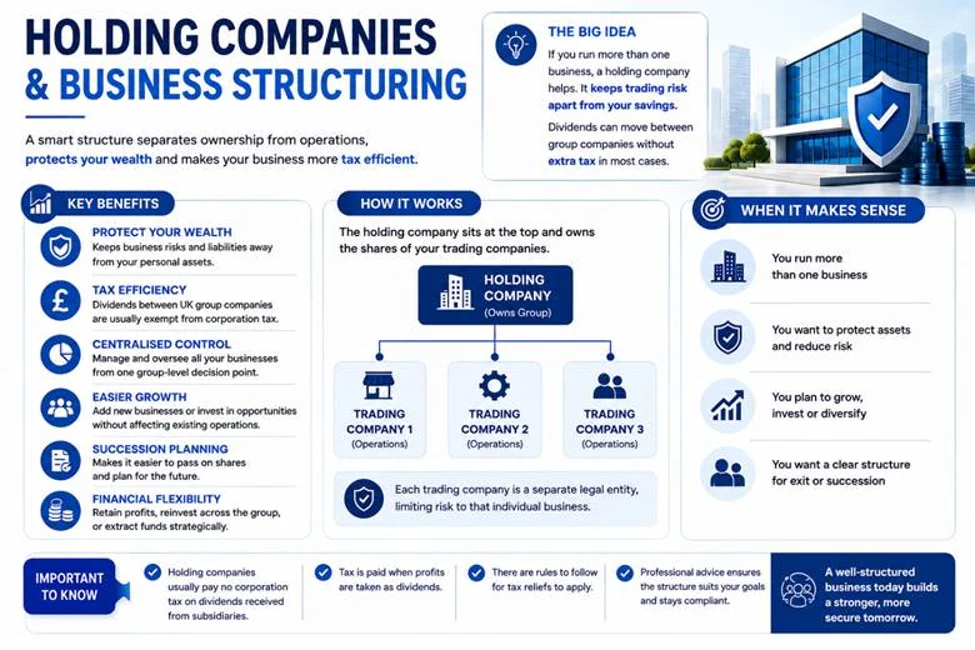
If you run more than one business, a holding company helps. It keeps trading risk apart from your savings. Dividends can move between group companies without extra tax in most cases.
Financial Planning for High-Net-Worth Individuals Beyond Tax
Tax planning is just one part of the picture. Financial planning for high-net-worth individuals also covers investments, retirement, and the effective transfer of wealth.
Succession Planning and Family Governance
Passing on wealth is about more than legal forms. Families who do it well also talk openly about values, roles, and money.
A clear family plan sets out how money is managed and shared. Open talks reduce disputes later. They also help the next generation make good use of what they inherit.
A current will, updated trust deeds, and a clear owner agreement all work together.
Business Exit Planning
Planning your exit years yields far better results than rushing.
Key early steps: sort your share structure and meet the rules for Business Asset Disposal Relief. Take cash out of the firm in a tax-smart way. Then plan how the sale proceeds will be taxed. With the BADR rate now rising to 18% from April 2026, the timing of a disposal matters more than it used to. Get advice before fixing a completion date.
After a sale, the money needs a clear home. Pension top-ups, investment plans, and EIS schemes can all help manage tax on future gains.
Common Tax Planning Mistakes Wealthy People Make
Even high earners make the same mistakes again and again. Here are the most common ones:
- Putting off IHT planning until health becomes an issue
- Not updating wills when family life changes
- Keeping old trust structures that no longer fit the family’s needs
- Poor records of gifts, deals, and trust payments
- Leaving pension wishes unchanged for years
- Focusing only on income tax while missing capital gains tax, IHT, and NIC
- Never checking whether the business ownership structure still makes sense
Late planning nearly always costs more than early advice. Once an estate reaches probate, many options are gone for good.
UK Tax Planning Documents You Should Have Ready
Working with a tax advisor is faster when you have the right papers ready. Here is what you need:
- Your last three tax returns and any HMRC letters
- Investment and trading account statements
- Property ownership records and mortgage details
- Pension statements for all your schemes, including old employer ones
- Company accounts and owner agreements if you run a business
- Trust deeds and trust accounts, if you have any
- Your current will and any letters of wishes
- Details of any gifts made in the last seven years
When to Work with Specialist Tax Planning Advisors
Many accountants do great day-to-day work. But at some point, compliance and strategic tax planning for wealthy individuals become two very different things.
You likely need specialist support when:
- Your income is often above £100,000, and your tax bill feels too high
- Your estate may face IHT, and you have not looked at this recently
- You own a business and have no exit plan in place
- Your assets sit in many structures, and no one sees the full picture
- You are close to retirement or a big financial event
A good wealth tax planning advisor looks at income tax, capital gains tax, IHT, and business tax all at once. Joined-up advice saves more than it costs.
How Much Do Tax Planning Services Cost?
Costs vary based on the complexity of your case. An initial review usually costs between £1,500 and £5,000. Ongoing advice typically ranges from £3,000 to £15,000 or more per year.
The right question is not what advice costs. It is what bad planning costs. One missed IHT step on a £3m estate can mean over £200,000 in tax that did not need to be paid.
Tax Planning Checklist for Wealthy Individuals
Use this list to check where you stand right now:
- Check your net income and confirm your pension plan for this tax year
- Find out if you have unused pension limits to carry forward
- Max out ISA payments for all adult family members
- Review capital gains tax exposure across all assets and property
- Check your estate value against current IHT bands
- Update your pension wishes to reflect what you want today
- Review your will and any existing trust arrangements
- Confirm your salary and dividend split are right for this year
- Ask whether a Family Investment Company or holding structure could help
Check your business exit readiness if a sale is within five years
Frequently Asked Questions
So, yes, under the 2024 Budget, unused pension fund would be included in your estate for IHT purposes from April 2027. But death-in-service lump sums remain free from IHT.
The old non-dom regime has been eliminated, and the new rules exempt foreign income/gains from new entrants from tax for 4 years. Previously UK-domiciled individuals will have to review their tax residence status.
Whole-of-life assurance in trust is not part of your estate for IHT purposes, so it avoids the £346m IHT issue with policies in the estate. This is essential as a result of pension IHT changes in 2027.
HMRC’s IHT investigations account for 18% of its investigations, each a complex process that demands thorough documentation of gifts, valuations, and 7-year PETs. Make sure that all gifts have a date and the recipient’s information.
If the excess exceeds £2.5m (per person), only 50% will be relieved, resulting in an effective IHT rate of 20%. Above £2.5m (per person), the tax rate will be 50%. Couples can shelter £5m in total via a spouse transfer.
Building a Long-Term Strategy to Protect and Preserve Wealth
Tax planning is not a one-off. Laws change. Your life changes. The 2024 Budget introduced new rules for the pension IHT, introduced new rates on capital gains tax, and abolished the old non-dom regime, replacing it with a new rules-based system, with new arrivals being exempt from UK tax on foreign income and gains for 4 years. The Autumn Budget 2025 further postponed the threshold freeze until 2031, and made dividend tax rates higher from April 2026, raised the BADR rate, reduced VCT relief and capped business and agricultural property relief at £2.5m and announced higher rates for property and savings income from April 2027.
All changes affect existing plans. If not, it is time to go back and reread your position. That could be enough for you at this time if your planning is only for pension payments and an ISA. However, if your estate is increasing in size or your income is increasing, the difference between what you’re keeping and what you could be keeping will widen. Consider how you are where you are. You can’t use the same tax plan for a high earner who needs to maximise income as you can for a business owner who has accumulated value in his or her business. A family that owns property and investments should have structures that differ from those of someone three years from a sale. A right plan isn’t the same for everybody. However, doing things at the wrong time is always later.
At Lanop Business and Tax Advisors, we work with high earners, business owners, investors, and families across the UK. We build tax-smart plans that protect your wealth and support your goals. To find out where you stand, get in touch with the team at lanop.co.uk and book an initial call.