
All those blogs about relocating to Cyprus start with sun and halloumi cheese. However, the information you really need to know will be hidden in the middle of the article.
This is what you really need to know: UK citizens are no longer EU citizens in Cyprus due to Brexit. This affects your visa application, your property purchase in Cyprus, and the permit you need to obtain. It’s better to get this sorted out from the very beginning because otherwise you will waste several months correcting your mistakes.
The bright side of the story: Cyprus is one of the most logical steps a wealthy UK citizen can take today.
This guide covers all of it.
Why UK HNWIs Are Relocating to Cyprus
The UK abolished non-dom status in April 2025. Thousands lost those breaks overnight. The Office for Budget Responsibility projected more than 10,000 non-dom exits per year from that point onward.
Cyprus was the obvious landing spot. It has its own non-dom regime. Still intact, still generous. The legal system is based on British common law. Direct flights link it to most UK airports. And for someone living off dividends, the tax gap is hard to ignore.
Our guide to low tax countries in Europe for UK high earners covers the full picture, including Italy, Greece, and the UAE.
What the Cyprus Non-Dom Regime Actually Does
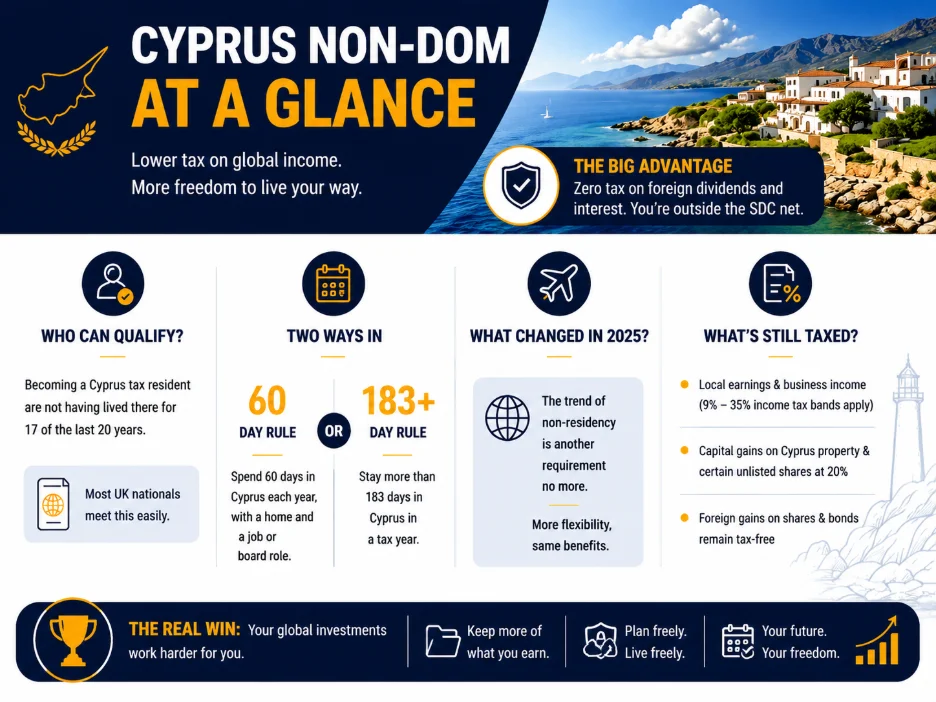
Cyprus non-dom status exempts you from the Special Defence Contribution (SDC). That is the local charge on dividends and interest. For non-dom residents, the rate on foreign dividends and interest is zero.
You qualify by being a Cyprus tax resident who has not lived there for 17 of the last 20 years. Most UK nationals clear that bar easily.
The 60-Day Rule Change in 2026
The 60-day rule lets you set up Cyprus tax residency with just 60 days there per year. That works well if you travel a lot.
The 60-day rule allows individuals to become Cyprus tax residents while spending a minimum of 60 days in Cyprus, provided all required conditions are met. These include not being tax-resident in another country, not spending more than 183 days in any other country, maintaining a permanent home in Cyprus, and having employment, business activity, or a position with a Cyprus company.
The 183-day rule is the other path. More than 183 days in Cyprus in a year, and you qualify.
Cyprus non-dom rule changes for HNWIs cover what happens after 17 years and how the 60-day conditions interact.
What Non-Dom Does Not Cover
Non-dom does not mean you pay zero on all of it. Cyprus income tax still applies to earnings and business income from Cyprus. The bands run from 0% on the first €19,500 up to 35% above €60,000. Capital gains tax at 20% applies to Cyprus home sales and some unlisted firm shares. Foreign gains on shares and bonds are tax-free.
The key win is on foreign passive income. Dividends from UK or global firms reach you with no Cyprus tax on them.
Residency Permits: Where Most People Go Wrong
This is where UK nationals hit their first wall. Post-Brexit, you are a third-country national in Cyprus. You cannot get the Yellow Slip.
The Yellow Slip is for EU citizens. If an article tells you to get a Yellow Slip, it is out of date.
Your Route: The Pink Slip
The Pink Slip is the Temporary Residence Permit for non-EU nationals. That includes UK citizens post-Brexit. You apply at the local Immigration City Unit before your 90-day visa-free window closes.
To qualify, applicants must demonstrate sufficient financial resources, provide proof of accommodation in Cyprus, maintain valid health insurance where required, and meet the immigration authority’s current requirements for temporary residence. The exact financial thresholds should be confirmed with the Cyprus Civil Registry and Migration Department at the time of application.
One thing worth knowing: UK nationals do not need a bank guarantee. Most other nations do. That is a genuine advantage.
Book your immigration slot as soon as you arrive. Slots go fast. You need to submit the full form, not just book a slot, to stop the 90-day clock.
The Category F Route
Many HNWIs choose Category F instead. This route is for people who live fully off income and assets held outside Cyprus.
It suits investors and retirees. No local firm or job needed. Your lawyer can confirm which route fits your situation.
Pre-Brexit UK Residents: Act Before August 2026
If you registered before 31 December 2020, your old Yellow Slip still holds. But there is a critical deadline right now. Holders of old paper MEU1 and MEU3 certificates must switch to biometric cards by 3 August 2026. After that, the paper ones are no longer valid. Act now if this is you.
Your UK Tax Exit: The Step People Underestimate
Relocating to Cyprus does not automatically end your UK tax obligations. The UK Statutory Residence Test (SRT) determines whether you are a UK tax resident. You need to cut ties with the UK clearly and in the right order.
Your first year of departure requires a split-year tax return. You claim split-year relief to cut your UK bill to cover only the period before you leave. You must file it. It does not happen by itself.
UK income does not go away just because you live in Cyprus. UK rent, pensions, and UK job income stay taxable in the UK. The Cyprus-UK Double Tax Treaty sets out how this works.
For business owners, Lanop’s guide to leaving the UK covers timing, company residency, and day counting.
A UK tax expert manages your exit. A Cyprus accountant manages your arrival. Both need to work together. Gaps between them are where costly errors occur.
Buying Property in Cyprus as a UK National
Post-Brexit, UK nationals follow the same rules as all non-EU buyers. You can buy one home for personal use, subject to the Council of Ministers’ permission. For non-EU nationals, the permitted property area is generally up to 4,000 square metres, subject to applicable rules and approvals.
You need Council of Ministers sign-off. This sounds daunting. It is not. Sign-off is nearly always granted. Refusals occur only in rare cases, such as land near military zones. Your lawyer handles it all. The approval process depends on the application and circumstances. Your lawyer can submit the application after signing the purchase contract and manage the process with the relevant authorities.
The Buying Process Step by Step
Step one
Get a Cyprus Tax ID (TIC). Your lawyer arranges this. You need it to complete the purchase and open your bank account.
Step two
Get an independent lawyer who works only for you. Not the agent’s lawyer. Not the developer’s lawyer. Your own. They check title deeds, permits, and that the home has no debts or claims against it.
Step three
Sign a reservation agreement and pay a small deposit, usually 1-2% of the price. This pulls it off the market while checks are completed.
Step four
Sign the full contract and pay the agreed deposit, usually 10 to 30%. Register it at the Land Registry within 60 days. That protects your rights. This protects your rights.
Step five
Submit the Council of Ministers application. This runs quietly in the background while all the rest moves forward.
Transfer taxes on resale homes run at 1.5% to 4%. New builds are subject to 5% VAT on the first 130 square metres. The value must be under €350,000, and you must live there for at least 10 years. Stamp duty treatment depends on the date and nature of the transaction. Buyers should confirm the current position with their Cyprus legal adviser before completing a purchase.
What Property Actually Costs in 2026
As of mid-2026, the median flat price in Cyprus is around €460,000. Houses and villas average €792,000. These vary a lot by area. Limassol and Paphos cost more. Larnaca and Famagusta are cheaper.
For permanent residency by investment, buy a new build from a developer for €300,000 or more. Show €50,000 or more in annual income from outside Cyprus. The permit lasts for life.
Opening a Cyprus Bank Account
Get a Cyprus bank account early on. You need it for the Pink Slip, the property purchase, and your non-dom setup.
Cyprus banks check who you are and where your money comes from. Be clear about where it comes from. Business sale, investment income, pension drawdown: all fines. Vague answers slow things down. A full file gets through fast.
Most resident accounts open within 1 to 2 weeks. Non-resident ones take two to four weeks.
You need: a valid passport, two proof-of-address docs, your Cyprus TIC, your UK tax number, and a self-cert form. Banks ask for larger opening deposits.
What It Costs to Live There
Cyprus runs about 20 to 40% cheaper than the UK. Food, bills, eating out, and transport all cost less.
A couple in Limassol, the priciest city, should budget € 2,200- € 2,800 per month. That covers rent, food, a car, and bills. In Paphos, Larnaca, or Nicosia, the same life runs €1,700 to €2,200.
That is without private school fees. If you have children at an international school, add that on separately.
Healthcare
Cyprus runs a public system called GeSY. It covers GP visits, specialist appointments, hospital care, and prescriptions. You pay 2.65% of your income. Co-pays are € 6- € 10 per visit.
Most expats also hold private cover. Costs run from €600 to €1,500 per person per year. A family plan is €2,000 to €4,500. Private cover gives faster access and more choice. The public system handles daily care and emergencies.
Schools
Public schools are free but teach in Greek. HNWI families almost always pick international schools.
Nicosia has the widest range. The American International School runs the IB. The English School follows the British curriculum. Limassol has a Heritage School. Paphos has good options for British families too.
Fees range from €5,000 to €15,000 per child. Add books, fees, and transport on top.
Step-by-Step: How to Relocate to Cyprus from the UK
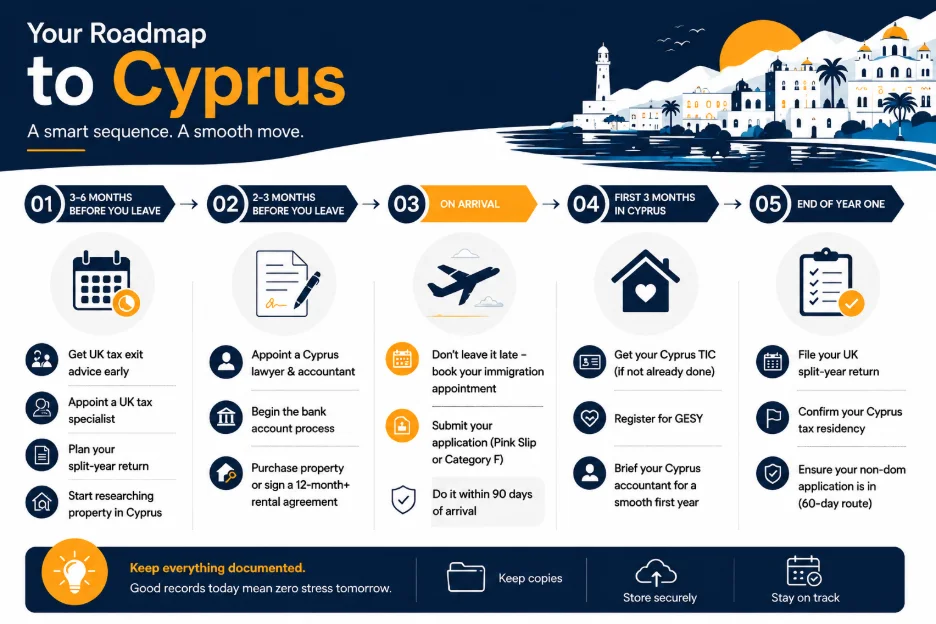
Get the order right. It saves time and stops dead ends.
- Three to six months before you leave: Take advice on your UK exit. Appoint a UK tax specialist. Start planning your split-year return. Begin looking at property in Cyprus.
- Two to three months before: Appoint a Cyprus lawyer and accountant. Start the bank account process. Begin the property purchase if buying or signing a rental agreement for at least one year.
- On arrival: Do not run down your 90 days. Book your immigration appointment straight away. Submit your Pink Slip or Category F application before the 90-day window closes.
- First three months in Cyprus: Get your Cyprus TIC if not already done. Register for GeSY. Brief your Cyprus accountant so your first year of non-dom filing is handled from day one.
- End of year one: File your UK split-year return. Confirm your Cyprus tax residency for that year. Check your non-dom application is in if you are on the 60-day route.
Cyprus vs Staying in the UK
After April 2025, former UK non-doms pay income tax on worldwide income. For someone receiving large dividends from a business or portfolio, the UK effective rate can reach 42-50%.
Cyprus non-dom keeps foreign dividends and interest fully outside the tax calculation. Cyprus income tax still applies to income earned locally. But the top rate is 35%, and most income below €60,000 is taxed at lower bands. For pure passive income, the effective rate under non-dom can be very close to zero. No capital gains tax on shares. No inheritance tax. No wealth tax. Cyprus corporate tax rates should be confirmed based on the relevant tax year and any legislative changes in force at the time.
The gap is stark. But the savings only land if the move is genuine. You need to live in Cyprus, meet the day-count rules, and properly cut your UK ties. Half measures do not work.
If you are weighing Cyprus against Italy or Greece, our head-to-head comparison of Italy, Greece, and Cyprus’s flat tax regimes is worth reading before you decide. And if you are still processing the non-dom abolition itself, the UK HNWI post non-dom guide maps out what your options look like now.
Final Thoughts
Relocation to Cyprus from Uk needs two sets of hands. One on the UK side. One on the Cyprus side. They need to speak to each other throughout the world.
The UK part- your split-year return, your SRT position, your ongoing UK income- all of this needs a specialist who knows international tax, not just domestic compliance. The Cyprus part- your non-dom application, your 60-day count, and your local filings needs someone who works in that system daily.
Lanop handles both sides. They work with UK business owners, investors, and HNWIs relocating to Cyprus. The UK exit and Cyprus setup are managed as one joined-up process. For a move where the numbers are significant, that matters more than most people expect.
Frequently Asked Questions
No. Cyprus allows dual residency. You keep your UK passport throughout. You are changing your tax residency, not your nationality.
Usually, yes. Some UK banks close or limit accounts for non-residents. Tell your bank you are relocating and check their policy for expats.
The treaty allows the UK to continue taxing UK state and government pensions, even if you live in Cyprus. The treatment of private pensions varies. Get this confirmed before you leave.
Yes. Cyprus ranks among the top ten safest countries in Europe in terms of reported crime. It is well suited to family life.
This raises UK PAYE questions and may create a permanent establishment issue for your employer. Get both your employer’s legal team and your tax adviser involved before you do it.
The SRT has tie-counting rules. The more ties you keep in the UK, the fewer days you can spend there before you risk being treated as a UK tax resident again. Work this out before you move.
No. Cyprus removed inheritance tax in 2000. There has been nothing to replace it since.