
Relocation to Germany can create new opportunities for UK business owners. However, moving abroad also brings important legal and tax responsibilities. Your residence status may change when you start living in Germany. Your UK company may also face new tax and reporting duties. At Lanop, we have guided UK owners across borders for nearly two decades. Our chartered accountants know the tax rules in both countries. Hence, this guide explains what to consider before relocating to Germany.
Can UK Business Owners Relocate to Germany and Continue Running a UK Company?
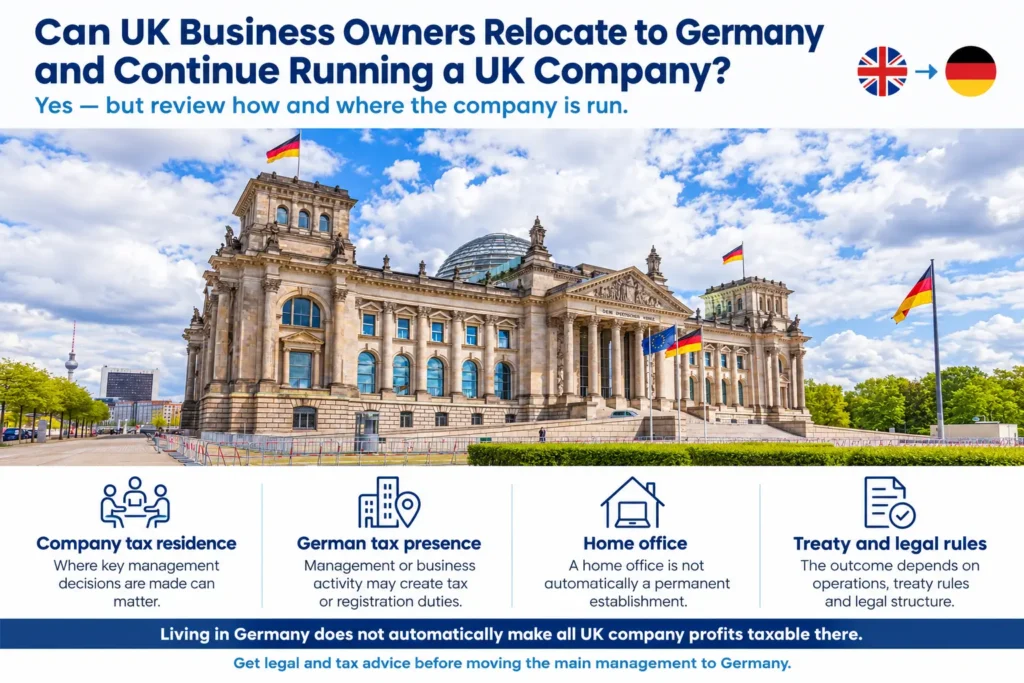
Yes. You can live in Germany and still own a UK company. Running a UK business from Germany can raise questions about company tax residence, permanent establishment, and German company-law treatment. The outcome depends on the facts. Living in Germany does not, by itself, mean that all company profits are taxable there.
A UK company may have German tax or registration duties if its management or business activity creates a German tax presence. The exact result depends on the company’s operations, treaty rules and legal structure. Get legal and tax advice before moving the main management to Germany.
Where key company decisions are made can matter, but a person’s home office does not automatically become a company’s permanent establishment. Germany’s 2026 guidance says the result depends on the facts, including how the space is used and whether management functions are carried out there.
What Are the Visa Requirements for UK Business Owners Relocating to Germany?
British citizens can enter Germany without a visa for a short stay of up to 90 days in any 180-day period. If they plan to live or work there longer, they need the right residence permission. British citizens can generally apply for a residence permit after arriving, but they must apply within their first 90 days. They must also register their address within two weeks of moving in
Do not assume that visa-free entry gives you permission to work or run a business in Germany. Check the conditions for your planned activity and apply for the correct residence permit.
Here are the Germany business visa requirements in simple form:
- A valid passport
- Proof of your German home address
- Proof of health insurance
- Proof that you have enough money
- A clear business plan
- Your CV and proof of your skills
- Passport photos and the permit fee
You apply at the local foreigners’ office. In German, it is called the Ausländerbehörde.
The German entrepreneur visa requirements focus on your plan. For a self-employment permit under Section 21, Germany considers whether there is an economic interest or regional need, whether the activity is expected to benefit the economy, and whether financing is secured.
What Are the Best German Residence Options for UK Business Owners and Entrepreneurs?
The best option depends on your work. Here is a quick view of the main routes.
| Route | Best for | Key point |
| Self-employment permit | Owners who start a German business | Needs a strong plan and proof of funds |
| Freelancer permit | Consultants and creative or IT experts | Needs proof of clients or contracts |
| Skilled worker permit | Owners who work for their own German firm | Needs a degree and a job contract |
| Family permit | Partners of German or EU residents | Needs proof of the family link |
A self-employment residence permit may be issued for up to three years. Some business owners can apply for a settlement permit after three years if they meet the legal conditions, including showing that the business has succeeded and can support them and their dependents. Freelancers may have different rules, so do not promise that every applicant can settle after 3 years.
Which German residence permit could suit a business owner?
The right German business residence permit depends on your planned work. If you want to set up a business or work as a freelancer, Germany has a self-employment route under Section 21 of its Residence Act.
For a business application, the authorities look at whether:
- There is economic value or local demand for your service.
- The business is expected to benefit the German economy.
- You have funding or a firm loan offer to carry out the plan.
- If you are over 45, you can show suitable pension provision.
Germany’s official business portal says the self-employment permit may be granted for up to three years at first. It also says successful business owners may be able to apply for a settlement permit after three years, subject to the relevant rules.
Freelancers may use a related route, but they need to show that they can fund their work and have any required professional license. The requirements are not the same for every type of business.
How Does Relocation to Germany Affect UK Tax Residence and Domicile?
Your tax home is not the same as your home address. Each country has its own test. Here are the main UK tax residency rules in practical words.
How Does the UK Test Work?
- The UK uses the Statutory Residence Test.
- It checks your days in the UK and your ties to the UK.
- Fewer than 16 days in the UK can make you non-resident in many cases.
- That limit is 46 days if you were not a UK resident in the last three years.
How Does Germany Decide Tax Residence?
- Germany sees you as resident if you keep a home there.
- A stay of more than 6 months also counts.
You may meet each country’s domestic residence rules at the same time. The UK–Germany treaty can then help determine your residence for treaty purposes, using factors such as a permanent home, closer personal and economic ties, habitual abode and nationality.
It does not simply make one country ‘win’ for every tax issue. UK split-year treatment may apply in some cases when someone leaves or arrives, but it is not automatic. Check the conditions for the relevant tax year.
What Happens to Domicile and Inheritance Tax?
The UK changed its rules from 6 April 2025, including replacing the former domicile-based system for relevant taxes with residence-based rules. Do not state a ten-year inheritance-tax rule without checking the current rules and the person’s circumstances.
You may be able to use form P85 to tell HMRC that you are leaving the UK. If you file Self Assessment, you may need to report your residence position through the relevant tax return instead. Check HMRC’s instructions for your situation.
What Taxes Will UK Business Owners Pay After Moving to Germany?
German tax can feel heavy at first. Below are the main German tax obligations for businesses and owners.
| Tax | Rate | Who pays |
| Income tax | 14% to 45% | You as a person |
| Solidarity surcharge | 5.5% of the tax | Mostly high earners |
| Corporate tax | 15% | Companies |
| Trade tax | About 14% on average | Companies and many owners |
| VAT | 19% or 7% | Sales of goods and services |
A German corporation may pay corporate income tax, the solidarity surcharge, and municipal trade tax. The combined rate depends on the municipality. A current 2026 estimate is about 30% on average, but the actual rate can vary by location.
German dividend tax may be 25% plus a 5.5% solidarity surcharge on that tax, producing an effective rate of 26.375% before any applicable church tax. The result can differ under the treaty or based on the shareholder’s circumstances.
What Is the UK Exit Charge When a Company Moves?
Germany business relocation tax starts with the UK side. UK company that ceases to be UK-resident may face a Corporation Tax exit charge on unrealized gains. Germany business relocation tax starts with the UK side.
UK company that ceases to be UK-resident may face a Corporation Tax exit charge on unrealized gains. These HMRC guidelines can deem the company as disposing of and reacquiring particular assets at their market value before losing UK tax resident status.
Whether there will be any charge will depend on the particular company and assets it holds. It could be costly for companies with land or brand value. A plan made before the move can cut that cost.
How Can UK Business Owners Avoid Double Taxation When Relocating to Germany?
The UK and Germany have a double-taxation treaty, originally signed in 2010 and later amended. It can allocate taxing rights and provide relief in some cases, but it does not guarantee that no income will be taxed in both countries or remove filing duties. This matters for any UK-Germany double tax case.
The treaty uses a tie-breaker when both countries call you resident. It checks these points in order:
- Where you keep a permanent home
- Where your life and money ties are closest
- Where you usually live
- Your nationality
The treaty may provide relief from double taxation, but the method depends on the income and the treaty provisions. Do not say that tax is always credited or that Germany taxes all dividends as the owner’s home country. Check the rules for the specific dividend and recipient:
- Keep a clear record of your days in each country.
- Get your German tax ID early.
- File returns on time in both countries.
- Ask an adviser to review your set-up each year.
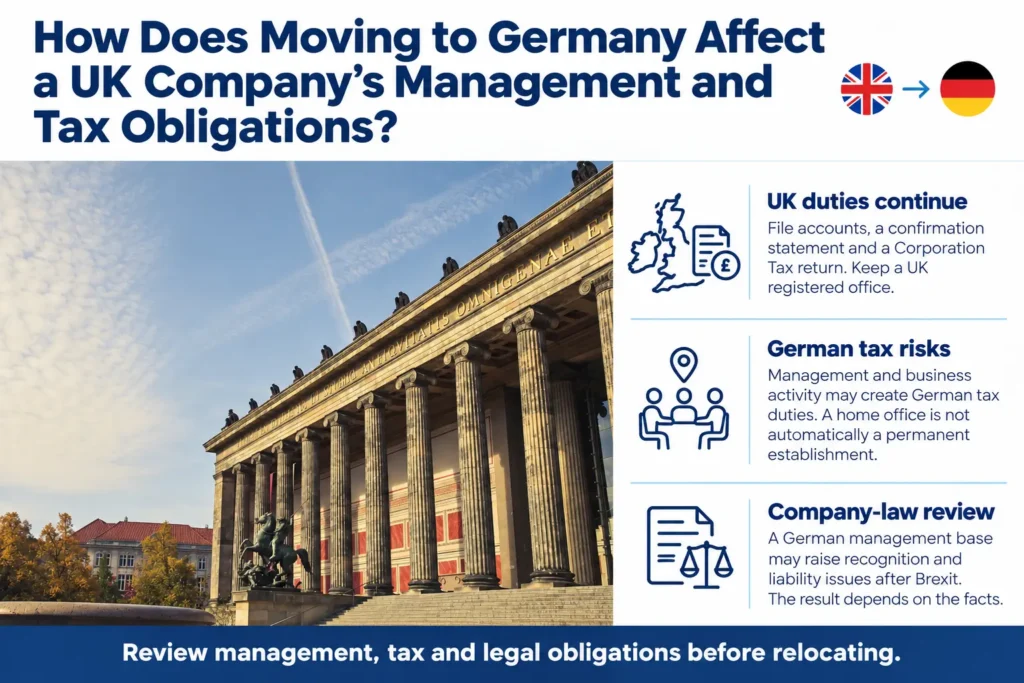
How Does Moving to Germany Affect a UK Company’s Management and Tax Obligations?
Your UK company still has duties in the UK. It must file accounts and a confirmation statement at Companies House. It must also file its corporation tax return. The registered office must stay at a UK address.
Germany adds new risks. If you run the firm from Germany, the German tax office may consider it German. This is the place of management test. Your home office may also count as a permanent base.
A UK Limited company whose real management base is in Germany may face recognition and liability issues under German company-law rules after Brexit. This is a legal risk, not an automatic result for every UK company.
What Is Permanent Establishment Risk?
Owning shares in a UK company is not the same as managing it each day. The tax picture may change if you make key choices from Germany. It may also change if you work there for the company or open a German office.
The UK and Germany treaty looks at permanent establishment. This is a fixed place of business such as an office. Profits linked to that place may be taxed in the other country. Your home office may count in some cases.
Before you move, write down where you will work. Note where the key decisions will happen. Review contracts and staff, plus any German customers or agents. The address on Companies House is not enough.
Should You Move the Company or Open a German Business?
You can keep the UK company and add a German branch or a German company. Each option has different legal and tax duties.
| Option | What it means | What to review |
| Keep the UK company | The UK firm keeps trading | German work activity and tax duties |
| Open a German branch | The UK firm works through a German location | Registration and possible German tax |
| Create a German company | A separate German firm is set up | Formation and accounts plus funding |
| Move your personal work only | You work in Germany while the UK firm stays | Your permit and tax residence |
This table is a starting point and not a plan. Get advice on the structure before you spend money. Check local licence rules too if you offer services in Germany. You can read more on our Germany business setup page.
Do UK Businesses Need to Register for VAT in Germany?
When a UK business creates taxable supply in Germany, it needs to register for German VAT. There is no universal rule making all the transactions to customers from Germany taxable.
Check where the supply takes place, what is being sold, and whether a special scheme applies. Germany’s standard VAT rate is 19%. A reduced rate of 7% applies only to specified goods and services.
VAT return deadlines depend on the business’s registration and reporting period. Look at the tax schedule issued by the German Tax authorities and file returns within those dates.
The rules that apply to VAT registration and VAT cases in Germany are dependent upon what you sell and the location of your customer. Goods that cross the border add customs steps.
Moving to Germany does not by itself end UK VAT duties. Whether UK VAT applies depends on the business’s sales and registration position. German VAT may also apply to certain transactions, so check both systems. Our VAT team can check which case fits you.
How Much Does It Cost to Relocate a Business to Germany?
Costs vary by city and by plan. The figures below are rough guides only.
| Cost item | Rough guide |
| Residence permit fee | Around €100 |
| GmbH set-up with notary and register fees | €1,000 to €2,000 plus €25,000 capital |
| Health insurance | €250 to €700 per month |
| One-bed flat in a big city | €900 to €1,800 per month |
| Tax adviser | Fixed monthly fee |
These items shape the Germany business relocation cost for most UK owners. The Germany business setup cost is lower with a branch or a UG. A branch needs no share capital. A UG can start with as little as €1.
What Is the Cost of Living for a Business Owner in Germany?
A single owner often needs €1,800 to €2,800 each month in a large city. Smaller cities like Leipzig cost less than Munich or Frankfurt.
How Much Share Capital Does a GmbH Need?
A standard German GmbH has share capital of €25,000. Germany Trade & Invest says €12,500 in cash can be enough for registration. This is company capital. It is not the full cost of moving or running the business.
What Is the Timeline and Checklist for Relocating a Business to Germany?
The time needed depends on the residence route, documents, appointments, business structure, and tax registrations. Build a plan with time for delays.
| When | What to do |
| 6 to 3 months before | Get tax advice and write your business plan |
| 2 months before | Book your first home and check health cover |
| Arrival | Register your address within 14 days |
| Month 1 | Open a bank account and apply for your permit |
| Months 2 to 4 | Register the business and the tax office file |
| Month 6 and after | Review tax and company set-up |
Here is a Germany business relocation checklist you can print:
- Pick a German company structure.
- Tell HMRC that you are leaving.
- Check your UK and German tax status.
- Arrange health insurance.
- Apply for your residence permit.
- Register your German address.
- Open a German bank account.
- Register your business with the trade office.
- File your tax office form for businesses.
- Check your VAT duties in both countries.
These steps show how to relocate to Germany without costly slips. Missing papers can cause long delays. UK to Germany relocations can also slow down at the permit step.
Frequently Asked Questions
Yes, health insurance is a legal requirement for anyone who lives in Germany. You can pick public cover or a private plan if you are self-employed. Many permit offices ask for proof of cover before they approve your application.
Yes, but you must first register as an employer and meet German payroll rules. You also pay social contributions for each worker on top of their monthly wage. German work contracts come with firm rules on paid leave and notice periods.
Yes, because one wrong step in either country can lead to costly tax bills. Lanop is a trusted choice as its chartered team guides UK owners across borders. Book a free consultation with Lanop to review your move before you leave.
Yes, but you must first register as an employer and meet German payroll rules. You also pay social contributions for each worker on top of their monthly wage. German work contracts come with firm rules on paid leave and notice periods.
Usually, you pay social security in one country at a time and not both. The UK and the EU have rules that decide which country gets your payments. Check your case early because gaps or overlaps in cover can be costly.
Final Thoughts
Germany offers real growth for UK business owners, but the move only pays off when the paperwork and the tax side are right. Get your permit sorted early. Know where you will be tax resident. Understand how your business income will be taxed in both countries. The given points protect your money and keep your plans on track.
The best time to check them is before you move, not after. A small gap in your tax planning can lead to double taxation or penalties that are hard to undo.
That is where Lanop comes in. Our team reviews your situation, explains your options in plain words, and helps you spot risks early. Speak with Lanop today and make your relocation to Germany with a plan you can trust.